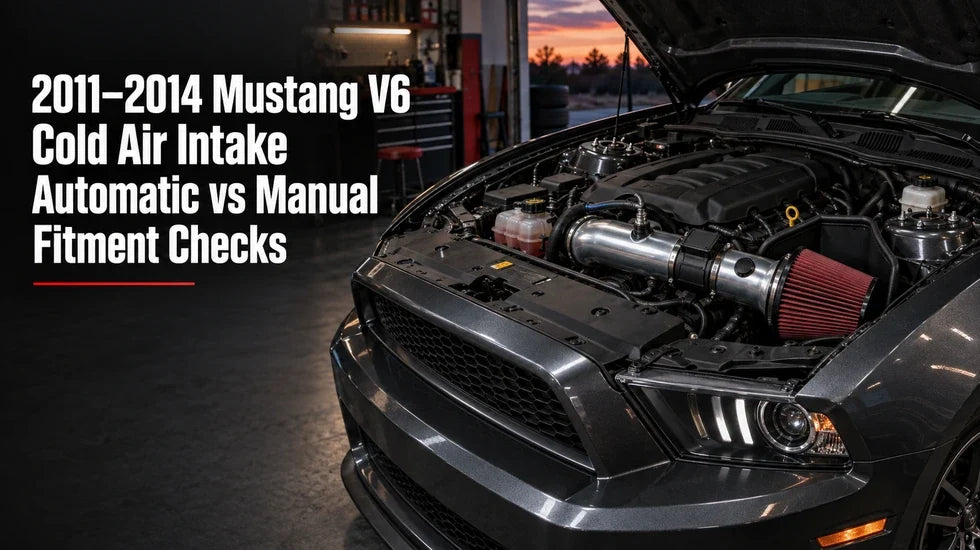
There is a trap hiding in the phrase “fits 2011–2014 Mustang V6.” The 3.7L Cyclone itself is the same basic target, sure. But the intake plumbing around it is not always a grab-the-box-and-go situation. Automatic cars can use an extra vacuum connection at the intake tube. Manual cars generally need that location sealed. Mix those pieces up and your nice Saturday bolt-on can turn into a rough-idle, hiss-under-the-hood headache.
Listen, I have seen people spend an hour polishing a new aluminum tube, then rush the one part that actually matters: the little fitting underneath it. That is backwards. A cold air intake is simple hardware, but air leaks do not care how simple it looks.
Quick Answer
- A 2011–2014 Mustang 3.7L V6 intake can fit either transmission only when its ports and supplied hardware match the car.
- On many automatic cars, the intake tube needs an added small vacuum fitting; on a manual, that same opening is normally closed with the supplied plug.
- The stock MAF sensor must sit in the correct direction, with its seal and connector fully seated, or idle quality and fault codes can suffer.
- Expect the biggest day-to-day change to be induction sound and throttle feel. Peak power depends on intake design, engine condition, exhaust, air temperature, and calibration.
- Before ordering, match the kit to the 2011–2014 3.7L V6, transmission, selected configuration, and local road-use rules.
Why Automatic vs Manual Fitment Matters on the 2011–2014 Mustang V6
The 2011–2014 Mustang V6 uses Ford’s naturally aspirated 3.7L Cyclone. It is a good little engine: rev-happy, compact, and much happier above 4,000 rpm than the old 4.0L ever was. The factory airbox, MAF meter, PCV plumbing, and brake-assist vacuum routing all share a very tight corner of the engine bay. That tight corner is where transmission-specific details show up.
For a 2011-2014 mustang cold air intake automatic vs manual v6 purchase, the tube itself may look identical in product photos. Turn it over, though, and the story changes. An automatic application can require a small barbed fitting for the additional vacuum hose. A manual application may use a plug at that same location. The wrong part does not look dramatic. It is still enough to create an unmetered-air problem.
The automatic-only small port is not decorative
On many 6R80 automatic V6 setups, a small hose connects to the intake tract near the brake booster/firewall area. The intake needs a matching port, grommet, and barbed fitting. If that port is left open, the engine is pulling air that the MAF never measured. If the hose is bent hard, split, or forced onto the wrong nipple, you can get the same result.
I remember a shop-style scenario from a 2018 build: a 2013 automatic V6 came in after a driveway intake install. The owner had everything clean, clamps shiny, filter straight. Yet it idled like it had a bad plug. We traced the hiss, looked under the tube, and found a manual-transmission plug where the automatic vacuum fitting belonged. Five minutes later, the engine settled down. That little fitting was the whole show.
Tech tip: Count the original intake-tube hose connections before removing anything. Take a phone photo from above and one from underneath. You are not doing it for social media; you are doing it because memory gets unreliable once parts are spread across the fender.

Manual cars need a real seal
A manual car does not get a free pass. Its unused opening has to be sealed with the correct plug. Do not improvise with tape, a random screw, silicone blob, or whatever you find in the junk drawer. Fuel vapor, oil mist, heat cycles, and vibration make bad shortcuts fail eventually. A proper plug is cheap. A vacuum leak diagnosis is not fun.
Map the 3.7L V6 Before Ordering a Cold Air Intake
Start with the basics: 2011–2014 Mustang, naturally aspirated 3.7L V6, and the transmission actually in the car. Do not order from the badge alone. A 5.0L GT tube is not a close enough substitute, and an older 4.0L V6 kit is a completely different animal.
If you are shopping specifically for a 2011–2014 Mustang V6 3.7L cold air intake kit, treat the product photos as a first look, not the final answer. Look at the actual tube ports, MAF mounting provision, heat shield, coupler, filter, and hardware included with the selected configuration.
| Area | Factory intake setup | Aftermarket intake check |
|---|---|---|
| MAF sensor | Mounted in the factory airbox/intake tract | Transfer it in the same airflow direction and secure its seal |
| PCV / breather hose | Connects to the intake tube | Match the fitting diameter and avoid kinks |
| Automatic vacuum hose | Small added intake connection on applicable cars | Use the correct barbed fitting and grommet |
| Manual-transmission port | No added hose at that location on applicable cars | Install the supplied plug fully and securely |
| Airbox mounting | Rubber grommets and a fender-side fastener | Reuse or install hardware exactly as the kit calls for |
Separate PCV plumbing from the extra vacuum line
These are easy to confuse when you are leaning over the passenger-side fender. The larger PCV or crankcase-breather connection belongs on its matching larger fitting. The small automatic-specific hose uses its own smaller fitting. They are not interchangeable. Forcing either hose onto the wrong port can split the hose or leave it loose enough to leak later.
A lot of beginners watch a fast install video, pull every hose loose, then start reconnecting by “what looks about right.” Don’t do that. Put one hose back at a time. If the tube has a 5/8-inch-style breather fitting and a smaller vacuum fitting, make sure each hose lands where it belongs before tightening a single clamp.
MAF Sensor Details That Keep the Idle Civilized
The MAF is the part I watch most closely. The sensor tells the PCM how much air is entering the engine. Change the tube design, leave a leak downstream of the sensor, mount the sensor backward, or let the connector sit half-latched, and the calculation gets ugly fast.
First rule: keep the airflow direction correct. Look for the sensor arrow if present. Compare the old orientation before removal. The sensing element must face the direction the kit intends. “It bolts in either way” is not a reason to guess.
Transfer the MAF carefully
- Disconnect the negative battery terminal before working around the MAF harness.
- Release the electrical connector rather than yanking on the wires.
- Remove the factory MAF with the proper Torx bit and keep the sensor clean.
- Seat it squarely into the new tube; do not pinch the seal.
- Tighten the supplied screws evenly. Snug is the goal, not stripped plastic.
- Route the harness with enough slack for engine movement, but keep it away from sharp edges.
If you want a broader read on the habits that prevent sensor trouble, this cold air intake installation guide for avoiding MAF codes covers the same basic rule: every clamp, seal, connector, and hose has a job.

Do not chase a number you cannot reproduce
People love asking, “How much horsepower?” Fair question. But a number without conditions is garage talk. A naturally aspirated 3.7L’s result depends on the tube diameter, filter location, intake-air temperature, exhaust changes, fuel quality, engine health, and whether the calibration is stock or revised. Some combinations feel sharper in the midrange. Others mostly add intake sound.
That does not make the intake pointless. It means use the right yardstick. If your goal is better induction sound, a washable filter, easier filter access, and a cleaner engine-bay look, judge it on those things too. If the goal is measurable power, use the same dyno, same correction method, same fuel, and same calibration for both pulls.
Open the Box Before You Pull the Factory Airbox
Here is a move that saves a lot of swearing: spread the kit out on a clean bench before you loosen the first factory clamp. Check the tube, filter, heat shield, coupler, clamps, MAF fasteners, mounting hardware, weatherstrip, and the transmission-specific small-port pieces.
The Ford Mustang cold air intake collection is useful when you are comparing layouts, but the selected kit still needs to match your own car’s year, engine, and transmission. Similar-looking Mustang hardware is not automatically interchangeable.

Bracket and heat-shield fitment
Factory airboxes sit on rubber grommets for a reason. The engine moves. The body does not. When a new heat shield or air dam is installed, its locating pins and brackets need to sit where the kit intends. If the shield is cocked forward, the filter can touch surrounding lines or sheet metal. If it is loose, the tube can settle after a few heat cycles and pull against the throttle-body coupler.
One of the most common bad habits is tightening everything while the pipe is still fighting the bracket. Leave the clamps slightly loose first. Seat the heat shield, align the tube, make sure the filter has room, then tighten in sequence. Slow is smooth here.

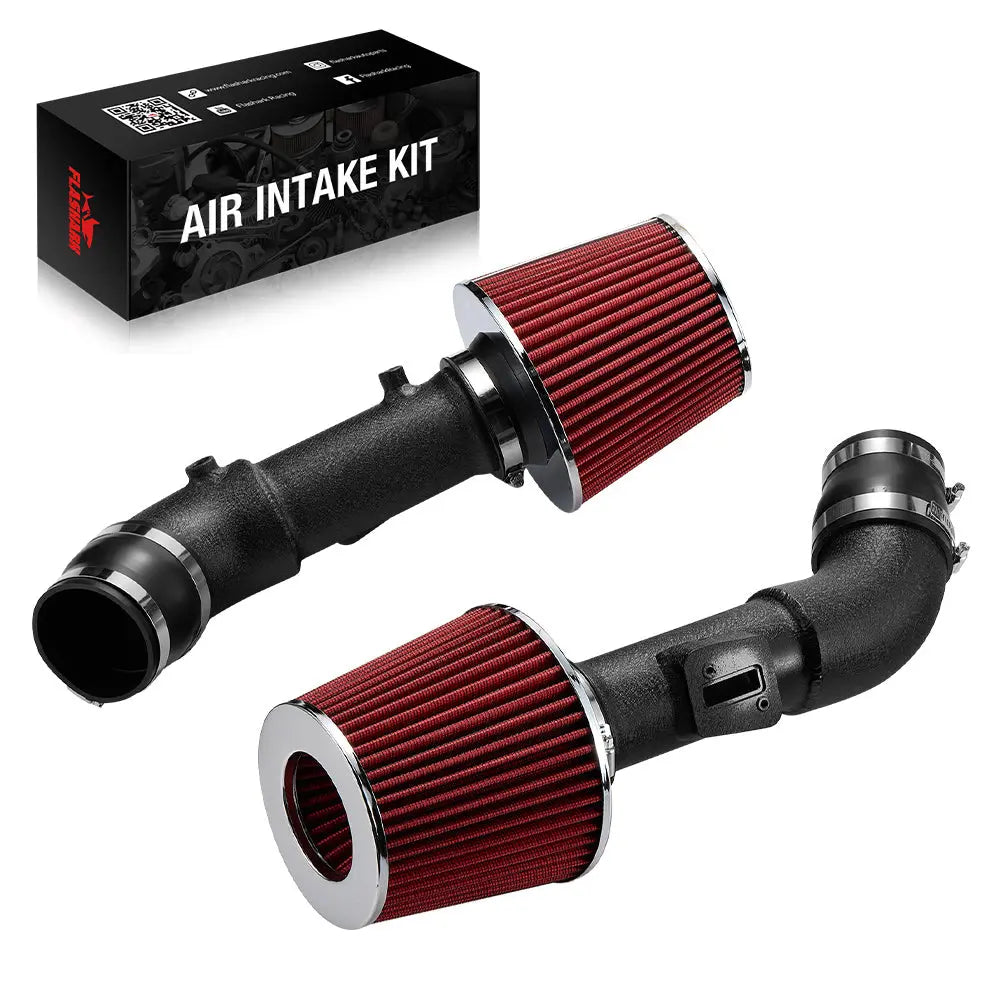
Polished aluminum tube, red washable filter, and heat-shield style layout for the naturally aspirated 3.7L V6 application.
Contact for price
View Mustang V6 intake kitInstall It, Then Check It Like a Technician
The install is usually a hand-tools job. That does not mean it deserves hand-waving. A basic socket set, flat screwdriver or nut driver, Torx bit for the MAF, and a little patience will do more for you than brute force ever will.
Before the first start
- Check that the MAF is facing the correct way and the connector is fully latched.
- Check that the PCV/breather hose is fully seated.
- On an automatic, check the small vacuum hose and its barbed fitting.
- On a manual, check that the unused small port is sealed with the correct plug.
- Check every clamp at the throttle body, intake tube, and filter.
- Check that the filter and heat shield are not rubbing hard against nearby lines or bodywork.
I remember another garage lesson: a 2012 manual came back after a cold start with a sharp whistle. The owner had tightened the throttle-body clamp perfectly. He had also forgotten to seat the little plug in the unused lower port. It was not a failed sensor. It was not a bad tune. It was one tiny air path doing exactly what physics says it will do.
First start and heat-cycle check
Start the engine and let it idle. Listen. A normal intake can sound deeper than stock, especially when the throttle opens. A steady hiss, hunting idle, warning light, or fuel smell is your cue to stop and inspect the work. Do not rev the engine hard just because the new tube looks good.
After a short, gentle drive, pop the hood again. Heat cycles can let silicone couplers settle. Put a hand on the tube only after it has cooled, check clamp position, and look for a hose that has walked out of place. This five-minute second look catches a surprising amount.

Choosing the Right 2014 Mustang V6 Cold Air Intake
A good 2014 Mustang V6 cold air intake choice is not the loudest tube or the shiniest filter. It is the kit that matches your naturally aspirated 3.7L, your transmission, your planned calibration, and the way you actually use the car.
For a street-driven Mustang, a properly fitted kit with a stable MAF location and clean hose routing is worth more than a big claim printed on the box. If the intake requires calibration, treat that as part of the purchase—not an optional afterthought. If your area has emissions or inspection requirements, review those rules before changing emissions-related hardware.
Bottom line: the right intake should bolt in without forcing the tube, stretching hoses, or inventing fittings. If it feels like you need to make the hardware “almost work,” stop and match the system to the vehicle.
FAQ: 2011–2014 Mustang V6 Cold Air Intake Fitment
Q1: Does a 2011–2014 Mustang V6 cold air intake fit both automatic and manual cars?
A1: It can, but only if the intake tube and included hardware match the transmission-specific connections. Automatic cars can need a small added vacuum fitting, while manual cars generally use a plug at that location.
Q2: Why does an automatic Mustang V6 intake need an extra small port?
A2: Applicable automatic cars use an additional vacuum hose near the intake tract. The replacement tube needs the correct fitting and seal so the hose is not left open, loose, or connected to the wrong port.
Q3: Can I use a manual-transmission intake on an automatic Mustang V6?
A3: Do not assume that you can. The automatic may need hardware the manual setup does not use. Match the selected kit to the transmission before ordering.
Q4: Can I use an automatic intake tube on a manual Mustang V6?
A4: Only when the unused port is correctly sealed using the hardware intended for that tube. An open or poorly sealed fitting can create an air leak.
Q5: Do I need to move the factory MAF sensor to the new intake?
A5: Most 3.7L V6 intake kits reuse the factory MAF sensor. Transfer it carefully, keep its airflow direction correct, and make sure its electrical connector locks into place.
Q6: Why did my check-engine light come on after a cold air intake install?
A6: Start with the simple stuff: MAF connector, MAF orientation, throttle-body coupler, PCV hose, small vacuum fitting or plug, and every clamp. A loose connection can cause trouble long before a sensor itself fails.
Q7: Does a Mustang V6 cold air intake require a tune?
A7: Tune requirements vary by intake design and calibration. Follow the requirement for the selected hardware. If a system calls for a tune, install the proper calibration before hard driving.
Q8: Will a cold air intake add horsepower to a 3.7L Mustang?
A8: Results vary with the intake design, exhaust, calibration, engine condition, fuel, and test conditions. Many owners notice intake sound and throttle response first; use controlled testing for any power comparison.
Q9: Is a heat shield important on a Mustang V6 intake?
A9: A heat shield helps separate the filter area from underhood heat. It also needs to sit correctly so it does not rub lines, pinch the filter, or pull the intake tube out of alignment.
Q10: How long does installation usually take?
A10: A straightforward bolt-on install can often be completed in roughly 30–60 minutes with basic hand tools, provided the kit matches the vehicle and all needed hardware is on hand.
Q11: Should I disconnect the battery before changing the intake?
A11: Disconnecting the negative battery terminal is a sensible precaution while working around the MAF connector and electrical harness. Follow the vehicle and kit instructions for your exact setup.
Q12: What should I inspect after the first drive?
A12: After the engine cools, inspect clamp position, hose seating, filter clearance, heat-shield alignment, and the MAF harness. A second check after a heat cycle is cheap insurance.

Steven Chen
Automotive Performance Specialist | Engine & Exhaust Systems
Steven focuses on practical engine performance, exhaust fitment, and real-world upgrade paths for classic and modern enthusiast vehicles. He reviews small-block Ford, LS, truck, and street/strip applications with one goal in mind: helping builders choose parts that actually work together. His philosophy: "Good power starts with the right combination, not the biggest part."