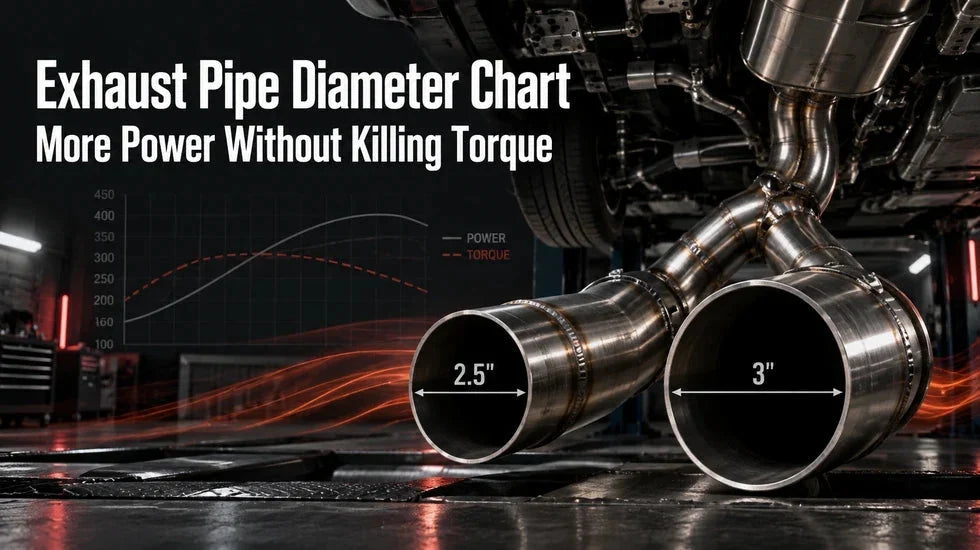
Exhaust Pipe Diameter Chart: More Power Without Killing Torque
A 3-inch exhaust sounds serious. A 4-inch pipe looks ready for war. Neither one is automatically right for your car.
Pipe size is a balancing act: give the engine enough cross-sectional area to move exhaust at full load, but do not buy so much area that you add weight, lose clearance, create an ugly cabin boom, and gain nothing where you actually drive. Horsepower matters. So do engine speed, layout, bends, mufflers, catalytic converters, and the smallest section hiding in the system.
Technician's note: Size the pipe for the power the engine actually makes—or will make after a defined build—not the horsepower you might chase someday. A good street exhaust supports the target without turning every commute into a compromise.
Quick answer
- Under 200 hp: A 2.0- to 2.25-inch single pipe is a sensible starting range for many street applications.
- 200-300 hp: Start around 2.25 to 2.5 inches for a single system, or roughly 2.0 to 2.25 inches per pipe in a true-dual layout.
- 300-400 hp: A 2.5- to 3.0-inch single or dual 2.25- to 2.5-inch layout commonly fits the job.
- 400-500 hp: Look in the 3.0- to 3.5-inch single range or about 2.5 to 3.0 inches per pipe for true duals.
- Above 500 hp: Treat the chart as a starting point. Turbo outlet size, rpm, exhaust length, muffler flow, catalytic converters, bends, heat, and intended duty become too important to ignore.
- For any build: Compare crank horsepower with crank horsepower, or wheel horsepower with wheel horsepower. Do not mix the two.
Exhaust Pipe Diameter Chart by Horsepower
This exhaust pipe diameter chart is deliberately given as a range. There is no honest universal line where a 2.5-inch pipe supports 349 hp and suddenly fails at 350. A straight mandrel-bent system with an efficient muffler is not the same as a long system with tight crush bends and a restrictive transverse muffler.
| Target Engine Power | Single-Pipe Starting Range | True-Dual Starting Range (Per Pipe) |
Typical Use |
|---|---|---|---|
| Up to 200 hp | 2.0-2.25 in. | Usually unnecessary; 1.75-2.0 in. if packaging requires duals | Stock or mildly modified compact street car |
| 200-300 hp | 2.25-2.5 in. | 2.0-2.25 in. | Naturally aspirated street car or mild truck |
| 300-400 hp | 2.5-3.0 in. | 2.25-2.5 in. | Modified street/performance build |
| 400-500 hp | 3.0-3.5 in. | 2.5-3.0 in. | High-output NA or moderate boosted build |
| 500-700 hp | 3.5-4.0 in. | 3.0-3.5 in. | Serious boosted or competition-oriented build |
| 700+ hp | Build-specific | Build-specific | Model the complete system and test pressure |
Use those numbers to make a shortlist. Then check the vehicle. A 420 hp pickup that tows at steady load is not the same job as a 420 hp lightweight car that sees ten seconds of wide-open throttle. Nor is a 420 whp car the same as one rated at 420 hp at the crank.
Stock vs. Aftermarket Exhaust: What Really Changes?
| Feature | Typical Factory System | Well-Matched Aftermarket Cat-Back | Poorly Chosen Oversized System |
|---|---|---|---|
| Pipe routing | Designed around cost, noise, clearance, and assembly | Smoother routing with fewer abrupt transitions | May require awkward bends to fit oversized tubing |
| Bend area | May use crush-bent or locally flattened sections | Mandrel bends can retain more area through the turn | Large nominal size does not fix a crushed or badly placed bend |
| Sound | Quiet and heavily controlled | Deeper or more aggressive, depending on muffler and resonator design | Can add boom, rasp, or highway drone |
| Flow capacity | Matched to stock output with production margins | Matched to a defined power range | Extra area may provide no useful gain |
| Clearance | Validated around the original chassis | Should preserve usable ground and body clearance | Larger tubing can crowd braces, axles, heat shields, and the floor |
Exhaust Pipe Diameter vs. Cross-Sectional Area
Here is the math that settles half the arguments in the parking lot:
Area = π × (inside diameter ÷ 2)2
Diameter is squared. That matters. Moving from a 2.5-inch inside diameter to 3 inches does not add 20% more area; it adds about 44%.

| Inside Diameter | Single-Pipe Area | Dual-Pipe Combined Area | Dual Equivalent as One Round Pipe |
|---|---|---|---|
| 2.00 in. | 3.14 sq. in. | 6.28 sq. in. | 2.83 in. |
| 2.25 in. | 3.98 sq. in. | 7.95 sq. in. | 3.18 in. |
| 2.50 in. | 4.91 sq. in. | 9.82 sq. in. | 3.54 in. |
| 2.75 in. | 5.94 sq. in. | 11.88 sq. in. | 3.89 in. |
| 3.00 in. | 7.07 sq. in. | 14.14 sq. in. | 4.24 in. |
| 3.50 in. | 9.62 sq. in. | 19.24 sq. in. | 4.95 in. |
| 4.00 in. | 12.57 sq. in. | 25.13 sq. in. | 5.66 in. |
That is why dual 2.5-inch pipes do not equal a single 5-inch pipe. Their combined area is equivalent to one round pipe about 3.54 inches across. Real flow still differs because two pipes have more wall surface, more bends, more welds, and usually different mufflers.
OD, ID, and Wall Thickness
Most exhaust tubing is sold by outside diameter, or OD. The hole the gas uses is the inside diameter, or ID:
ID = OD - (2 × wall thickness)
A nominal 3-inch tube with 0.065-inch walls has an approximate 2.87-inch ID before coatings, seams, or deformation enter the picture. The theoretical internal area is about 6.47 square inches—not the 7.07 square inches of a true 3-inch ID.
And listen, a muffler marked “2.5-inch inlet” may use a slip-fit end intended to receive 2.5-inch OD tubing. A tip can have a 4-inch exit while connecting to a 2.5-inch pipe. The number printed largest on the product photo is not always the dimension you need.
Single vs. Dual Exhaust Pipe Size

Single Exhaust
A single system is lighter, simpler, and easier to route. One well-designed 3-inch path can outperform a messy dual system with poor merges, crushed bends, and two restrictive mufflers. Turbo cars often use a large single because the exhaust has already joined at the turbine outlet and chassis space is limited.
True Dual Exhaust
True duals divide the flow between two pipes. They make packaging sense on many V-engine platforms and give the builder more choices for crossovers, mufflers, and tailpipe placement. But they add tubing, joints, hangers, weight, and cost.
Dual Tips Are Not True Duals
A single pipe that splits into two tips near the bumper is still a single-flow system upstream. The Y-junction, center pipe, or single-inlet muffler can remain the controlling section. Count flow paths, not shiny outlets.
X-Pipe, H-Pipe, and Y-Pipe Effects
An X-pipe or H-pipe connects the banks of a dual system and changes pulse interaction as well as sound. A Y-pipe combines two paths into one. Its throat deserves a close look: a beautifully built 3-inch cat-back cannot erase a badly pinched merge ahead of it.
How to Match Exhaust Pipe Size to Power, Displacement, and RPM
Start With Real Horsepower
Horsepower is the practical starting point because it reflects how much air and fuel the engine is processing. Use the same measurement basis throughout the job. If the dyno sheet says 360 whp and a chart uses crank horsepower, do not pretend those figures are interchangeable.
Also separate present output from a real upgrade plan. “Cam, intake, and tune booked for next month” is a plan. “Maybe a 1,000 hp build one day” is a daydream. Do not punish today's street car for tomorrow's fantasy.
Use Displacement and RPM as Corrections
A lazy 6.0-liter V8 and a 2.0-liter four-cylinder can make similar peak power while delivering it at very different engine speeds. The V8 moves large pulses at lower rpm. The four-cylinder may hold high mass flow near redline. Pipe length, collector behavior, firing order, and intended torque band change what feels right.
For a daily driver, I lean toward the smaller end of a safe range when the car spends most of its life between 1,500 and 4,000 rpm. For a road-course car that lives near peak power, I care more about sustained high-load restriction and temperature. Same horsepower. Different job.
Street, Tow, and Race Use Are Different Jobs
- Daily street: Favor response, clearance, controlled sound, and good fit.
- Towing: Consider sustained load, heat, low-to-midrange behavior, and cabin drone at cruising rpm.
- Street/strip: Leave sensible room for documented upgrades without wrecking street manners.
- Road course: Watch sustained exhaust temperature and high-rpm pressure, not just a short dyno pull.
- Drag-only: Packaging, noise, and low-speed comfort may matter less; measured performance matters more.
Naturally Aspirated vs. Turbo Exhaust Diameter
Naturally Aspirated Engines Need a Matched System
An NA engine does not need a cork in the tailpipe. What it can benefit from is a system that manages pulse energy, gas speed, collector timing, and low flow loss across the rpm range that matters. Oversize every section and you may spend more for a system that is heavier, harder to package, and no faster.
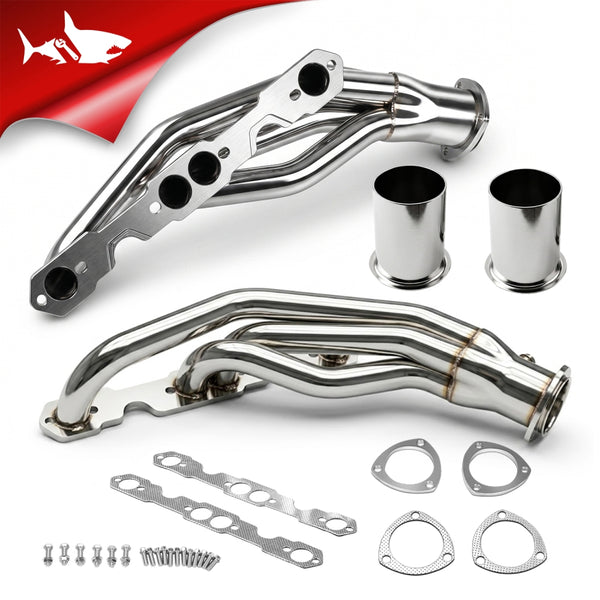
The same logic starts upstream. Flashark's guide to 1-3/4 vs. 1-7/8 header primary sizing explains why a larger tube can move the useful power band instead of simply adding power everywhere.

Turbo Engines Care About Post-Turbine Restriction
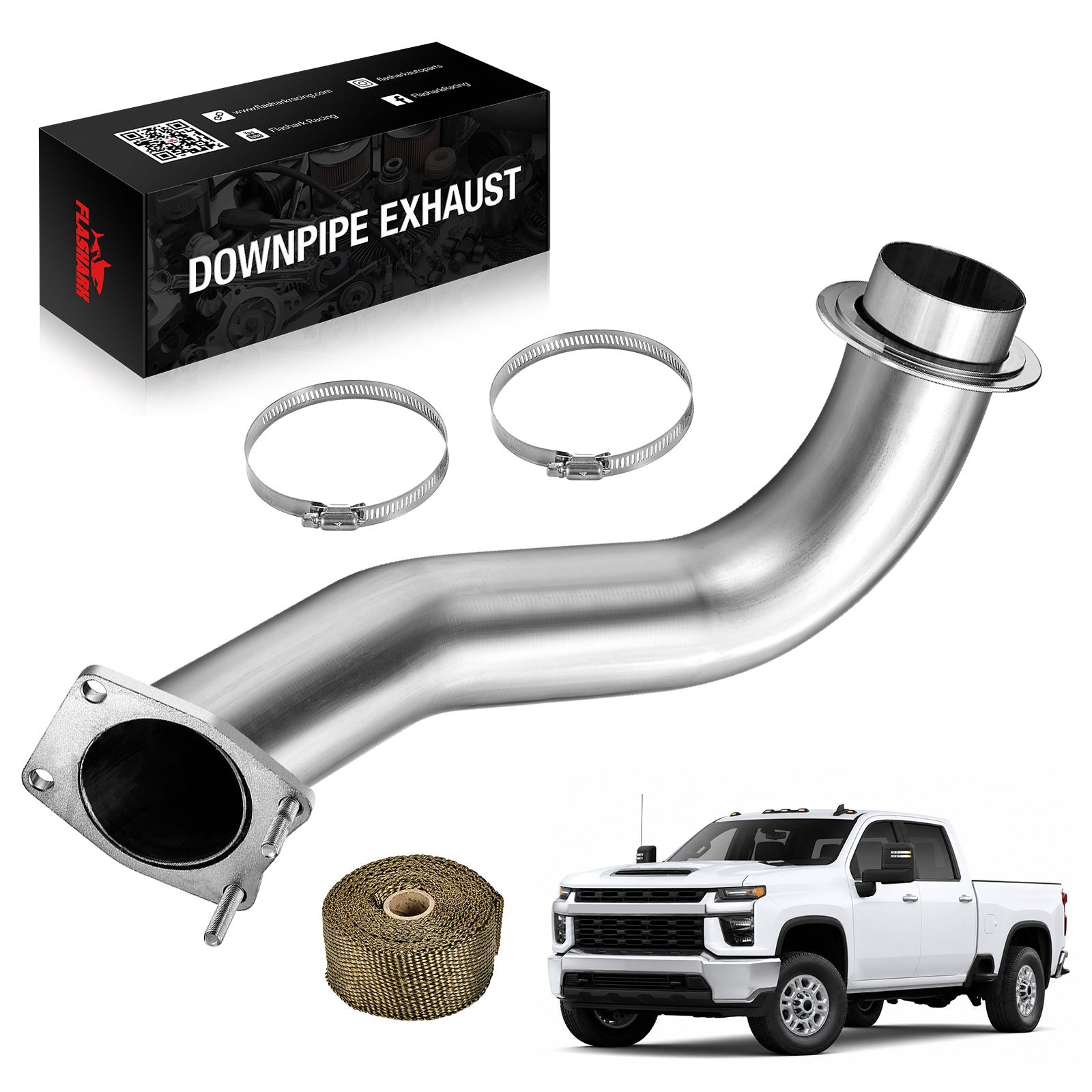
After the turbine, lower restriction generally helps reduce the pressure the turbo works against. That still does not make “largest available” a complete answer. Check the downpipe, catalytic converter, flex section, bends, mufflers, target power, and ground clearance as one system.
A 4-inch cat-back behind a restrictive downpipe may add noise and bulk while leaving the real choke point untouched. On the other hand, a high-output turbo build can overwhelm tubing that was perfectly comfortable at stock boost. Context wins.
Supercharged Does Not Mean Turbocharged
A mechanically supercharged engine moves more air, but it does not have a turbine sitting in the exhaust stream. Size it from airflow, power, rpm, and the complete exhaust layout. Do not copy a turbo rule solely because both engines use boost.
Does a Bigger Exhaust Pipe Always Make More Power?
No. It removes a restriction only when the previous system was restrictive at the operating point being tested.
When the Pipe Is Too Small
- Pressure rises upstream at high mass flow.
- The engine spends more work pushing exhaust out.
- Power can flatten at high rpm.
- A turbocharger may see greater pressure after the turbine.
- Heat load can rise during sustained operation.
When the Pipe Is Too Large
- The system costs and weighs more.
- Routing around the axle, driveshaft, braces, and floor becomes harder.
- Ground clearance can shrink.
- Sound can become boomy or tiring.
- The extra area may produce no measurable gain at the engine's actual flow rate.
A Garage-Side Sizing Case
Here is how I handle the argument when a naturally aspirated street-car owner is stuck between 2.5 and 3 inches. I do not point at the bigger pipe and call it “future-proof.” I write down the present power, realistic next-step power, common driving rpm, collector size, catalytic-converter outlet, muffler design, and the tightest bend under the car. Then I calculate area.
Say the existing 2.5-inch-ID path offers 4.91 square inches and the proposed 3-inch-ID path offers 7.07. That is roughly 44% more area. If the engine is near 280 hp, spends its life on the street, and still has a smaller restriction upstream, that extra area needs a reason. Sound preference could be one. Future forced induction could be another. “Three is bigger than two-and-a-half” is not a reason.
I have watched beginners buy the pipe first and measure the car later. Then the tubing touches a rear brace, the muffler hangs low, and the adapter necks straight back down at the factory flange. Measure the whole path. It saves money, burned knuckles, and an irritating second trip to the exhaust shop.
The Backpressure Myth: What the Engine Actually Needs
An engine does not need harmful backpressure to make torque. It needs an exhaust that controls pressure losses and uses pulse behavior effectively. Those are not the same thing.
Smaller tubing can sometimes produce a better result in part of the rpm range because gas velocity and wave behavior change. Calling that benefit “backpressure” muddies the diagnosis. A restriction that forces the piston to work harder during the exhaust stroke is a loss.
This distinction also explains why header primaries, collectors, catalytic converters, mid-pipes, and tailpipes cannot be treated as one uniform tube. For a plain-language look at where a cat-back begins and what it changes, read what a cat-back exhaust actually does.
How to Use an Exhaust Pipe Size Calculator
A useful exhaust pipe diameter calculator should ask more than horsepower. At minimum, enter or record:
- Current and target horsepower.
- Crank hp or wheel hp.
- Single, split-rear, or true-dual layout.
- Naturally aspirated, turbocharged, or supercharged induction.
- Peak-power rpm and normal driving rpm.
- Street, tow, endurance, or short competition use.
- Pipe OD, wall thickness, and calculated ID.
- Catalytic-converter, muffler, bend, and merge restrictions.
If a calculator spits out one diameter without explaining its assumptions, treat it as a rough estimate. Area math compares geometry. It does not model every pressure pulse, bend, temperature change, perforated muffler core, or catalytic substrate under the car.
Quick Dual-to-Single Diameter Formula
For two equal round pipes:
Equivalent single diameter = one dual-pipe diameter × 1.414
Example: 2.5 × 1.414 = 3.54 inches. Again, that is area equivalence—not proof that two real exhaust systems will flow identically.
What Restricts Flow Besides Exhaust Pipe Diameter?
The smallest number on the tape measure matters, but shape and component design matter too.
- Crush bends: The outside label stays the same while the inside of the bend narrows.
- Y-pipe throats: Two healthy branches can dump into one ugly pinch point.
- Flanges: Misaligned openings create steps that disturb flow.
- Catalytic converters: Substrate area and condition matter, not just inlet diameter.
- Mufflers and resonators: Core diameter, perforation, chambers, packing, and internal turns affect pressure and sound.
- Leaks: A leak is not a free-flow upgrade. It can alter sound, allow fumes into the cabin, and make diagnosis messy.
If a car suddenly feels flat after exhaust work, do not blame diameter before checking joints and flanges. Use this high-rpm exhaust leak diagnosis guide to separate a sizing issue from a sealing problem.
How to Measure Your Existing Exhaust Pipe
Measure OD With Calipers
- Let the exhaust cool completely.
- Raise the vehicle on a lift or support it on correctly rated jack stands placed at approved lifting points. Never work under a vehicle held only by a jack.
- Find a clean, straight section away from weld beads, flares, and clamp damage.
- Measure outside diameter with a caliper in at least two directions.
- If the readings differ, the tube is oval or deformed; record both values.
- Measure the mating muffler, adapter, or flange separately.

Measure Diameter From Circumference
When calipers cannot reach, wrap a flexible tape or non-stretch string around a straight section:
Diameter = circumference ÷ 3.1416
A circumference of 7.85 inches works out to roughly 2.50 inches in diameter. Keep the tape square to the tube. A diagonal wrap gives you a larger, wrong number.
Match the Connection, Not Just the Nominal Size
A slip-fit connection needs one part sized to enter the other. A butt joint needs a sleeve or suitable band clamp. A flanged joint needs compatible bolt spacing, flange shape, gasket, and opening. Do not expect a clamp to crush a half-inch mismatch into a durable seal.
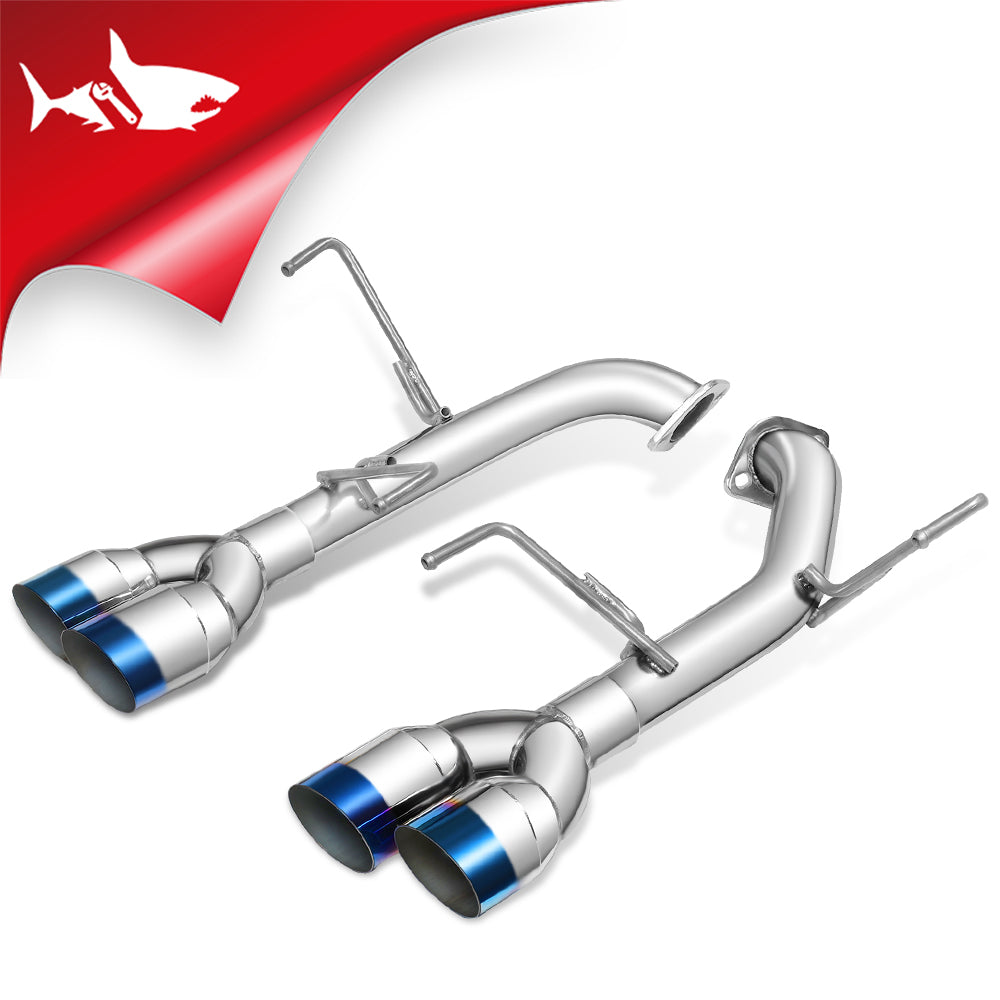
When comparing Flashark cat-back exhaust systems by vehicle and pipe layout, match the vehicle year, engine, drivetrain, exhaust connection, and selected configuration before ordering. Diameter is one part of fitment, not the whole fitment check.
Sound, Drone, and the Cost of Oversizing
Larger tubing can shift exhaust tone, but diameter alone does not decide whether a car sounds deep, raspy, quiet, or unbearable. Cylinder count, firing order, pipe length, crossover, resonator, muffler, tip location, gearing, and cruise rpm all pile into the result.
If the car booms at one steady highway speed, throwing a larger muffler at it may miss the cause. Diagnose whether you have overall volume, metallic rasp, structural contact, or a narrow resonance problem. The guide to getting a deep exhaust sound without highway drone walks through those differences.
Exhaust Pipe Size Guide: Final Buying Checklist
- Record year, make, model, engine, drivetrain, and body style.
- Use a realistic target-power range.
- Keep crank hp and wheel hp separate.
- Identify single, Y-pipe, dual-out, or true-dual routing.
- Measure tubing OD and note wall thickness when known.
- Inspect the downpipe, collector, catalytic converter, Y-pipe, muffler, and tightest bend.
- Check axle, driveshaft, brace, fuel-line, brake-line, bumper, and floor clearance.
- Decide how much highway drone and exterior volume you will tolerate.
- Match flanges, slip joints, reducers, clamps, hangers, and gaskets.
- Review local emissions, noise, and road-use requirements before modifying the system.
Frequently Asked Questions About Exhaust Pipe Sizes
Q1: What size exhaust pipe do I need for my horsepower?
A1: For a rough street starting point, use 2.0-2.25 inches below 200 hp, 2.25-2.5 inches around 200-300 hp, 2.5-3 inches around 300-400 hp, and 3-3.5 inches around 400-500 hp for a single system. Then correct for induction type, rpm, layout, components, and duty.
Q2: Is a 3-inch exhaust too big for a naturally aspirated engine?
A2: Not automatically. A high-output or high-rpm NA engine may use it well. A low-output street engine with a smaller upstream restriction may gain noise and bulk without gaining power. Use actual output and the complete system.
Q3: How much horsepower can a 2.5-inch exhaust support?
A3: There is no universal limit. A single 2.5-inch system is a common starting point in roughly the 200- to 350-hp neighborhood, depending on layout and components. Dual 2.5-inch pipes have twice the geometric area of one.
Q4: How much horsepower can a 3-inch exhaust support?
A4: A single 3-inch pipe commonly appears in 300- to 500-hp street builds, but that range is not a guarantee. Muffler flow, catalytic converters, bends, length, temperature, and acceptable pressure loss move the answer.
Q5: Is dual 2.5-inch exhaust better than single 3-inch?
A5: Dual 2.5-inch pipes offer about 9.82 square inches of combined theoretical area versus 7.07 for one 3-inch pipe, using true IDs. Better still depends on routing, mufflers, weight, ground clearance, crossover design, and how much flow the engine needs.
Q6: What single pipe equals dual 2.5-inch exhaust?
A6: By geometric area, dual 2.5-inch pipes equal a single pipe about 3.54 inches in diameter. Two real pipes will have more internal wall surface and different routing, so area equivalence does not guarantee identical flow.
Q7: Does a larger exhaust pipe reduce low-end torque?
A7: An oversized system can shift gas speed and pulse behavior and may make the car feel softer in part of the rev range. Results depend on the engine and complete exhaust. The explanation is more precise than saying the engine “lost needed backpressure.”
Q8: Does an engine need exhaust backpressure?
A8: It does not need harmful flow resistance. A well-designed system limits pressure loss while managing velocity and exhaust pulses for the intended rpm range. Restriction and useful wave tuning are different effects.
Q9: Should a turbo car use a larger exhaust pipe?
A9: Turbo engines often benefit from lower restriction after the turbine, especially as power rises. Size the downpipe and cat-back as a system, then account for catalytic converters, mufflers, target power, heat, noise, and chassis space.
Q10: Should I size exhaust by displacement or horsepower?
A10: Start with actual or target horsepower because it better represents required airflow. Use displacement, peak rpm, induction type, and vehicle use to refine the choice.
Q11: Is exhaust pipe diameter measured by ID or OD?
A11: Exhaust tubing is commonly sold by outside diameter. Internal flow area is set by inside diameter, which depends on wall thickness. Muffler inlets, expanded ends, tips, and clamps can use different fit conventions, so measure the mating parts.
Q12: How do I measure an exhaust pipe without calipers?
A12: Wrap a flexible tape around a clean, straight section to get circumference, then divide by 3.1416. Keep the tape perpendicular to the pipe and avoid expanded or clamp-crushed sections.
Q13: Is exhaust tip diameter the same as pipe diameter?
A13: Often it is not. A 4-inch tip may connect to a 2.5-inch tailpipe. Use the connection diameter when selecting parts; use exit diameter mainly for appearance and its contribution to sound.
Q14: Should the cat-back match the downpipe diameter?
A14: The diameters do not always have to be identical, but the transition should be deliberate and properly sealed. A small downpipe outlet or abrupt step can remain the limiting section ahead of a larger cat-back.
Q15: Should I buy a larger exhaust for future upgrades?
A15: Leave room for a defined near-term build, not an imaginary one. If the future turbo, cam, heads, or power target is chosen, size for that combination. Otherwise, the smaller safe option often fits and drives better today.
Q16: Do mandrel bends matter more than pipe diameter?
A16: Both matter. Mandrel bends preserve more cross-sectional area through a turn. A nominally larger crush-bent pipe can narrow enough at the bend to surrender much of its advertised size advantage.
Final Verdict
The right exhaust is not the largest pipe that clears the floor. It is the smallest practical system that supports the real airflow target without creating excessive pressure loss, packaging trouble, or sound you cannot live with.
Start with the exhaust pipe size chart. Compare area. Divide flow correctly between dual pipes. Adjust for power, displacement, rpm, induction type, and duty. Then crawl under the vehicle and find the smallest section. That last step is where internet theory finally meets steel.