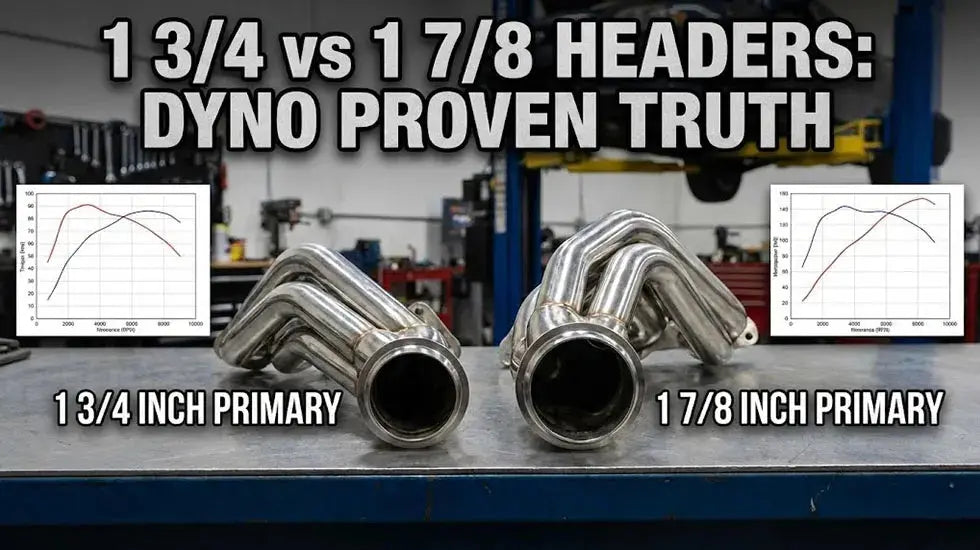
Look, I get it. We are car guys. In our world, "bigger" usually equals "better." Bigger displacement, bigger tires, bigger turbo, bigger cam. So, when you're staring at a checkout screen for a set of long tube headers, and the 1 7/8-inch option is only $50 more than the 1 3/4-inch set, your brain screams, "Do it. Get the big ones."
Stop right there.
I’ve spent the last 15 years under the lifts, wrestling with exhaust manifolds on everything from daily-driven Silverados and Scat Packs to 9-second Corvettes. I've seen the dyno sheets, and more importantly, I've driven these cars on the street. I’m going to tell you something the parts catalog won't: Oversizing your headers can actually make your car feel slower.
We aren't talking about peak horsepower numbers at 7,000 RPM that you only see on a dyno sheet or a dedicated track run. We are talking about the torque curve—the stuff that actually pushes you back in your seat when the light turns green.
🚦 The "Too Long; Didn't Read" Cheat Sheet
If you only take one thing away from this article, make it this breakdown. Choose your size based on your build stage, not your ego.
-
Pick 1 3/4" Headers If:
- Your engine is stock internal (stock cam, stock heads).
- You drive 90% on the street (under 6,000 RPM).
- You prioritize stoplight-to-stoplight torque.
- Target: Up to ~500 WHP (LS/LT/Hemi) or ~475 WHP (Coyote 5.0L).
-
Pick 1 7/8" Headers If:
- You are running Forced Induction (Supercharger/Turbo).
- You have a "Stroker" engine (416ci, 427ci, etc.) or high-flow aftermarket heads.
- Your camshaft makes peak power above 6,500 RPM.
- Target: 550+ WHP.
The Science of Flow: Velocity vs. Volume
Here is the physics lesson, minus the boring chalkboard. Engines don't just "push" exhaust out; they rely on a vacuum pulse to pull it out. This is called the Scavenging Effect.
Think of a garden hose. If you turn the water on (exhaust gas) and let it flow out of the open end, it has volume, but no pressure. Now, put your thumb over the end. The stream shoots out faster and further. That is velocity.

1 3/4" Headers: These are your "thumb on the hose." The slightly smaller diameter keeps exhaust gas velocity high. This high speed creates a strong vacuum behind each exhaust pulse, literally sucking the burnt gas out of the cylinder and pulling the fresh air/fuel mixture in. This efficiency at low-to-mid RPM is what creates torque.
1 7/8" Headers: These are the "open hose." They can handle a massive volume of air without restriction. But at low RPMs, the gas moves lazily. You lose that vacuum effect. The cylinder doesn't clear out as well, and your low-end torque suffers.
Note for the Ford guys: Since the Coyote 5.0L is a DOHC engine that revs higher and flows more air per cubic inch than a pushrod LS or Hemi, you can generally get away with 1 7/8" headers a bit earlier in your build. But for a strictly street-driven stock 5.0L, 1 3/4" is still going to feel snappier around town.
The "Butt Dyno" Reality: Street Driving
I hear it all the time: "But the 1 7/8 headers made 10 more horsepower on the dyno!"
Sure. At redline. How often do you drive at redline on your way to work? Probably never.
🛠️ Mechanic's Log: The Camaro Mistake "I remember back in '19, a kid brought in his stock 6.2L Camaro SS. He had read on the forums that 'bigger is better' and installed 1 7/8 headers himself in his driveway. He came to my shop begging for a tune because the car felt 'lazy.' He swore something was broken. 'It feels heavy off the line,' he told me. We threw it on the dyno. While he gained about 8 HP at the very top of the rev range, he had lost nearly 15 ft-lbs of torque below 3,500 RPM compared to a proper 1 3/4 setup. He spent $1,500 to make his daily driver feel slower in stop-and-go traffic. Don't be that guy."

The Compromise?
If you are planning to add a Whipple or ProCharger next year, go ahead and buy the 1 7/8" now so you don't have to buy twice. But be prepared for the car to feel a bit soft on the bottom end until you get that boost.
Installation Nightmares: The Knuckle Buster Factor
Nobody talks about this until they are lying on the concrete with dirt in their eyes. That extra 1/8th of an inch doesn't sound like much, but in a cramped engine bay like a C6 Corvette or a 4th Gen F-Body, it is the difference between a 4-hour job and a 2-day nightmare.
⚠️ Honest Warning: Many DIY guys watch a YouTube tutorial and think it's a direct bolt-on. But I’ve seen countless cases where 1 7/8 headers end up rubbing against the steering shaft or literally cooking the starter motor because the clearance is so tight. I've had to dent brand new primary tubes with a hammer just to get them to clear the frame rail. If you don't absolutely need the flow, save your knuckles (and your starter solenoid) and stick to the 1 3/4 size.

The "Brand Tax" vs. Budget Reality
Let's be real about money. If you have an unlimited budget, go buy Kooks, ARH (American Racing Headers), or Stainless Works. They are the gold standard, period. Their fitment is perfect, and their collectors are works of art.
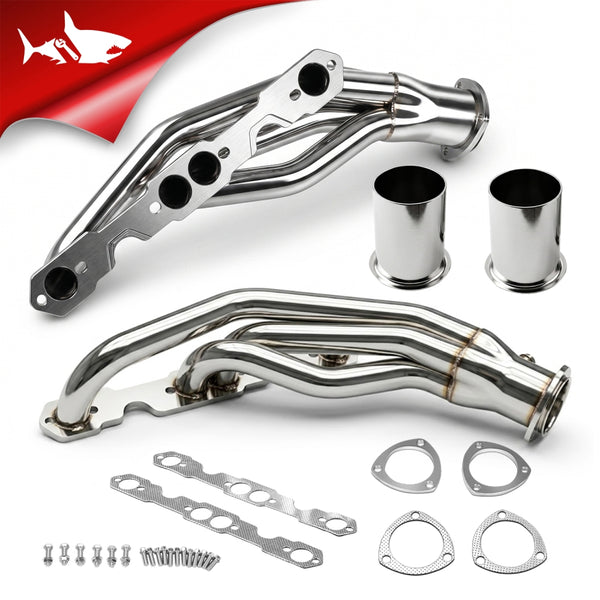
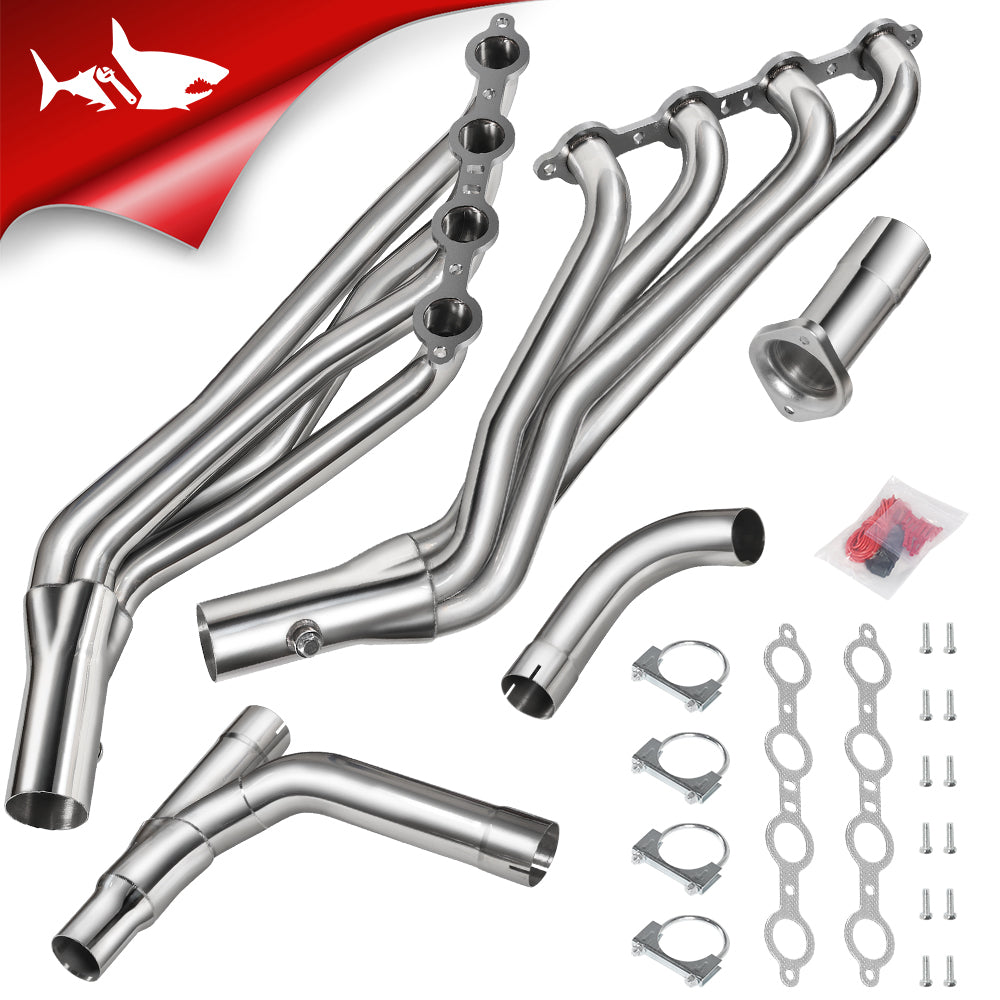
But not everyone wants to drop $1,500+ on pipes for a street car. This is where I've been genuinely surprised by Flashark headers lately. Usually, "budget headers" mean warped flanges and hammering pipes to make them fit. But the last few Flashark stainless kits I installed on LS and Hemi platforms actually lined up with the cylinder head ports without me needing a pry bar. For a sub-$600 option, they offer a solid balance of flow and fitment that gets you 90% of the performance for half the price.

Data Comparison: What to Expect
Here is a realistic breakdown of what happens when you bolt these on a standard V8 (LS/LT/Hemi).
| Feature | 1 3/4" Headers | 1 7/8" Headers |
|---|---|---|
| Low-End Torque (Sub 3k RPM) | High (+15-20 ft-lbs over stock) | Moderate (Can lose torque vs 1 3/4) |
| Peak HP Gain (Stock Internal) | +20-25 WHP | +25-30 WHP |
| Installation Difficulty | Moderate | High (Steering shaft/Starter issues) |
| Best Application | Street / Daily Driver / Autocross | Drag Strip / Forced Induction / High-RPM |
Final Verdict: Don't Ego-Mod
Building a fast car is about system matching. A huge exhaust on a stock engine is like putting a fire hose on a kitchen sink—it doesn't flow more water; it just looks ridiculous.
If you are staying Naturally Aspirated (NA) and driving on the street, the 1 3/4 header is the king of the stoplight. It’s snappy, fun, and easier to install. If you are chasing 4-digit horsepower or building a dedicated track toy, step up to the 1 7/8 or even 2-inch headers.
Frequently Asked Questions (FAQ)
Q1: Will 1 7/8 headers hurt my low-end torque on a stock engine?
A1: Yes. On a stock displacement engine (like a standard 5.3L or 6.2L), the reduced exhaust velocity creates a "lazy" scavenging effect. While you might not notice it at wide-open throttle, the car will feel less responsive at part-throttle cruising and initial acceleration (1,500–3,000 RPM).
Q2: Can I run 1 3/4 headers with a supercharger?
A2: You can, but they will become a restriction eventually. If you are running low boost (5-7 psi) and staying under 550 WHP, 1 3/4 works fine and preserves torque. However, once you start pushing serious boost, the heat and volume require the 1 7/8 inch tubes to prevent backpressure buildup.
Q3: Do 1 7/8 headers sound louder than 1 3/4?
A3: Not necessarily "louder" in decibels, but the tone changes. Larger diameter tubes (1 7/8") tend to produce a deeper, hollower, "bassier" tone. The smaller 1 3/4" tubes often have a sharper, raspier crackle to them.
Q4: What is the horsepower limit for 1 3/4 headers?
A4: In my experience, 1 3/4 headers are efficient up to about 500-550 rear wheel horsepower (RWHP). Beyond that point, the restriction starts to cost you significant peak power.
Q5: Are 2-inch headers ever necessary for a street car?
A5: Almost never. Unless you have a 454ci+ stroker motor or you are making 800+ HP, 2-inch headers will absolutely destroy your low-speed drivability. They are nightmare to install and overkill for 99% of builds.
Q6: Do I need a tune after installing headers?
A6: Absolutely. Installing Long Tube headers moves the Oxygen (O2) sensors further downstream and drastically changes airflow. Without a tune, your fuel trims will be way off, your car will likely run lean, and you'll trigger a Check Engine Light (CEL) immediately.
Q7: Which size is better for an LS3 (Camaro/Corvette)?
A7: If it's a "Bolt-on" car (intake/exhaust/tune only), stick with 1 3/4". If you are doing a Cam swap and Heads at the same time, go 1 7/8".
Q8: Is the installation harder for 1 7/8 headers?
A8: Yes. In tight engine bays, that extra width causes interference with steering shafts, K-members, and starter motors. It often requires lifting the engine or removing the steering column to get them in.
Q9: Should I wrap my headers?
A9: I prefer Ceramic Coating over exhaust wrap. Wraps can trap moisture and oil, leading to rusted pipes or even fires. Ceramic coating keeps the heat inside the pipe (which improves velocity!) and protects the metal.
Q10: Why do you mention Flashark headers?
A10: Because fitment on budget headers is usually terrible, but Flashark has been consistent in my shop. If you want high-end flow without the $2,000 price tag, they are a solid option that actually clears the steering shaft.