If you own a Small Block Chevy (SBC), you know the smell. It’s a mix of unburnt hydrocarbons and missed potential. I’ve been wrenching on these "Mouse Motors" since before OBD-II was a standard, and I’ve seen more cracked cast-iron manifolds than I’ve had hot dinners.
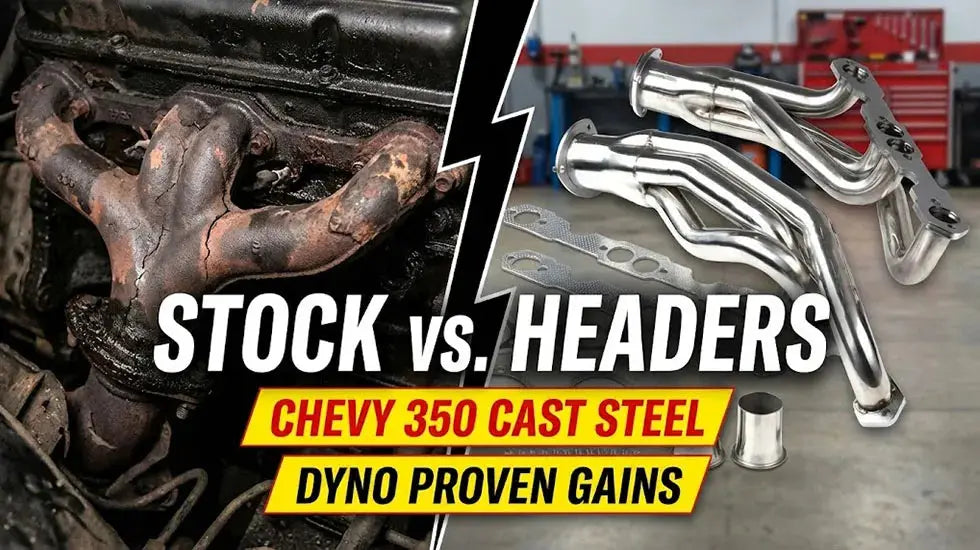
You’re probably here because you’re tired of your 350 sounding like a wheezing tractor, or maybe you cracked a manifold bolt trying to fix an exhaust leak. The debate is eternal: Stock Cast Iron vs. Tubular Headers.
I’m not going to give you the glossy brochure sales pitch. I’m going to tell you about the burnt spark plug wires, the starter motors that die from heat soak, and the actual dyno numbers I’ve seen on the rollers. Let’s get your hands dirty.
🚀 The "Bottom Line" Up Front (TL;DR)
Should you swap? Yes, but manage your expectations.
- Real HP Gains: Shorty headers typically add 5-10 HP, while Long Tubes deliver 10-20 HP. On a modified engine (Cam/Intake)? Gains can jump to 25-40 HP.
- Torque: Headers shift torque. Long Tubes help top-end; Shorties preserve low-end grunt for towing.
- The "Gotcha": You will need to address the dipstick tube, spark plug access, and starter heat.
- Verdict: Keep manifolds for a farm truck restoration. Go headers for everything else.
Why Stock Manifolds "Choke" Your Engine

To understand why we swap these, you have to look at the flow. Stock cast iron manifolds are basically "logs." They dump exhaust from four cylinders into one common chamber immediately. It’s like trying to evacuate a burning building through a single revolving door—everyone crashes into each other.
This creates backpressure. The piston has to push harder to expel the gas, wasting energy.
Exhaust headers work on "Scavenging." By giving each cylinder its own primary tube, the exhaust pulse creates a vacuum behind it. This vacuum literally sucks the burnt gas out of the cylinder, allowing a fresh air/fuel charge to rush in. More air = more fuel = more power.
The Ugly Truth: What Nobody Tells You About Installing Headers
Most articles skip this part. As a mechanic, this is where I make my money—fixing the headaches caused by bad installs.
⚠️ The Dipstick Dilemma:
On a stock Chevy 350 (especially 1980+ models), the oil dipstick tube is bolted directly to the stock manifold. When you remove the manifold, that bracket has nowhere to go.
The Fix: Don't find this out at midnight on a Sunday. You will need to either fabricate a spacer, bend the tube (risky—it kinks easily), or buy a flexible Lokar-style dipstick. Factor this into your budget.
1. Spark Plug Access is a Nightmare
On stock manifolds, changing plugs is a 10-minute job. With certain headers, plug #5 and #7 become your worst enemies. I've seen headers that require you to use a cut-down wrench just to get the plug out.
Pro Tip: If you have "Angle Plug" heads (common on performance builds), verify the headers fit angle plugs. Standard headers will hit the spark plug boots.

2. The "Hot Starter" Issue
Headers are thin steel. They radiate heat instantly. On a Chevy, the starter motor is right next to the passenger side exhaust. Heat soak increases resistance, leading to that dreaded "click... click..." when you try to start the car hot.
The Fix: If you opt for chevy 350 long tube headers, you absolutely must wrap your starter in a heat shield blanket or upgrade to a Mini-High-Torque starter. The proximity of the large collector tubes makes heat management critical.

Manifolds vs. Shorty vs. Long Tube: The Specs
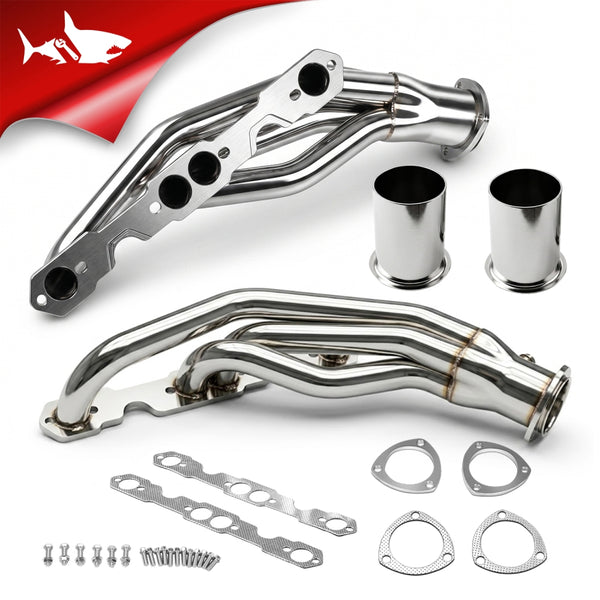
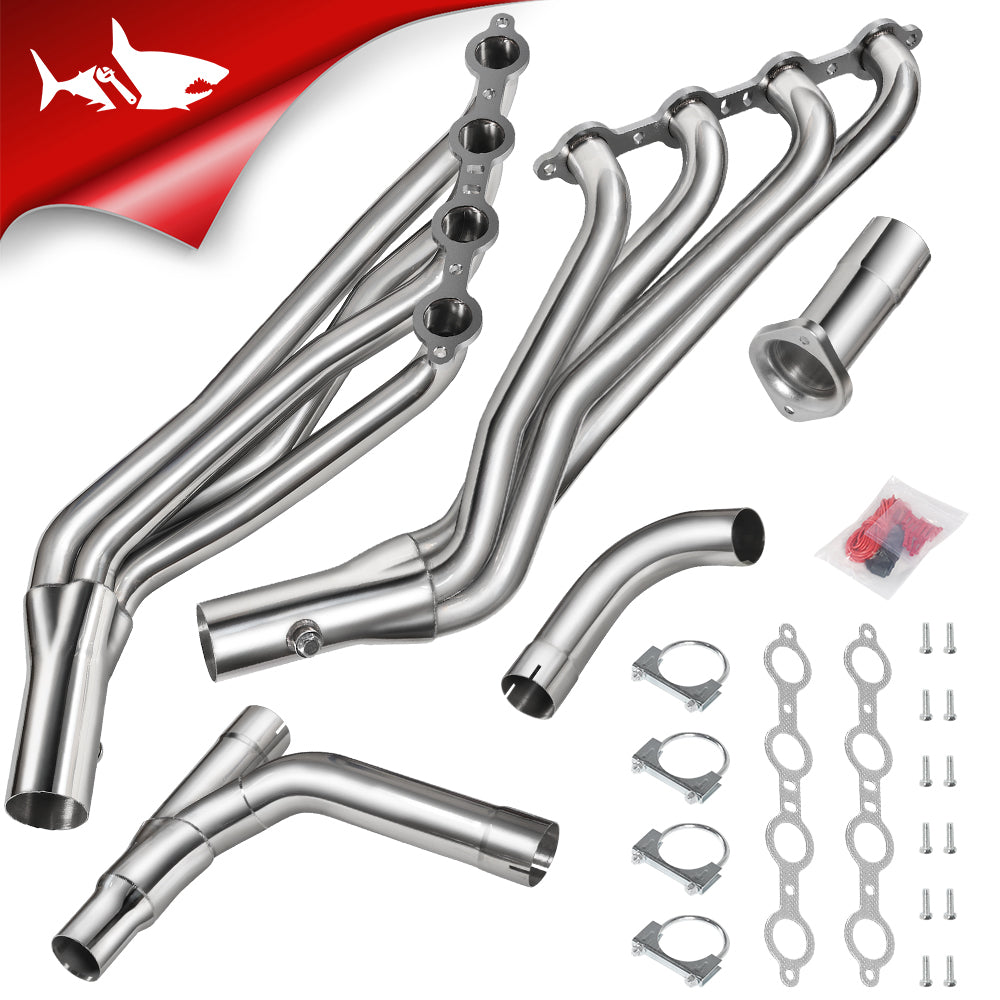
This is the most common question I get at the shop. Generally speaking, chevy 350 shorty headers are the best choice for daily drivers and towing. They preserve low-end torque and are much easier to install. However, if you are chasing peak horsepower and high RPMs, the long tubes listed in the table below are the winner.

| Feature | Stock Cast Iron | Shorty Headers | Long Tube Headers |
|---|---|---|---|
| HP Gain (Stock 350) | Baseline | 5-10 HP | 10-20 HP |
| Torque Curve | Flat / Low End | Good Mid-Range | High RPM focused |
| Installation Pain | Easy (Heavy lifting) | Moderate (Bolt access) | High (Clearance issues) |
| Ground Clearance | Excellent | Excellent | Poor (Watch speed bumps) |
| Sound Profile | Quiet / Muffled | Crisp / Aggressive | Deep / Loud / Choppy |
My Honest Take on Brands (And Saving Money)
Look, if you have an unlimited budget, go buy Hooker Super Competitions or Kooks. They are the gold standard. But most of us are working on a budget.
I’ve seen a lot of hate for budget headers, but the manufacturing has improved massively in the last 5 years. I recently installed a set of chevy 350 headers from Flashark on a customer's OBS (Old Body Style) truck.
Here is the mechanic's truth: The welds were surprisingly decent (TIG welded), and the flanges were flat. For a daily driver or a budget street build, you don't need to spend $1,200. Just make sure you use premium gaskets (like Remflex or MLS) and meaningful hardware. The headers are fine; it's the cheap paper gaskets that ruin the experience.
Stop Choking Your Engine
Whether you're restoring a C10 or waking up a Camaro, airflow is free horsepower.
Check Fitment For Your Chevy 350FAQ: People Also Ask
Q1: Do headers improve MPG on a Chevy 350?
A1: Theoretically, yes. By improving efficiency, the engine doesn't work as hard to cruise. However, in reality, your MPG usually stays the same or drops slightly because the new sound encourages you to step on the gas pedal harder!
Q2: Should I wrap my headers?
A2: It's a double-edged sword. Wrapping reduces under-hood temps significantly (protecting your starter and wires), but it can trap moisture against the header tubes, causing them to rust out faster if they aren't high-quality stainless steel.
Q3: Stainless Steel vs. Chrome: Which is better?
A3: Always choose Stainless Steel. Chrome plating on cheap headers turns blue effectively immediately after startup and will eventually peel and rust. Stainless (304 grade is best) lasts much longer and can be polished back to a shine.
Q4: Will headers cause a Check Engine Light?
A4: On an older carbureted 350? No. On a TBI or Vortec fuel-injected 350 (OBD1/OBD2)? Maybe. You need to ensure the headers have a bung for the O2 sensor. If the flow is too fast, the sensor might read "lean," requiring a tune.
Q5: Do I need to re-jet my carburetor after installing headers?
A5: Usually, yes. Because you are moving more air, your engine will run slightly lean. You might need to go up a jet size or two to maintain the optimal air/fuel ratio and prevent overheating.
Q6: What is the best primary tube size for a stock 350?
A6: Stick to 1-5/8 inch. Going bigger (like 1-3/4 inch) on a stock or mild engine will actually kill your low-end torque because the exhaust velocity drops too low.
Q7: Can I install headers without lifting the engine?
A7: With Shorty headers? Yes. With Long Tubes? It depends on the car, but often you'll need to jack up the engine a few inches or remove the steering shaft to wiggle them in.
Q8: Why do my header bolts keep coming loose?
A8: Thermal expansion. The head is iron/aluminum, the header is steel; they expand at different rates. Solution: Use locking bolts (Stage 8) or drill/safety wire them.
Q9: Are ceramic coated headers worth the extra money?
A9: 100% Yes. Ceramic coating keeps the heat inside the pipe (increasing flow velocity) and drastically lowers engine bay temps. It also prevents rust better than paint.
Q10: Long tube headers vs manifolds sound difference?
A10: Manifolds sound muffled and smooth. Headers sound crisp, louder, and more "choppy." You will hear the individual firing pulses much more clearly.