


 Need car parts? Shop by vehicle
(Select the exact fit for your vehicle)
Need car parts? Shop by vehicle
(Select the exact fit for your vehicle)
Jeep Exhaust Header
Brand: All | Chevy | Ford | Dodge | Jeep | BMW | Nissan | Toyota | Honda | Subaru | Other
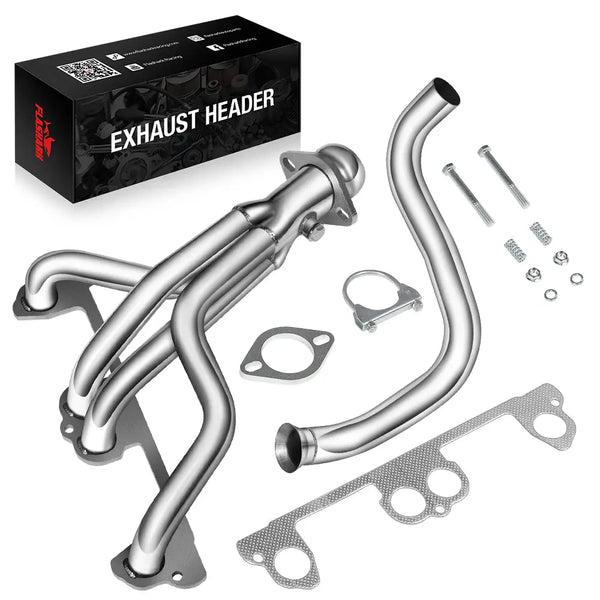
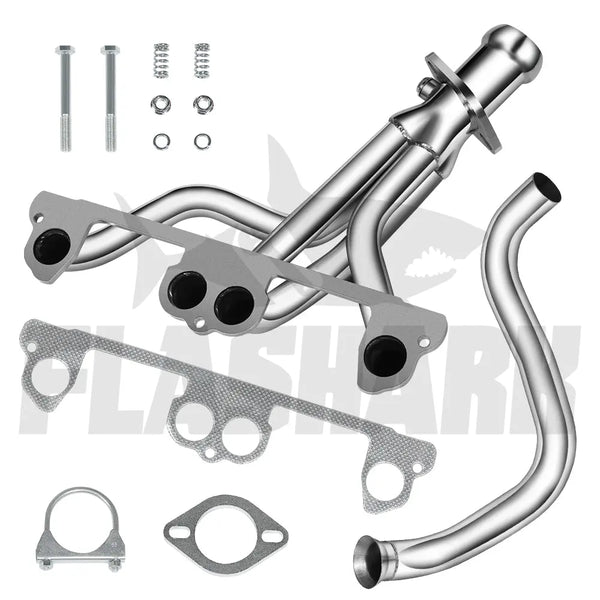
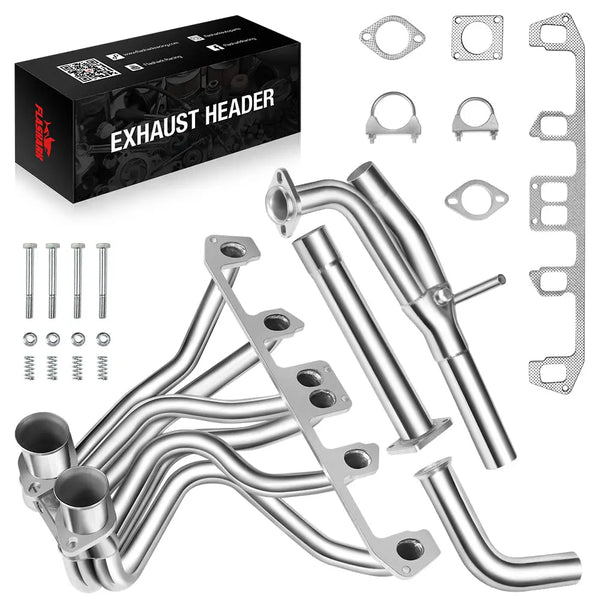
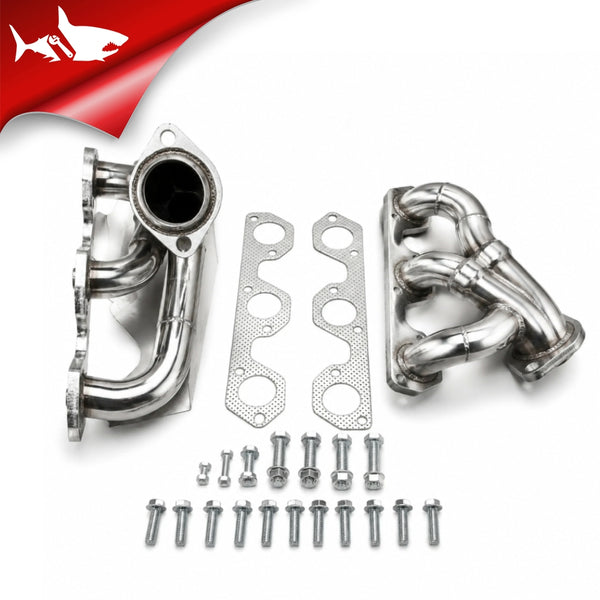
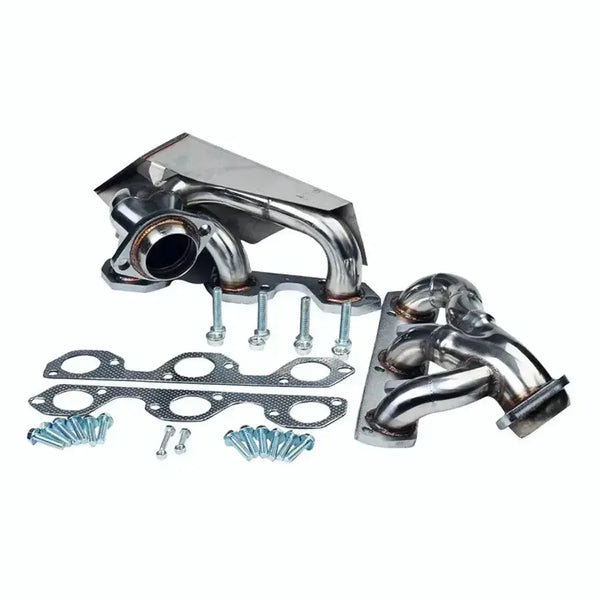
Flashark offers a range of high-performance Jeep Exhaust Headers designed to enhance your Jeep's power, improve exhaust flow, and give it a deeper, more aggressive sound. Whether you're off-roading or cruising, our headers ensure better engine efficiency and durability. Find the perfect match for your Jeep model and take your driving experience to the next level with Flashark premium exhaust solutions.


Brand: All | Chevy | Ford | Dodge | Jeep | BMW | Nissan | Toyota | Honda | Subaru | Other
Flashark offers a range of high-performance Jeep Exhaust Headers designed to enhance your Jeep's power, improve exhaust flow, and give it a deeper, more aggressive sound. Whether you're off-roading or cruising, our headers ensure better engine efficiency and durability. Find the perfect match for your Jeep model and take your driving experience to the next level with Flashark premium exhaust solutions.
Jeep Exhaust Headers: Stop the Ticking, Unleash the Torque, and Bulletproof Your Rig
Let’s be real. If you own a Jeep, there’s a 90% chance you know exactly what the “death tick” sounds like. You fire up your rig, and instead of a smooth idle, it sounds like a clapped-out diesel tractor bouncing off the drive-thru wall. Factory Jeep cast-iron manifolds are notoriously garbage. They heat cycle, warp, snap the rear bolts, and eventually crack right down the middle. Period. You lose low-end grunt, your fuel economy tanks, and your cabin smells like raw exhaust. Slapping temporary exhaust putty on it is a joke. You need a permanent mechanical fix.
BLUF (Bottom Line Up Front):
- The Problem: OEM cast manifolds inevitably crack due to extreme thermal stress and poor factory flow design.
- The Solution: Upgrading to T304 stainless steel tubular headers permanently cures the exhaust leak while drastically improving exhaust scavenging.
- The Flashark Advantage: Expect 12-18 whp and 15-22 lb-ft of torque gains directly at the wheels (depending on engine size), with 3/8" thick CNC-machined flanges that simply do not warp.
- Application: Direct-fit options for rock-crawling low-end torque (Shorties) or aggressive highway passing power (Long Tubes).
Factory Flaws vs. Flashark Engineering: Materials Matter
Forget the forum BS about just "living with the leak." Running a cracked manifold throws off your O2 sensor readings, causing your engine to dump excess fuel. It ruins your catalytic converters and washes your cylinders. Factory manifolds are poured in cast iron—a cheap, brittle metal that holds heat like an oven. When you plunge into a mud puddle after crawling in 4-Low, that rapid cooling shatters the cast iron.
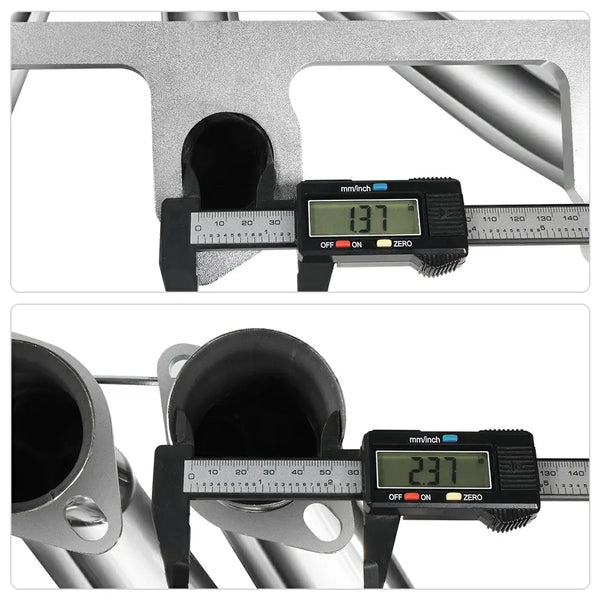
That’s exactly why we engineered Flashark Jeep headers using heavy-duty T304 stainless steel. We use .065-inch wall thickness tubing and precision TIG welds. Our flanges are surface-milled dead flat after welding to guarantee a leak-proof seal against the cylinder head. It’s a buy-once, cry-once upgrade.
Mechanic's Note: I remember back in '18, a pristine TJ 4.0 rolled into my bay sounding terrible. The owner was tearing his hair out over a massive loss of power and this relentless ticking noise. We pulled the heat shield off the factory cast manifold, and there it was—a gaping, jagged crack wrapping completely around the collector. A classic 4.0L death sentence. A lot of rookies read online tutorials and try to just braze the cast iron or slap on muffler cement. I highly recommend you never do that. It blows out the second you hit a steep grade. Yank the junk, do it right once, and bolt on a set of mandrel-bent stainless headers.
Choosing Your Weapon: Shorty vs. Long Tube Headers
Don't just buy what looks cool. You need to match the header architecture to how you actually use your Jeep.
Shorty Headers: The Crawler's Choice
If you're driving a Jeep JK 3.6, a TJ 4.0, or an XJ Cherokee, shorty headers are usually your best bet. They are designed to bolt directly to your factory Y-pipe and catalytic converters. Because the primary tubes are shorter, they preserve exhaust gas velocity at lower RPMs. This translates to instant throttle response and off-idle torque—exactly what you need when you're trying to bump a 35-inch tire up a granite ledge at 1,500 RPM.
Long Tube Headers: V8 Highway Brawlers
Got a 5.7 Hemi Grand Cherokee or a Jeep SRT8? Shorties are a waste of your time. You need long tube headers. By extending the primary tubes down past the firewall before they merge into the collector, long tubes create a powerful vacuum effect (scavenging) that literally sucks the next pulse of exhaust gas out of the cylinder. This pushes your torque peak higher in the RPM band, giving you the brutal passing power needed to overtake on the highway.
| Feature | Shorty Headers | Long Tube Headers |
|---|---|---|
| Best For | Rock crawling, daily driving, tight engine bays | Mud bogging, track racing, highway pulls |
| Powerband | Low-to-mid RPM (1,200 - 4,000 RPM) | Mid-to-high RPM (3,500 - 6,500 RPM) |
| Installation | Direct bolt-on, retains factory cats | Requires custom mid-pipes/tuning |
| Dyno Yield (Est.) | +8 to 15 whp | +20 to 35 whp (V8 applications) |
Beyond the Dyno: The Hardcore Science of Scavenging
We need to talk about volumetric efficiency. It’s not just about making the pipes bigger. If you slap massive 2-inch primary tubes on a stock Jeep 4.0, you will actually lose power. Why? Because the exhaust gas loses velocity, cools down, and stagnates. Flashark perfectly sizes our primaries (usually 1.5" to 1-5/8" for V6/I6, and 1-3/4" to 1-7/8" for V8s) to keep exhaust gases moving fast and hot. This thermal management reduces under-hood temps by up to 15% while maximizing the scavenging effect.
Top Jeep Engine Platforms & Proven Gains
The Legendary 4.0L Inline-6 (TJ, XJ, ZJ, WJ)
The 4.0 is bulletproof, but its exhaust manifold is a tragic joke. Swapping to a Flashark tubular header is a mandatory reliability mod. You’ll feel an immediate difference dragging heavy steel bumpers and 33s up a hill, usually picking up around 12-14 whp and a massive bump in throttle response.
The JK & JL Era (3.8L & 3.6L Pentastar)
The minivan motors. Look, they do the job until you add heavy armor and a winch. If you think the 3.6 is sluggish, the early JK 3.8L is a total dog when pushing 35s because those factory logs literally strangle the exhaust. Bolting Flashark shorty headers on the 3.8L delivers the raw, off-idle grunt needed to spin mud tires without roasting your clutch. For the 3.6 Pentastar guys, it instantly fixes that annoying mid-range flat spot. Across both platforms, you get your highway merging power back, dropping 0-60 times by nearly half a second on the Dynocom.
The Hemi V8s (Grand Cherokee 5.2/5.9, 5.7, SRT8)
If you're running a Grand Cherokee 5.7 or an SRT8 with stock exhaust logs, you are choking out 30+ horsepower. Long tube headers on the 5.7 Hemi Jeep Grand Cherokee transform the SUV from a grocery getter into a violent, tire-shredding machine. The exhaust note alone goes from a muted hum to an absolute roar.
Engine Swaps (LS, SBC, and V8 Conversions)
Building a custom CJ7 or YJ? We know the headache of trying to cram a Small Block Chevy or an LS into a narrow Jeep frame. Our block-hugging conversion headers and specific fenderwell headers clear your steering shaft and motor mounts, so you don't have to take a hammer to your firewall.
The Mechanic's Pitfall Guide: Installation & Tuning Warnings
Don't jump into this blind. Ripping out 15-year-old exhaust components is a fistfight with rust.
⚠️ Wrenching Warning: Avoid the Snap
Do not put a breaker bar on a dry, cold exhaust manifold bolt. You will snap it flush with the aluminum cylinder head, turning a 3-hour job into a 3-day nightmare involving drills and EZ-outs. Soak every stud in Kroil or PB Blaster for at least 48 hours before you turn a wrench. Heat the bolts with a MAP gas torch. Work them back and forth. Patience pays off.
Also, let’s talk about emissions compliance. If you bolt on long tube headers and delete your factory catalytic converters, you are going to trigger a Check Engine Light (CEL). Your ECU will panic. You either need high-quality O2 sensor spacers (non-foulers) or, preferably, a custom ECU tune to adjust your fuel trims and turn off the rear O2 monitoring. Know your local inspection laws before you start ripping out cats.
Frequently Asked Questions (FAQ) About Jeep Headers
Q1: Do headers on a Jeep 4.0 actually make a difference?
A1: Absolutely. Beyond permanently fixing the inevitable cracked factory cast-iron manifold, aftermarket headers improve exhaust gas scavenging. You'll instantly feel restored low-end torque, which is critical for pushing oversized off-road tires and improving overall drivability.
Q2: Will installing headers on my Jeep JK void the warranty?
A2: By law (Magnuson-Moss Warranty Act), a dealership cannot void your entire vehicle warranty simply because you installed aftermarket parts. However, if the dealer can prove the headers directly caused a specific failure (like melting a nearby sensor due to improper heat shielding), they can deny a claim for that specific part.
Q3: How much horsepower do headers add to a 5.7 Hemi Grand Cherokee?
A3: On a 5.7 Hemi, swapping from restrictive factory logs to a set of properly tuned long tube headers typically yields an additional 20 to 35 wheel horsepower (whp) and comparable torque gains, especially in the mid-to-high RPM range.
Q4: Shorty vs. Long Tube headers for Jeep Wrangler: Which is better for off-roading?
A4: Shorty headers are vastly superior for off-roading and rock crawling. They retain low-end torque (under 3,000 RPM), maintain necessary ground clearance, and easily clear suspension travel, whereas long tubes are optimized for high-RPM horsepower and hang lower under the chassis.
Q5: Do I need a tune after installing headers on my Jeep SRT8?
A5: Yes. If you install long tube headers on an SRT8, the dramatic increase in airflow and the likely relocation or removal of factory catalytic converters will alter your air/fuel ratios and trigger a Check Engine Light. A custom tune is required to maximize power and correct the ECU's parameters.
Q6: Why do Jeep 4.0 factory exhaust manifolds always crack?
A6: The factory Jeep 4.0 manifold is made of rigid cast iron and is tied tightly to the intake manifold. As the long inline-6 engine flexes and heat-cycles during off-road use or towing, the rigid cast iron cannot expand or flex, causing it to snap at its weakest point—usually the collector.
Q7: Can I install Jeep headers myself, or do I need a shop?
A7: You can do it yourself in a driveway if you have solid mechanical skills, but it is highly frustrating. You will battle rusted bolts, tight firewall clearances, and steering shaft interference. You must have penetrating oil, a torch, and an assortment of extensions and swivel sockets.
Q8: What are fenderwell headers and do I need them for my CJ7?
A8: Fenderwell headers route the exhaust primary tubes out through the inner wheel wells rather than dropping straight down inside the frame rails. They are practically mandatory for CJ7s with V8 engine swaps (like a Small Block Chevy) to bypass the narrow Jeep frame and steering linkage.
Q9: Will aftermarket headers fix the ticking noise in my Jeep?
A9: If the ticking noise is caused by an exhaust leak from a cracked manifold or a blown manifold gasket (which is the case 90% of the time on Jeeps), then yes, replacing it with a high-quality stainless header and a fresh multi-layer steel (MLS) gasket will completely eliminate the noise.
Q10: Do I need to replace my O2 sensors when installing new headers?
A10: It is highly recommended. O2 sensors degrade over time and often seize inside the old exhaust manifold. Stripping the threads while trying to remove them is common. Starting fresh with new O2 sensors ensures your engine gets accurate air/fuel readings with the new increased airflow.


