


 Need car parts? Shop by vehicle
(Select the exact fit for your vehicle)
Need car parts? Shop by vehicle
(Select the exact fit for your vehicle)
Mazda Catback Exhaust
Brand: ALL | Honda | Nissan | Toyota | Ford | Chevy | BMW | Mazda | Subaru | Lexus | Hyundai | Mitsubishi | Other
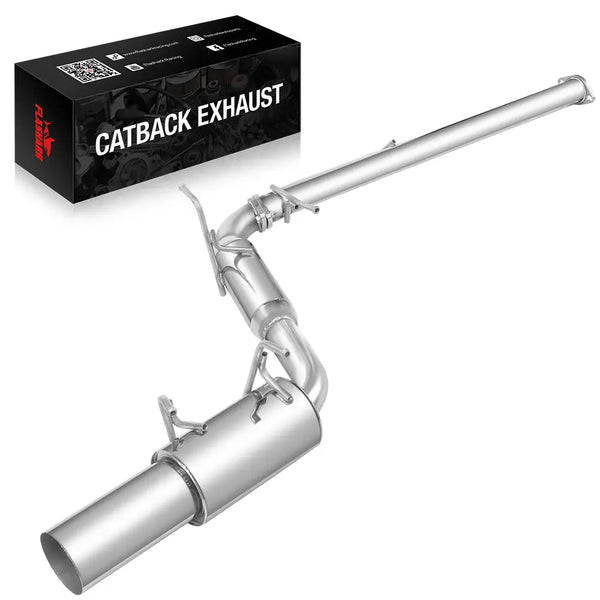
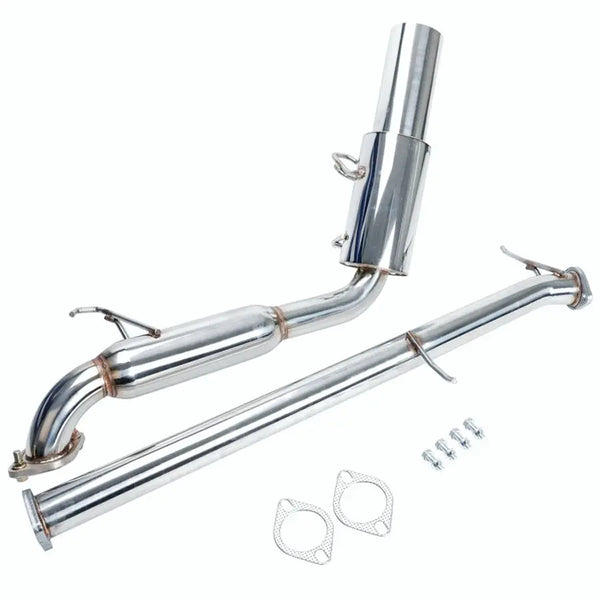
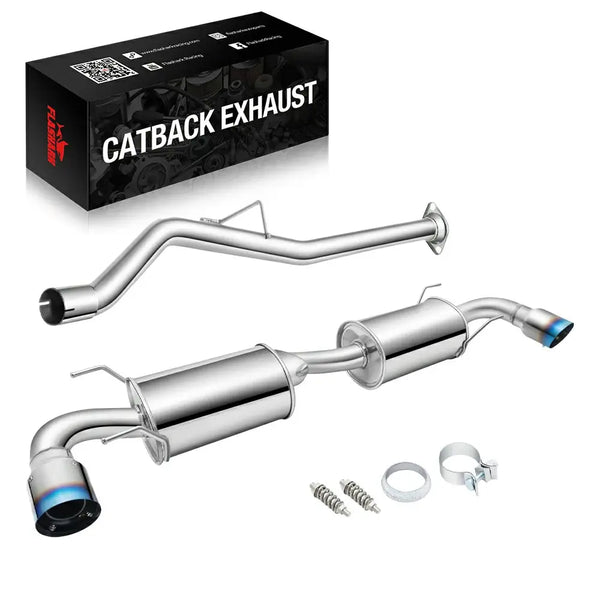
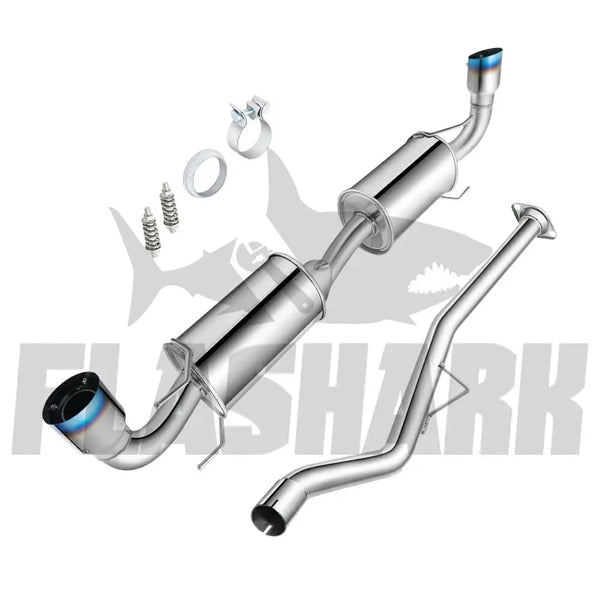
A Mazda Catback exhaust improves performance by replacing the stock system with a larger diameter and more efficient mid-pipe, muffler, and tailpipe. Flashark Mazda Catback exhaust systems are made from durable SUS-304 stainless steel, featuring a fully polished surface, CNC-machined flanges, and mandrel bends. Its straight-through design enhances horsepower, torque, and overall performance, delivering better exhaust flow and power for your Mazda.
Brand: ALL | Honda | Nissan | Toyota | Ford | Chevy | BMW | Mazda | Subaru | Lexus | Hyundai | Mitsubishi | Other
A Mazda Catback exhaust improves performance by replacing the stock system with a larger diameter and more efficient mid-pipe, muffler, and tailpipe. Flashark Mazda Catback exhaust systems are made from durable SUS-304 stainless steel, featuring a fully polished surface, CNC-machined flanges, and mandrel bends. Its straight-through design enhances horsepower, torque, and overall performance, delivering better exhaust flow and power for your Mazda.
Squeezing Real Power From Your Ride: The Ultimate Flashark Mazda Catback Guide
Let's be brutally honest. If you’ve ever put your car on a lift—whether you're wrenching on an ND Miata or a turbocharged Mazda 3—you've seen the tragedy hanging out back. Mazda engineers dialed in the chassis perfectly to give you that pure "Jinba Ittai" (horse and rider as one) feeling. But then the bean counters stepped in. They strapped a massive, heavily baffled, 35-pound steel trash can to your rear axle. It is a total buzzkill. That factory muffler isn't just dead weight ruining your cornering balance; it's a physical wall blocking your exhaust flow. Forget what the keyboard warriors on the forums tell you about "needing" that heavy muffler for low-end backpressure. It's absolute garbage. That stock setup suffocates your Skyactiv engine and completely mutes the raw, mechanical feedback you bought the car for in the first place. It’s time to cut the dead weight.
The Bottom Line Up Front (BLUF): What a Flashark Mazda Catback Actually Delivers
- Measurable Dyno Output: Expect a proven 10-15 whp bump on the 2.5T models, and a solid 5-8 whp on naturally aspirated 2.0L engines, with drastically sharper throttle response.
- The Weight Diet: Ditching the factory suitcase muffler sheds roughly 15 to 18 lbs from the rear of the car—a massive handling benefit for lightweight chassis like the MX-5.
- Acoustic Engineering: Awakens a deep, throaty sports growl on throttle, utilizing targeted resonators to keep the cabin completely drone-free at 75 mph highway cruising.
- True Bolt-On: Precision-engineered flanges bolt directly to your factory mid-pipe. Zero welding, zero cutting, and zero trips to a muffler shop.
Ditching the Restrictive Factory Setup: Pain Points & Flashark Solutions
I’ve busted my knuckles on enough rusted factory tailpipes to know that mild steel just doesn't survive. Give it a few winters, and the OE tubing looks like flaking tree bark. But it's not just about corrosion—it's about the restrictive bends.
Aerospace-Grade Materials & Mandrel-Bent Craftsmanship
Flashark refuses to use cheap alloys. We build our systems using thick-walled T304 and T409 stainless steel. The real performance trick, however, is the CNC mandrel bending. When a factory pipe bends around the rear subframe, the machine crushes the metal, shrinking the inner diameter and killing your exhaust velocity. A mandrel bend stays perfectly round. If you run a 2.5-inch Mazda Catback, it stays a true 2.5 inches the entire way out, keeping gas velocity dangerously high.
The Sound of Power: Tuning the Signature Mazda Note
You didn't buy a Mazda to sound like a straight-piped lawnmower. The Skyactiv-G naturally aspirated engines are notorious for a tinny, metallic "rasp" if the exhaust isn't tuned correctly. Tuning this is a literal science. Flashark packs our mufflers with high-density, high-temp fiberglass and utilizes specific chamber volumes to absorb those harsh, high-frequency trash noises. What you get is a deep, resonant growl when you downshift, and a smooth, refined tone when you're just commuting.
Proven Performance Gains: Scavenging and Flow Dynamics
Let’s talk fluid dynamics. Replacing your restrictive factory pipe with a high-flow setup maximizes the scavenging effect. Fast-moving exhaust gases create a low-pressure vacuum behind them, literally sucking the next pulse of spent gases out of the combustion chamber. Less pumping loss for the engine means it revs much freer, making heel-toe downshifts feel telepathic.
Choosing Your Layout: Dual Exit vs. Single Out & Tip Styles
Don't just buy a system blindly because it looks cool in a picture. You need the layout that matches your build philosophy.
| Exhaust Layout | Ideal Mazda Build | The Good | The Bad |
|---|---|---|---|
| Dual Exit (Twin Tip) | Street Cars, Mazda 3, Daily MX-5s | Perfect symmetrical aesthetics matching the factory bumper cutouts. Deep, balanced stereo sound. | Slightly heavier than a single exit due to extra piping and muffler material. |
| Single Exit (JDM Style) | Track-focused MX-5 Miatas | Absolute maximum weight reduction. Aggressive, hardcore JDM racing look. | Leaves an empty cutout hole in the factory dual-exit rear bumper diffuser. |
The Hardcore Nerd-Out: Hidden Benefits of a Free-Flowing Mazda Exhaust
Here is a secret the dyno sheets won't tell you: weight distribution. The MX-5 Miata prides itself on a perfect 50:50 weight balance. Hanging a massive, heavy factory muffler completely behind the rear axle acts like a pendulum during hard cornering. Ripping that out and bolting up a lightweight Flashark system physically reduces the polar moment of inertia. The rear end will feel noticeably more planted and willing to rotate when you pitch the car into a tight hairpin.
Platform-Specific Deep Dive: Mazda Engines and Power Dynamics
You cannot treat a high-revving naturally aspirated motor the same way you treat a torquey turbo setup. Here is exactly how we engineer airflow for your specific powerplant.
ND MX-5 Miata (2.0L Skyactiv-G): Freeing the High-Revving Soul
The 2.0L Skyactiv-G loves to live near the redline, but the stock exhaust heavily restricts that top-end rush. By bolting on a properly sized 2.5-inch exhaust, you completely un-cork the high-RPM breathing. It amplifies those glorious little exhaust pops on aggressive downshifts and makes the engine feel desperate to pull all the way to fuel cutoff.
Mazda 3 & CX-5 Turbo (2.5T Skyactiv-G): Turbo Spool and Heat Management
The biggest complaint from 2.5T owners is that the car is fast, but it sounds like an angry vacuum cleaner. Backpressure is the mortal enemy of a turbocharger. By opening up the exhaust, we drop that pressure drastically. Your turbo spools noticeably sooner, turbo lag is heavily reduced, and the exhaust note drops into a deep, aggressive bass tone rather than a muted hiss.
Mazdaspeed 3 (2.3L MZR DISI Turbo): The Classic Hot Hatch Breathing
For the older Speed 3 guys, pulling heat away from that aging K04 turbo is critical for survival. A high-flow system gives extreme thermal energy an immediate escape route. Dropping your Exhaust Gas Temperatures (EGTs) protects your turbo seals and gives you that violent, raw hot-hatch roar when you hit full boost.
The Mechanic's Warning: Avoiding Mazda Exhaust Pitfalls and CEL Nightmares
⚠️ Garage Truths: Don't Butcher the Jinba Ittai
"Listen to me carefully. Just last week, I had a kid bring his ND Miata into my bay. He wanted to go loud on a tight budget, so he went to a shady muffler shop, sawed off the factory catalytic converter, and welded on a piece of scrap straight pipe. Total hack job.
His dash was lit up like a Christmas tree with Check Engine Lights (CEL), the car smelled like raw fuel, and he lost all his low-end grunt. Taking off from a red light felt like driving a golf cart because he completely ruined the exhaust gas velocity.
Hear me out: a proper Mazda Catback Exhaust from Flashark bolts on strictly after the factory cats. You don't mess with the O2 sensors. You keep the check engine lights off. You get the sound, you keep your low-end torque, and your dash stays 100% code-free. Do it right the first time."
Frequently Asked Questions (Mazda Catback Exhausts)
Q1: Does a catback exhaust void my Mazda factory warranty?
A1: No. Under the federal Magnuson-Moss Warranty Act, a Mazda dealership cannot legally void your vehicle's overall powertrain warranty simply because you bolted on an aftermarket exhaust. They would have to mathematically prove the exhaust directly caused a specific mechanical failure.
Q2: Will installing a Flashark catback trigger a Check Engine Light (CEL) on my Mazda 3?
A2: Absolutely not. Because the system is installed downstream of the primary catalytic converters and O2 sensors, your ECU's emissions monitoring system remains completely untouched. You will not throw any error codes.
Q3: How do you fix exhaust drone on a Skyactiv engine at highway speeds?
A3: Drone is a maddening, low-frequency sound wave that vibrates the cabin, usually striking around 2,500 to 3,000 RPM. Flashark eliminates this by engineering precision mufflers with high-density acoustic packing and specific chamber resonance that naturally cancels out those frequencies, keeping your commute sane.
Q4: Single vs. Dual Exhaust for an MX-5 Miata: Which is better?
A4: It depends on your goal. A single-exit exhaust is strictly for hardcore track guys who want maximum weight reduction. A dual-exit exhaust is better for 95% of street drivers because it perfectly fills the factory bumper cutouts and provides a balanced, refined stereo sound.
Q5: Can I install a Mazda catback exhaust myself on jack stands?
A5: Yes. If you have a decent socket set, a safe set of jack stands, and a can of penetrating oil (like WD-40 or PB Blaster) for the rusty flange bolts, you can easily do this in your driveway. Flashark systems are 100% bolt-on. Expect the job to take about 1.5 to 2 hours.
Q6: How much horsepower does a catback actually add to a 2.5T Mazda?
A6: On the turbocharged 2.5L motors, relieving backpressure pays off well. Expect a realistic gain of 10 to 15 wheel horsepower (whp). More importantly, the turbo spools much faster, drastically improving your off-the-line throttle response.
Q7: Will a free-flowing exhaust ruin the low-end torque on my 2.0L Skyactiv-G?
A7: Only if you go too big. Slapping a massive 3-inch pipe on a naturally aspirated 2.0L will kill exhaust velocity and gut your low-end torque. Flashark properly sizes our NA piping (typically 2.5-inch) to maximize top-end flow without sacrificing the low-end punch you need for daily driving.
Q8: Is a Flashark Mazda catback exhaust CARB compliant in California?
A8: Yes. Because a catback exhaust does not alter, remove, or relocate the factory emissions equipment (the catalytic converters), it is legally classified as a sound-modifying component and is 50-state emissions legal, including in California.
Q9: Do I need a custom ECU tune (like VersaTune/Cobb) after putting a catback on?
A9: No custom tuning is required. The factory Mazda ECU is incredibly adaptive. Through its Long Term Fuel Trims (LTFT), the computer will automatically recognize the improved exhaust flow and safely adjust the air/fuel ratios after a few drive cycles.
Q10: T304 vs. T409 Stainless Steel: Which does my Mazda need?
A10: T304 is the premium alloy with high nickel and chromium content, meaning it virtually ignores rust—mandatory if you live in a climate with heavy winter road salt. T409 is a durable, budget-friendly alternative that develops surface oxidation (a brown tint) over time but will never rust through like cheap factory steel.