


 Need car parts? Shop by vehicle
(Select the exact fit for your vehicle)
Need car parts? Shop by vehicle
(Select the exact fit for your vehicle)
Toyota Catback Exhaust
Brand: ALL | Honda | Nissan | Toyota | Ford | Chevy | BMW | Mazda | Subaru | Lexus | Hyundai | Mitsubishi | Other
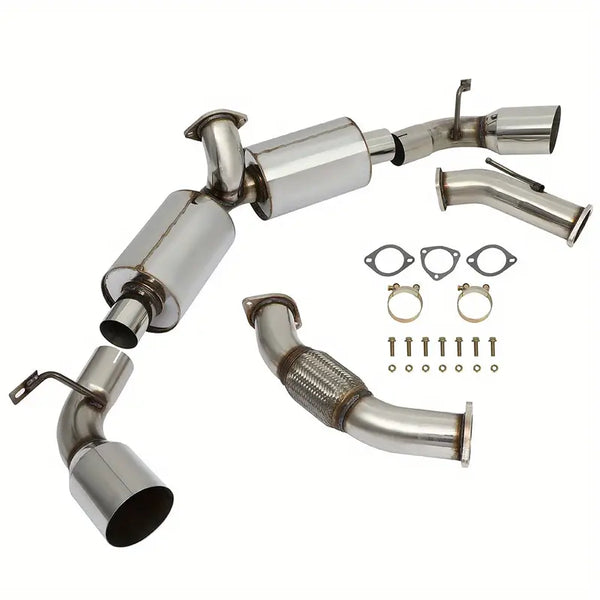
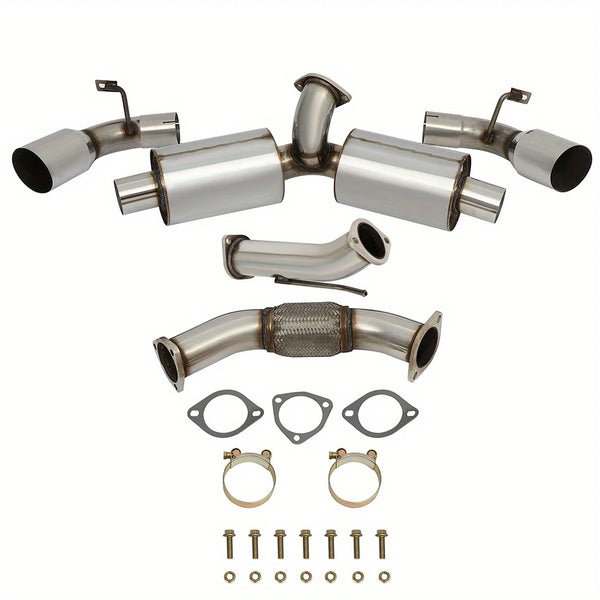
Upgrade your Toyota's exhaust system with our high-performance Catback Exhaust solutions. Designed to improve exhaust flow, reduce backpressure, and enhance engine efficiency, these systems provide a noticeable increase in horsepower and torque. Not only will you enjoy a deeper, more aggressive exhaust note, but our Toyota Catback Exhaust systems are built for durability and a perfect fit, ensuring a seamless installation and long-lasting performance.


Brand: ALL | Honda | Nissan | Toyota | Ford | Chevy | BMW | Mazda | Subaru | Lexus | Hyundai | Mitsubishi | Other
Upgrade your Toyota's exhaust system with our high-performance Catback Exhaust solutions. Designed to improve exhaust flow, reduce backpressure, and enhance engine efficiency, these systems provide a noticeable increase in horsepower and torque. Not only will you enjoy a deeper, more aggressive exhaust note, but our Toyota Catback Exhaust systems are built for durability and a perfect fit, ensuring a seamless installation and long-lasting performance.
Real Performance: The Definitive Flashark Toyota Catback Exhaust Guide
Let's get straight to it. Your stock Toyota engine is literally suffocating right now. Picture yourself trying to run a marathon while breathing through a cocktail straw. That’s exactly what your factory exhaust system is doing to your motor. When manufacturers build trucks, they engineer them for the absolute quietest cabin possible and lowest production costs. That means crush-bent tubing, heavy baffled mufflers, and massive restrictions that choke out throttle response. We are here to fix that.
BLUF (Bottom Line Up Front): The Flashark Advantage
- Verified Power: Expect a legitimate 10-18 whp and 15-22 lb-ft of torque increase across the mid-range, depending on your engine displacement.
- Bulletproof Build: Constructed entirely from TIG-welded 304 aviation-grade stainless steel. It will outlast the frame of your truck.
- Acoustic Perfection: A deep, guttural growl under heavy acceleration, engineered specifically to guarantee zero drone during 70 mph highway cruising.
Stock Exhaust Pain Points vs. The Flashark Solution
Most forum guys talk about exhaust mods purely for sound, but let's look at the physical hardware. Factory exhausts are predominantly made from cheap 409 stainless or aluminized steel. Add a few winters, some road salt, or some aggressive off-roading, and that metal starts flaking away. The internal baffles break loose, creating a maddening rattle. Replacing it with a toyota Catback Exhaust isn't just about noise; it's about permanently bulletproofing your undercarriage.
🔧 The Mechanic's Anchor: I'll never forget a 2016 Tacoma that rolled into my bay last month. 150k miles on the dash. The owner complained about a nasty ticking sound and cab fumes giving him headaches. I threw it on the lift. The factory 409-grade flange right behind the Y-pipe had rusted completely through, blowing hot exhaust gas straight onto the floorboard heat shields. We ripped that rusted trash off and bolted on a Flashark toyota Catback. The difference? Flashark uses massive CNC-machined flanges and thick 304 stainless. It bolted right up to the factory hangers. Problem solved, permanently.
Engineered to Last: Premium Materials & Precision Craftsmanship
Forget what you read in marketing brochures; look at the welds. A true performance exhaust relies on smooth gas flow. Factory pipes use "crush bends" which crimp the pipe and restrict flow by up to 20% at the corners. Every Flashark system utilizes mandrel-bent tubing. This means the internal diameter remains identical through every single curve. Combine that with beautiful, stacked-dime TIG welds, and you get a flow path that completely eliminates power-robbing turbulence.
Sculpting the Perfect Roar: Sound Characteristics Explained
Nobody wants their truck sounding like a raspy, straight-piped lawnmower. Getting the sound right is pure acoustic engineering. We utilize a precisely calculated resonator chamber paired with a straight-through perforated core muffler. This design actively cancels out high-pitch frequencies (the annoying rasp) while allowing the low-frequency sound waves to pass freely. The result is a deep, aggressive tone when you stomp the pedal, but completely manageable acoustics when you're just driving the kids to school.
Dyno-Proven Gains: Unleashing Hidden Horsepower and Torque
Bigger isn't automatically better. If you just slap a massive 4-inch pipe on a naturally aspirated motor, you kill your exhaust gas velocity and lose all your low-end torque. You'll feel it immediately when towing. Flashark engineers calculate the optimal diameter—usually 2.5 to 3 inches depending on the specific application—to reduce backpressure while maintaining maximum exhaust scavenging. This vacuum effect literally pulls spent gases out of the combustion chamber faster, giving you sharper throttle response and measurable dyno gains.
Battle of the Stances: Dual Exit vs. Side Exit vs. Turn-Down
Your exit style dictates both the look of your rig and how it performs on the trail. Let's break it down simply so you buy the right setup for your build.
Hardcore Tech Talk: Backpressure vs. Exhaust Scavenging
Listen up, because this is where 90% of garage mechanics get it wrong. Engines don't "need" backpressure. That's a stubborn myth. What they need is exhaust gas velocity. When an exhaust pulse travels down the pipe, it creates a low-pressure zone behind it. If the pipe is sized correctly, this low-pressure zone literally sucks the next pulse out of the engine. That’s called the scavenging effect. Flashark systems are mathematically tuned to optimize this velocity, giving you that punchy low-end torque you need to get heavy tires moving off the line.
Engine-Specific Synergy: Tuning Popular Toyota Powerplants
Not all engines breathe the same. We tailor the flow dynamics specifically for what sits under your hood.
Tacoma 3.5L V6 (2GR-FKS) & 2.7L (2TR-FE)
The 3.5L Atkinson cycle engine is notorious for feeling gutless in the mid-range. By optimizing the mid-pipe diameter, our catback system helps wake up that dead zone between 2500 and 4000 RPM, preventing the transmission from constantly hunting for gears on slight highway inclines.
Tundra 5.7L V8 (3UR-FE) & 3.4L i-FORCE MAX
For the legendary 5.7L, it’s all about uncorking that authentic American-style V8 rumble that Toyota muffled from the factory. For the newer 3.4L twin-turbo hybrids, the focus shifts to minimizing turbo backpressure. Less restriction after the downpipes means faster turbo spool and a dramatically throatier spool-up sound.
4Runner 4.0L V6 (1GR-FE)
The 4.0L is a bulletproof tractor motor, but it's sluggish. Upgrading the exhaust on a 4Runner drastically improves pedal feel. Plus, our specific routing ensures you maintain maximum ground clearance for those technical rock gardens.
The Mechanic's Warning: Emissions, Catalytic Converters, and CELs
⚠️ Garage Warning: Read Before You Wrench
Let me save you a massive headache. Do not mess with your primary catalytic converters unless you are building a dedicated track-only vehicle. Every week, I see guys who read bad advice online, rip out their cats, and end up with a dashboard lit up like a Christmas tree and an engine stuck in limp mode. A Flashark Toyota Catback Exhaust is designed to bolt right up after your factory emissions equipment. You don't touch the cats. You don't mess with the O2 sensors. That means zero Check Engine Lights (CEL), perfectly legal emissions, and zero stress when inspection time rolls around.
Frequently Asked Questions (FAQs) About Toyota Catback Exhaust
Q1: Will a Flashark Toyota Catback Exhaust void my factory warranty?
A1: No. Thanks to the Magnuson-Moss Warranty Act, simply bolting on an aftermarket catback system will not void your entire vehicle warranty. Dealerships can only deny a claim if they can prove the aftermarket part directly caused the specific failure.
Q2: Can I install this Catback system in my driveway, or do I need a shop?
A2: You can absolutely do it in your driveway. Flashark systems are direct bolt-on replacements utilizing factory hanger locations. If you have a decent socket set, some WD-40 for the rubber hangers, and a couple of hours on a Saturday, you can tackle this yourself.
Q3: Will upgrading my exhaust improve my Toyota's MPG (Fuel Economy)?
A3: Mechanically, reducing exhaust restriction increases engine efficiency, which can yield a 1-2 MPG bump. However, let's be real—you're going to love the new V6 or V8 sound so much that your right foot will get heavier, completely negating any fuel savings.
Q4: Does this exhaust drone at highway speeds?
A4: Zero drone. We engineered specific Helmholtz resonators into the mid-pipe section to target and cancel out the low-frequency sound waves that cause cabin resonance between 2000 and 2500 RPM.
Q5: Do I need a custom tune (ECU Remap) after installing a Catback?
A5: No tune is required. Because this is a catback system, you are not altering the oxygen sensors or the catalytic converters. Your factory ECU will easily adapt to the improved exhaust flow on its own.
Q6: What is the difference between an Axle-Back and a Catback Exhaust?
A6: An axle-back system only replaces the muffler and tailpipe located behind the rear axle, mostly changing the sound. A catback replaces everything from the catalytic converter all the way back, providing significantly better airflow and actual horsepower gains.
Q7: Will this system clear an aftermarket upgraded spare tire?
A7: Yes. Our standard and side-exit configurations are routed precisely to accommodate up to a 33-inch, and in some models, a 35-inch full-size spare tire tucked under the bed.
Q8: How do I clean and maintain the 304 stainless steel exhaust tips?
A8: 304 stainless resists rust beautifully, but carbon soot will build up. Use a quality metal polishing compound and a microfiber cloth every few months to wipe away the carbon and bring back that mirror finish.
Q9: Will a Flashark Catback trigger a Check Engine Light (CEL)?
A9: Absolutely not. Since you are leaving the factory catalytic converters and O2 sensors completely intact and untouched, your truck's computer won't trigger any emissions-related error codes.
Q10: Is the Flashark Toyota Catback 50-state emissions legal?
A10: Yes. Because the system does not alter, move, or remove any factory emissions control devices, it is legal in all 50 states, including California, as a sound and performance modification.


