Let's cut the marketing fluff. If you are here, you’re likely dealing with the infamous "Hemi Tick."
It starts as a faint tapping on cold starts, and eventually, it sounds like a tractor. I see this every single week in the shop. The issue isn't just "bad luck"—it's physics. The factory exhaust manifolds are cast iron, while your cylinder heads are aluminum. They expand and contract at different rates. Eventually, the manifold warps, and snap—there go the rear studs on cylinders 7 and 8.

So, you have to rip the exhaust off anyway. The question is: Do you replace it with a Shorty Header or commit to a Long Tube setup?
This isn't just about sound. It's about torque curves, ECU tuning, and whether you want to pass inspection or set a quarter-mile time. I’ve been wrenching on Rams, Chargers, and Challengers for 15 years—here is the technical reality of what you need.
- Ram 1500 Owners (Daily/Towing): Go with Shorty Headers. You keep your low-end torque (crucial for getting a heavy truck moving), requires no tuning, and installation is manageable.
- Charger/Challenger R/T (Performance): Go with Long Tube Headers. You gain significant top-end HP (+25-30whp), but you must tune the ECU and the installation is tight.
- The Golden Rule: Never reuse factory manifold bolts. Use Grade 8 hardware and OEM Mopar MLS gaskets, or you'll be doing this job again in 6 months.
The Engineering: Why Stock Manifolds Fail
Before we talk upgrades, understand the failure point. The stock "log style" manifolds restrict exhaust velocity. It's like trying to exhale through a straw.
Aftermarket headers use Mandrel-bent stainless steel tubing. This offers two benefits:
- Thermal Consistency: Stainless steel dissipates heat differently than cast iron, reducing the stress on the mounting bolts.
- Scavenging: This is the key. By smoothing the flow, the exiting exhaust pulse creates a vacuum behind it, literally pulling the next pulse out of the cylinder. Better scavenging = more fresh air in = more combustion.
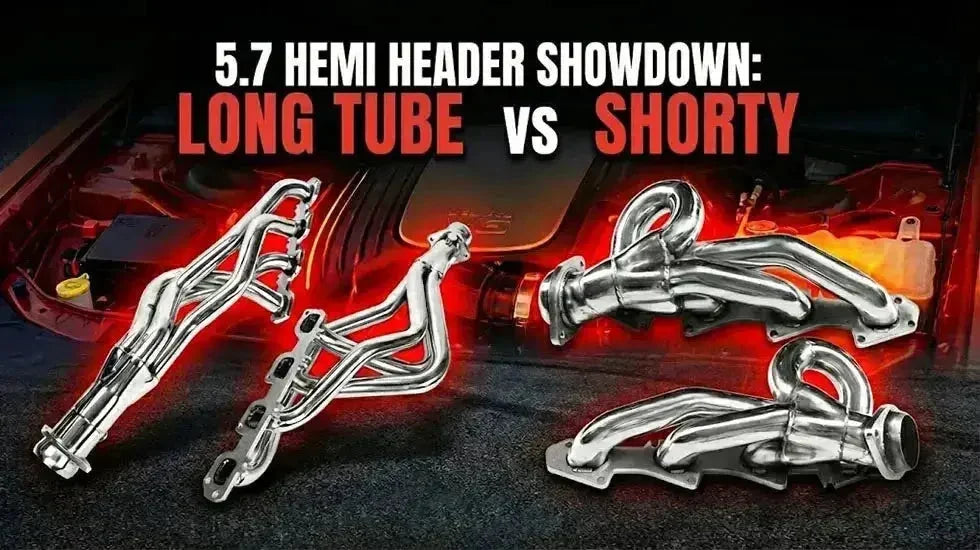
Shorty Headers: The "Fix It Right" Solution

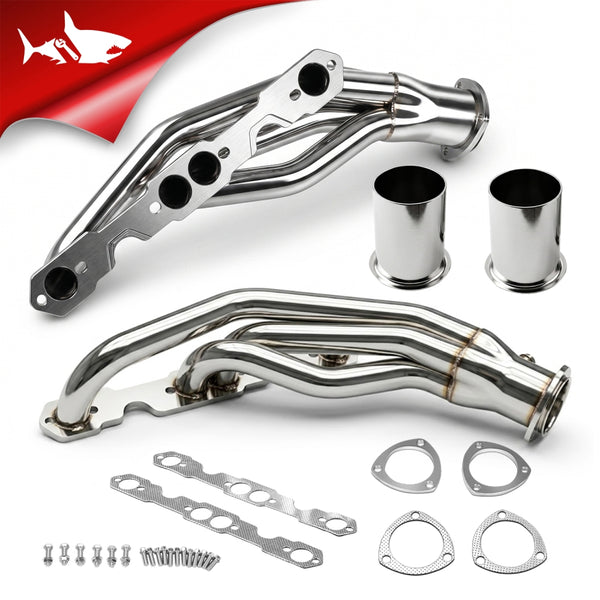
Shorty headers are direct bolt-on replacements. They end at the exact same flange location as your stock manifolds, meaning they bolt directly to your factory catalytic converters (mid-pipes).
Who is this for?
This is for the Ram 1500 owner or the daily-driver Charger. If you tow a boat or haul lumber, you care about torque from 1,500 to 3,000 RPM. Shorties preserve this low-end grunt. They won't make massive peak horsepower numbers (maybe +10-12 hp), but they fix the tick permanently and pass emissions in most states.
"Back in 2019, a customer brought in some $150 unbranded headers. I warned him about the flange thickness, but he insisted on the install to save cash.
Three months later, he was back. The flanges were so thin (less than 1/4 inch) that the heat warped them like a banana, blowing out the gasket. We had to do the entire 6-hour labor job twice.
The Mechanic's Rule: I don't care what brand you buy, but you must ensure the flange is at least 3/8-inch thick and laser-cut. This is why I personally comfortably install Flashark’s stainless series—they meet that 3/8" thickness spec without the 'Kooks' or 'ARH' price tag. Don't pay for the logo, pay for the steel thickness."
Long Tube Headers: The Horsepower Commitment
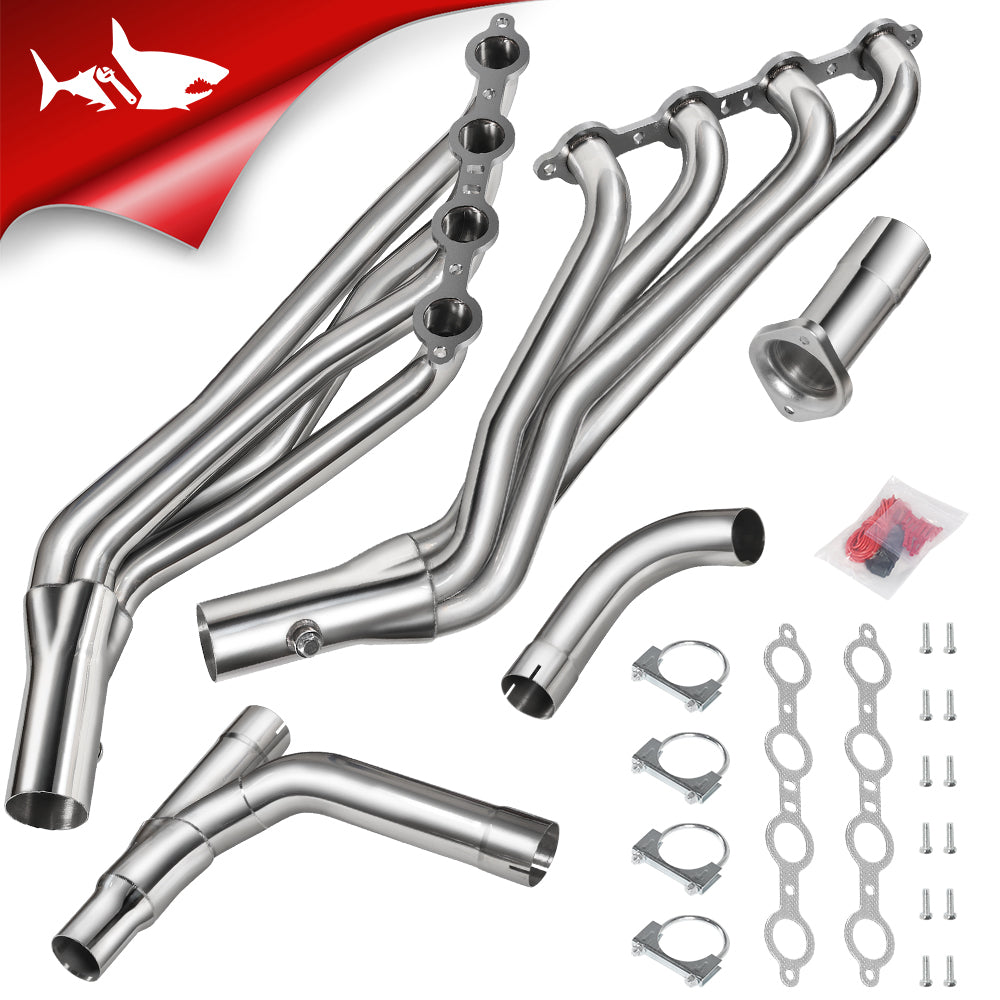
Long tube headers extend much further down, usually eliminating the factory catalytic converters or pushing them further back. They optimize exhaust velocity for high-RPM power.
The Gains & The Trade-off
On a dyno, hige-flow 5.7 Hemi long tube headers really shine above 3,500 RPM. You are looking at +25 to +30 wheel horsepower with a proper tune. The sound is aggressive, deep, and raw.
However, because you are changing the exhaust velocity so drastically, you will lose a tiny bit of torque right off idle. For a lighter car (Challenger), this doesn't matter. For a heavy truck, you might feel it.
If your Dodge or Ram is made in 2015 or later, stop and read this.
Long tube headers REQUIRE a custom ECU tune to turn off the rear O2 sensors and adjust fuel maps. However, Mopar encrypted the PCMs starting in 2015. You cannot just plug in a tuner.
You must buy an "Unlocked PCM" or send yours out to be unlocked. This costs an extra $200-$600 on top of the headers and the tuner device.
"A young guy brought his 2016 Charger R/T to the shop last year. He had spent his whole budget on long tube headers and a basic handheld tuner. We got the headers installed—which is a bear of a job on the AWD models—and went to flash the tune.
Brick wall. The tuner wouldn't communicate with the encrypted ECU. The car was throwing codes, running rich, and stuck in limp mode. He had to leave the car on my lift for 5 days while we express-shipped his PCM to be unlocked. Don't be that guy. Budget for the unlock before you buy the pipes."
Installation Realities: What the Manual Doesn't Say
Whether you choose Shorty or Long Tube, here is the technical advice needed to ensure the job doesn't turn into a disaster.
1. The Dipstick & Steering Shaft

On the driver's side, space is non-existent. You will likely need to unbolt the steering shaft to slip the headers in. The oil dipstick tube is also in the way. Do not force it—it will snap. Unbolt it from the block.
I recall a customer who bought a set of 5.7 Hemi long tube headers specifically for his Ram, thinking it was a 2-hour job because the wheel wells look open. He ended up having to lift the engine slightly on the driver's side just to clear the steering knuckle. It fits, but you have to be patient.
2. The Starter Heat Soak (Long Tubes Only)
Long tube headers often route the piping dangerously close to the starter motor (especially on the passenger side). The radiant heat can cook the starter solenoid, leading to "hot start" issues where the car won't crank after driving.
Pro Tip: While you are in there, wrap your starter with a reflective heat shield or blanket. It’s a $30 insurance policy that saves you a tow truck later.
3. Gaskets & Hardware
Toss the paper gaskets that come in the box. I don't care who made them. Use OEM Mopar Multi-Layer Steel (MLS) gaskets (Part #5045495AA / #5045496AA). Also, verify your bolts. If your headers utilize the factory studs, great. If they use new bolts, ensure they are Grade 8 and use high-temp anti-seize.
👮 The "Smog Check" Reality Check
Before you click "Buy," check your state laws. This is the number one reason I see customers returning parts.
- California & CARB States (NY, CO, etc.): You generally CANNOT install Long Tube Headers legally. They move the catalytic converters from the factory location, which is an automatic fail. You strictly need "Shorty" headers that have a stamped CARB EO Number (Executive Order).
- The "Visual" Fail: Even if your car doesn't throw a Check Engine Light (because you tuned it out), a sharp smog technician will look underneath. If they see long tubes displacing the cats, you fail the visual inspection.
- Federal/Other States: Shorty headers are usually 49-state legal because they retain factory converter locations.
Ask yourself: Do I want to swap my exhaust back to stock every year just to get a sticker? If not, Shorties are the safer bet.
Verdict: Making the Call
| Feature | Shorty Headers | Long Tube Headers |
|---|---|---|
| Best Application | Ram 1500 (Towing/Daily), States with Inspection | Charger/Challenger (Track/Street), Max Sound |
| HP Gain | +10-12 WHP | +25-30 WHP (Requires Tune) |
| Torque Curve | Preserves Low-End | Shifts to Mid/High RPM |
| PCM Tuning? | No (Plug & Play) | YES (Unlock required for 2015+) |
| Installation Difficulty | Hard (6/10) | Advanced (9/10) - Needs O2 Extensions |
The Sound Test: Drone, Rasp, and Roar
Let's be real. You aren't just buying headers for performance; you want your Hemi to sound like a beast. But there is a massive difference between "good loud" and "headache loud."
🎵 Shorty Headers Sound
- Tone: Deep, refined, and crisp.
- Volume: About 15-20% louder than stock.
- Cabin Drone: Non-existent. You can still hold a conversation on the highway.
- Verdict: Best for daily drivers who want to hear the engine only when they step on it.
🔥 Long Tube Headers Sound
- Tone: Raw, choppy, and aggressive.
- Volume: 40-50% louder (wake-the-dead loud).
- Cabin Drone: Significant. Without high-quality resonators, you will feel the vibration at 2,000 RPM.
- Verdict: For the "Look at Me" crowd and track builds.
Ready to Fix the Tick?
Whether you need Shorties for towing or Long Tubes for the track, Flashark’s 3/8" thick stainless flanges solve the warping issue for good.
*Both include required gaskets & hardware.