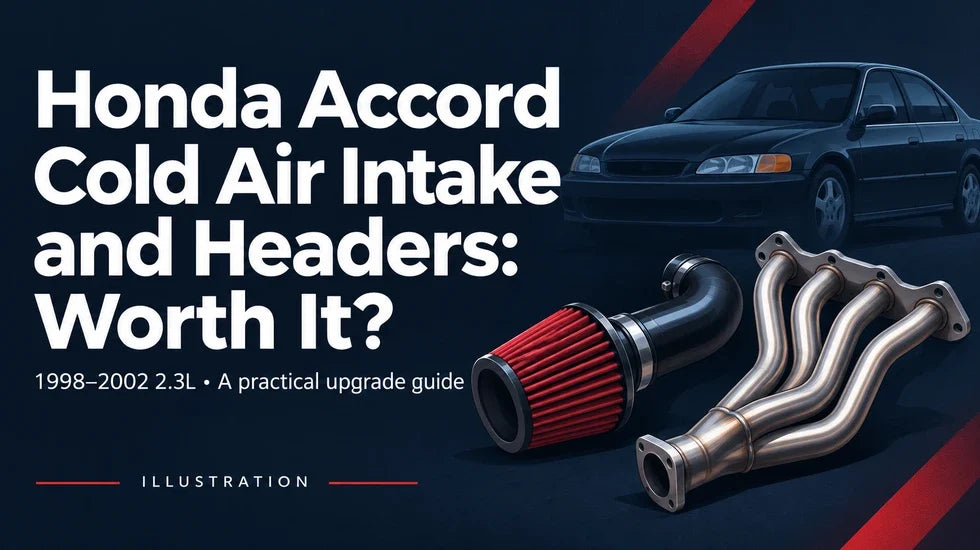
A Honda Accord cold air intake and header combination can make an older four-cylinder feel more engaging, especially when induction sound and engine-bay appearance are part of the goal. Whether it is money well spent depends on the condition of the car underneath those new parts.
Isaac Jetter’s Accord upgrade video puts that question into a useful garage context. He installs intake and exhaust components, enjoys the sound, and also describes existing transmission trouble. That makes the project a lesson in upgrade priorities, not a controlled horsepower test.
- Choose this combination for a planned intake-and-exhaust project, with realistic expectations about sound and response.
- Repair transmission faults, broken hardware, leaks, and inadequate exhaust supports before judging performance.
- Check the exact 2.3L application and each component’s connections; a model-year range alone is insufficient.
- Compare the complete installed cost and emissions requirements before placing an order.
What the Accord video actually tells you
A parts budget is only the starting point
The creator introduces the project as a roughly $300 combination of a header, connecting exhaust section, and intake. His description links to the Flashark bundle. Treat that amount as the context of his build, rather than a fixed quote for yours. Prices, individual options, and the work needed on an older car can change the total considerably.
There is also a difference between buying components and finishing a dependable installation. A snapped fastener, damaged mounting point, or previously modified pipe can consume the time and money saved on the initial purchase. Before comparing packages, set aside a repair allowance and decide whether you can safely complete the work yourself.
The driving impression has an important limitation
During the drive, Isaac describes an automatic transmission that is not working properly. That matters because acceleration depends on the drivetrain as well as the engine. An engine that sounds busier does not necessarily send more usable power to the tires. A faulty transmission also prevents a fair comparison of how the car responds before and after the work.
The useful takeaway is the creator’s enjoyment of the sound and appearance. A power claim would require measurements under comparable conditions. If your own Accord flares engine speed without corresponding acceleration, investigate that symptom first. Buying airflow parts will not resolve the underlying transmission fault.

Match the parts to your 2.3L Accord
Start with the engine and the individual component
For a 1998–2002 four-cylinder project, record the model year, trim, engine identification, and emissions configuration before shopping. Do not substitute a V6 listing or assume a part from a later Accord shares the same connections. A swapped engine requires checking the hardware actually fitted to the car, rather than relying only on its registration year.
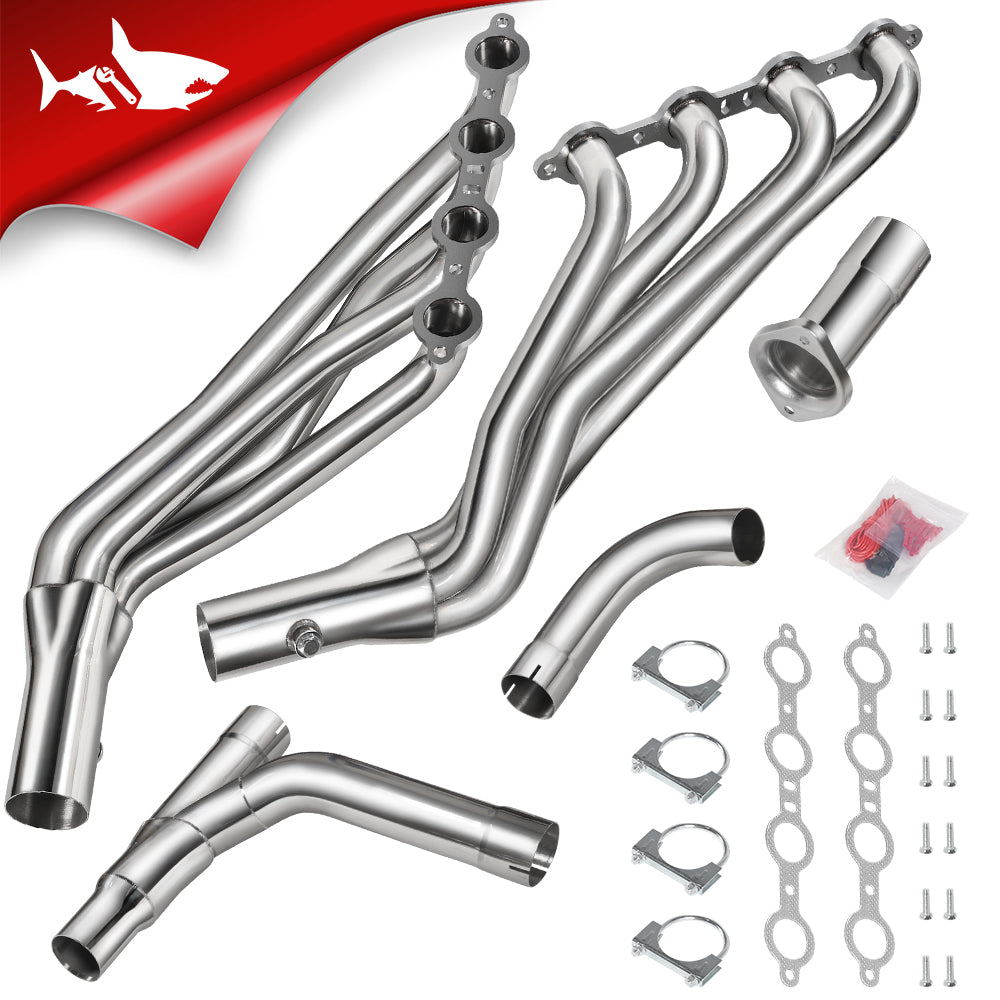
The Flashark 2.3L Accord exhaust header is a stainless 4-2-1 option for selected EX/LX applications. Compare the cylinder-head flange, oxygen-sensor provision, and connection to the downstream exhaust. The intake has its own application and connection requirements; approval for one component is not automatic approval for the other.
Inspect what previous owners changed
An older Accord may already have a repaired front pipe, altered hanger, different catalyst, or replacement intake hose. Photograph those areas while the car is still assembled. Compare connection positions and mounting points before removing anything, and ask the installer to identify parts that will be retained. This is especially important when the exhaust no longer follows its original layout.
A connecting pipe is not the same thing as a complete cat-back system, and a header does not supply every downstream component. Keep required catalysts and monitoring equipment functional. For broader layout comparisons, the exhaust header collection is a starting point; use exact application details to narrow the choice.

Flashark Accord 2.3L exhaust header
Header-only option · SKU FLES08035. Compare engine, flange, and downstream connection before ordering.
$169.99 USD$299.99
Separate intake sound from intake temperature
Look at the air path, not just the product name
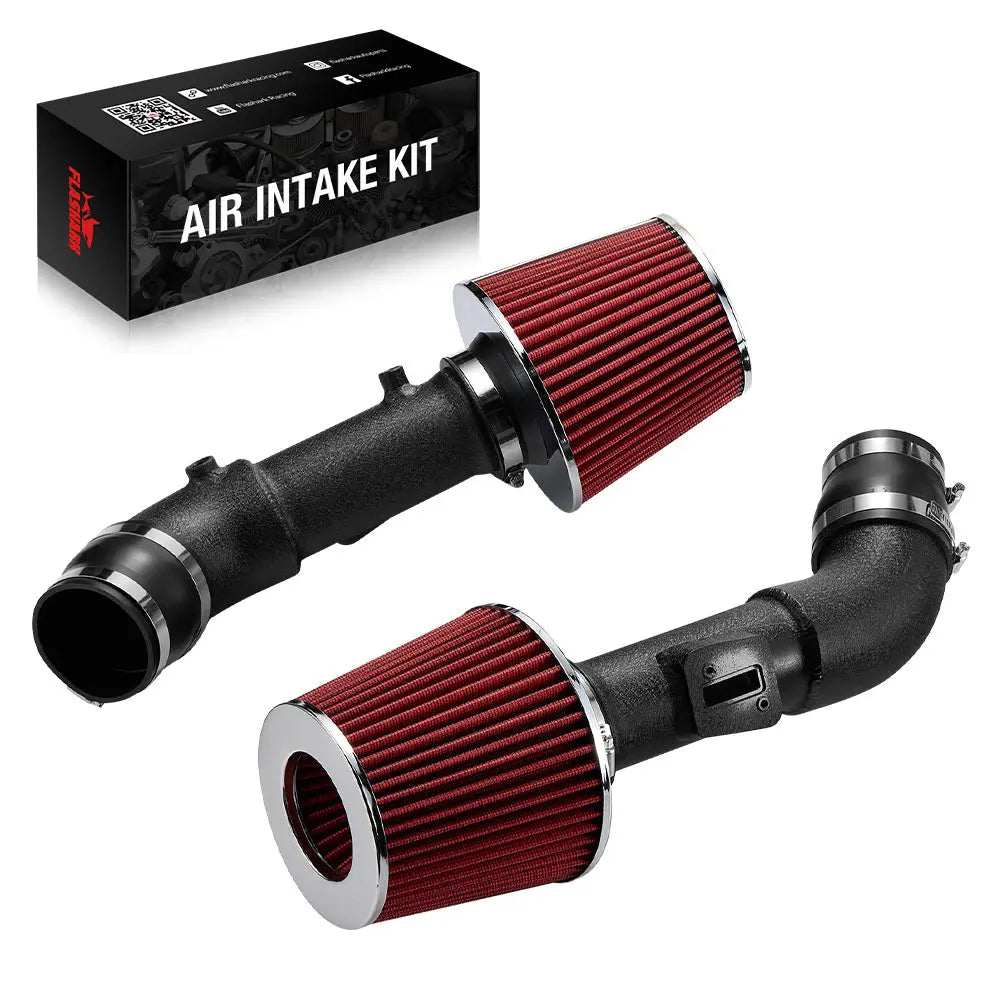
A Honda Accord cold air intake replaces upstream intake components; it is not a new intake manifold or throttle body. An exposed cone filter can make induction noise easier to hear. Whether the engine receives cooler air depends on the filter location, outside-air supply, and isolation from surrounding heat—not the color or finish of the tube.
In the video, the creator points to the battery beside the filter when discussing heat. That position alone does not demonstrate a sealed cold-air supply. AEM’s intake-design overview distinguishes an engine-compartment short-ram layout from a full cold-air system. Judge the installed arrangement and operating conditions instead of treating the names as interchangeable guarantees.
Check hoses, filter access, and exposure
Before removing the stock intake, photograph every hose and electrical connection involved. Match each connection to the correct function in the service information. Do not reconnect a hose to whichever nipple happens to be closest, and do not leave an unused opening unsealed. Check that the tube is supported and cannot rub against wiring, the battery, or a sharp body edge.
Leave enough room to remove and service the filter. Retain appropriate splash protection and avoid routes that expose it to standing water or direct spray. The Accord 2.3L intake-only kit is one option to assess; compare other vehicle-specific layouts in the air intake kit collection. For terminology, see how a cold air intake works.


Flashark Accord 2.3L intake kit
Intake-only option · SKU FLIS08758. Not legal for sale or use in California; check requirements in your jurisdiction.
$87.00 USD$170.00
Fix sealing and support before chasing performance
Missing fasteners are a repair job
At approximately 3:00 in the video, Isaac identifies a missing nut and a damaged stud at the manifold. That is a useful reminder to inspect the head-side hardware before fitting a replacement header. A new gasket cannot make up for a missing clamping point. Inspect the threads and sealing surfaces, and have damaged hardware repaired using the appropriate procedure.
Allow the exhaust to cool before working. Use the vehicle and component instructions for gasket choice, fastener sequence, and torque. An impact wrench is not a substitute for final torque control. If a stud breaks, stop and assess access and extraction risk rather than forcing the remaining fasteners tighter to compensate.
Align the exhaust before final tightening
Support the vehicle at the specified points with suitable equipment, and support the exhaust separately while joints are apart. Assemble the relevant connections loosely enough to check alignment, then follow the prescribed tightening sequence. The exhaust should sit naturally on its supports instead of being pulled into position by the cylinder-head flange.
Check the flex section, hangers, and clearance to nearby components. A pipe that touches the body can create a new vibration or rattle even when the joints appear sealed. Route oxygen-sensor wiring away from hot tubing and moving parts, with no tension on the connector. Preserve the required thermal protection around sensitive components.

Choose intake-only, header-only, or a bundle
Choose the smallest project that solves your problem
If your main goal is induction sound and your exhaust is healthy, start by assessing an intake-only installation. If the front exhaust needs work, inspect the full repair scope before choosing between a stock-style replacement and a performance header. A bundle makes sense when both upgrades are intentional and each part fits the planned configuration.
Hypothetical daily-driver scenario: an owner likes the idea of a louder intake but has an intermittent transmission flare. The better first purchase is diagnosis, not a package of performance parts. Once the car drives consistently, the owner can decide whether the sound change is worth the remaining budget.
| Choice | Best reason to consider it | Check first |
|---|---|---|
| Intake only | Induction sound and filter service | Routing, connections, heat, legality |
| Header only | A planned front-exhaust change | Hardware, sealing, catalyst connection |
| Combined kit | Both changes are part of the build | Both applications and total installed cost |
Compare the exact options in your cart
The Flashark Accord header-and-intake bundle provides a combined shopping option. Compare its selected contents with buying the components separately; do not assume a bundle is automatically cheaper. Check the product selector carefully so an intake-only order does not become a combined order, or the reverse.
Hypothetical weekend-project scenario: an owner plans both upgrades on a healthy car but discovers corroded exhaust hardware during inspection. The sensible budget includes extraction or replacement work before any optional finishing touches. A lower parts subtotal is not a saving if the car remains unusable while an essential repair waits.

Flashark Accord header + intake bundle
Combined option · SKU FLES08035-IS08758. Match both components to your exact vehicle and emissions requirements.
$259.99 USD$399.99
Product-option prices shown in USD as of November 16, 2026. Taxes, delivery, installation, and repairs can change the total; confirm the final cart price.
Make the first drive a check, not a power claim
Inspect operation before testing acceleration
Start in a well-ventilated location and check for abnormal idle, leaks, loose components, and warning lights. Read diagnostic trouble codes rather than immediately clearing them. Inspect intake connections and exhaust joints before assuming the engine needs a tune. After the system cools, recheck mounting and fasteners according to the component instructions.
For a useful comparison, keep fuel, load, route, and weather as consistent as practical. Never use public-road speeding as a performance test. If measured output matters, arrange a controlled test on a healthy car and distinguish wheel horsepower from engine horsepower. Keep a simple record of changes so you can trace any new symptom to the work performed.
Include emissions compliance in the buying decision
Physical fit does not establish road legality. The FLIS08758 intake carries a California sale-and-use restriction. Check requirements for your own jurisdiction and exact part before ordering. Where an exemption is required, match the approval to the actual part and vehicle application; a general quality certificate is not an emissions approval.
CARB’s aftermarket-parts guidance explains its Executive Order process. The EPA’s tampering guidance also makes retaining functional emissions controls part of the decision. Once fitment, condition, and compliance are settled, a Honda Accord cold air intake and header project is easier to judge on its real benefits: the sound you enjoy, the work you can complete properly, and any improvement you can actually measure.
Frequently asked questions
Q1: How much horsepower will an intake and header add to a 2.3L Accord?
A1: There is no reliable single number for every car. Engine health, air temperature, exhaust configuration, calibration, and installation all affect the result. Use comparable before-and-after measurements on a healthy vehicle; louder acceleration is not a horsepower measurement.
Q2: Does a cone filter beside the battery automatically draw cold air?
A2: No. Filter position, outside-air supply, and separation from engine-bay heat matter. A battery beside an exposed filter does not establish a sealed cold-air path or prove lower intake temperatures.
Q3: Should I buy an intake or a header first?
A3: Start with repairs and your main goal. An intake is a smaller project for induction sound and filter access. A header involves exhaust hardware, sealing, downstream connections, and emissions requirements. Choose the work your car actually needs.
Q4: Is the combination worth it on an Accord with transmission problems?
A4: Resolve the transmission problem first. A drivetrain fault can prevent engine output from reaching the wheels properly and makes a driving-impression comparison unreliable. Intake and exhaust changes do not repair a failing transmission.
Q5: Will these 2.3L parts fit a V6 or a 2003 Accord?
A5: Do not use the 2.3L application as a match for a V6 or a 2003 model. Match each component to the exact year, engine, trim, emissions configuration, and connection layout. Engine swaps need additional checks.
Q6: Can I install the header with one missing stud or nut?
A6: Repair damaged studs and replace missing fasteners before completing the installation. A gasket needs the specified clamping arrangement to seal. Follow the applicable service procedure and torque specification rather than compensating by overtightening other nuts.
Q7: What should I check if the engine runs poorly after installation?
A7: Read diagnostic codes, then inspect hose routing, connectors, intake joints, exhaust sealing, and oxygen-sensor wiring. Correct mechanical and electrical faults before considering calibration changes. Stop driving if a serious fault, fuel leak, or exhaust intrusion is present.
Q8: Does the intake-and-header combination always need a tune?
A8: There is no universal answer for every combination. Keep required sensors and emissions controls functional, verify installation, and assess operating data with a qualified technician. A tune should not be used to hide a leak, a sensor fault, or disabled emissions monitoring.
Q9: Can I use these parts in California?
A9: The FLIS08758 intake carries a California sale-and-use restriction. Do not select it for a California road-car installation. For other parts and jurisdictions, check the exact application and required approvals before buying; physical fit does not establish emissions legality.
Q10: Does the video mean the whole job will cost $300?
A10: No. That is the creator’s stated parts budget for his project. Your total also depends on the selected parts, taxes, delivery, labor, damaged hardware, and any required repairs. Compare the exact cart contents and keep a separate repair allowance.