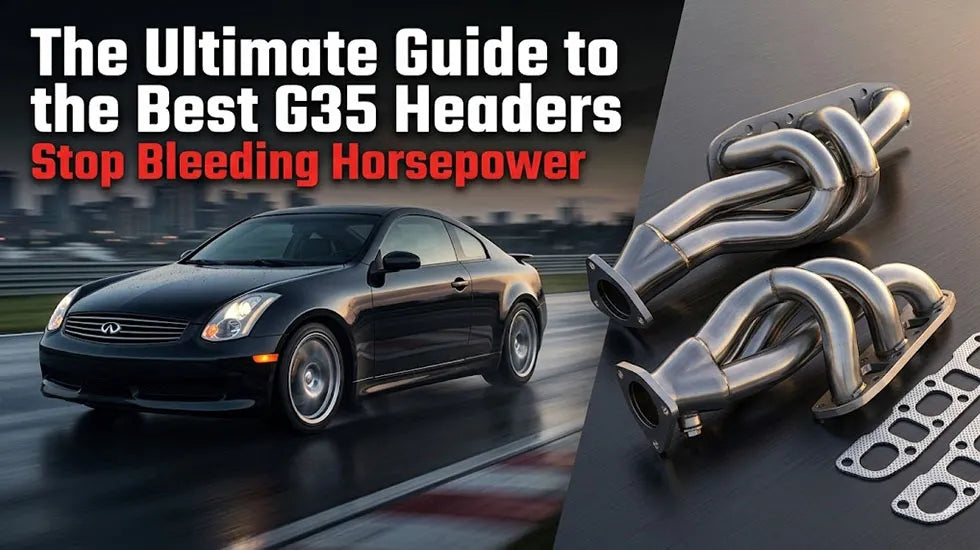
Si estás trabajando en un VQ35DE, ya conoces esa legendaria nota de escape. Pero debajo de ese sonido, los colectores de escape de hierro fundido de fábrica están literalmente asfixiando tu motor. Después de años de desarmar sistemas de escape de Nissan e Infiniti, he visto a innumerables conductores malgastar dinero en tubos de reemplazo baratos que se deforman y gotean en una semana. Encontrar los mejores colectores de escape para G35 significa entender exactamente lo que estás atornillando a tu bloque. Analicemos datos reales de ajuste, cifras realistas de dinamómetro y cómo mejorar adecuadamente el flujo de tu escape.
Resumen rápido: ¿Qué colectores de escape deberías comprar?
Encontrar la configuración adecuada depende completamente de tus objetivos de construcción y de las leyes de emisiones locales. Aquí tienes lo esencial:
- Para uso diario y emisiones estrictas: Opta por los Shorty Headers. Se atornillan directamente a tus catalizadores de fábrica, rara vez activan una luz de verificación del motor (CEL) y proporcionan un sólido aumento en el par motor de rango medio.
- Para máxima potencia y construcciones de pista: Necesitas Long Tube Headers (LTH) combinados con una reprogramación de la ECU. Espera ganancias probadas en dinamómetro de 15-20 whp, pero prepárate para eliminar tus catalizadores de fábrica.
- La solución "ideal": Si tus colectores OEM están agrietados y produciendo un tictac, actualizar a una configuración "shorty" de acero inoxidable T304 de alta calidad es la forma más inteligente de reparar la fuga y ganar 5-8 whp al mismo tiempo.
Por qué tus colectores OEM del G35 te están frenando
La ingeniería de Nissan en la plataforma VQ fue fantástica, pero los colectores de escape son un punto débil conocido. Son pesados, restrictivos y muy propensos a agrietarse por el estrés térmico. El hierro fundido atrapa el calor, y más de una década de ciclos de calor extremos pasa factura al metal.

🛠️ Expediente del mecánico: Un G35 Coupé del 05 llegó recientemente con un código P0420 y un terrible ruido de tictac en los arranques en frío. Después de luchar durante una hora con los tornillos oxidados del escudo térmico, encontramos el problema real: el colector de hierro fundido del lado del pasajero tenía una microfisura justo en el colector. Estaba aspirando aire fresco, alterando completamente las lecturas del sensor de O2 y matando su par motor a bajas revoluciones. Los cambiamos por un juego de tubos de acero inoxidable del mercado de accesorios, y el motor finalmente volvió a respirar correctamente.
El cuello de botella del rendimiento
Los colectores de serie presentan conductos de longitud desigual y estilo "log". Este diseño fuerza que los pulsos de escape de diferentes cilindros choquen entre sí, creando una contrapresión masiva. Para desbloquear la potencia, necesitas un sistema diseñado para el efecto de barrido, donde un pulso de escape crea activamente un vacío para extraer el siguiente pulso del cilindro adyacente.
El eterno debate: Colectores cortos (Shorty) vs. colectores largos (Long Tube) para G35
Al investigar los mejores colectores para G35 para tu construcción específica, te encontrarás inmediatamente con el debate entre los colectores cortos y los colectores largos. Así es como se desglosan los datos reales.
| Característica | Colectores cortos (Shorty Headers) | Colectores largos (Long Tube Headers - LTH) |
|---|---|---|
| Ganancias de HP (Dyno) | 5-8 whp (sin ajustar) | 15-25 whp (requiere ajuste) |
| Instalación | Difícil (Tornillos demonio) | Muy difícil (Problemas de espacio con el eje de dirección) |
| Convertidores Catalíticos | Conserva los catalizadores OEM o de alto flujo | Elimina los catalizadores (Tubo de prueba integrado) |
| Sonido de escape | Gruñido de VQ más profundo y refinado | Extremadamente agresivo, ruidoso, propenso a la resonancia |
¿Qué hace que un colector sea de calidad? (La lista de verificación del comprador)

El mercado de accesorios del VQ está inundado de opciones de baja calidad. Si compras un juego de gama baja con bridas delgadas, terminarás pagando el doble en mano de obra cuando se deformen y causen una fuga de escape tres días después. Esto es lo que debes buscar al comprar colectores de escape para G35 o cualquier colector de escape automotriz de alto rendimiento:
- El material importa: Insiste en acero inoxidable T304. Resiste la oxidación mucho mejor que el acero inoxidable 409 más barato y soporta los ciclos intensos de calor sin agrietarse.
- Bridas gruesas: Quieres una brida que tenga al menos 3/8" (10 mm) de grosor. El metal delgado se deforma en el momento en que lo aprietas a la especificación contra un bloque de motor caliente.
- Soldaduras limpias: Busca soldaduras TIG consistentes y apiladas como monedas. Manejan la vibración del motor significativamente mejor que las soldaduras MIG descuidadas.
⚠️ Advertencia de instalación: Siempre verifica la planitud de la brida con un calibrador de precisión antes de instalar cualquier colector de escape automotriz del mercado de accesorios. Saltarse este paso es la forma en que terminas pagando a un taller $600 para que los quite de nuevo para el rectificado.
Las configuraciones premium de marcas como Motordyne o PPE pueden costarte fácilmente cerca de $1,000. Si tienes un presupuesto limitado, normalmente tienes que conformarte con metal barato y delgado que se oxida. Sin embargo, hay excepciones. Si quieres acero inoxidable T304 y bridas gruesas sin vaciar tu cartera, este es el kit exacto que recomiendo para un conductor diario:

Colectores de escape FLASHARK VQ35DE (G35 / 350Z 03-07)
- Ganancias: Est. 5-8 WHP (sin ajustar)
- Material: Acero Inoxidable T304 Premium
- Diseño: Conductos de 1.75" a colector de 2.1"
- Paquete: Colectores, juntas y herrajes
La dura realidad de la instalación: Enfrentando los "tornillos demonio"
Reemplazar los colectores del VQ35DE es un trabajo notoriamente brutal. Si vas a hacerlo con el coche sobre borriquetas en tu entrada, planifica liberar todo tu fin de semana.
El mayor obstáculo son las tuercas traseras superiores de los colectores de fábrica, encajadas justo contra el cortafuegos. La comunidad VQ las llama los "Tornillos Demonio". Han estado horneándose a temperaturas extremas durante dos décadas. Si rompes un espárrago en la culata de aluminio, tu proyecto de fin de semana se acaba de convertir en una pesadilla que implica quitar el motor.
El protocolo del taller: Rocía esos espárragos específicos con PB Blaster o Kroil varias veces durante 48 horas antes incluso de coger una llave. Usa un soplete de gas MAP para calentar las tuercas y desliza una extensión flexible de 24 pulgadas desde debajo del coche. La paciencia es la única forma de ganar esta batalla.
Preguntas frecuentes (FAQ sobre colectores G35)
P1: ¿Estos colectores VQ35DE se ajustarán a mi Nissan 350Z y Infiniti G35 de 2003-2007?
R1: ¡Sí! Estos colectores de escape están específicamente diseñados para un ajuste directo atornillado en los modelos Nissan 350Z 2003-2006, Infiniti G35 Sedán 2003-2006 e Infiniti G35 Coupé 2003-2007 equipados con el motor VQ35DE de 3.5L.
P2: ¿La instalación de estos colectores de escape del mercado de accesorios encenderá la luz de "Check Engine" (CEL)?
R2: Dado que estos colectores conservan las ubicaciones de los soportes para los sensores de O2 de fábrica, generalmente no activan una CEL por sí solos. Sin embargo, si los combinas con tubos de prueba sin catalizador, es posible que necesites espaciadores de O2 o una reprogramación personalizada de la ECU para evitar que la luz se encienda.
P3: ¿Necesito una reprogramación de la ECU después de instalar estos colectores para 350z?
R3: Aunque tu motor VQ35DE funcionará de forma segura sin una reprogramación, recomendamos encarecidamente obtener una reprogramación profesional de la ECU. Una reprogramación te ayudará a maximizar las ganancias de caballos de fuerza y par motor desbloqueadas por el flujo de gases mejorado de tu nueva configuración de escape.
P4: ¿Cuántos caballos de fuerza ganaré con estos colectores para G35 y 350Z?
R4: Los clientes suelen ver una ganancia estimada de +10 a +15 WHP (caballos de fuerza en la rueda) en el dinamómetro. Para un rendimiento máximo, recomendamos combinar estos colectores Infiniti con un sistema de escape catback de alto flujo y una afinación adecuada.
P5: ¿El paquete incluye todas las juntas y herrajes necesarios?
R5: ¡Absolutamente! Tu compra incluye 2x juntas de bloque de motor, 2x juntas de colector de 3 pernos y un juego completo de herrajes de instalación (6 pernos, 6 tuercas, 6 arandelas). No necesitarás hacer viajes adicionales a la tienda de repuestos.
P6: ¿Estos colectores de escape VQ35DE son un reemplazo directo atornillable?
R6: Sí, están diseñados para reemplazar directamente tus restrictivos colectores de hierro fundido de fábrica sin modificaciones importantes. Sin embargo, debido a que el compartimento del motor VQ35DE es increíblemente ajustado, recomendamos encarecidamente la instalación profesional por un mecánico certificado.
P7: ¿Cómo cambiarán estos colectores el sonido de mi Nissan o Infiniti?
R7: La actualización a estos colectores curvados con mandril mejorará significativamente la nota de tu escape. Transforman el sonido de fábrica estándar en un gruñido más profundo, agresivo y exótico de coche deportivo sin causar un molesto zumbido en carretera.
P8: ¿De qué material están hechos estos colectores Infiniti G35?
R8: Nuestros colectores están fabricados con acero inoxidable T304 de primera calidad con un acabado pulido espejo. Esto garantiza una resistencia al calor, durabilidad y protección contra el óxido muy superiores en comparación con los colectores de hierro fundido de fábrica.
P9: ¿Puedo usar estos colectores de escape para 350z con tubos de prueba o catalizadores de alto flujo?
R9: ¡Sí! Estos colectores cuentan con un colector estándar de 2.1" y una brida de 3 pernos, lo que los hace totalmente compatibles con convertidores catalíticos OEM, catalizadores de alto flujo del mercado de accesorios y la mayoría de los tubos de prueba estándar diseñados para la plataforma VQ35DE.
P10: ¿Qué tan rápido es el envío y ofrecen garantía?
R10: Ofrecemos envío gratuito con un tiempo de entrega estimado de solo 3 a 5 días hábiles. Además, tu compra está respaldada por nuestra sólida garantía de 270 días, ¡para que puedas comprar tus nuevos colectores para coupé G35 con total tranquilidad!
P11: ¿Por qué debería elegir los colectores FLASHARK en lugar del colector de escape de serie?
R11: Los colectores de serie obligan a que los gases de escape choquen, creando una contrapresión que ahoga tu motor. Nuestros colectores VQ35DE cuentan con conductos primarios de 1.75" ajustados con precisión para crear un "efecto de barrido", extrayendo los gases de escape de manera eficiente para una respuesta del acelerador y una potencia notablemente mejores.