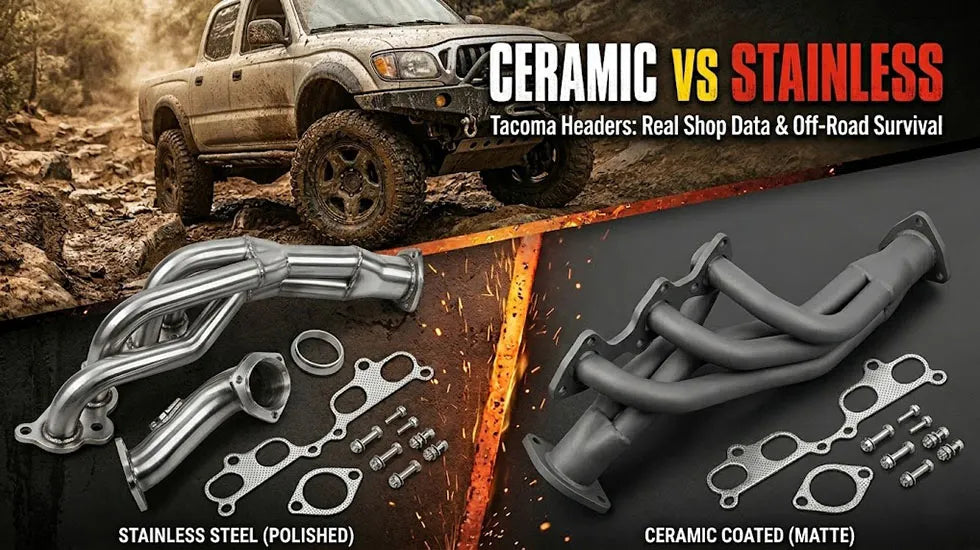
Le atornillaste neumáticos de barro de 33 pulgadas a tu Tacoma, le agregaste placas protectoras de acero pesado y le pusiste un cabrestante en la parte delantera. Se ve imponente, pero ahora ese motor confiable se siente muy lento en el sendero. El restrictivo múltiple de escape de fábrica está asfixiando tu equipo. Sabes que necesitas una mejora del mercado de accesorios. Pero justo antes de sacar tu tarjeta de crédito, te encuentras con un muro masivo de debates en foros: colectores de Tacoma con recubrimiento cerámico vs. acero inoxidable. ¿Cuál de ellos realmente sobrevive al abuso brutal de la conducción todoterreno?
Honestamente, hay una cantidad increíble de basura de marketing por ahí. He pasado 15 años trabajando duro en el taller, desarmando cientos de estos camiones. Te lo diré directamente, sin el discurso de venta. Veamos datos reales del taller, la supervivencia real en los senderos y averigüemos qué le conviene a tu camión.
La respuesta corta (veredicto del taller):
- Elige recubrimiento cerámico SI: Con frecuencia te arrastras sobre rocas a velocidades de un solo dígito, atraviesas pantanos profundos o vives en el desierto. La retención de calor reducirá significativamente las temperaturas debajo del capó y evitará que se te quemen los arneses de cables.
- Elige acero inoxidable SI: Tienes un presupuesto realista, principalmente conduces por caminos forestales a alta velocidad o usas tu vehículo a diario, y quieres una configuración altamente duradera y resistente a los impactos que durará más que el propio camión.
Por qué el material importa para los colectores de Tacoma en el sendero
Mira, una Tacoma no es un coche de pista de asfalto. Cuando conduces todoterreno, sometes tu escape a un verdadero infierno. A baja velocidad, el arrastre a altas RPM significa que prácticamente no hay flujo de aire a través de la parrilla para enfriar las cosas. La acumulación de calor se convierte en tu mayor enemigo. Agrega el choque térmico de salpicar a través de un arroyo helado mientras tus tubos de escape están al rojo vivo, y tienes la receta para soldaduras agrietadas y bridas deformadas.
Colectores de acero inoxidable: el caballo de batalla fiable

Cuando hablamos de acero inoxidable, generalmente nos referimos al grado 304 o 409. El 409 desarrollará óxido superficial con el tiempo —es feo, pero no se pudrirá fácilmente. El grado 304 es el estándar de oro para la prevención de la oxidación. No se oxidará, aunque adquirirá un color azul dorado impresionante después de algunos ciclos de calor intenso.
Si instalas un buen juego de colectores de acero inoxidable, obtendrás una configuración que puede soportar golpes físicos. No se romperán si una roca suelta salta y los golpea. ¿La principal desventaja? Actúan como un enorme calentador dentro del compartimento del motor.
Colectores con revestimiento cerámico: el escudo térmico premium
El revestimiento cerámico no es solo una pintura elegante de alta temperatura. Es una barrera térmica legítima. Al mantener el calor extremo del escape dentro de los tubos, aumenta la velocidad de los gases de escape (porque el aire caliente se mueve más rápido), lo que realmente ayuda a la extracción y al par motor a bajas revoluciones. Pero para los todoterrenos, el verdadero punto de venta es evitar que el resto del compartimento del motor se derrita.
🛠️ Expediente de mecánico: el rastreador de 1.ª generación
Hace unos años, un rastreador de rocas Tacoma del 99, bellamente maltratado, llegó a mi taller. El motor 2.7L 3RZ del propietario era prácticamente a prueba de balas, pero constantemente luchaba contra una luz de "Check Engine" (CEL) después de recorrer senderos técnicos lentos. Abrimos el capó y la acumulación de calor era insana. El calor masivo que irradiaba de un juego de colectores baratos sin recubrimiento había literalmente cocinado el cableado de su sensor de O2 hasta que el aislamiento se derritió y se cortocircuitó. Los cambiamos, controlamos el calor y la temperatura ambiente debajo del capó bajó casi 100°F. Si conduces lento y con mucho calor, la gestión térmica no es opcional.

La prueba de tortura todoterreno: cruces de agua y barro
Aquí es donde el debate sobre los colectores con recubrimiento cerámico vs. los de acero inoxidable se vuelve intenso. ¿Qué sucede cuando una tubería de escape a 1200 °F se sumerge repentinamente en un río a 40 °F?
El acero inoxidable desnudo soporta este choque térmico increíblemente bien. El acero inoxidable 304 de alta calidad tiene la flexibilidad metalúrgica para contraerse rápidamente sin romperse. El recubrimiento cerámico, por otro lado, puede ser un poco más delicado. Si compras un colector recubierto barato y mal preparado, las inmersiones repentinas en agua helada harán que el recubrimiento se microfracture y se desprenda en trozos. Sin embargo, los recubrimientos de grado aeroespacial de primera línea suelen sobrevivir sin problemas. ¿En cuanto al barro? Se adhiere al acero inoxidable crudo y retiene la humedad, mientras que tiende a lavarse de los recubrimientos cerámicos mucho más fácilmente con una lavadora a presión.
Pesadillas de instalación: lo que nadie te dice
Hablemos de la instalación. Llegar a esos tornillos del colector de fábrica, especialmente en equipos viejos y oxidados, pondrá a prueba tu paciencia.
⚠️ Advertencia: No tomes atajos aquí
Escúchame atentamente. Muchos mecánicos aficionados desatornillan su colector de hierro fundido de fábrica agrietado y luego atornillan sus nuevos colectores brillantes usando la vieja junta de escape de fábrica aplanada solo para ahorrar treinta dólares. El 100% de las veces, esto provoca un desagradable tictac de escape en menos de 500 millas, desajusta los valores de combustible y activa una luz de "Check Engine". Hazlo bien la primera vez: compra juntas MLS (Multi-Layer Steel) nuevas y usa pasta de cobre antideslizante de alta temperatura en los tornillos.

Datos de dinamómetro: ¿Vale la pena el dinero extra?
Dejemos las suposiciones. Reemplazar el restrictivo colector de hierro fundido de fábrica hará que tu camioneta se despierte, sin importar el material. Los motores más antiguos de 2.4L (2RZ) y 2.7L (3RZ) son conocidos por estar asfixiados en el puerto de escape.
| Configuración de escape | Ganancia estimada de HP en rueda | Impacto en la temperatura debajo del capó | Durabilidad todoterreno |
|---|---|---|---|
| Colector de hierro de serie | Línea base (Restrictivo) | Alto (Propenso a la acumulación de calor) | Propenso a agrietarse con el tiempo |
| Acero inoxidable 304 de alto flujo | +8 a 12 whp | Muy alto (Irradia calor) | Excelente (Resistente a impactos) |
| Con recubrimiento cerámico | +9 a 14 whp | Bajo (Retiene el calor dentro del tubo) | Excelente (Si el recubrimiento es de alta calidad) |

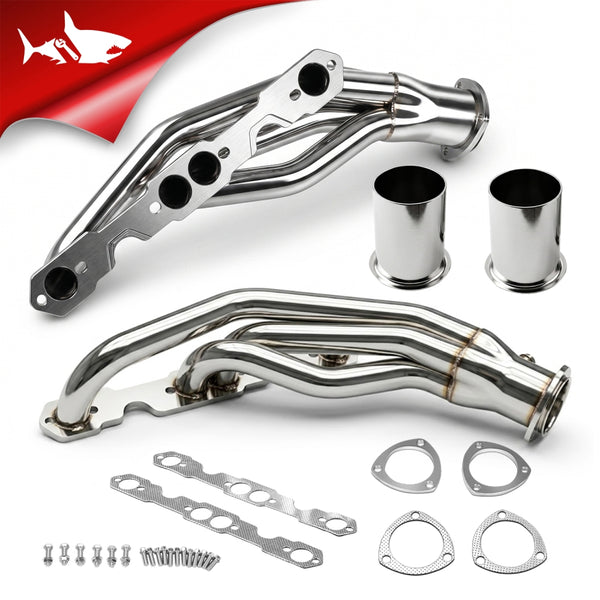
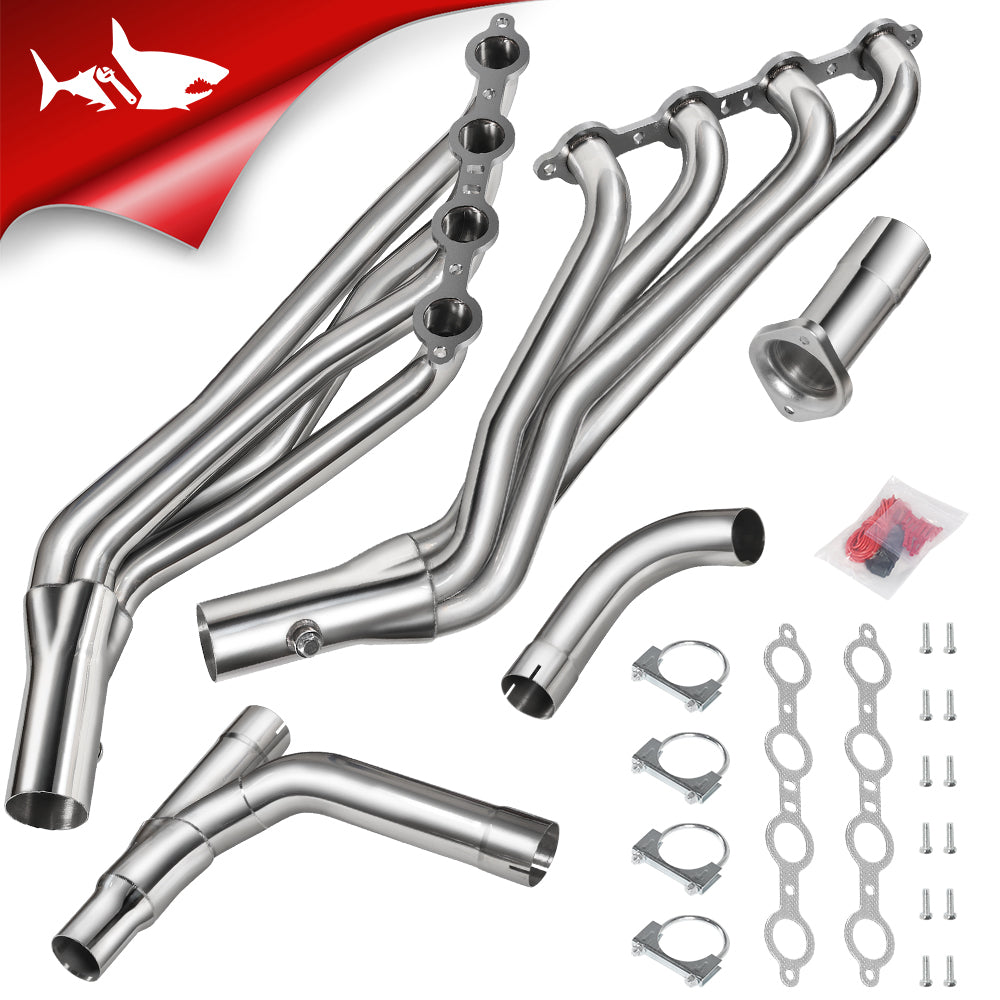
Colectores de escape de acero inoxidable para Toyota Tacoma 2.4L/2.7L L4 RWD 1995-2001
Deshazte del colector de hierro de fábrica agrietado y restrictivo. Diseñamos estos colectores de acero inoxidable soldados con TIG para brindar ganancias reales de caballos de fuerza, una mejor extracción de escape y un compartimento del motor mucho más limpio. Montaje directo para los motores 2RZ/3RZ.
Ver compatibilidad y precioTomando la decisión: Dándole vida a la Tacoma de 1.ª generación
Si estás construyendo una legendaria Tacoma de 1.ª generación (1995-2001), ya sabes que el chasis y los motores son inmortales. ¿Pero esos colectores de serie? Son pesados, restrictivos y propensos a agrietarse.
Para la mayoría de los que salen a los senderos o construyen un overlander a prueba de balas, no necesitan gastar $800 en tuberías de carreras personalizadas con recubrimiento cerámico. Una configuración de acero inoxidable resistente y soldada con TIG te ofrece la mejor relación calidad-precio: máxima fiabilidad, sólida potencia a bajas revoluciones y no se pudrirá. Esa es exactamente la razón por la que almacenamos y recomendamos las configuraciones de Flashark para estos camiones viejos específicos. Es una actualización directa, sin complicaciones, que simplemente funciona.
Preguntas frecuentes (FAQ)
¿Tienes algunas preguntas persistentes antes de empezar a trabajar con las llaves? Esto es lo que me preguntan en el taller todo el tiempo con respecto a los sistemas de escape de Tacoma.
P1: ¿Los colectores con recubrimiento cerámico duran más que los de acero inoxidable?
R1: No necesariamente en términos de integridad estructural. Un colector de acero inoxidable 304 de alta calidad resistirá la oxidación durante décadas. Sin embargo, los recubrimientos cerámicos protegen el acero subyacente del estrés térmico y la corrosión, lo que potencialmente los hace durar tanto tiempo, siempre que el recubrimiento no se dañe por impacto físico.
P2: ¿La instalación de colectores del mercado de accesorios anulará la garantía de mi Tacoma?
R2: Bajo la Ley de Garantía Magnuson-Moss, un concesionario no puede anular la garantía completa de tu vehículo simplemente porque instalaste colectores del mercado de accesorios. Deben demostrar que la pieza del mercado de accesorios causó directamente la falla en cuestión (por ejemplo, una fuga de escape quemó un cable).
P3: ¿Los colectores de acero inoxidable pueden oxidarse con el tiempo?
R3: Depende totalmente del grado. El acero inoxidable 409 desarrollará un óxido superficial parduzco, pero no se oxidará fácilmente. El acero inoxidable 304 de primera calidad es altamente resistente al óxido, aunque se decolorará (azul o dorado) debido al calor extremo del escape.
P4: ¿Cuánto más fresco mantiene el compartimento del motor un colector con recubrimiento cerámico?
R4: En una prueba de dinamómetro o una lenta subida todoterreno, un recubrimiento cerámico de calidad aeroespacial puede reducir las temperaturas ambiente debajo del capó hasta 100°F a 150°F en comparación con el metal desnudo, salvando tus mangueras y cableado.
P5: ¿Necesito una reprogramación (remapeo de la ECU) después de instalar colectores en mi Tacoma?
R5: Para los colectores cortos o de longitud media atornillables, tu ECU de fábrica generalmente puede ajustar los valores de combustible lo suficiente como para compensar el mejor flujo sin que se encienda la luz de "Check Engine". Sin embargo, si optas por colectores de tubo largo completos que eliminan los catalizadores, necesitarás absolutamente una reprogramación personalizada.
P6: ¿Cuál es la mejor manera de limpiar el barro de los colectores con recubrimiento cerámico?
R6: Espera a que el motor esté completamente frío. Usa agua a baja presión y un desengrasante suave. Nunca mojes un colector cerámico caliente con agua fría de una hidrolavadora, ya que el choque térmico puede agrietar el recubrimiento.
P7: ¿Son mejores los colectores cortos o los colectores largos para el todoterreno?
R7: Los colectores cortos son generalmente mejores para 4x4. Aumentan el par motor en el rango bajo a medio, que es exactamente lo que necesitas para el rock crawling o el barro. Los colectores largos aumentan la potencia en la parte alta de la banda de RPM, lo que es mejor para la calle y las carreras en pista.
P8: ¿Por qué los colectores de acero inoxidable se vuelven azules o dorados?
R8: Esta es una reacción metalúrgica natural llamada tinte térmico. Cuando el cromo en el acero inoxidable se expone a altas temperaturas de escape y oxígeno, forma una capa de óxido en la superficie que altera la forma en que la luz se refleja en él.
P9: ¿El choque térmico de los cruces de agua es malo para el recubrimiento cerámico?
R9: La pintura cerámica barata de bricolaje se desprenderá. Los recubrimientos cerámicos de alta gama, horneados, están diseñados para soportar razonablemente bien el choque térmico. Pero sumergir repetidamente un colector al rojo vivo en agua helada eventualmente pondrá a prueba los límites de cualquier recubrimiento.
P10: ¿Los colectores con recubrimiento cerámico suenan diferente a los de acero inoxidable?
R10: Sí, ligeramente. Los colectores de acero inoxidable desnudo tienden a tener un "ting" más áspero y agudo en el tono del escape debido a la resonancia de las paredes metálicas más delgadas. El recubrimiento cerámico agrega masa y amortigua parte de esa vibración de alta frecuencia, lo que resulta en un tono de escape un poco más profundo y silencioso en la parte delantera.