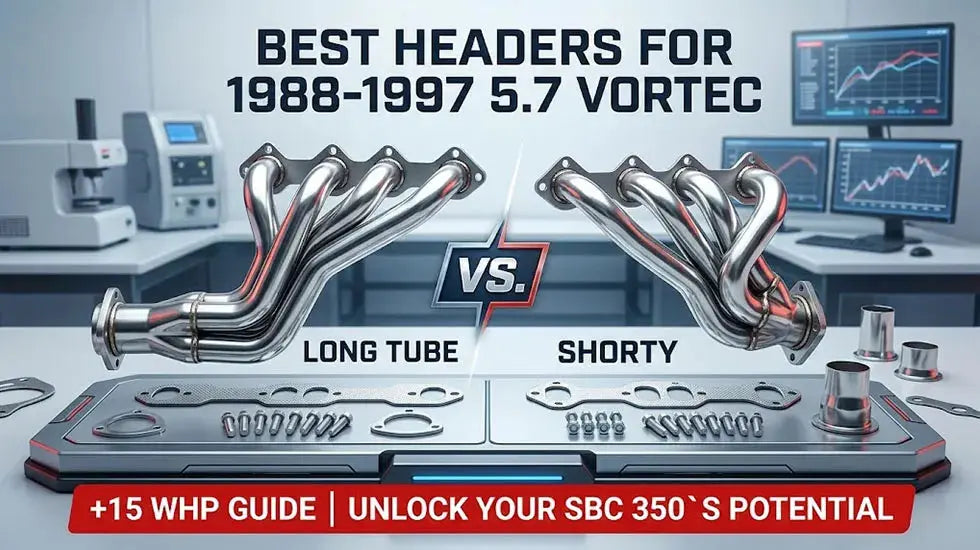
Olvidémonos de los rollos de marketing y vayamos directo al grano. Si tienes una camioneta Chevy o GMC GMT400 de 1988 a 1997 con motor V8 de 5.7L, ya sea con el confiable TBI (inyección del cuerpo del acelerador) de 1988-1995 o con el Vortec L31 original de 1996-1997, tienes un punto débil conocido en las culatas. ¿Ese tictac rítmico en las mañanas frías? Rara vez se trata de un taqué colapsado. Casi siempre se trata de un colector de escape de hierro fundido de fábrica agrietado o una junta de compuesto reventada.

Los leños de hierro fundido de fábrica son disipadores de calor restrictivos. Se calientan, se deforman y finalmente se rompen. Añadir otro reemplazo barato de fábrica es una solución provisional. Necesitas colectores de acero inoxidable. Pero en cuanto empiezas a buscar mejoras, te encuentras con el clásico debate: ¿Colectores de tubo largo o colectores cortos?
Hoy, analizamos los hechos crudos y probados en el taller sobre cómo elegir los tubos adecuados para su motor específico y cómo ver realmente esa potencia adicional en el dinamómetro.
Conclusiones rápidas: ¿Qué encabezados se adaptan a tu configuración?
- Elija los colectores Shorty si: Su camión es de uso diario o un remolque especializado. Los colectores Shorty mantienen la velocidad de los gases de escape a bajas RPM, conservando el torque a bajas revoluciones (por debajo de 2500 RPM) necesario para mover un remolque pesado. Además, se atornillan directamente al tubo en Y de fábrica.
- Elija colectores de tubo largo SI: Busca la máxima potencia máxima y el agresivo sonido de barrido de un V8. Espere un aumento aproximado de 8 a 12 caballos de fuerza (whp) en un motor en buen estado, pero prepárese para modificar la sección central del escape.
- Regla de holgura: Nunca compre kits universales para un camión OBS. Los cabezales deben doblarse específicamente para que no queden obstruidos el eje de dirección y el eje de transmisión delantero en los modelos 4x4 (serie K).
La realidad de las distancias de escape OBS
Mejorar el escape en un chasis del 88-97 se basa estrictamente en la holgura y el ajuste. Cualquier técnico experimentado te contará historias de terror sobre los colectores universales. Los tubos primarios se atascan contra el eje de transmisión delantero o, peor aún, interfieren con la columna de dirección, lo que hace que la camioneta sea peligrosa de conducir.
🛠️ En la bahía: La pesadilla del lado del pasajero
Si hay algo que distingue a un principiante del profesional, es el perno del colector trasero del lado del pasajero, más cercano al cortafuegos, en estos 5.7L. Es conocido por romperse al ras de la culata debido a los ciclos de calor extremos y la falta de flujo de aire. Si intentas forzar bridas baratas y mal ajustadas en estas culatas, acabarás teniendo fugas de escape para siempre. Invertir en colectores con bridas gruesas de 3 pernos mecanizadas por CNC no solo se trata de rendimiento, sino de asegurarte de no tener que volver a desmontar los colectores en seis meses.
Ya sea que elija tubos largos para maximizar su efecto de barrido o cortos para una instalación directa, invertir en acero inoxidable T304 con bridas gruesas de 3 pernos soldadas con TIG es la única manera de hacer el trabajo bien a la primera. No querrá estar debajo de su camión reapretando pernos cada fin de semana.
El dilema clásico: colectores de escape largos o cortos en el V8 de 5.7L
Para elegir bien, hay que comprender la física básica del escape. Los colectores de hierro fundido de fábrica generan una contrapresión enorme. Es como intentar exhalar mientras se respira a través de una pajita de plástico gruesa. Los colectores de posventa solucionan este problema, pero la longitud de los tubos primarios cambia el punto donde se siente la potencia.
La mecánica de los colectores de tubos largos
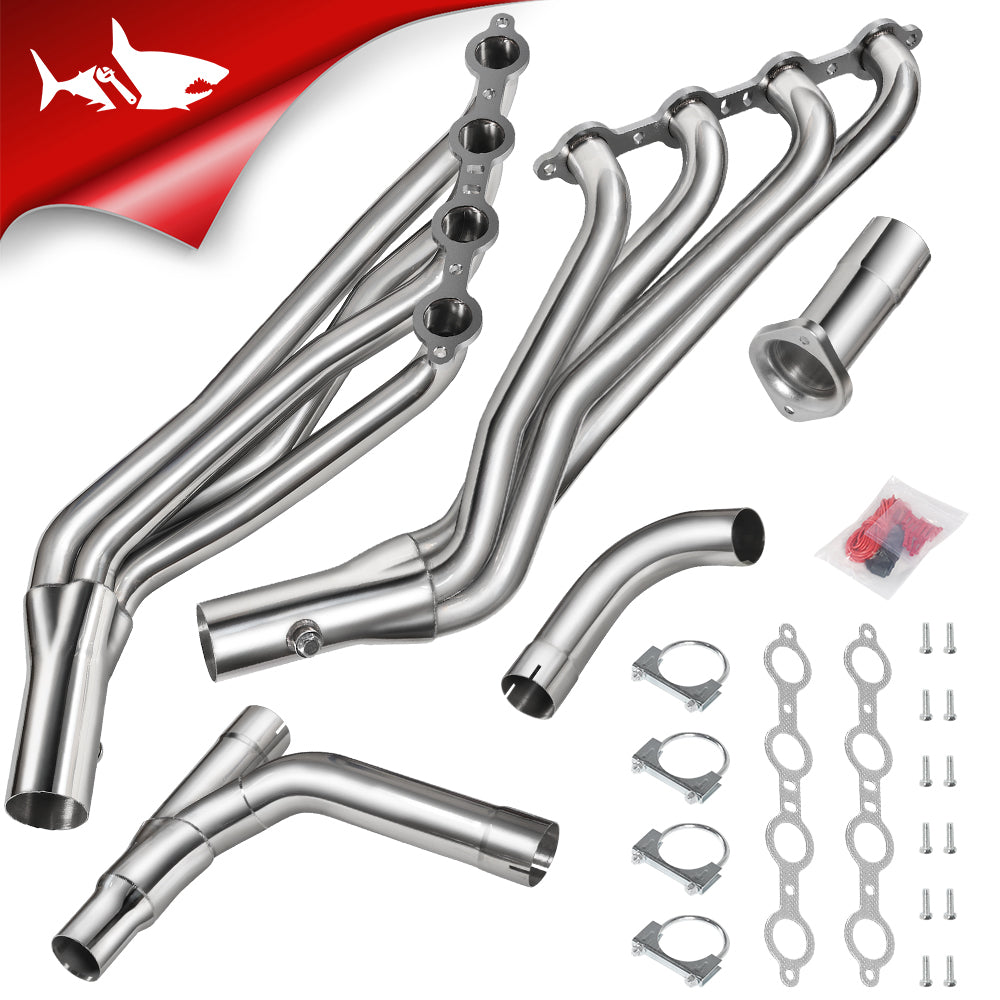
Los tubos largos utilizan un tubo primario más largo antes de unirse al colector. Este diseño crea un fuerte vacío, un proceso conocido como "efecto de barrido". A medida que un pulso de escape recorre el tubo largo, extrae los gases de escape del siguiente cilindro. ¿El resultado? Una potencia masiva a medias y altas revoluciones. En un banco de potencia adecuado, un 350 SBC equipado con tubos largos y una buena puesta a punto suele generar entre 10 y 15 CV adicionales en las ruedas traseras. Si quieres gritar en la carretera y escuchar el clásico rugido del V8, esta es tu opción.
Por qué tienen sentido los encabezados cortos
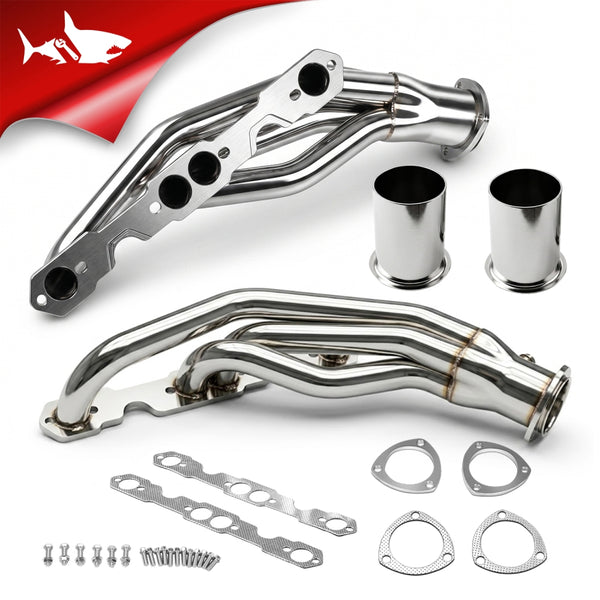
Los colectores cortos se integran en el colector mucho más cerca de la culata. Su barrido no es tan agresivo a altas RPM, pero son excelentes para mantener la velocidad de los gases de escape a bajas revoluciones. ¿Por qué es importante? Por el par motor. Si usa su K1500 o Suburban para transportar una lancha o una caravana, necesita potencia a bajas revoluciones. Además, los colectores cortos están diseñados para conectarse directamente a los tubos de escape de fábrica. Sin soldaduras ni cortes.
| Tipo de encabezado | Enfoque de banda de potencia | Dificultad de instalación | Mejor aplicación |
|---|---|---|---|
| Hierro fundido de fábrica | Restrictivo en todos los RPM | Propenso a agrietarse / pernos oxidados | pila de chatarra |
| Encabezados cortos | Ralentí a 4.000 RPM (par motor de gama baja) | Fácil (atornillado directo) | Conducción diaria, remolque, construcción de calles ligeras |
| Colectores de tubo largo | 3000 RPM hasta la línea roja (potencia máxima) | Moderado (puede requerir modificación de tubería en Y) | Construcciones de alto rendimiento, sonido agresivo |
La mejor opción para máxima potencia: cabezales de tubo largo Flashark 5.7 Vortec

Si has decidido buscar potencia y ese sonido de escape profundo y gutural, necesitas tubos que no interfieran con el compartimento del motor. Para los modelos Chevy/GMC 5.7L de 1988 a 1997 (C/K 1500/2500, Tahoe y Blazer), recomiendo instalar un juego adecuado de colectores de tubo largo Vortec 5.7 .
Estos no son tubos delgados ni baratos. Están fabricados en acero inoxidable T304 de alta calidad con pulido espejo. Los tubos de entrada de 1,5 pulgadas se extienden hasta una enorme salida de 3,0 pulgadas, lo que reduce considerablemente la contrapresión del Vortec 5.7. Observamos un aumento constante de 10-15 HP/Tq al instante después de instalarlos.
- Diseño a prueba de fugas: Las bridas están soldadas con TIG y mecanizadas por CNC. Esto garantiza que se asienten perfectamente planas sobre la culata.
- Kit completo: No tienes que ir a la ferretería a mitad de la instalación. El kit incluye los reductores, los pernos y las juntas metálicas adecuadas.
La mejor opción para una instalación fácil: cabezales cortos Flashark de 3 pernos

Lo entiendo. No todos quieren pasarse todo el sábado bajo una camioneta modificando un tubo en Y. Si usas tu Silverado o Sierra a diario y solo quieres arreglar esa fuga de escape y, al mismo tiempo, mejorar la respuesta del acelerador, necesitas un juego de colectores Vortec Shorty de 5.7 litros fiables.
Están diseñados como reemplazo directo. Pero aquí es donde diferenciamos a los profesionales de los aficionados: hay que leer las notas de compatibilidad. Si bien son compatibles con la gran mayoría de las C1500/K1500 de 1988 a 1997 y las Suburban/Tahoe de 1992 a 1995, no son compatibles con la Chevy V6 de 4.3L de 1996 ni con la Silverado de 5.0L de 1993. Conocer estas exclusiones le ahorra la pesadilla de devolver piezas de coche sucias.
Con el mismo acero inoxidable T304 y una brida robusta de 3 pernos, se integran perfectamente a su sistema actual. Conserva su potencia básica para transportar madera y se deshace de los desechos de hierro fundido para siempre.
Consejos de un mecánico profesional para instalar cabezales en un Chevy OBS
Muchos novatos ven un tutorial, agarran una pistola de impacto de media pulgada y disparan directamente los tornillos del colector de admisión. He visto el resultado cientos de veces. Rompen la cabeza del tornillo, dejando el espárrago roscado enterrado para siempre en el bloque del motor. De repente, tu divertido proyecto de una tarde se convierte en una pesadilla de varios días en el taller.
Les aconsejo a todos: no se apresuren. Consigan una lata de PB Blaster o Kroil. Rocíen abundantemente cada perno del colector de escape la noche anterior al trabajo. Déjenlo en remojo. Al día siguiente, usen herramientas manuales (una buena barra rompedora y un dado de seis puntas) para aflojarlos a mano. Requiere paciencia, pero les ahorra horas de taladrar y roscar.
Además, deseche las juntas de papel baratas que vienen con los kits genéricos. Use las juntas metálicas incluidas en los kits Flashark, apriételas desde los pernos centrales hacia afuera y vuelva a apretar los pernos después del primer ciclo de calentamiento completo (haciendo funcionar el camión hasta que se caliente y luego dejándolo enfriar por completo).
Más mejoras de servicio pesado para la construcción de su camión
Conseguir que tu OBS Chevy respire correctamente es solo el primer paso. Si tienes una flota o tienes otras camionetas en tu entrada que se asfixian por las restricciones de escape de fábrica, te tenemos cubierto. Asegúrate de explorar nuestro catálogo completo de colectores automotrices de alto flujo para diversas plataformas. Mejorar tu escape es la modificación más rentable que puedes hacer.
Preguntas frecuentes (FAQ)
P1: ¿Los cabezales realmente marcan la diferencia en un Vortec 5.7?
R1: Sí, absolutamente. Reemplazar los restrictivos y a menudo agrietados colectores de hierro fundido de fábrica por colectores de escape soluciona de inmediato las fugas de escape, mejora la respuesta del acelerador y proporciona un notable aumento de potencia al reducir la contrapresión del escape.
P2: ¿Cuántos HP agregan los colectores de tubo largo a un SBC 350?
A2: Según pruebas de dinamómetro en el mundo real, instalar un juego de colectores de tubo largo en un motor de 5,7 L en buen estado generalmente generará una ganancia de entre 10 y 15 caballos de fuerza en las ruedas (whp) y un torque equivalente, especialmente en el rango de RPM medio a alto.
P3: ¿Son mejores los cabezales cortos para remolcar?
A3: Sí. Los colectores cortos mantienen mejor la velocidad de los gases de escape a bajas RPM que los tubos largos. Esto conserva el par motor a bajas revoluciones que tanto necesitas al remolcar un remolque o una embarcación pesada desde una posición totalmente parada.
P4: ¿Necesito ajustar mi Chevy 5.7L después de instalar los cabezales?
A4: Para colectores cortos de reemplazo directo, la ECU de fábrica generalmente se puede adaptar sin necesidad de una calibración. Para colectores de tubo largo, mientras el camión esté en marcha, se recomienda una calibración personalizada para ajustar la relación aire/combustible y maximizar la potencia del flujo de aire mejorado.
P5: ¿Estos cabezales se adaptarán a un K1500 4WD?
A5: Sí. Tanto los colectores cortos Flashark como los kits de tubos largos EH28022 están diseñados específicamente para despejar el eje de transmisión delantero y los componentes de la suspensión de las camionetas Chevy y GMC 4WD (serie K) 1988-1995.
P6: ¿Qué juntas debo utilizar para los colectores Vortec 5.7?
A6: Nunca use juntas baratas de papel o composite, ya que se quemarán rápidamente con el calor del V8. Utilice siempre juntas metálicas de alta calidad (incluidas en los kits Flashark) para un sellado permanente y hermético contra la culata.
P7: ¿Por qué se agrietó el colector de escape de mi motor 5.7L de fábrica?
A7: El hierro fundido es rígido y frágil. Tras años de exposición a ciclos de calor extremos (calentándose al máximo al conducir y enfriándose rápidamente con la lluvia o la nieve), el metal se tensa y acaba desarrollando grietas finas, causando ese infame tictac.
P8: ¿Valen la pena los cabezales de acero inoxidable T304?
A8: Vale la pena. El acero inoxidable T304 ofrece una resistencia superior a la oxidación y la corrosión en comparación con el acero dulce o el acero inoxidable 409 de bajo costo. Además, soporta temperaturas extremas de escape sin deformarse, lo que garantiza un rendimiento duradero.
P9: ¿Necesito un soldador para instalar cabezales cortos?
A9: No. Los colectores cortos están diseñados para una instalación directa con pernos. Cuentan con una brida de 3 pernos que se conecta directamente al tubo de escape en Y de fábrica sin necesidad de cortar ni soldar.
P10: ¿Debo remojar los pernos viejos del colector antes de quitarlos?
A10: Como mecánico profesional, mi regla principal es la siguiente: Sí. Remoje bien todos los pernos del colector de escape de fábrica con aceite penetrante (como PB Blaster) la noche anterior. Esto reduce drásticamente la probabilidad de que se rompa un perno oxidado dentro del bloque del motor.