You want the car lower. Fair enough. But the gap between the tire and fender is the easy part to photograph; what happens when that tire hits a broken patch of pavement is the part you have to live with.
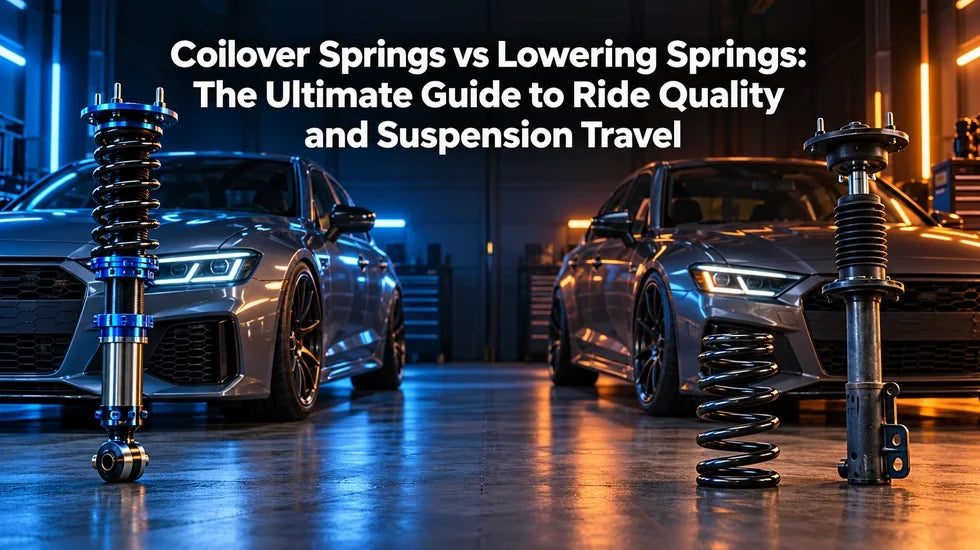
The phrase coilover springs vs lowering springs can be confusing. A complete coilover kit includes springs and dampers as a system, though its exact adjustments depend on the kit. Lowering springs replace the original springs and work with either the existing dampers or a separately chosen set. Both approaches can make a good street car. Both can also make one miserable if the height, available travel, and damping are wrong.
What Are Coilovers and Lowering Springs?
First, let’s get the parts straight. A lowering spring is a replacement spring designed to put the car at a different static height. The original strut or shock may stay in place, or it may be replaced with a damper chosen to work with the new spring. The spring itself does not give you a height-adjustment knob.
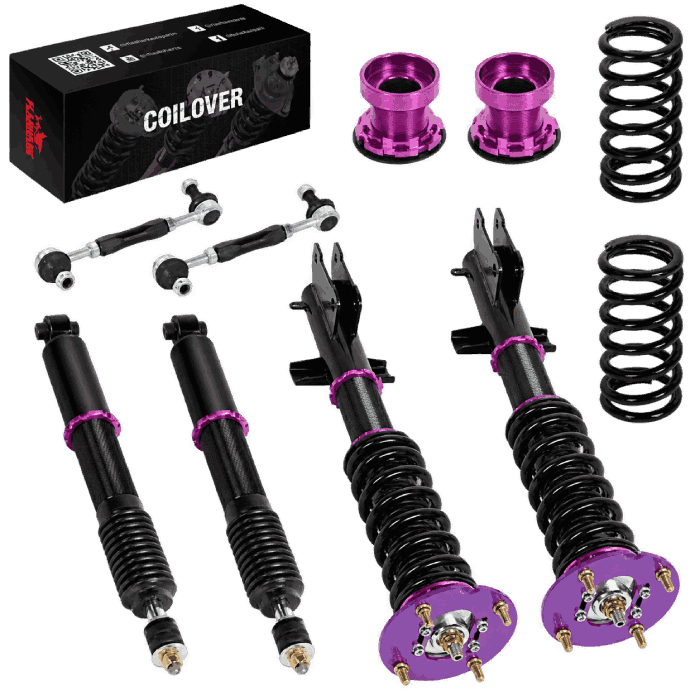
A complete coilover kit changes the spring-and-damper setup. Many kits use a threaded body or spring seat to set height within the manufacturer’s specified range. Some add adjustable damping. Others do not. On cars with separate rear springs and shocks, a kit may keep that separate layout at the rear. The name on the box cannot tell you every adjustment you’ll get.
Which Parts Does Each Setup Replace?
With lowering springs, the basic parts swap is simple to describe: the springs come out and new springs go in. The job itself can involve strut disassembly, spring compression, and inspection of mounts, bearings, isolators, and dampers. A complete coilover kit generally replaces more of the original spring-and-damper assembly, although the exact arrangement depends on the chassis.

Here is the practical comparison. These are configuration differences, not promises about a particular vehicle:
| Feature | Original suspension | Lowering springs | Complete coilover kit |
|---|---|---|---|
| Ride height | Factory setting | Generally a fixed, application-specific drop | Adjustable on a height-adjustable kit, within its stated range |
| Dampers | Original equipment | Retained or replaced separately | Supplied as part of the kit |
| Damping adjustment | Depends on the vehicle | Depends on the dampers used | Depends on the selected kit |
| Main buying question | Are the parts still healthy? | Are the springs and dampers suited to each other? | Does the kit provide the travel and adjustments you need? |
Which Adjustments Do You Actually Get?
Separate four things that often get bundled into one sales pitch: ride height, spring preload, damping, and alignment adjustment. They are different controls. Turning a damping adjuster changes the damper’s behavior; it does not put compression travel back into a car set too low. An adjustable spring seat is not automatically an adjustable camber mount.
If you are shopping Flashark, its vehicle-specific coilover kits are a useful place to compare the available configurations. Check the selected vehicle application and the listed adjustments before choosing a kit.
Shopping for an Adjustable Setup?
Start with your exact vehicle, then compare height adjustment, damping adjustment, and the hardware listed for that kit.
How Does Each Setup Lower the Car?
A spring holds up the car’s weight. Change the spring and you can change where the suspension settles under that weight. A lowering-spring set aims for a predetermined ride height on its intended application. A height-adjustable coilover gives you a specified adjustment range. Neither makes the wheel well infinitely deep.
Fixed Drop vs Adjustable Ride Height
A fixed drop can be appealing when you know exactly what you want: less wheel gap, no plans to change wheel and tire size, and no interest in revisiting the settings every season. Adjustable height earns its keep when you need room to tune clearance or balance appearance against usable travel.
Measure before ordering. Use the same points at all four corners, on level ground, with consistent tire pressure and a similar fuel load. A car with tired original springs or a factory sport package may not settle exactly as the advertised drop suggests. Record the result after installation instead of judging it from a photograph taken at an angle.
Why a Lower Stance Does Not Guarantee Better Grip
A lower center of gravity can help reduce body movement. That is only one part of grip. If the car runs out of compression travel over a mid-corner bump, the tire can have a harder time following the road. If the alignment moves to a poor setting for your use, the car may feel lively in the driveway and less settled on the highway.
Garage rule: Choose the lowest height that still lets the suspension do its job on the roads you actually drive. A dramatic parked stance is a poor test of a moving car.
A Before-and-After Height Measurement
Here is how I would handle a car whose owner says, “Just take out some wheel gap.” I would measure all four corners first, record the tire size and pressure, and ask about the usual load in the car. After the swap, I would measure again at the same points, then check clearance through steering and suspension movement. If one corner looks wrong, I would inspect the installation and the parts before trying to hide the difference with an arbitrary adjustment. That sequence is more useful than promising a drop number before touching the car.
Suspension Travel and Bump Stops: Where Ride Quality Changes
This is the part people feel but rarely measure. A suspension needs room to compress when the wheel rises and room to extend when it drops into a dip. Lowering changes where the car sits within that working range. How much travel remains depends on the vehicle, damper dimensions, spring, bump-stop design, and final height.
Compression Travel, Droop, and the New Static Position
Picture the damper halfway through its stroke with the car parked. A road bump asks it to compress; a dip asks it to extend. Move the parked position lower without accounting for the available stroke and you can use up compression room sooner. A damper intended for a lowered setup may manage that working position differently from an original damper. You still have to respect the car’s wheel-well and chassis clearances.
Do not treat “lower by one inch” as a universal travel calculation. Motion ratios differ by suspension design, and the damper may not move the same distance as the wheel. Measure the actual setup.

What Repeated Bump-Stop Contact Feels Like
Bump stops are part of suspension design. Brief contact under a large load is not the same as crashing into them over every ordinary road seam. Repeated early contact can feel like a sharp second hit after the initial bump. It may be especially obvious with passengers or cargo aboard.
Nor should every harsh impact be blamed on a bump stop. Excessive tire pressure, a short tire sidewall, worn mounts, loose hardware, damper settings, or a damaged damper can produce similar complaints. Work through the car instead of buying another spring on instinct.
A Rough-Road Diagnosis
If someone brought me a lowered daily driver that thumped over the same bridge joint every morning, I would begin with a repeatable drive at a known load. Then I would check tire pressures, ride height, clearance marks, bump-stop condition, and damper operation. I would drive the same route after each meaningful change. “It feels terrible” is a useful starting complaint; it is not a diagnosis. The point of the repeatable route is to find which change actually fixes the hit.
Spring Rate and Damper Matching: Which Setup Rides Better?
People ask whether coilovers or springs ride better as if the label itself has a spring rate. It doesn’t. A moderate lowering spring on a suitable damper may be comfortable for one commuter. A well-chosen coilover may control body motion better than that car’s worn original suspension. Set a kit too low, fit an unsuitable spring, or use a poor damper, and either route can feel awful.
Spring Rate Is Only One Part of Comfort
Spring rate describes how much force it takes to compress a spring by a given distance. It does not describe the whole ride. Two cars with similar rates can feel different because of vehicle weight, suspension geometry, damper tuning, tires, and how much travel is left at the chosen height.
A “progressive” spring changes its effective behavior through compression. That can be useful, but the word alone is no comfort guarantee. A stiff tire with a short sidewall can make small road texture far more noticeable even when the suspension parts have not changed.
Why Damper Valving and Stroke Matter
The spring supports the car and stores energy. The damper controls how the suspension moves and settles. If the car keeps bouncing after a disturbance, examine the damper and spring combination. If it slams over bigger bumps, examine travel and bump-stop engagement as well. You need both questions; a softer damping click cannot create physical clearance.
Adjustable damping is useful when you know what problem you are trying to solve. Start from the kit’s setup instructions, change one setting at a time, and test on the same roads. Spinning every adjuster at once makes it harder to learn anything.

Stock Dampers, Matched Dampers, and Complete Kits
There are three sensible paths to price out: springs with healthy, suitable existing dampers; springs with matched replacement dampers; or a complete coilover kit. A spring-only invoice can look cheap until the old struts need replacing. A coilover invoice can look expensive until you account for the dampers and adjustments included.
Do not assume every factory damper is unsuitable for every lowering spring. Check the spring maker’s application guidance and the actual condition of the dampers on your car. Some springs are developed for use with factory dampers; others are better paired with dampers designed for the new operating range.
Alignment, Tires, and the Work After Installation
Once the car sits at its final height, the wheels still need to point where you want them. Lowering can change camber and toe, and the adjustment available at the factory hardware varies by chassis. Tires make the result visible: a car that feels fine from the driver’s seat can still wear a shoulder or scrub its tread.
Camber, Toe, and Uneven Tire Wear
Camber is the wheel’s inward or outward tilt when viewed from the front. Toe describes where the wheels point relative to the vehicle’s centerline when viewed from above. Both matter, but toe deserves special attention on a daily driver because an unwanted toe setting can scrub tires over every mile.
Ask for the alignment measurements, not just a receipt that says “alignment done.” The right target depends on the car, tires, and intended use. A street commute and a track day do not automatically call for the same settings. If a target cannot be reached with the existing adjustment range, identify the reason before buying correction hardware.

The Installation and Post-Install Checklist
- Record the original ride height and inspect the existing dampers, mounts, bushings, and tires.
- Match every part to the vehicle and follow the kit and vehicle service instructions. Use the proper spring compressor when disassembling a loaded strut.
- Install and torque fasteners as specified. Suspension pivots that require tightening at normal ride height should be handled that way.
- Set the intended final height, then check tire-to-fender, spring-to-tire, brake-hose, sensor-wire, and underbody clearance.
- Measure the alignment. Recheck the car after an initial period of driving for noises, leaks, rubbing, and changes in height.
If I heard a new clunk after a suspension installation, I would not reach for the damping knob first. I would inspect the hardware and contact points, then reproduce the noise at low speed on a known surface. A loose mount, a line touching a moving part, and a tire rubbing a liner call for different fixes. The sound alone cannot tell you which one you have.
Does Lowering Require an ECU Tune or Affect Road Legality?
A spring or coilover change is not, by itself, an engine-power modification that calls for an ECU power tune. Vehicles with electronically controlled dampers, ride-height sensors, or other integrated systems can have additional installation requirements. Check the instructions for the exact vehicle and selected kit.
Road-use requirements vary by location and vehicle. Keep lighting, tire coverage, clearance, and required safety equipment in mind when setting height. If the car is also getting exhaust work, treat that as a separate decision with its own fitment and emissions requirements.
Which Should You Choose for Daily Driving?
For most people, the answer to coilover springs vs lowering springs starts with three honest questions: How rough are your roads? How much height adjustment will you really use? What condition are your current dampers in?
A Decision Tree for Commutes, Back Roads, and Track Days
- Mostly commuting, modest fixed drop: Consider application-specific lowering springs and evaluate whether your existing dampers are suitable and healthy.
- Commuting with worn dampers: Compare a matched spring-and-damper package against a complete coilover kit. Price the whole repair.
- Wheel and tire changes or a specific clearance target: A height-adjustable kit may give you room to set the car up, provided the final height preserves usable travel and clearance.
- Frequent setup changes or track use: Compare kits by spring options, damper behavior, adjustment range, and service support rather than the number of clicks alone.
- Comfort is the priority and the current car is tired: Restoring the original suspension is a real option. Lowering is not required to make a worn car drive better.
Compare the Full Installed Cost
Add up the springs or kit, any dampers you need, mounts and wear items, labor, alignment, and any vehicle-specific hardware required to reach the intended settings. Then think about the tires. If an aggressive drop shortens their life, the purchase price did not capture the cost of the setup.
My choice for a street car would be the setup that can stay composed on its worst regular road, with enough clearance for its usual passengers and load. Choose the height last, after you understand what the car needs to do. That is how coilover springs vs lowering springs becomes a useful decision instead of a fight over which box has the better name.
Frequently Asked Questions
Q1: Does a coilover always have adjustable damping?
A1: No. Some kits adjust ride height but have fixed damping. Others add damping adjustment. Check the specific kit’s features.
Q2: Why can lowering springs make a car reach its bump stops sooner?
A2: Lowering can change the suspension’s resting position and leave less compression room. The result depends on the spring, damper, bump stops, vehicle, and final ride height.
Q3: Are coilovers or lowering springs better for a daily driver on rough roads?
A3: The better choice is the one with suitable damping, usable travel, and a sensible height for those roads. A mild spring-and-damper setup or a street-oriented coilover can both work.
Q4: Are lowering springs with matched shocks better than budget coilovers?
A4: They can be. Compare the actual parts, vehicle application, available travel, support, and total installed cost. Price alone does not tell you how either setup will ride.
Q5: How much comfort will I lose with a mild drop?
A5: There is no reliable universal number. Tire construction, road condition, spring rate, damper tuning, and remaining travel can change the result substantially.
Q6: Can I install lowering springs on my existing factory struts?
A6: That depends on the springs’ application guidance and the struts’ condition. Inspect for leaks, weak control, and worn mounts before reusing them.
Q7: Do I need an alignment after installing springs or coilovers?
A7: Have the alignment measured after the car reaches its final ride height. Changing height can change wheel angles, and the available adjustment differs by vehicle.
Q8: Do coilovers or lowering springs require an ECU tune?
A8: A suspension swap does not ordinarily call for an engine-power tune. Check vehicle-specific instructions for any electronically controlled suspension or ride-height systems.
Q9: Are coilovers and lowering springs street legal in my state?
A9: Requirements vary by state and vehicle. Check the rules that apply where the car is registered and used, including any requirements affected by the final ride height.
Q10: Is a premium spring-and-shock setup worth more than an entry-level coilover kit?
A10: It may be if it suits your fixed-height goal and offers better control on your roads. A coilover kit may be worth the additional cost when you will use its height or damping adjustments. Compare complete installed costs.