Long-tube headers are one of those Mustang mods that sound simple until the car is on a lift and the factory mid-pipe is lying on the floor. Then the real questions start. Where did the catalytic converters go? Will the stock pipes still fit? What happens to the O2 sensors? And why does every forum answer seem to begin with “it depends”?
For the 2011–2014 Mustang GT, that answer really does depend on the complete exhaust path. The 5.0L Coyote is a strong platform, but long tubes are not an axle-back swap. You are changing the front half of the exhaust system. That means collectors, connection pipes, catalytic converters, sensor routing, clearance, and possibly calibration all enter the conversation.
Quick Answer
- Long-tube headers replace the factory exhaust manifolds and change the factory converter connection path. They do not automatically require a catless setup.
- On many S197 5.0 builds, catalytic converters move into a matching catted X-pipe or connection-pipe assembly behind the long-tube collectors.
- A factory mid-pipe usually does not bolt directly to long tubes because the collector sits farther back and may use a different diameter or connection style.
- High-flow cats can be a more livable route for a street-focused car, but they do not guarantee emissions compliance, a clean dash, or inspection approval in every location.
- Before buying anything, match the headers, collector outlet, downstream pipe, O2 routing, catalytic-converter plan, and local road-use requirements as one system.
Do Long Tube Headers Replace Cats on a 2011–2014 Mustang GT?
They replace the factory manifolds and alter the original catalytic-converter arrangement, but they do not inherently “delete” catalytic converters. That distinction matters.
The stock S197 5.0 exhaust starts at the cylinder heads, passes through compact factory manifolds, then reaches the converter section before continuing into the rest of the exhaust. Long tubes stretch the primary tubes much farther down the car before they merge at collectors. That new collector location is the whole point of the design. It also means the original front-pipe geometry is no longer where it used to be.
So when somebody asks, “Do long tube headers replace cats?” the practical answer is this: they can replace the original converter-containing section with either a catted or catless downstream system, depending on the parts selected. The headers are one piece. The matched connection pipes are another.
| Area | Factory S197 GT Layout | Long-Tube Header Layout |
|---|---|---|
| Front exhaust section | Compact cast manifolds | Long individual primary tubes |
| Collector location | Near factory connection geometry | Farther downstream |
| Catalytic converters | Part of the original front exhaust arrangement | Often relocated into a matched catted X-pipe or connection pipe |
| Factory mid-pipe | Designed around stock manifolds | Usually requires a matched or fabricated connection |
| O2 sensor routing | Factory-length harness routing | May require careful rerouting or extension harnesses |
Headers and Catalytic Converters Do Different Jobs
Headers manage exhaust pulse timing, tube length, collector design, and flow path. Catalytic converters treat exhaust gases. They are related because they live in the same system, but they are not interchangeable parts.
That is why a set of headers can be sold without cats, while another kit can pair similar headers with a catted X-pipe. The first setup is only the header assembly. The second is a more complete front-exhaust package.
Shop-floor rule: Never buy long tubes as if they are a standalone bolt-on. Buy the entire path from cylinder head to your existing cat-back.
Where the Catalytic Converters Go After Long-Tube Installation
On a typical 2011–2014 Mustang GT long-tube build, the collectors end farther back than the factory manifold outlets. A short, matched connection section then bridges the headers to the rest of the exhaust. If you choose a catted system, that is commonly where the catalytic converters live.

Think of it like this:
- Factory: cylinder head → stock manifold → original converter section → mid-pipe → cat-back
- Long-tube, catted: cylinder head → long-tube header → catted connection pipe/X-pipe → cat-back
- Long-tube, catless: cylinder head → long-tube header → non-catted connection pipe → cat-back
That middle section is where people get caught out. A 2011 Mustang GT can have a perfectly good aftermarket cat-back and still need a new front connection. Matching pipe diameter alone does not make parts compatible. Collector angle, outlet diameter, flange style, slip-joint design, and overall length all matter.
Why the Stock Mid-Pipe Usually Will Not Reach
Long tubes physically move the handoff point. The factory mid-pipe was built around factory manifolds, not a pair of 1.75-inch primary tubes ending in 2.50-inch collectors farther under the car.
A common garage scenario goes like this: the owner orders headers because the price looks right, assumes the stock mid-pipe can be reused, and discovers the connection is several inches away from where it needs to be. Now the car is apart, the job has stopped, and the “cheap” header purchase has turned into a rush order for pipes, clamps, gaskets, or fabrication.
Do not do that. Measure first. Read the connection details. Match the collector to the planned X-pipe or H-pipe before the first bolt comes loose.

Headers with Catalytic Converter: The Street-Focused Route
A catted long-tube arrangement keeps catalytic elements in the exhaust path while taking advantage of the longer primary-tube layout. For a Mustang that sees street miles, weekend drives, and occasional hard pulls, this is often the more practical direction.
High-flow cats can change the sound and reduce restriction compared with a more restrictive factory setup. But hear this clearly: “high-flow” does not mean universally street legal, inspection-proof, or guaranteed not to trigger a catalyst-efficiency code. The final result depends on the converter design, installation quality, sensor behavior, calibration, and the rules where the car is registered.
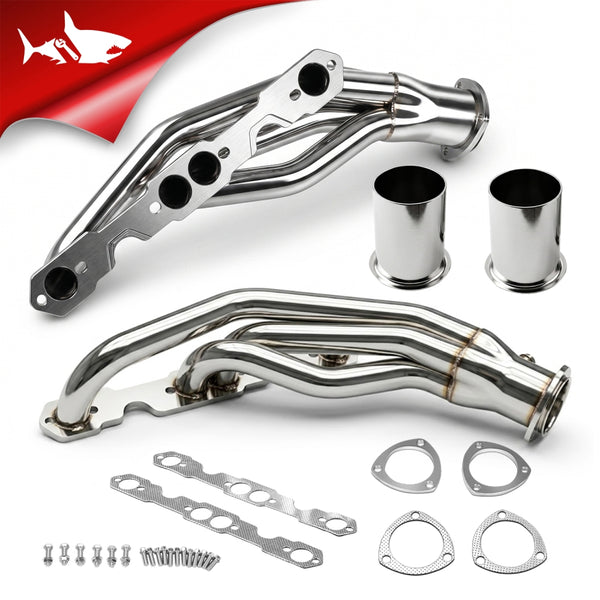
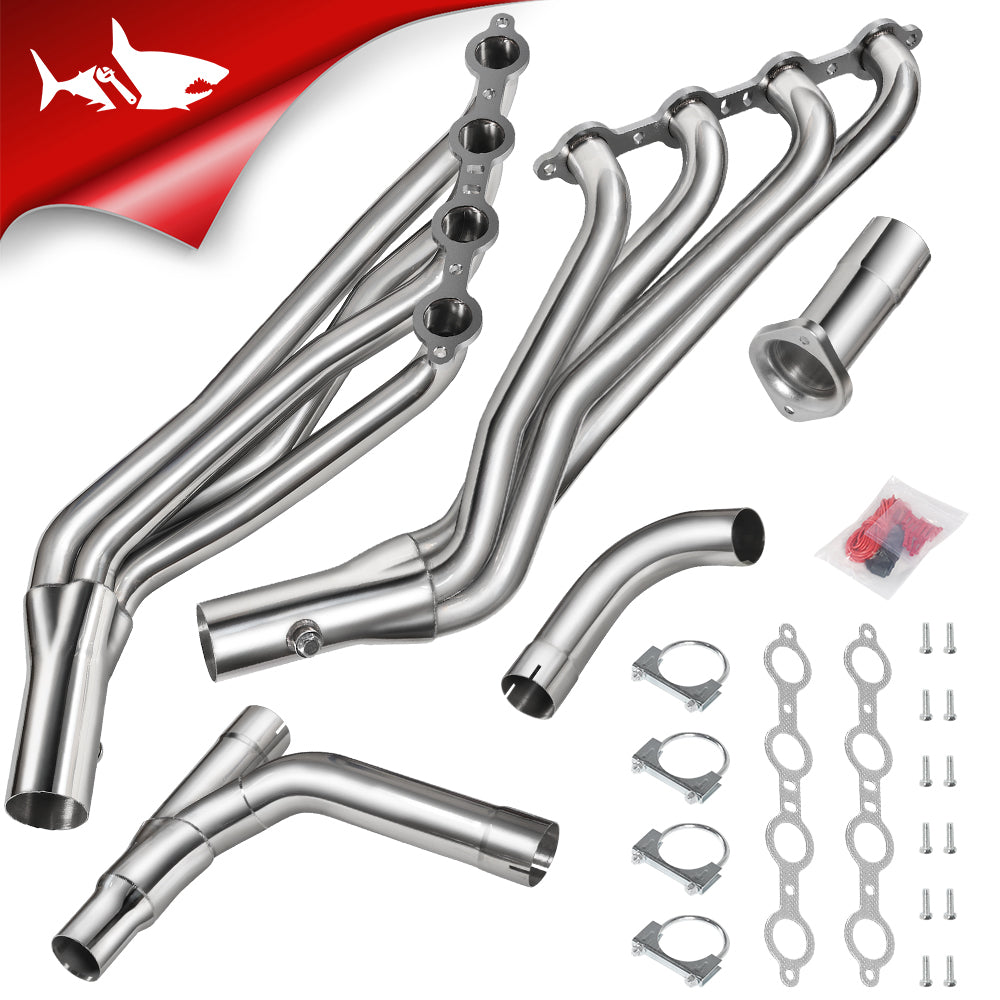
For owners starting with the header side of the build, these 2011–2014 Mustang GT 5.0 long-tube headers use 1.75-inch primaries and 2.50-inch collectors. They are a starting point for a custom or matched front-exhaust plan, not a promise that any existing X-pipe will bolt on.

1.75-inch primaries, 2.50-inch collectors, stainless construction, header gaskets, and installation bolts.
$199.99 $399.99
Catted vs. Catless Long-Tube Headers: What Actually Changes?
Sound clips make this decision look easy. Real ownership makes it less dramatic and more expensive.
A catted setup generally keeps more exhaust odor under control and can take some of the harsh edge out of the note. A catless setup is more open, louder, sharper at cold start, and more likely to bring catalyst-monitoring issues. The latter is not just a “more power” choice. It changes the way the car smells, sounds, and behaves in the driveway, garage, and cabin.

Catted Long Tubes: Better Balance for Many Street Cars
For a naturally aspirated Coyote with a sensible cat-back, catted long tubes can deliver a deeper, harder-edged V8 sound without turning every morning start into a neighborhood event. They still require planning. They still require a matched connection pipe. They can still create diagnostic or inspection issues.
But the ownership experience is usually less raw. Less exhaust smell. Less crackle. Less chance that the car feels like a track toy when all you wanted was a stronger pull and a serious exhaust note.
Catless Long Tubes: More Than a Volume Knob
Catless pipes remove catalytic-converter function from that part of the system. The sound gets more immediate. So does the smell. Cold starts become sharper, and the rear O2 monitoring conversation becomes harder.
For public-road vehicles in the United States, emissions equipment is not something to treat as optional hardware. Review local emissions and road-use requirements before modifying emissions-related equipment. A part labeled for off-road or competition use is not a free pass for street use.
Do not chase a tiny theoretical gain while ignoring the setup you will live with for the next two years. A properly sorted catted system is often the better answer for a car that actually leaves the garage.
For a broader comparison of the trade-offs, see long-tube headers with high-flow cats versus catless setups. The engine is different, but the decision points around sound, converter placement, and ownership reality still apply.
O2 Sensors, Check-Engine Lights, and Tune Expectations
The Coyote does not care that your headers look great under the car. It cares what the sensors report.
The upstream O2 sensors play a major role in fueling feedback. The downstream sensors are used to monitor catalyst performance. Long-tube installation can move sensor locations, change wire routing, alter heat exposure, and change what the rear sensors see after the converters.

Front and Rear O2 Sensors Are Not Interchangeable Jobs
The front sensors help the engine manage fuel delivery. The rear sensors help the PCM evaluate catalytic-converter performance. Keep their locations, connectors, and routing organized during teardown. Take photos before disconnecting anything. It saves a lot of head scratching later.
On some long-tube layouts, the original harness may not comfortably reach the new bung location. An extension harness can solve a length problem, but it must be routed away from heat, sharp edges, moving parts, and tension. Do not stretch a sensor lead like a guitar string and call it finished.
Why a CEL Can Show Up Days Later
Sometimes the car starts, idles, and drives normally after installation. Then a few drive cycles later, the dash light comes on. That can happen because the PCM needs time to run its monitor routines.
Common causes include:
- Small leaks at a collector, gasket, clamp, or slip joint
- O2 wiring routed too close to heat
- Old sensors that were already slow or marginal
- Rear sensors reading catalyst behavior outside the stock expectation
- A mismatch between the selected mid-pipe, converters, and calibration
A tune may be worth discussing with a professional familiar with the 2011–2014 Coyote platform, especially when the full intake and exhaust combination has changed. Tune requirements vary by vehicle and installed hardware. A calibration should not be treated as a workaround for disabled or removed emissions equipment.
Listen to this one: Fix exhaust leaks and wiring mistakes before blaming the tune. A clean mechanical installation comes first.
Installation Reality: What to Check Before the Car Is Apart
Installing long tubes on a Coyote is not impossible at home. It is also not a casual Saturday job for somebody who has only installed an axle-back. Access is tight. Heat shields, fasteners, steering-related clearance, sensor routing, and downstream alignment all take time.
The Pre-Install Checklist
- Confirm 2011–2014 Ford Mustang GT, 5.0L Coyote V8, and S197 chassis.
- Confirm whether the car has factory exhaust pieces, an aftermarket X-pipe, H-pipe, or cat-back.
- Match the header collector diameter and connection style to the planned front pipe.
- Choose the catalytic-converter plan before ordering the connection pipes.
- Check whether O2 extensions, new sensors, clamps, collector hardware, or fabrication are needed.
- Inspect the selected configuration and package contents before installation.
- Plan for new gaskets and a careful fastener-tightening sequence.
A familiar mistake is buying the headers, then discovering the rest of the exhaust was built around a different brand’s collector position. The solution is not forcing the pipes together with clamps and optimism. Exhaust systems need to sit naturally before final tightening. If the connection is under stress, it will eventually tell you—usually with soot, a ticking leak, or a broken fastener.
First Start and Heat-Cycle Checks
After installation, start the car and listen. Do not rev it immediately. Let it idle long enough to check for ticking at the flange, collector, and downstream joints. Keep sensor wiring, brake lines, hoses, and heat-sensitive pieces clear of the header tubes.
After the first complete heat cycle, let the car cool and inspect the fasteners again. Stainless systems move with temperature. That is normal. A leak is not.
If you are comparing different setups for future builds, browse the wider Ford Mustang performance exhaust header and keep the same rule in mind: fit the vehicle and complete exhaust path, not just the engine badge.

Final Call: Build the Whole Exhaust, Not Just the Header Section
Long tubes can make a 2011–2014 Mustang GT feel more alive in the upper rev range and sound far more serious. That is why people keep doing the swap. But the good installs are planned from the cylinder head to the cat-back.
If you want a street-focused build, start by deciding how you want to handle catalytic converters and local compliance. Then choose headers, a matching catted connection section if appropriate, O2 routing, and the downstream exhaust. That order prevents the most expensive surprises.
Long tubes do not automatically replace cats with empty pipes. They replace the factory front-exhaust geometry. What replaces the original converter section is your next decision.
FAQ
Q1: Do long tube headers replace cats on a 2011–2014 Mustang GT?
A1: They replace the factory manifolds and change the original converter connection path. Catalytic converters can remain in a matching catted X-pipe or connection-pipe assembly.
Q2: Can I keep my stock catalytic converters with long tube headers?
A2: The factory converter section usually does not directly connect to long-tube collectors. A matched catted connection pipe or custom exhaust work may be required.
Q3: Will long tube headers bolt to the factory mid-pipe?
A3: Usually not. Long tubes move the collector location and may use a different outlet diameter or joint design.
Q4: What is the difference between headers and catalytic converters?
A4: Headers direct and merge exhaust pulses from the cylinder heads. Catalytic converters treat exhaust gases. They perform separate jobs within the same exhaust system.
Q5: Are catted long tubes better than catless long tubes for a street car?
A5: A catted setup is often easier to live with because it can reduce odor and soften some harshness. Local laws, inspection requirements, and the full exhaust setup still matter.
Q6: Do high-flow catalytic converters guarantee no check-engine light?
A6: No. Catalyst efficiency codes can still occur because of sensor behavior, exhaust leaks, converter performance, wiring issues, or calibration differences.
Q7: Do I need O2 sensor extensions for long tube headers?
A7: Some setups need them because the sensor bungs sit farther from the factory harness connection. Check the header layout and routing before installation.
Q8: Can I reuse my factory O2 sensors?
A8: If the sensors are healthy and the connectors match, they may be reusable. Inspect their condition, wiring length, and heat clearance during installation.
Q9: Do long tube headers require a tune on a 2011–2014 Mustang GT?
A9: Tune requirements vary with the complete exhaust system, catalytic-converter arrangement, O2 sensor locations, and other modifications. Consult a Coyote-experienced professional for the complete combination.
Q10: Can a tune legally turn off emissions monitors?
A10: A calibration should not be used to bypass or defeat emissions-control requirements. Review applicable road-use and emissions rules before modifying related equipment.
Q11: How much horsepower do long tube headers add to a Coyote Mustang?
A11: Results depend on primary size, collector design, intake, downstream exhaust, fuel, engine condition, calibration, and dyno conditions. Use a product-specific before-and-after test to judge a particular build.
Q12: What comes with the Flashark 2011–2014 Mustang GT long tube headers?
A12: The listed set includes the header pair, header gaskets, and installation bolts. Connection pipes, catalytic converters, and O2 extensions should be planned separately unless included with the selected system.
Q13: Will these headers fit a 3.7L V6 Mustang?
A13: No. The discussed header application is for the 2011–2014 Mustang GT equipped with the 5.0L Coyote V8.
Q14: Can I install long tube headers at home?
A14: It is possible with correct lifting equipment, tools, workspace, and exhaust-installation experience. Many owners choose a professional installer because access around the Coyote engine is limited.

Steven Chen
Automotive Performance Specialist | Engine & Exhaust Systems
Steven focuses on practical engine performance, exhaust fitment, and real-world upgrade paths for classic and modern enthusiast vehicles. He reviews small-block Ford, LS, truck, and street/strip applications with one goal in mind: helping builders choose parts that actually work together. His philosophy: "Good power starts with the right combination, not the biggest part."