That off-beat burble rolls into the parking lot and everybody turns around. You know the sound. A minute later, somebody says the usual line: “Unequal length makes low-end torque; equal length makes top-end power.” Neat answer. Too neat.
A header is not four drinking straws feeding a bigger straw. Every exhaust-valve opening launches hot gas, a pressure pulse, and a train of waves. Runner length changes when those waves reach a merge and when reflected waves return toward the cylinder. Diameter, bend radius, firing order, collector shape, cam timing, and engine speed all get a vote. Honestly, the EL-versus-UEL badge tells you far less than most sound clips suggest.
Quick Answer
- For a naturally aspirated engine chasing repeatable power: a well-developed equal-length layout usually gives more consistent pulse timing from cylinder to cylinder, but only when runner diameter, total length, bends, and collector geometry suit the engine.
- For a sound-first street build: unequal length headers can create a deeper, syncopated note. They do not automatically add low-end torque, and the rest of the exhaust can either sharpen that character or bury it under drone.
- For a turbo engine: turbine inlet volume, heat retention, pulse pairing, and single-scroll or twin-scroll architecture matter as much as runner equality.
- For a tight chassis: a clean UEL layout with smooth bends and a proper merge can be a smarter piece than an “equal-length” design full of crushed bends and clearance problems.
- For any build: judge the result with an overlaid torque curve, repeatable logs, leak checks, and sound measurements—not one peak number or a phone video.
Exhaust Pulse Basics: Flow Is Only Half the Story
Gas flow and pressure waves are different things
When an exhaust valve cracks open, cylinder pressure is still well above the pressure in the primary tube. The first event is blowdown: a hard discharge that sends a positive pressure wave down the pipe. The gas itself moves quickly, but the pressure disturbance travels through the hot gas at roughly the local speed of sound. Those are not the same speed.
That distinction matters. The tuning effect is not simply “the exhaust has time to leave before the next cylinder fires.” A wave reaches a collector, area change, or pipe end, reflects, and can return as a lower-pressure wave. If that lower pressure arrives near valve overlap, it can help clear residual exhaust and encourage the fresh charge to start moving. Arrive at the wrong moment and the same system can flatten a useful part of the torque curve.

Garage note: An engine does not need backpressure to make torque. It needs the right pipe area, gas velocity, wave timing, and collector behavior for the rpm band that matters.
Firing order sets the pulse schedule
Take an even-fire four-cylinder four-stroke engine. It has four combustion events over 720 degrees of crank rotation, so one event occurs every 180 degrees. At 6,000 rpm the crank turns 100 times per second, which means the exhaust system sees about 200 firing events per second across all four cylinders. Runner geometry decides how evenly those events arrive at a shared collector.
Equal physical paths can preserve an even arrival pattern. Different paths introduce delays. But there is a catch: on a V-engine, a boxer engine, or a divided turbo system, the right question is not only “Are the tubes the same length?” It is also “Which cylinders share this collector, and where do they sit in the firing order?”
Equal Length Headers vs Unequal Length Headers: What Changes?
Equal length does not mean long tube
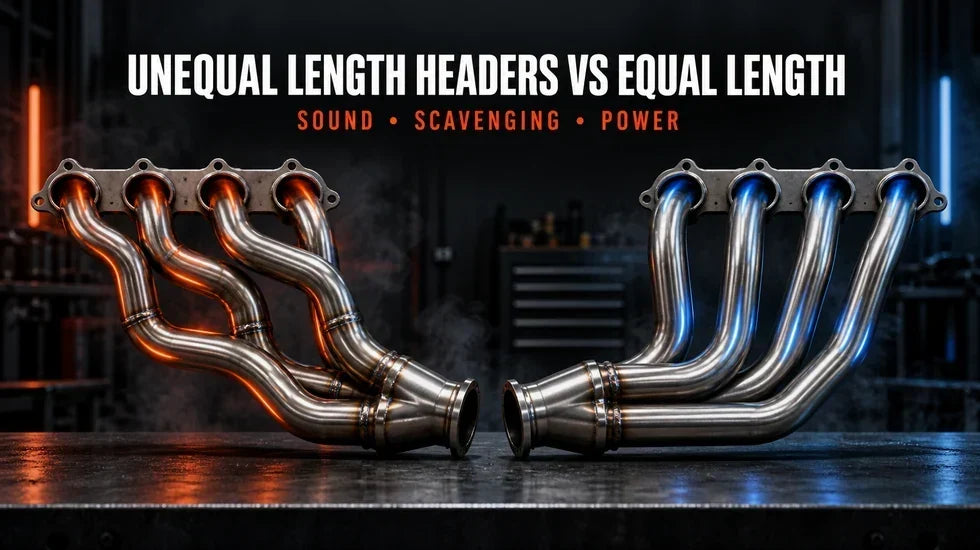
These labels describe different dimensions. Equal versus unequal compares one cylinder’s route with another. Shorty versus long tube describes how far the primaries run before the main merge. A shorty can be equal length. A long-tube can be unequal. A 4-1 and a 4-2-1 can both be built either way.
If those terms are getting crossed up, start with how exhaust headers work, then compare the practical differences between shorty and long-tube header designs.
| Design point | Typical factory manifold | Purpose-built equal-length header | Purpose-built unequal-length header |
|---|---|---|---|
| Primary paths | Usually compact; length follows packaging | Closely matched to a common measuring point | Intentionally or practically different |
| Pulse arrival | Depends on casting and firing order | More evenly timed when paired correctly | More staggered at the merge |
| Sound tendency | Muted by thick casting and full exhaust | Smoother, more uniform beat | More syncopated, often deeper beat |
| Packaging | Usually compact | Can require longer routing | Can route around chassis obstacles |
| Power result | Baseline varies by engine | Depends on the complete combination | Depends on the complete combination |
These are design tendencies, not promised specifications. A good collector and smooth bends can outweigh a small runner-length difference.
How unequal can an “equal” header be?
There is no honest universal answer such as half an inch, two inches, or five percent. A two-inch difference is a much larger fraction of an 18-inch primary than a 36-inch primary. The useful tolerance also moves with exhaust temperature, target rpm, port length inside the head, and which reflection order the designer is using.
Measure every runner along its centerline, from the same point at the flange to the same plane in the collector. Do not run a tape along the inside radius of one bend and the outside radius of another. Record inside diameter and bend radius too. Length without area is only half a measurement.
Why UEL Headers Sound Different
The famous rumble is rhythm before it is volume. Stagger the pulses at the common merge and the exhaust note develops uneven spacing, stronger low-frequency modulation, and a beat your ear interprets as burble. Equalize the paths and that beat generally becomes smoother and more regular.
Still, bolting UEL tubing onto any four-cylinder will not magically duplicate a Subaru EJ. Displacement, firing order, collector layout, catalytic converters, resonators, mufflers, tailpipe length, and even the microphone alter what you hear. A turbocharger also removes energy from the exhaust stream and softens pulse edges.

Rumble, rasp, loudness, and drone are four separate problems
A deeper note may not be louder on a sound meter. Rasp is a sharp, metallic texture. Drone is a narrow, sustained cabin resonance at a repeatable speed and load. One can exist without the others. If the car sounds brilliant during a throttle blip but pounds your ears from 1,900 to 2,200 rpm in top gear, use this deep exhaust sound without drone guide to isolate the frequency and mechanical causes.
Equal vs Unequal Length Headers: Torque and Horsepower
UEL does not automatically mean more low-end torque
Listen to me on this one: a longer primary can move a strong tuning effect toward a lower engine speed, but a set containing several different lengths does not automatically create a better low-rpm curve. One cylinder may see a helpful returning wave while another sees it too early or too late. Meanwhile, a smaller primary, a 4-2-1 merge, or a calibration change may be doing the work that gets credited to “UEL.”
The reverse shortcut fails too. An equal-length set can miss the target if the tubing is too large, the merge is crude, or the route uses tight, flattened bends. Equal length is a timing tool, not a quality certificate.
Pipe diameter sets the velocity-versus-capacity trade
Increase inside diameter and cross-sectional area rises with the square of radius. That buys high-flow capacity, but it can soften gas velocity and pulse strength when the engine is below the intended range. Go too small and high-rpm pressure loss climbs. This is why a mild street engine, a 7,500-rpm naturally aspirated build, and a turbo V8 should not share one blanket diameter rule.
Read the curve, not the hero number
Suppose one setup gains 8 whp at 6,500 rpm but loses 6 lb-ft from 3,000 to 4,200 rpm. Is it better? On a road-course car that stays above 5,000 rpm, perhaps. On a heavy street truck that shifts early, probably not. Compare average torque inside the operating band, the area under the curve, the torque dip, and where engine speed lands after every shift.
Do not publish or trust an “8–12 whp gain” unless the comparison names the vehicle, engine, fuel, correction standard, gear, baseline hardware, calibration state, and run-to-run spread. Wheel horsepower is not crank horsepower. Mixing them is shop-talk malpractice.
Naturally Aspirated, Single-Scroll, and Twin-Scroll Builds

Naturally aspirated engines
NA combinations expose header tuning clearly because no turbine sits downstream of the primaries. Cam overlap, port velocity, compression, collector dimensions, and the rpm band all interact. For a street engine, the fattest average curve is usually more useful than a sharp peak near redline.
Single-scroll turbo engines
Here the fight changes. Runner volume, heat loss, turbine inlet pressure, wastegate behavior, and pulse energy join the discussion. Shorter routing can reduce volume before the turbine; equal routing can improve timing consistency. Neither guarantees faster spool by itself. Compare boost onset at the same throttle, gear, load, ignition strategy, and ambient conditions.
Twin-scroll turbo engines
Correct cylinder grouping comes first. The runners must keep interfering pulses separated into the appropriate turbine-scroll passages. A beautifully equal set feeding the wrong cylinder pairs can squander the entire divided-housing idea. Check firing order, flange division, wastegate routing, and whether the separation continues all the way to the turbine inlet.
Choosing a Header for the Way You Drive
- Daily street car: favor the rpm used in traffic and highway merging, manageable heat, ground clearance, and a sound you can tolerate for two hours.
- NA track car: match the primary and collector to the rpm reached in gear, then compare average power across that window.
- Turbo street car: study transient response, turbine inlet layout, heat control, and boost behavior—not only peak flow.
- Sound-first build: choose the pulse character deliberately, then use the resonator and muffler to control rasp and drone.
- Packaging-limited swap: prioritize port alignment, smooth radii, steering-shaft clearance, ground clearance, and service access.
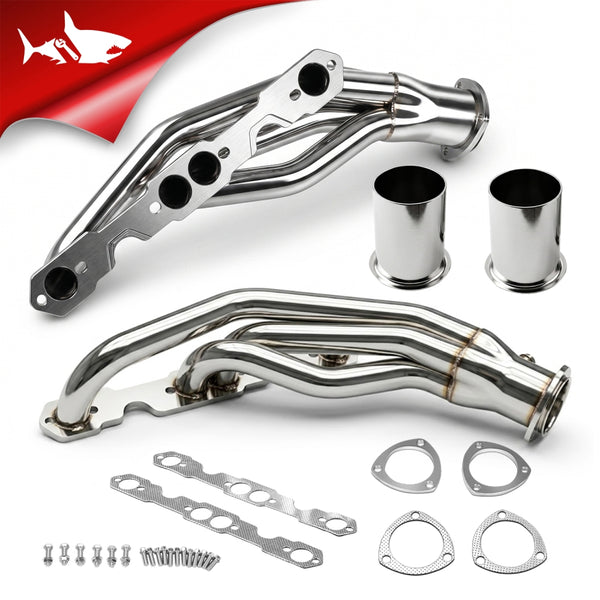
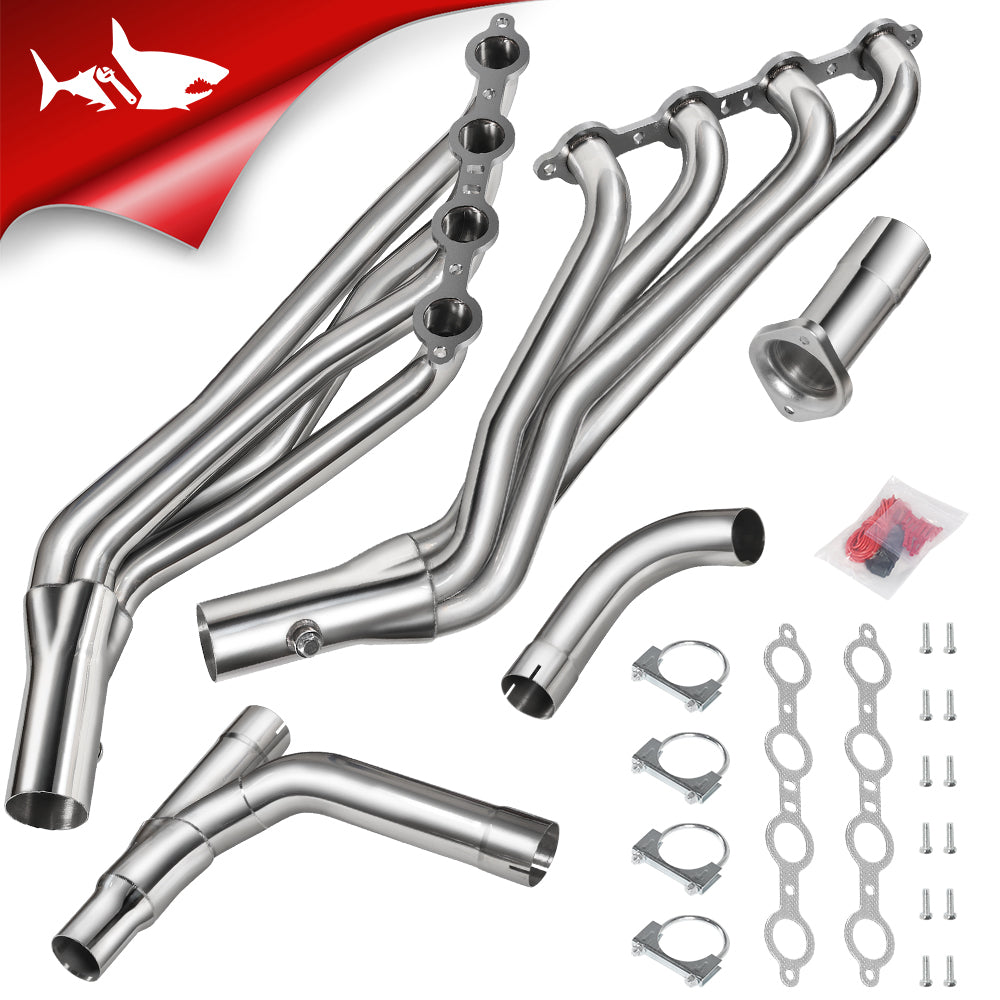
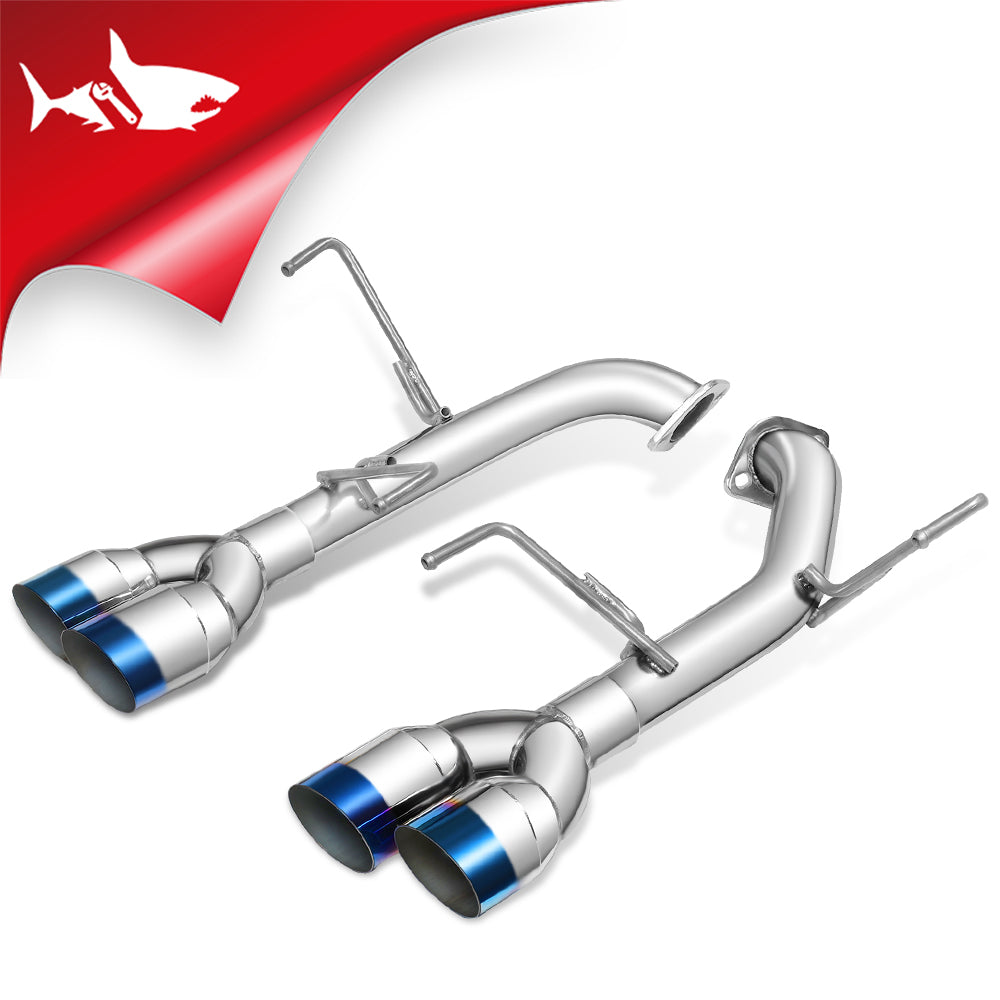
When you are ready to compare actual layouts, browse vehicle-specific exhaust header options from Flashark. Match the part to the vehicle year, engine, drivetrain, steering layout, emissions equipment, and downstream connection. A header that fits the wrong version of the chassis is not a bargain.
Installation Lessons That Matter More Than the Badge
A first-person shop-floor case
I remember a late-model V8 truck whose owner blamed its miserable 65-mph boom on the muffler. The truck went on the lift before another part went into the cart. The tailpipe sat only a few millimeters from a crossmember; engine load moved the system just enough to touch, and the body became a speaker. Re-centering the exhaust and tightening the clamps from front to rear changed the cabin behavior without replacing the muffler.
That job sticks with me because it is the perfect warning for header comparisons: a mechanical installation fault can impersonate an acoustic design problem. Check the car before condemning the runner layout.
Use this installation sequence
- Confirm the vehicle year, engine, drivetrain, steering layout, oxygen-sensor locations, and exhaust connection.
- Inspect flange flatness, port alignment, weld penetration, and collector entry before installation.
- Test-fit with fasteners loose. Check the starter, oil pan, steering shaft, crossmember, transmission, wiring, hoses, and floor.
- Keep oxygen-sensor wiring away from hot tubes and moving steering parts.
- Align the downstream exhaust without forcing it toward the collector.
- Tighten in the specified sequence and use the fastener torque appropriate for the engine and gasket system.
- Start cold, listen for ticks, inspect for leaks, and recheck clearance as the system warms.
- After several heat cycles, inspect fasteners, slip joints, wiring, soot marks, and witness marks from contact.
A leak upstream of an oxygen sensor can pull outside air into the exhaust and distort sensor readings. A leak also produces a sharp tick that people mistake for “more header sound.” If power falls away as rpm rises, work through this high-rpm exhaust leak diagnosis. If you find a dark trail around a flange, use these exhaust-flange soot and gasket checks before throwing another gasket at it.
How to Measure and Test the Difference
Measure runner length correctly
Run flexible wire or narrow hose along each primary’s centerline. Use the same flange reference and the same collector plane every time. For a 4-2-1, record primary lengths, cylinder pairings, secondary lengths, and the final merge. Add inside diameter, bend radius, and any step changes to the worksheet.
Build a fair A/B test
- Use the same vehicle, dyno, gear, fuel, tire pressure, and correction standard.
- Bring coolant, oil, and intake-air temperature into the same window.
- Make repeated runs and show the spread, not only the best pull.
- Record lambda, ignition timing, knock correction, cam position, and boost or wastegate duty where applicable.
- Separate the hardware change from calibration changes whenever the engine can be operated safely that way.
- Overlay torque and horsepower, then calculate average output in the rpm band the car actually uses.

Measure the sound instead of arguing about it
Use the same microphone, gain, distance, angle, road, gear, and operating temperature. Record warm idle, a steady 2,000-rpm hold, loaded acceleration, deceleration, and highway cruise. A spectrum plot can show whether a change strengthened a low-frequency beat or merely raised the whole sound level.
The Bottom Line
Unequal length headers are a pulse-timing and packaging choice with a recognizable acoustic side effect. They are not an automatic low-torque button. Equal-length headers are a powerful design tool, but the label cannot rescue poor diameter, bad bends, weak collectors, leaks, or a mismatch with the engine’s operating range.
Choose with the whole combination in mind. Measure it. Drive it where it lives. Then look at the curve and listen from inside the cabin—not just behind the bumper.
Frequently Asked Questions
Q1: Are equal-length headers better than UEL headers?
A1: They often provide more consistent cylinder-to-cylinder wave timing, but “better” depends on primary diameter, total length, collector design, firing order, rpm range, fitment, and sound goals.
Q2: Do UEL headers make more low-end torque?
A2: Not automatically. A specific design can improve part of the low or midrange, but that result may come from its total runner length, diameter, collector, or calibration rather than inequality alone.
Q3: Do UEL headers reduce horsepower?
A3: They can give up output in some rpm bands compared with a well-tuned equal-length design. The size and location of the difference are engine- and design-specific, so compare complete curves under matched conditions.
Q4: Why do UEL headers sound different?
A4: Different runner travel times stagger the pulses reaching a shared collector. That changes the rhythm and harmonic balance, often producing a deeper, less even beat.
Q5: Do UEL headers create the Subaru rumble?
A5: They contribute strongly to the classic sound on certain Subaru layouts. A different engine can develop a similar off-beat character, but displacement, firing order, turbocharger, collector, catalysts, resonators, and mufflers keep it from sounding identical.
Q6: Will an equal-length header remove boxer rumble?
A6: It generally smooths the pronounced off-beat pulse character. The finished note still depends on the turbocharger and the rest of the exhaust.
Q7: Are UEL headers bad for an engine?
A7: Runner inequality alone does not prove an engine is unsafe. Watch lambda, knock activity, fuel trims, exhaust temperature where measurable, and cylinder-specific behavior. Heat management and calibration matter.
Q8: Does a header swap need an ECU tune?
A8: Requirements vary by vehicle and installed hardware. Changes to catalysts, oxygen-sensor locations, airflow, boost control, or cam targets can affect calibration needs. Follow the vehicle-specific hardware and calibration path.
Q9: Can a header cause a check-engine light?
A9: The tube-length label is not the direct cause. Leaks, changed catalyst behavior, altered oxygen-sensor placement, damaged wiring, or fuel-control changes can trigger a fault.
Q10: Do equal-length headers improve turbo spool?
A10: They can improve pulse consistency, but spool also depends on pre-turbine volume, heat retention, turbine sizing, housing design, ignition, load, boost control, and divided or undivided routing.
Q11: Can UEL headers work with a twin-scroll turbo?
A11: Lengths do not have to be mathematically identical, but correct firing-order pairing and continuous pulse separation to the divided turbine inlet are essential.
Q12: How much power does an equal-length header add over UEL?
A12: There is no responsible universal number. Look for same-car testing that states engine setup, fuel, gear, dyno type, correction standard, calibration, temperatures, and run-to-run variation.
Q13: Are equal-length headers the same as long-tube headers?
A13: No. Equal length compares the runners with one another. Long tube describes the distance before the main collector. Either design can be equal or unequal.
Q14: How should header runner length be measured?
A14: Measure along each tube’s centerline from a consistent flange reference to a consistent merge plane. Include secondary routing in a 4-2-1 system and record inside diameter alongside length.
Q15: Can a YouTube sound clip settle the EL-versus-UEL choice?
A15: No. Microphone gain, compression, camera position, engine load, and the downstream exhaust alter the clip. Compare standardized recordings and spend time listening inside the car at cruise.

Steven Chen
Automotive Performance Specialist | Engine & Exhaust Systems
Steven focuses on practical engine performance, exhaust fitment, and real-world upgrade paths for classic and modern enthusiast vehicles. He reviews small-block Ford, LS, truck, and street/strip applications with one goal in mind: helping builders choose parts that actually work together. His philosophy: "Good power starts with the right combination, not the biggest part."