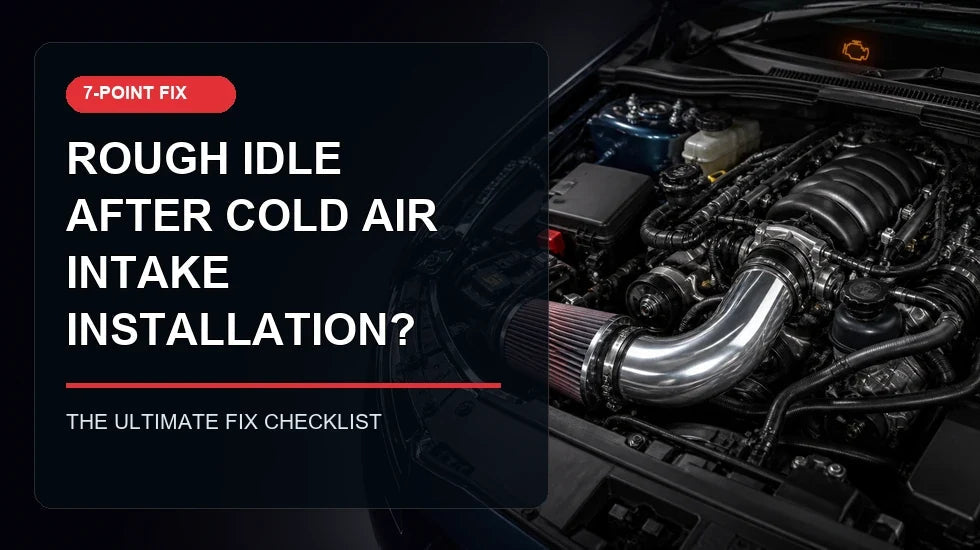
You installed a cold air intake for a sharper throttle, a cleaner engine bay, and a little more induction sound. Instead, the engine shakes at the first cold start, the rpm hunts at a stoplight, or the truck falls on its face when you tip into the pedal. That is not the kind of “break-in” anyone signed up for.
Here is the blunt version: when a car ran normally before the intake swap and immediately runs badly afterward, start with the parts you just touched. Do not fire the parts cannon at the MAF sensor, oxygen sensors, or throttle body. A pinched seal can imitate a dead sensor. So can one loose PCV hose.
- If the problem started on the first startup, check MAF direction, the MAF seal, the electrical connector, and every hose or clamp moved during installation.
- If fuel trims are strongly positive at idle but move closer to normal near 2,500 rpm, a post-MAF air or vacuum leak becomes more likely. Treat that pattern as a clue, not a universal pass/fail test.
- If the intake uses a different MAF housing diameter or places the sensor beside a sharp bend, the issue may be airflow measurement—not “too much cold air.”
- A brief idle correction after battery disconnection can be normal. Repeated stalling, violent surging, flashing CEL, or reduced-power mode is not.
- Before buying parts, save the codes and freeze-frame data, reseal the installation, and reinstall the stock airbox for an A/B test if needed.
Mechanic’s note: A trouble code names the system that noticed a problem. It does not always name the failed part. P0101 can show up when air bypasses a perfectly good MAF; P0171 can be caused by an intake leak, but it can also come from fuel-delivery or sensor problems.
Why a Cold Air Intake Can Cause a Rough Idle
On a MAF-based engine, the ECU calculates fueling from measured airflow plus data from the intake-air-temperature sensor, throttle position, oxygen sensors, and other inputs. Air that enters downstream of the MAF is not included in that measurement. The cylinders receive it anyway. The mixture trends lean, the ECU adds fuel, and idle quality can fall apart.
Idle exposes small mistakes. The engine is moving relatively little air, while manifold vacuum is high. A leak that seems minor at 2,500 rpm can represent a meaningful slice of total airflow at 650–750 rpm. That is why a split elbow or half-seated coupler may shake the car at a red light yet feel less obvious once the throttle opens.
Cold Starts Make Marginal Seals Easier to Find
Cold-start fueling is deliberately different from warm, closed-loop operation. Rubber is also firmer when cold, and an aging PCV elbow or intake gasket may seal differently after heat reaches it. So a cold-only stumble does not prove the CAI is defective. It tells you to compare cold and warm behavior carefully.
Rough, High, Hunting, and Stalling Idle Point in Different Directions
- Shaking at a nearly steady rpm: look at misfire data as well as airflow and fuel trims.
- High idle: suspect air entering around the throttle path, an open vacuum port, or a model-specific idle-control issue.
- Rpm cycling up and down: the ECU may be chasing an unstable airflow signal or leak.
- Stalling as the vehicle stops: inspect post-MAF leaks, MAF installation, and idle relearn requirements before driving farther.
- Hesitation only under boost or heavy load: widen the search to charge piping, fuel supply, ignition, and required calibration.
Before You Touch Anything, Save the Evidence
Plug in a capable OBD-II scanner before clearing the light. Write down the exact code, pending codes, coolant temperature, engine speed, calculated load, and fuel trims in the freeze frame. “It had a MAF code” is not enough. P0101, P0102, and P0103 do not mean the same thing.
| Code or Pattern | What It Tells You | What to Check First |
|---|---|---|
| P0101 | MAF signal does not agree with the ECU’s expected airflow model | MAF direction, housing geometry, connector, contamination, and post-MAF leaks |
| P0171 / P0174 | The ECU has reached a lean-condition threshold on one or both banks | Unmetered air, PCV/EVAP plumbing, MAF under-reporting, then fuel delivery |
| P0172 / P0175 | The ECU detects a rich condition | MAF over-reporting, filter or sensor contamination, excess fuel, and model-specific faults |
| P0300–P030x | Random or cylinder-specific misfire was detected | Air leak plus ignition, injector, and mechanical checks |
| P0507 | Idle speed is higher than commanded | Open ports, vacuum leaks, throttle body, and relearn procedure |
Also note whether the problem happens in Park, in Drive with your foot on the brake, with the A/C compressor on, or only after an overnight cold soak. Those details cut diagnostic time. They are not trivia.
Check the Cold Air Intake MAF Direction First
Cold air intake MAF direction is the first visual check because it takes two minutes and causes plenty of avoidable trouble. Find the airflow arrow on the sensor or housing. It must point from the filter toward the throttle body or turbo inlet. No arrow? Compare the factory position, the new intake instructions, and the shape of the sensing element. When you verify cold air intake MAF direction, photograph the original housing first; that reference is far more useful than trying to remember the connector angle later.
Do not use connector position as your only reference. On one application the plug faces up. On another it points toward the fender. The sensing element’s relationship to the airflow is what matters.

Inspect the MAF O-Ring, Gasket, and Flange
Pulling the MAF from the stock tube can leave its O-ring stuck in the old housing. A seal can also roll out of its groove as the sensor is inserted. Look closely. The sensor should sit flat without being forced, and the small screws should tighten evenly.
Do not lean on those screws like they hold a wheel on. A distorted plastic flange can leak even though both screw heads feel tight. Use the torque value supplied for the exact kit or vehicle when one is available.
One GMT800 truck sticks with me. It started, idled high, dropped low, and nearly stalled after the intake went on. The owner was ready to order a MAF because a sensor-related code appeared immediately.
I grabbed the tube behind the MAF and twisted it. It moved. The worm clamp looked tight from above, but its band sat at an angle and too close to the silicone edge. We loosened the whole tract, pushed the tube deeper into the coupler, squared the clamp behind the tube’s bead, and tightened the assembly only after everything sat naturally. The idle settled on restart.
That is why I keep saying it: check the mechanical seal before blaming the electronics.
Silverado and Sierra owners who want the complete removal, MAF-transfer, alignment, and first-start sequence can use our Chevy Silverado cold air intake installation guide.
Check Every Clamp, Coupler, and Post-MAF Seal
Start at the MAF and work toward the engine. Touch every joint. A clamp can be tight while the joint underneath it is not sealed—especially when the clamp is hanging over an edge, the tube is barely inserted, or a reducer has been installed backward.

- Loosen the tract enough that it is not preloaded against the heat shield or body.
- Seat each tube fully inside its coupler without bottoming one component against another.
- Position the clamp squarely on solid material, normally behind a bead when a bead is present.
- Rotate clamp screws away from wiring, coolant hoses, the hood, and sharp edges.
- Tighten gradually from the throttle-body end outward while preserving alignment.
- Grab the tube. A properly seated joint should resist reasonable twisting and pulling by hand.
Warning: Do not hunt for a vacuum leak by spraying brake cleaner, carb cleaner, propane, or starting fluid around a hot, running engine. A smoke machine designed for automotive diagnostics is the safer, cleaner choice.
Inspect PCV, Breather, EVAP, and Vacuum Lines
A small hose is easy to overlook after a big polished tube goes in. Trace every connection that came off the factory intake. Depending on the vehicle, that may include a valve-cover breather, PCV fresh-air line, EVAP purge connection, bypass-valve reference, or another model-specific vacuum port.
Intake Vacuum Leak Symptoms You Can Use as Clues
Common intake vacuum leak symptoms include a sharp hiss or whistle, high idle, rpm hunting, hesitation just off idle, stalling at stops, positive fuel trims, and lean codes. Sometimes the rpm takes too long to return after you blip the throttle. Sometimes the symptom is much worse cold.
None of those proves a leak by itself. A stuck-open purge valve, weak fuel delivery, contaminated MAF, or ignition problem can overlap with the same complaint. The useful clue is the pattern.
Use Fuel Trims as a Pattern, Not a Magic Number
Suppose total correction is around +18% at warm idle and drops toward +6% while holding roughly 2,500 rpm. On many MAF-based gasoline engines, that pattern pushes a vacuum or post-MAF leak higher on the list because the leak represents a smaller share of total airflow as rpm rises. But factory strategy, altitude, load, and engine design matter. Always compare against service information for the vehicle in front of you.
If the visual inspection finds nothing, smoke-test the intake tract at low regulated pressure appropriate for that system. Watch the MAF seal, underside of couplers, PCV fittings, throttle-body connection, and any capped accessory port. On a turbo vehicle, follow the manufacturer’s procedure; a boost-side pressure test and an intake vacuum test are related jobs, not always the same test.

Clean the MAF Sensor Without Damaging It
A MAF sensing element is delicate. Touching it with a finger, wiping it with a towel, or blasting it with shop air can turn a simple inspection into a real sensor failure. If contamination is plausible, remove the sensor by its housing, use only cleaner labeled for MAF sensors, and let it dry completely before reinstalling it.
An over-oiled reusable filter can deposit residue in the intake stream. A dry filter avoids the re-oiling step, but it still must be cleaned and dried correctly. Our guide to cleaning a cold air intake filter safely separates the process for dry and oiled media.
Listen to me on this one: do not use throttle-body cleaner, brake cleaner, a cotton swab, or a brush on the MAF element. And do not assume cleaning will fix a missing O-ring or wrong-size housing. It will not.

Check MAF Housing Diameter and Airflow Geometry
This is where a lot of “everything is tight” diagnoses go sideways. The ECU does not see airflow with human eyes. The MAF samples air moving through a specific region of its housing, and the calibration translates that signal into estimated air mass. Change the diameter, sensor depth, screen, or nearby bend, and that relationship can change.
The math gets serious quickly. Cross-sectional area is proportional to diameter squared. If an aftermarket MAF section is 5% larger in diameter, its area is about 10.25% larger. A 10% diameter increase creates roughly 21% more area. That does not mean fueling will be wrong by exactly the same percentage, but it shows why “the tube is only a little bigger” is not a calibration argument.

| Parameter | Factory Intake | Aftermarket Intake | Diagnostic Meaning |
|---|---|---|---|
| MAF section inside diameter | Known basis for stock calibration | Must match the kit design or be calibrated | Diameter changes local air velocity and sensor transfer behavior |
| Sensor depth and clocking | Fixed by OEM housing | Depends on flange and adapter | Wrong depth can place the element in a different velocity region |
| Bend before or after MAF | Designed with OEM straight length/screens | May move closer to the sensor | A sharp nearby bend can create uneven or turbulent flow |
| Hose and accessory ports | Factory-routed and sealed | Transferred or adapted during install | Every transferred port is a possible leak point |
| Filter and heat management | Closed OEM package | Open, shielded, or fender-mounted | Affects IAT and consistency, not just peak airflow |
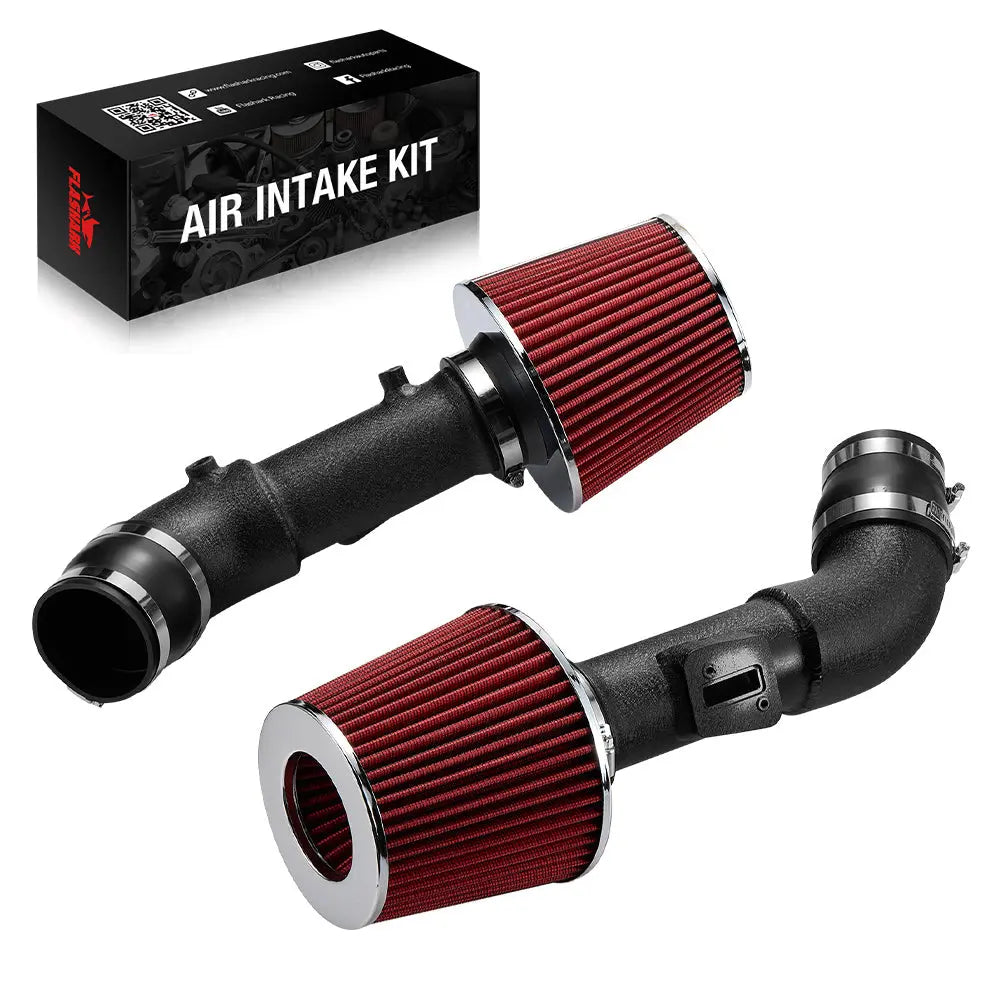
Before buying any kit, confirm the exact year, model, engine, MAF arrangement, and tune requirement. Flashark organizes its vehicle-specific cold air intake kits by application so you can start with the right layout instead of adapting a universal tube around a sensitive sensor.
Construction also matters. A short ram and a true cold-air layout can put the filter in very different temperature and water-exposure zones. MAF housing scale, heat shielding, and calibration are also discussed in our Camaro SS cold air intake and MAF scaling guide. Use its platform-specific figures only for the Camaro generation and setup identified there—not as universal intake data.
Does the ECU Need an Idle Relearn or a Tune?
Maybe. But a relearn cannot tighten a clamp.
Battery disconnection, throttle-body service, or a model-specific control strategy may require an idle or throttle relearn. Use the OEM procedure for the exact vehicle. The old “disconnect the battery, wait ten minutes, and hope” routine is not a universal diagnostic method.
When a Tune Becomes a Real Possibility
- The intake manufacturer explicitly labels the kit tune required.
- The MAF housing diameter, sensor depth, or airflow straightener differs materially from stock.
- The intake is not designed for the exact engine and model-year control strategy.
- The car also has a larger throttle body, camshaft, forced induction, injectors, or other major airflow changes.
- The installation passes a smoke test, wiring checks out, live data remains implausible, and the stock intake restores normal operation.
Do not tune around a mechanical leak. You may make one operating area look better while leaving the actual fault in place.
Use the Stock Airbox as Your Best A/B Test
Never throw the original intake away. Put it back exactly as it was, including the original MAF seal, hoses, clamps, and airbox. Clear adaptations only if the service procedure calls for it, then repeat the same cold-start and warm-idle checks.
If the engine immediately returns to normal, the new intake or its installation moves to the top of the list. That still does not tell you which detail failed. If the problem remains, inspect anything disturbed during the job and widen the diagnosis beyond the intake.
A 15-Minute Rough Idle After Cold Air Intake Checklist
- Save stored and pending codes plus freeze-frame data.
- Confirm the intake part number matches the year, model, engine, and MAF layout.
- Verify the MAF airflow arrow points toward the engine.
- Check that the MAF connector is locked and no terminal is bent or pushed back.
- Inspect the MAF O-ring or gasket for a cut, fold, or missing seal.
- Reseat every coupler downstream of the MAF.
- Square every clamp and keep it on solid clamping material.
- Reconnect every PCV, breather, EVAP, and model-specific vacuum hose.
- Look under the tube for hidden cracks, folded silicone, and open ports.
- Inspect the filter for excess oil, water, packaging, or incorrect seating.
- Clean the MAF only with MAF-safe cleaner when contamination is plausible.
- Compare MAF housing diameter, sensor depth, and bend location with stock.
- Smoke-test the tract when a visual check finds nothing.
- Perform the correct vehicle-specific relearn if required.
- Reinstall the stock intake and repeat the test before buying sensors.
Choosing the Right Replacement or Upgrade
If the current kit is the wrong application, missing an adapter, or built around incompatible MAF geometry, stop trying to “make it fit.” Choose a system designed for the vehicle and verify the product page’s engine and model-year boundaries before ordering.
For truck applications, browse GMC Sierra and GMC truck air intake kits or Ford F-150 and Ford truck cold air intakes by platform. Civic and Accord builders can compare Honda Civic and Accord cold air intake kits while checking engine, sensor type, transmission, and model year. A brand name on the box does not override fitment. The details still win.
- The check-engine light is flashing.
- The engine repeatedly stalls in traffic.
- The vehicle enters reduced-power or limp mode.
- There is heavy misfire, backfire, abnormal smoke, or a strong raw-fuel smell.
- The filter or intake tube is loose enough to detach.
- Throttle response is unpredictable or the engine cannot hold idle.
When the Cold Air Intake Is Not the Root Cause
Timing is evidence, not proof. The intake job may have disturbed a brittle hose that was already failing. Or the complaint may be unrelated and simply appeared on the same weekend.
If the stock intake does not restore normal operation, continue with ignition coils and plugs, fuel pressure, injector balance, EVAP purge operation, PCV function, intake-manifold sealing, throttle-body condition, wiring integrity, and engine mechanical health. Use misfire counters and live data. Do not guess.
Final Verdict: Fix the Airflow Error Before Replacing Parts
The best diagnostic order is simple: scan first, verify MAF direction, seal every post-MAF joint, reconnect the PCV and vacuum plumbing, check contamination, verify housing geometry, and perform a relearn or tune only when the application calls for it.
Most owners searching for rough idle after cold air intake do not need another random parts recommendation. They need to find where measured airflow and actual airflow stopped agreeing. Start there. Your wallet—and probably your MAF sensor—will thank you.
FAQ: Rough Idle After Cold Air Intake Installation
Q1: Can a cold air intake cause a rough idle?
A1: Yes. A cold air intake can contribute to a rough idle when it introduces a post-MAF leak, changes MAF housing geometry, disturbs a hose or connector, contaminates the sensor, or requires calibration. A correctly fitted and sealed vehicle-specific system should not be dismissed as “normal” if it repeatedly stalls or sets codes.
Q2: Why does my car idle rough after installing a cold air intake?
A2: Start with what changed: MAF direction and seal, coupler position, clamps, the electrical connector, and PCV or breather hoses. If those pass inspection, compare live data and the aftermarket MAF housing with the factory setup.
Q3: Which way should the MAF sensor face on a cold air intake?
A3: The airflow arrow should point from the air filter toward the throttle body, engine, or turbo inlet. If there is no visible arrow, follow the vehicle-specific intake instructions and use the original sensor orientation as a reference. Connector position alone is not reliable.
Q4: What happens if the MAF sensor is installed backward?
A4: The sensor may report inaccurate or unstable airflow. Possible results include rough idle, hesitation, stalling, a check-engine light, and MAF or mixture-related codes. The exact behavior depends on sensor design and ECU strategy.
Q5: What are common intake vacuum leak symptoms?
A5: Common clues include hissing, high or hunting idle, rough idle, stalling at stops, slow rpm return, hesitation, positive fuel trims, and P0171 or P0174. These symptoms overlap with other faults, so confirm the leak visually or with an appropriate smoke test.
Q6: Can a loose intake clamp cause a check-engine light?
A6: Yes, particularly when the loose joint is downstream of the MAF and lets unmetered air enter. That can produce lean or airflow-plausibility codes. A clamp may look tight while sitting crooked or too close to the coupler edge.
Q7: Can an oiled cold air intake filter damage the MAF sensor?
A7: Excess filter oil can contaminate some MAF sensing elements, but oil should not be blamed without inspection. Confirm the filter type and service method, inspect for residue, and clean only with MAF-safe cleaner.
Q8: Should I clean the MAF after installing a cold air intake?
A8: Clean it only when contamination is plausible. Use a cleaner labeled specifically for MAF sensors and allow the element to dry fully. Cleaning will not correct a vacuum leak, damaged seal, backward sensor, or incompatible housing.
Q9: Does a cold air intake need an ECU relearn?
A9: Some vehicles may need an idle or throttle relearn after battery disconnection or related service. Follow the OEM or kit procedure for the exact vehicle. A relearn cannot repair an open hose or leaking coupler.
Q10: Does a cold air intake require a tune?
A10: It depends on the kit. A system designed around compatible factory MAF geometry may work with the stock calibration, while a larger housing or substantially modified airflow path may require tuning. Follow the kit manufacturer’s requirement for the exact application.
Q11: Why does my car stall when stopping after a CAI install?
A11: As airflow falls toward idle, a post-MAF leak or unstable MAF signal can have a larger effect on fueling. Check the sensor installation, MAF seal, couplers, PCV hoses, and vehicle-specific idle-control procedure before continuing to drive.
Q12: Why is the rough idle worse when the engine is cold?
A12: Cold-start fuel strategy and temperature-sensitive seals can expose a marginal leak. However, cold-only roughness may also come from ignition, injectors, intake-manifold sealing, or other faults, so do not limit the diagnosis to the CAI.
Q13: Can a cold air intake cause P0101, P0171, or P0174?
A13: It can contribute to those codes through incorrect MAF readings or unmetered air. The codes identify an airflow or mixture problem; they do not prove the MAF itself has failed.
Q14: Why does the engine run better when I unplug the MAF?
A14: Many ECUs substitute modeled airflow values when the MAF is disconnected. If the engine improves, that supports further checks of the MAF signal, housing, wiring, and post-MAF leaks, but it is not a conclusive MAF replacement test.
Q15: Should I reinstall the stock airbox to test the problem?
A15: Yes, when the factory parts are complete and safe to reinstall. A careful stock-versus-aftermarket A/B test is one of the quickest ways to determine whether the new intake system is involved.
Q16: How long should I wait for the ECU to adjust to a cold air intake?
A16: There is no universal mileage or idle-time answer. Mild correction after battery disconnection can occur, but repeated stalling, violent surging, flashing CEL, or reduced-power mode requires diagnosis now—not another long drive.

Steven Chen
Automotive Performance Specialist | Engine & Exhaust Systems
Steven focuses on practical engine performance, exhaust fitment, and real-world upgrade paths for classic and modern enthusiast vehicles. He reviews small-block Ford, LS, truck, and street/strip applications with one goal in mind: helping builders choose parts that actually work together. His philosophy: "Good power starts with the right combination, not the biggest part."