I spend my days in the shop staring at HPTuners datalogs and pulling wrenches on GM V8s. When a 5th or 6th Gen Camaro SS rolls into my bay complaining about a sluggish throttle or a muted top-end pull, I don't even need to scan the car to know the first bottleneck. GM built the LT1 and LS3 to be absolute monsters, but then they strangled them to meet factory NVH (Noise, Vibration, and Harshness) regulations.
To keep the cabin quiet, they routed your intake air through corrugated plastic tubes and restrictive sound resonators. The result? Air turbulence and heat soak. If you're looking for the best cold air intake for Camaro SS, you need to look past the shiny polished tubes on Instagram and start looking at IAT (Intake Air Temperature) data and MAF (Mass Air Flow) scaling. Because if your intake isn't managing those two things, you are actively losing horsepower.
Executive Summary: The Mechanic's Bottom Line
If you just want the straight facts on how to set up your Camaro's airflow without triggering a check engine light, here is the breakdown based on your generation and goals:
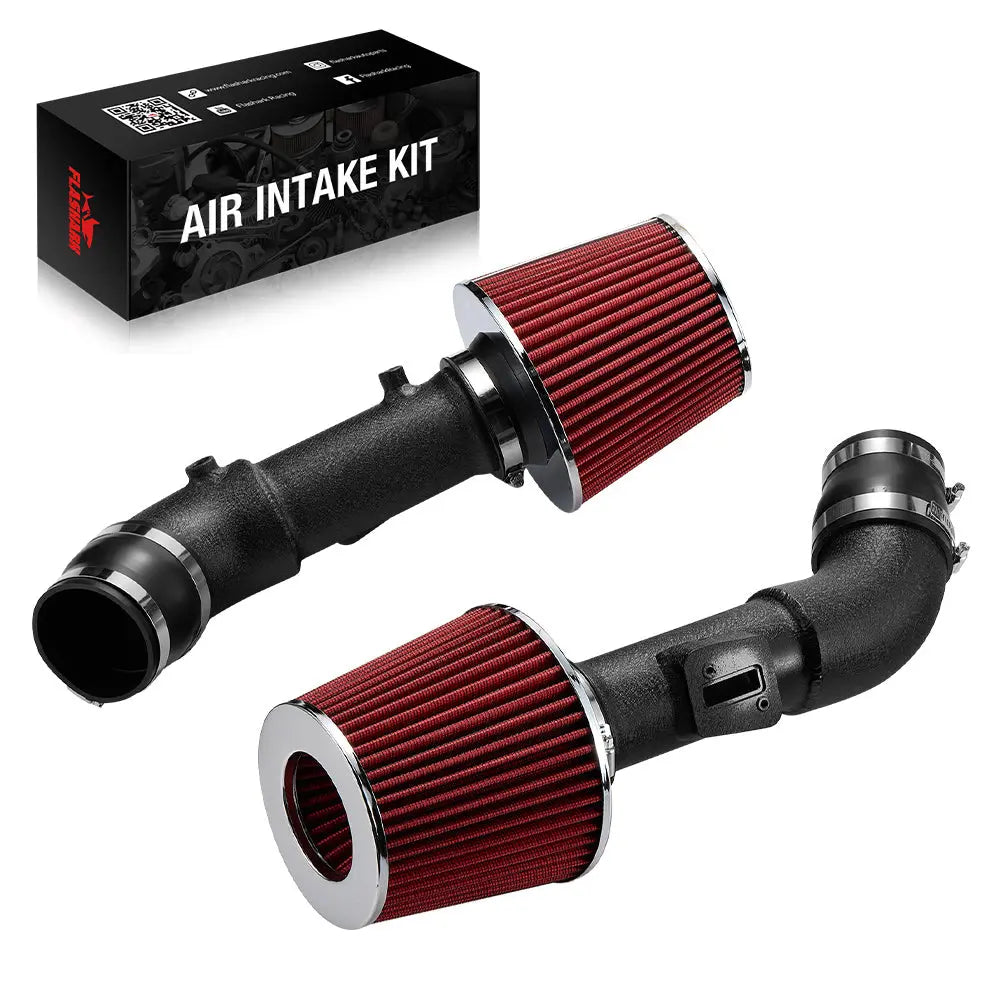
- Best for 2016-202X (Gen 6 LT1) - No Tune Required: The critical factor here is the MAF housing diameter. The Flashark 6th Gen Intake uses a 1:1 scaled MAF housing, meaning fuel trims stay within the safe factory +/- 5% margin. Expect a drop in turbulence and a proven 8-12 WHP gain on the stock tune.
- Best for 2010-2015 (Gen 5 LS3/L99) - Maximum Heat Management: These engine bays are notorious for heat soak. You must use an intake with a dedicated, heavy-duty heat shield to isolate the filter from radiator wash. The Flashark 5th Gen kit drops IATs closer to ambient, preventing the ECU from pulling timing.
- The Golden Rule of Airflow: Never install an open-element filter without a heat shield. If your IATs cross 135°F, your ECU will pull ignition timing, and your 400+ HP V8 will feel like a V6.
Why the Factory Setup Chokes Your V8 (And What Actually Works)
Let’s talk fluid dynamics. An engine is an air pump. Power is made when you pack dense, oxygen-rich cold air into the cylinders. The factory intake tube is full of accordion-style ridges. When air passes over those ridges at high velocity, it creates turbulence. Turbulence slows the air down.

On top of that, the factory flat-panel paper filter is dense. It's great for lasting 30,000 miles without maintenance, but terrible for high-RPM flow. When we develop and test intakes here at Flashark, we focus on mandrel-bent aluminum piping to give the air a straight, frictionless shot into the throttle body.
🛠️ From the Shop Floor
I remember back in '18, a guy brought his 2016 Camaro SS into the shop. He was frustrated, complaining that the car felt bogged down off the line and didn't have that classic V8 snap. We strapped it to the dyno and plugged in HPTuners. The factory intake tract was completely heat-soaked after two pulls, and the IATs were reading 142°F. The ECU was pulling almost 4 degrees of timing to prevent knock.
We tore that plastic junk out and bolted on a proper Flashark cold air system with an aluminum tube and an isolated heat shield. On the very next pull, the IATs dropped to just 6 degrees above ambient room temperature. Not only did the timing come back, but the dyno showed a clean +11 WHP across the curve. The throttle response was instantly sharper because the engine didn't have to fight vacuum restriction to gulp air.
Gen 6 LT1 (2016-Present): The MAF Sensor Survival Guide
If you own a 6th Gen, you need to respect the Mass Air Flow (MAF) sensor. GM engineers made the LT1’s ECU incredibly sensitive to air volume changes. If you bolt on a cheap aftermarket intake where the pipe diameter around the MAF sensor isn't perfectly engineered, the air velocity gets skewed. The sensor lies to the ECU, your air/fuel ratio goes lean, and your dash lights up with a Check Engine Light (CEL).

This is exactly why we engineered the 2016 - 2019 Camaro SS cold air intake with precise MAF scaling. You can bolt this on in your driveway, and the factory ECU will adapt seamlessly. No custom tune required. You get the aggressive induction roar under heavy throttle, the increased throttle response, and zero tuning headaches.
View Flashark Gen 6 Intake Specs
Gen 5 LS3/L99 (2010-2015): Beating the Heat Soak
The 5th Gen Camaros are legendary, but they have a massive flaw: the engine bay turns into an oven in stop-and-go traffic. If you upgrade your intake but fail to manage the heat, you are actually downgrading your car.
⚠️ Warning: The "Naked Filter" Trap
Lots of beginners watch online tutorials and just rip out their factory airbox to clamp a cheap, naked $40 cone filter directly onto the throttle body tube. I suggest you absolutely never do this. Without a heat shield, that open filter acts like a vacuum for 160-degree air radiating straight off the radiator hoses and exhaust headers. Your ECU will detect the hot air, pull timing to save the engine, and you will literally lose horsepower compared to the stock box. Don't cheap out on thermal protection.

The 2010 - 2015 Camaro SS cold air intake was built specifically to combat this. We use a heavy-duty, custom-fit heat shield equipped with weather stripping that seals directly against the hood liner. This essentially creates a cold-air box that draws denser air directly from the fender well area, completely blocking out engine radiant heat.
View Flashark Gen 5 Intake Specs
The Data: Flashark vs. Factory Intake
Numbers don't lie. Here is what you are actually getting when you step up to a properly engineered intake system.

| Spec / Feature | Factory SS Airbox | Flashark Performance Intake |
|---|---|---|
| Airflow Path | Corrugated plastic (High turbulence) | Smooth mandrel-bent aluminum |
| Filtration Media | Flat paper (Restrictive, throwaway) | High-flow 4-layer cotton (Washable) |
| IAT Management | Closed plastic box (Prone to soaking) | Custom heat shield with hood seal |
| Expected HP Gain | Baseline | +8 to +12 WHP (No tune) |
People Also Ask (Camaro SS Cold Air Intake FAQs)
I get bombarded with these questions in the shop and on the forums. Here are the straight answers.
Q1: Does a cold air intake actually add horsepower to a Camaro SS?
A1: Yes. On a dyno, a properly designed intake like the Flashark will consistently show an 8 to 12 wheel horsepower (WHP) increase on a stock 6.2L V8. This happens because you are reducing vacuum restriction, allowing the engine to ingest a higher volume of denser air.
Q2: Do I need a custom tune after installing a Flashark CAI?
A2: No. Our intakes are engineered with a 1:1 scale of the factory MAF sensor housing. This means your sensor reads the incoming air accurately, and the factory ECU can easily adjust the short-term and long-term fuel trims to handle the extra airflow safely.
Q3: Will installing an aftermarket intake void my Chevy warranty?
A3: No, an intake alone will not void your entire powertrain warranty. Under the Magnuson-Moss Warranty Act, a dealership must prove that the aftermarket part directly caused the specific failure you are claiming. For example, an intake won't void your transmission warranty.
Q4: What's the real difference between open and closed box intakes for the SS?
A4: A fully closed box offers the absolute lowest IATs but heavily mutes the engine sound. An open-element filter with a proper heat shield (like our design) gives you a massive increase in induction volume (that deep V8 roar) while still effectively blocking engine bay heat. It’s the best balance for street and track use.
Q5: Why is my 6th Gen Camaro throwing a CEL after an intake install?
A5: 99% of the time, this is user error during install. The most common causes are installing the MAF sensor backward, failing to seat the sensor plug until it "clicks," or having a vacuum leak because the silicone couplers weren't tightened down evenly over the throttle body.
Q6: How much do Intake Air Temperatures (IATs) drop with a proper heat shield?
A6: Compared to an unprotected "naked" filter, a sealed heat shield setup can drop cruising IATs by 20°F to 40°F. Keeping your IATs below 135°F is critical, as that is typically the threshold where the GM ECU begins actively pulling ignition timing.
Q7: Oiled vs. dry filters: Which is better for the LT1/LS3?
A7: Both flow excellent air. Oiled filters catch finer dust particles and flow slightly better at the extreme high end, but you must be careful not to over-oil them after cleaning, which can foul the MAF sensor. Dry filters are easier to maintain (just wash and dry) and carry zero risk of MAF oil contamination.
Q8: How often do I need to clean the intake filter?
A8: For normal city and highway driving, we recommend inspecting the filter every 15,000 miles and doing a full wash/cleaning every 25,000 to 30,000 miles. If you live in a dusty, arid environment, cut those intervals in half.
Q9: Can I install this myself, or do I need a shop?
A9: You can absolutely do this yourself. The Flashark kits are 100% bolt-on. If you have a basic socket set, a flathead screwdriver, and 45 minutes of free time on a Saturday, you can install this in your driveway. No cutting or drilling is required.
Q10: Does a cold air intake change the exhaust or engine sound?
A10: It changes the engine induction sound significantly. Because you are removing the factory plastic mufflers/resonators attached to the stock intake tube, you will hear a deep, aggressive suction roar from the front of the car whenever you go wide open throttle.
Q11: Will this fix the throttle lag on my stock Camaro?
A11: Yes, it drastically improves throttle tip-in. By replacing the restrictive paper filter and ribbed tubing with a smooth, high-flow path, the engine doesn't have to work as hard to pull a vacuum when you suddenly snap the throttle blade open.