Sinceramente, si tuviera un dólar por cada vez que un dueño de un VQ entrara al taller estresado por la configuración de su escape, tendría suficiente para comprar un motor nuevo. Escúchame: estás buscando ese tono agresivo perfecto para tu G37 o 370Z, pero te aterroriza que tu coche suene como una trompeta enojada. Lo entiendo.
Ya sabes que los catalizadores de fábrica están ahogando tu VQ37VHR. Sabes que necesitas quitarlos. ¿El verdadero dolor de cabeza? Decidir entre configuraciones resonadas o no resonadas.
Antes de que empecemos a hilar fino sobre frecuencias acústicas y hojas de dinamómetro, vamos a ir al grano. Esto es exactamente lo que necesitas saber.
Aspectos clave: ¿Qué configuración se adapta a tu coche?
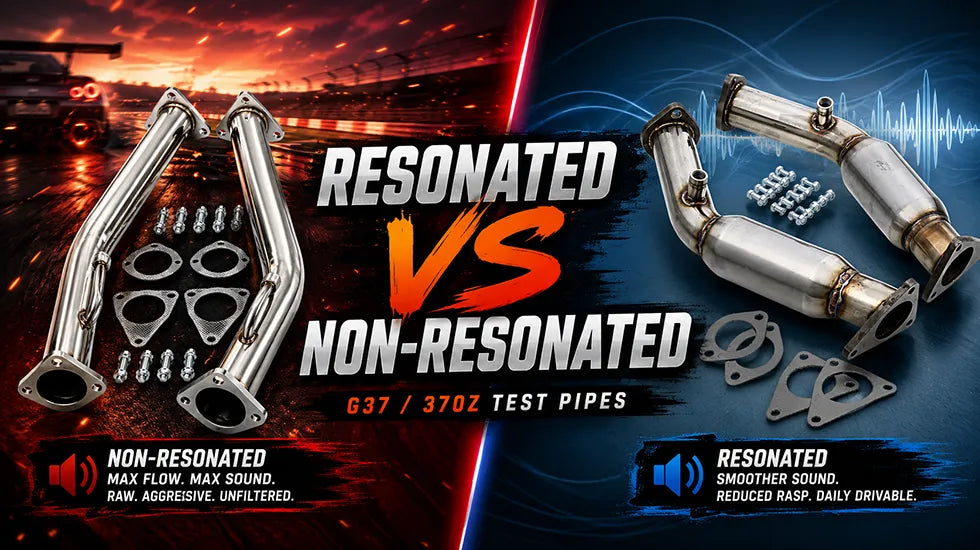
- Elige no resonado si: Buscas la máxima potencia en las ruedas (WHP), utilizas un sistema de escape de alta calidad del mercado de accesorios que ya gestiona bien las frecuencias, planeas usar un mapa de llamas (UpRev/EcuTek), o simplemente quieres el sonido más fuerte y crudo posible para la pista.
- Elige resonado si: Tu coche es de uso diario, utilizas el sistema de escape de fábrica (o solo un axle-back), no toleras el zumbido de la carretera a 3.000 RPM, y tu objetivo principal es eliminar el infame raspe metálico del VQ.
- Diferencia de rendimiento: La diferencia de potencia entre ambos es insignificante en coches de calle (típicamente entre 1 y 3 whp en un dinamómetro).
- La luz de verificación del motor (CEL): Ambos estilos probablemente encenderán una luz de verificación del motor (CEL) sin espaciadores de O2 o una reprogramación adecuada de la ECU.
¿Qué son los "test pipes" y por qué mejorarlos?
Los catalizadores de fábrica son ladrillos densos y pesados con forma de panal diseñados para mantener las emisiones dentro de los límites legales. También son enormes cuellos de botella. Cuando pisas el acelerador, esos catalizadores actúan como un tapón en tu sistema de escape, creando una contrapresión que anula el par motor de rango medio y amortigua la respuesta del acelerador.
Al reemplazarlos por test pipes, literalmente le estás dando espacio al motor para respirar. Pero eliminar esa restricción cambia drásticamente la acústica de los gases de escape que salen del bloque.
Diferencias clave entre los "test pipes" resonados y no resonados
Veamos la física real de lo que está sucediendo debajo de tu coche.
Estructura física y dinámica de flujo
Los tubos no resonados son esencialmente tubos de acero rectos y huecos. Desde una perspectiva puramente de dinámica de fluidos, ofrecen el camino de menor resistencia. Los gases de escape salen de los colectores y pasan directamente al tubo en Y. Es un flujo de aire crudo y sin restricciones.
Un tubo resonado presenta una sección ligeramente más ancha que contiene un núcleo perforado envuelto en material de empaque (generalmente fibra de vidrio o malla de acero inoxidable). El gas de escape sigue fluyendo directamente a través del orificio central, pero las ondas sonoras se expanden hacia el material de empaque.

El factor sonido (volumen vs. tono)
Si buscas volumen, los no resonados son tu mejor opción. Son violentamente ruidosos al arrancar en frío. Sin embargo, no filtran nada. Cada frecuencia áspera que produce el motor VQ se amplifica.
Los tubos resonados no necesariamente hacen que el coche sea silencioso, simplemente mejoran el tono. El resonador se enfoca y absorbe las ondas sonoras de alta frecuencia. Pierdes un poco de volumen bruto, pero ganas un gruñido mucho más profundo y gutural.
Análisis en profundidad: Test pipes resonados vs. no resonados para G37 y 370z
Las plataformas VQ35 y VQ37 son notoriamente difíciles de hacer sonar "bien". Si simplemente atornillas tubos rectos a estos motores, obtienes lo que la comunidad llama la "Trompeta VQ".
Manejo del infame "rasp" del VQ
El rasp es ese ruido metálico, agudo y tintineante que ocurre cuando sueltas el acelerador o alcanzas el rango superior de RPM.
Si estás utilizando el tubo en Y y el silenciador de fábrica, colocar tubos no resonados casi garantizará un rasp severo. El sistema de fábrica no está ajustado para manejar la afluencia repentina de energía acústica bruta. En este escenario, los tubos de prueba resonados para G37 son un salvavidas. Actúan como un amortiguador, suavizando los pulsos de escape antes de que lleguen al resto de tu sistema.
Pero, si ya tienes un catback doble de 3 pulgadas de primera calidad y bien diseñado que gestiona el sonido de forma eficaz, puedes usar un conjunto de tubos de prueba no resonados para G37 y 370z sin que suene como una desbrozadora. Te da el gruñido mecánico puro sin la vibración de una lata.
Ganancias de potencia en dinamómetro: ¿Los resonadores roban caballos de fuerza?
Muchos en los foros te dirán que los resonadores matan el flujo. Veamos los números.
| Tipo de configuración | Ganancia estimada de potencia en las ruedas (WHP) | Contrapresión | Mejor uso |
|---|---|---|---|
| Convertidores catalíticos OEM | Línea base | Alta | Cumplimiento de emisiones |
| Test Pipes Resonados | + 7 a 10 whp | Muy baja | Uso diario, tono profundo |
| Test Pipes No Resonados | + 8 a 12 whp | Ninguna | Carreras en pista, flujo máximo |
En un dinamómetro, los tubos no resonados sí producen un poco más de potencia a la línea roja. Pero estamos hablando de 1 a 3 whp. A menos que estés construyendo un coche de ataque de tiempo dedicado donde cada gramo de peso y fracción de caballo de fuerza importan, no vas a sentir la diferencia en el asiento del conductor.

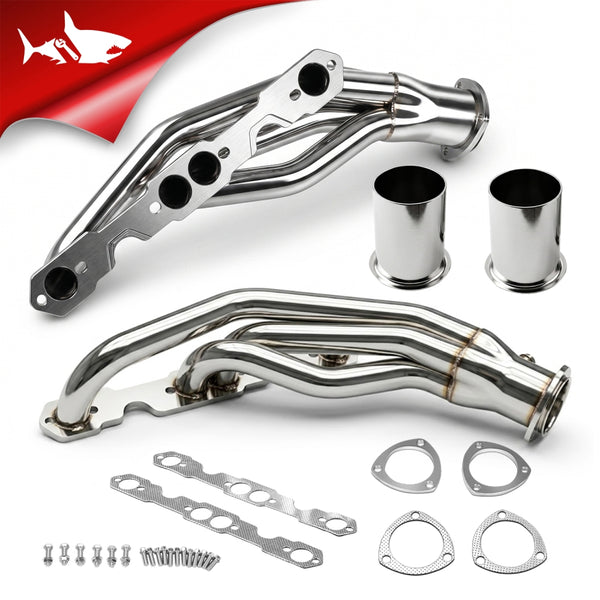
Flashark 2.5" Test Pipes no resonados (2008-2018 G37/370Z)
$175.00 $139.99
- Flujo máximo: Acero inoxidable T-304 de 2.5" y bridas CNC
- Sonido: Tono VQ agresivo y crudo (no resonado)
- Ajuste: 370Z (09-18), G37 Coupé/Sedán/G37x (08-13)
Montaje, instalación y los "Demon Bolts"
🔧 Cuaderno del mecánico: La pesadilla del concesionario
Recuerdo que en 2023, un 370Z manual impecable llegó al taller para una construcción básica de respiradero. El propietario quería cambiar sus catalizadores en el camino de entrada, pero se rindió y nos lo remolcó. Cuando lo subimos al elevador, vimos por qué.
Si vas a hacer esta instalación tú mismo, presta atención. Los tres pernos superiores que conectan los catalizadores de fábrica a los colectores de escape se conocen cariñosamente en la comunidad como los "Demon Bolts" (Pernos Diabólicos). Debido a que sufren miles de ciclos de calor, prácticamente se sueldan con el óxido. Muchos principiantes miran tutoriales en línea, se meten debajo del coche, pelan la cabeza del perno y luego se quedan completamente atascados. Sugiero que nunca los abordes desde abajo.

⚠️ Consejos de instalación de expertos
- Empápalo: Rocía PB Blaster o Kroil en esos pernos cada noche durante tres días antes de empezar el trabajo.
- Ataque de arriba hacia abajo: Para los Demon Bolts, accede desde la parte superior del compartimiento del motor. Retira las tomas de aire. Utiliza un mínimo de tres pies de extensiones de alta resistencia y una toma giratoria.
- Palanca: Usa una barra de palanca enorme. No uses una pistola de impacto de inmediato; romperás el perno.
Ya sea que instales test pipes resonados para 370z o vayas con un tubo recto completo, el dolor de la instalación es exactamente el mismo. Pero en el segundo en que enciendas el motor, esa frustración desaparecerá.
¿Cuál deberías elegir para tu construcción?
Mira, no hay una opción "mejor" universal aquí. Todo se reduce a tu tolerancia al ruido y tus objetivos finales.
Si quieres el flujo más eficiente posible, te encanta el sonido mecánico puro de un VQ y planeas disparar llamas con una reprogramación de EcuTek, ir completamente sin resonar es la respuesta. Es un rendimiento puro y sin filtros. Solo prepárate para el volumen.
Si usas tu coche a diario, vives cerca de vecinos enfadados y odias absolutamente el sonido metálico a 4.000 RPM, gasta el dinero extra o reconsidera la combinación de tu sistema de escape.
Preguntas Frecuentes (FAQ)
P1: ¿Los "test pipes" no resonados causarán una luz de verificación del motor (CEL)?
R1: Sí, absolutamente. La eliminación de los catalizadores de fábrica elimina el sustrato que monitorean los sensores de O2 posteriores. Necesitarás espaciadores de sensor de O2 (defoulers) o una reprogramación adecuada de la ECU para desactivar la luz de verificación del motor (CEL).
P2: ¿Los "test pipes" resonados pierden potencia en comparación con los no resonados?
R2: La diferencia es extremadamente marginal. Debido a que los tubos resonados aún tienen un diseño interno directo, fluyen increíblemente bien. Podrías perder de 1 a 2 caballos de fuerza en las ruedas en comparación con los tubos no resonados, lo cual es imperceptible en la calle.
P3: ¿Cuánto más ruidosos son los tubos de prueba no resonados en un G37?
R3: Espera un aumento de volumen de alrededor del 30% al 40% sobre tu configuración actual. Los arranques en frío serán violentamente ruidosos y el tono del escape será mucho más agresivo con el acelerador a fondo.
P4: ¿Los test pipes harán que mi 370z eche llamas?
R4: Si utilizas tubos no resonados combinados con una reprogramación específica de la ECU (mapa de llamas), sí, es muy probable. No recomendamos intentar echar llamas con tubos resonados, ya que el combustible crudo y el calor pueden dañar el material de empaque interno.
P5: ¿Qué es exactamente el "rasp" y cómo lo solucionan los "test pipes" resonados?
R5: El rasp es un sonido de vibración metálica áspero y de alta frecuencia, casi como si agitaras una lata de café llena de tornillos. Los resonadores utilizan la cancelación acústica y el material de empaque que absorbe el sonido para capturar y eliminar esas frecuencias altas específicas.
P6: ¿Puedo pasar las pruebas de emisiones o smog con los "test pipes"?
R6: No. Quitar los catalizadores de fábrica hace que el vehículo sea ilegal para su uso en la calle en áreas con control de emisiones (como California). Los "test pipes" son estrictamente para uso fuera de carretera o en pista.
P7: ¿Cuánto tiempo se tarda en instalar los "test pipes" en un 370z/G37?
R7: Para un mecánico experimentado con elevador, se tarda aproximadamente de 2 a 3 horas. Si lo haces con caballetes y te encuentras con los "Demon Bolts" oxidados, puede convertirse fácilmente en un trabajo de todo el día.
P8: ¿Necesito una reprogramación de la ECU después de instalar los "test pipes"?
R8: Aunque puedes conducir el coche sin una reprogramación (ignorando la luz de verificación del motor), lo recomendamos encarecidamente. Una reprogramación ajusta tu relación aire/combustible (AFR) para compensar el enorme aumento del flujo de escape, maximizando tus ganancias de caballos de fuerza reales.
P9: ¿Cuál es la diferencia entre los "test pipes" y los catalizadores de alto flujo (HFC)?
R9: Los catalizadores de alto flujo (HFC) todavía contienen un núcleo de panal metálico (normalmente de 200 celdas) para filtrar los gases de escape y mantener las cosas algo legales, reduciendo el volumen. Los "test pipes" son tubos completamente huecos sin ningún tipo de filtración.
P10: ¿Los "test pipes" no resonados zumban en la carretera?
R10: Eso depende en gran medida de tu sistema de escape catback. Si combinas tubos no resonados con un sistema axle-back sin silenciador, experimentarás un zumbido severo dentro de la cabina alrededor de las 3.000 RPM. Un catback de calidad minimizará esto.
P11: ¿Los "test pipes" huelen mal?
R11: Sí. Debido a que no hay catalizador para quemar los hidrocarburos no consumidos, el escape olerá fuertemente a gasolina cruda, especialmente cuando esté al ralentí en los semáforos.