


 Need car parts? Shop by vehicle
(Select the exact fit for your vehicle)
Need car parts? Shop by vehicle
(Select the exact fit for your vehicle)
Colector de escape de Chevy C1500

Choosing Headers for Your Chevy C1500
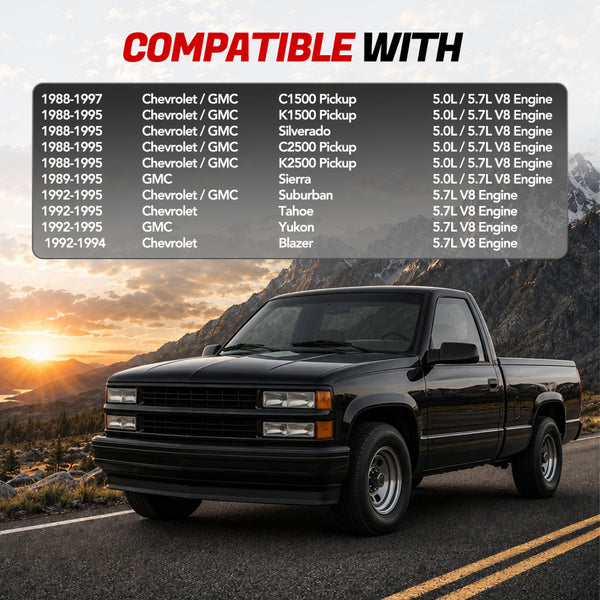
This collection is intended for select 1988-1996 Chevrolet C1500 2WD trucks with compatible 5.0L 305 or 5.7L 350 small-block V8 engines. It does not cover every vehicle that uses a 305 or 350 engine. Model year, drivetrain, engine management, exhaust routing, and previous modifications all affect whether a header fits correctly.
The products shown use a long tube design rather than a factory-style cast manifold or shorty header. Longer primary tubes can reduce exhaust restriction and change the truck's exhaust character, but they also extend farther under the vehicle. That makes clearance and downstream exhaust connection checks especially important.
Before You Buy
- Confirm that the truck is a 1988-1996 Chevrolet C1500 with 2WD.
- Verify a compatible 5.0L 305 or 5.7L 350 small-block V8.
- Compare the 3-inch, three-bolt collectors with the existing exhaust connection.
- Check the number and location of the truck's O2 sensors.
- Identify engine swaps, suspension changes, or custom exhaust work that may affect clearance.
What Is Included
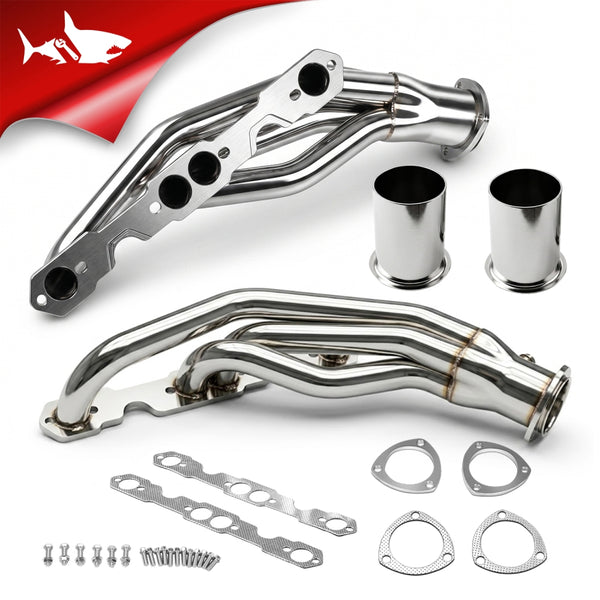
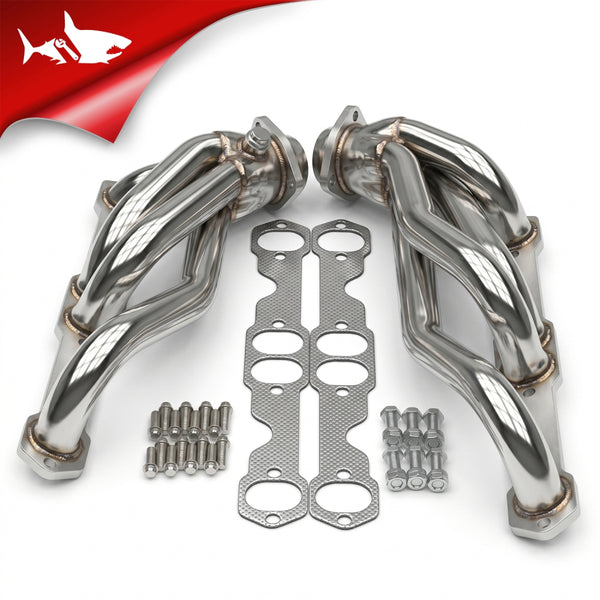
The listed headers use 1.5-inch primary inlets leading to 3-inch outlets with three-bolt collector flanges. Reducers, bolts, and metal gaskets are listed with the kit. Check the current product listing and package contents before installation, especially if separate exhaust adapters, O2 fittings, fasteners, or replacement spark plug wires may be needed for your truck.
Although reducers are included, their presence does not guarantee a direct connection to every factory Y-pipe or aftermarket exhaust. Pipe diameter, flange position, collector angle, catalytic converter placement, and previous exhaust work can change what is required after the headers are installed.
Long Tube Headers and Factory Manifolds
Factory cast manifolds are compact and designed around the original exhaust layout. Long tube headers use extended primary tubes to create a less restrictive path before the exhaust reaches the collectors. On a compatible small-block C1500, this can support improved exhaust flow and a stronger exhaust note.
Actual performance depends on the condition of the engine, camshaft, fuel and ignition calibration, catalytic converters, mufflers, pipe size, and other modifications. These headers should be treated as one part of the full exhaust system rather than a guaranteed source of a specific horsepower or torque increase.
Collector and Exhaust Connection
Each header terminates at a 3-inch collector with a three-bolt flange. Before removing the factory manifolds, compare that connection with the truck's current Y-pipe or dual-exhaust layout. A vehicle with factory piping may need adapters or downstream exhaust work, while a truck with a custom system may require alignment or fabrication.
Mock up both headers before fully tightening the flange bolts. This makes it easier to inspect collector angle, pipe routing, ground clearance, and the space available for catalytic converters or other emissions equipment.
Clearance Checks That Matter
Long tube headers occupy more space than factory manifolds. Check both sides for clearance around the steering shaft, starter, transmission, frame, brake lines, wiring, and spark plug boots. Plug wires must be routed away from hot primary tubes, and nearby hoses or wiring should not rest against the headers.
Lowered suspension, non-original engine mounts, transmission changes, and engine swaps can alter the position of the engine or exhaust. A part designed around an unmodified C1500 cannot be assumed to fit the same way on a modified truck.
O2 Sensors, Catalytic Converters, and Tuning
The current header specifications identify an O2 sensor provision, but the exact sensor count, bung location, and wiring requirements should be confirmed for the truck's model year and engine management system. Do not assume that one provision will satisfy every original sensor arrangement.
Changing the O2 sensor position, catalytic converter location, or downstream exhaust can affect fuel-control feedback, emissions monitoring, and warning-light behavior. Some combinations may benefit from calibration changes, while others may require exhaust or sensor-related work. A tune is not automatically required in every case, but the page cannot guarantee that a check engine light will not occur.
Emissions and Road-Use Warning
Long tube headers may change the location or operation of emissions equipment. No product-specific road-use or emissions certification is established here. Confirm local inspection requirements and whether the original catalytic converters and O2 sensors can remain in compliant operating positions before installation.
Frequently Asked Questions
Q1: Will these headers fit every 1988-1996 Chevy C1500?
A1: No. They are intended for select 1988-1996 Chevrolet C1500 2WD trucks with a compatible 5.0L 305 or 5.7L 350 small-block V8. The engine, drivetrain, exhaust layout, and vehicle modifications must still be checked.
Q2: Are these long tube or shorty headers?
A2: These are long tube headers. Their extended primary tubes require more underbody clearance and a more careful downstream exhaust connection check than many shorty headers.
Q3: Will these headers fit a 4WD Chevy C1500 or K1500?
A3: This collection is limited to compatible C1500 2WD applications. Fitment on a 4WD truck or K-series chassis should not be assumed because the front driveline, frame clearance, and exhaust routing differ.
Q4: Do the headers fit both 5.0L 305 and 5.7L 350 engines?
A4: The listed engine range includes compatible 5.0L 305 and 5.7L 350 small-block V8 applications. Engine size alone does not confirm fitment, so verify the truck's year, 2WD chassis, engine configuration, and exhaust layout.
Q5: Will the 3-inch collectors connect directly to my factory exhaust?
A5: A direct connection cannot be guaranteed. Compare the three-bolt flange, collector angle, pipe diameter, Y-pipe position, and catalytic converter layout with the existing exhaust before installation.
Q6: Are reducers, gaskets, and mounting hardware included?
A6: Reducers, bolts, and metal gaskets are listed with the header kit. Review the current package contents before installation because additional adapters, exhaust hardware, or sensor-related parts may be required for a specific truck.
Q7: Do these headers have an O2 sensor port?
A7: The current specifications identify one O2 sensor location. Confirm its position and compatibility with the truck's original sensor count, wiring, and emissions system before ordering.
Q8: Do long tube headers require a tune?
A8: Not in every configuration. The need for tuning depends on the model year, engine management system, O2 sensor arrangement, catalytic converter setup, and other engine or exhaust modifications.
Q9: Can these headers cause a check engine light?
A9: A no-CEL result cannot be guaranteed. Moving or changing O2 sensors, catalytic converters, or exhaust flow can affect emissions monitoring, so the complete vehicle configuration should be evaluated before installation.
Q10: Will installation require exhaust modification?
A10: It may. Some trucks can use the supplied reducers as part of the connection, while others may need adapters, pipe alignment, welding, or custom downstream exhaust work.
Q11: What should be checked for clearance during installation?
A11: Check the steering shaft, starter, transmission, frame, brake lines, wiring, spark plug boots, collectors, and downstream piping. Inspect the full steering range and keep heat-sensitive components away from the primary tubes.
Q12: Are these headers legal for street use?
A12: Road-use and emissions requirements vary by location and vehicle configuration. No product-specific emissions approval is established here, so confirm local rules and inspection requirements before modifying the catalytic converter or O2 sensor arrangement.


