
Honda Downpipe Exhaust & Test Pipes: What This Upgrade Really Changes
Let’s be honest. Most old Honda exhaust problems do not start with some fancy horsepower theory. They start under the car, with rusted flange bolts, a tired catalytic converter, a crooked test pipe, or a turbo downpipe that “almost fits” until the O2 sensor points straight into the chassis.
If you are shopping for a Honda downpipe exhaust or a Honda test pipe for a Civic, CRX, Del Sol, Integra, or a T3/T4 turbo B-series or D-series build, the real question is not just “will it make power?” The better question is: will it flow better, seal correctly, clear the chassis, keep the O2 sensor where it belongs, and match the way your car is actually built?
That is where this category matters. Flashark Honda downpipes, test pipes, and related exhaust sections are aimed at older Honda and Acura platforms where one small exhaust mismatch can turn a simple bolt-on job into a Saturday full of busted knuckles.
BLUF — Bottom Line Up Front:
- For mild naturally aspirated Civic, CRX, Del Sol, and Integra builds: a test pipe or freer-flowing exhaust section usually improves sound and flow, but do not expect magic. On a healthy stock NA setup, gains may be small, often around 0-3 whp. If the old catalytic converter is partially clogged or the car already has headers and a catback, 2-6 whp is more realistic.
- For turbo B-series or D-series setups: downpipe flow matters a lot more. On small T3/T4 Honda turbo builds running roughly 7-12 psi with a proper tune, I have seen restrictive downpipe swaps free up about 12-25 whp at the wheels when the old pipe was a real bottleneck.
- For street-driven cars: catted options are generally the safer direction for emissions, smell, and inspection concerns. Catless downpipes and test pipes can trigger CEL and may not be legal for road use in many areas.
- For swapped or custom-built cars: never buy only by engine code. A B18 swap in an EG Civic, a D16 turbo kit in an EK, and a stock Integra exhaust layout can all need different clearance and flange checks.
Why Upgrade a Honda Downpipe or Test Pipe?
The factory exhaust path on older Hondas was built for cost, emissions, quiet operation, and mass production. Not for your 20-plus-year-old Civic with a header, a half-rusted cat section, a cheap catback, and an owner who wants the engine to breathe past 6,500 rpm.
A better downpipe or test pipe helps clean up one of the most ignored parts of the exhaust system: the transition between the manifold, turbo, catalytic converter area, and the rest of the exhaust. That transition is where bad bends, tiny pipe diameter, crushed gaskets, and leaking flanges steal response.
The Real Problems With Stock or Poorly Matched Exhaust Sections
On an old Honda, the exhaust problem is rarely one single thing. It is usually a stack of small issues. A rusty flange. A collapsed flex section. A converter that has lived through 180,000 miles of heat cycles. A rear O2 sensor that has been removed and reinstalled so many times the threads look like chewed aluminum.
Here is what I see most often in the shop:
- Factory catalytic converter sections that are partially restricted or physically damaged.
- Cheap test pipes with thin flanges that warp after repeated heat cycles.
- Wrong pipe length, causing the catback to sit under tension.
- O2 bungs welded at a bad angle, making sensor wiring tight or twisted.
- Exhaust leaks at the lower flange because someone reused a crushed gasket.
- Turbo downpipes that clear the engine, but hit the firewall, fan, or subframe once the engine torques under load.
That is why a Honda downpipe exhaust is not just a shiny tube. It is a fitment part, a flow part, and sometimes the difference between a clean install and a car that rattles every time you take off from a stoplight.
What a Better Downpipe or Test Pipe Can Improve
A properly matched Honda test pipe or downpipe can reduce restriction, improve exhaust flow, sharpen throttle response, and change the exhaust tone. On turbo setups, it can also help the turbine discharge exhaust gases more efficiently. That matters. After the turbine, restriction is the enemy.
Do not listen to people who say every catless pipe adds huge power. That is forum noise. On a mild naturally aspirated D16 or B18, the improvement might be mostly sound and response. On a turbo B16, B18, D15, or D16 setup, especially with a small T3/T4 turbo, a better downpipe can be much more noticeable because the turbo is sensitive to post-turbine restriction.
Where This Upgrade Makes the Biggest Difference
The biggest difference usually shows up in three situations:
- Turbo Honda builds: especially B-series and D-series cars using T3/T4-style turbo hardware.
- Older cars with tired exhaust parts: where the original cat section or old aftermarket pipe is leaking, clogged, or badly aligned.
- Complete exhaust setups: cars that already have headers, a catback exhaust, intake work, cams, or tuning support.
On a bone-stock daily driver, a Honda test pipe is not going to turn a slow car into a monster. But if the factory section is restrictive or damaged, you may feel cleaner revving, quicker response, and a louder, sharper exhaust note.
Pain Points and Flashark Advantages
Flashark sits in a useful spot for Honda owners who want better flow without jumping into custom-fabrication pricing. The goal is not to sell you some fantasy “bolt-on race car” story. The goal is to solve the physical weak points: old restriction, poor pipe transition, cracked gaskets, weak hardware, and fitment headaches on aging Honda and Acura chassis.
Fitment Pain: Civic, CRX, Del Sol, and Integra Are Not All the Same Underneath
This is where beginners get burned. They see “B-series” or “D-series” in a product title and assume everything will line up. No. Listen to me for a second: engine family matters, but it is not the whole fitment story.
A 1992 Civic hatch with a B18 swap is not the same under the car as a stock 1998 Integra LS. A CRX with a turbo D16 is not the same job as an EK Civic with a naturally aspirated D-series header. And once a previous owner has touched the exhaust, all bets get looser.
Mechanic’s Note — Real Shop Case:
I remember a 1998 Civic hatch that came into the shop with a small T3/T4 turbo kit. The owner bought a cheap downpipe because the flange looked right in the photos. On the bench, sure, it looked close. But once we got the car on the lift, the lower flange sat about half an inch off from the rest of the exhaust, and the O2 bung pointed so high that the sensor wire was stretched tight against the firewall. The owner thought the pipe was “bad.” The real problem was that the car had a swapped engine, an aftermarket manifold, and a catback that had already been modified twice. That is why I always tell Honda guys: check flange angle, pipe route, O2 location, and where the pipe meets the rest of the exhaust before you tighten anything.
Installation Pain: Rust, Heat Cycles, and Old Honda Hardware
Old Hondas are simple cars, but simple does not mean easy. Exhaust bolts live a hard life. Heat, water, road salt, and years of vibration turn clean hardware into brown little nightmares.
Before installing a Honda downpipe exhaust or test pipe, prepare like the bolts are going to fight you. Use penetrating oil. Have replacement hardware ready. Get an O2 sensor socket. Keep anti-seize nearby. And please, do not crawl under the car with one tiny jack and a dream. Use jack stands or a lift.
Sound Pain: Louder Does Not Always Mean Better
Catless Honda exhaust parts can sound aggressive. Sometimes that is exactly what you want. But on a small displacement four-cylinder, especially a D-series or B-series with a straight-through catback, the tone can turn raspy fast.
A test pipe can make the exhaust louder, sharper, and smellier. If the car already has a loud muffler delete or a cheap straight-through system, do not be surprised when highway drone shows up around 2,800-3,500 rpm. A resonator can save your ears. Seriously.
Flashark Value for Honda Exhaust Builds
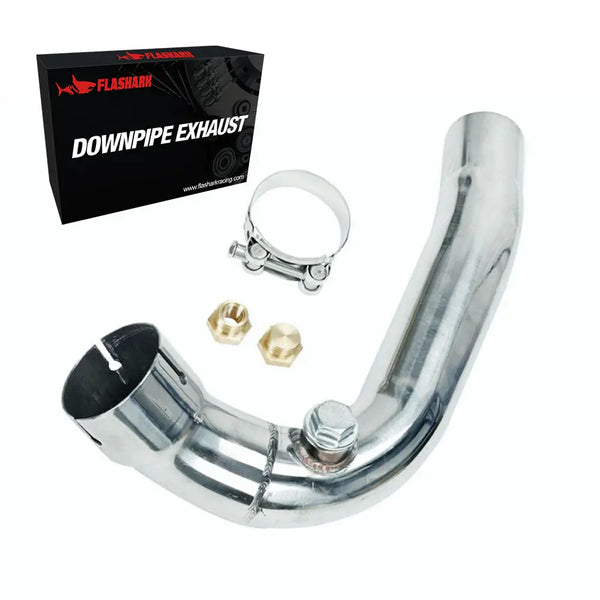
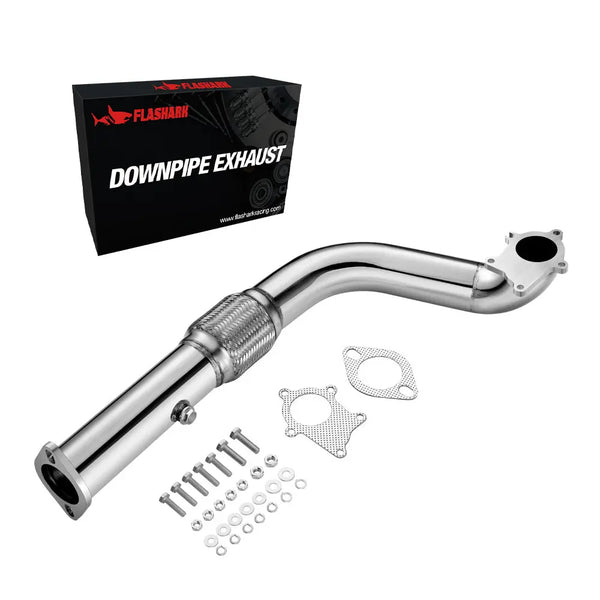
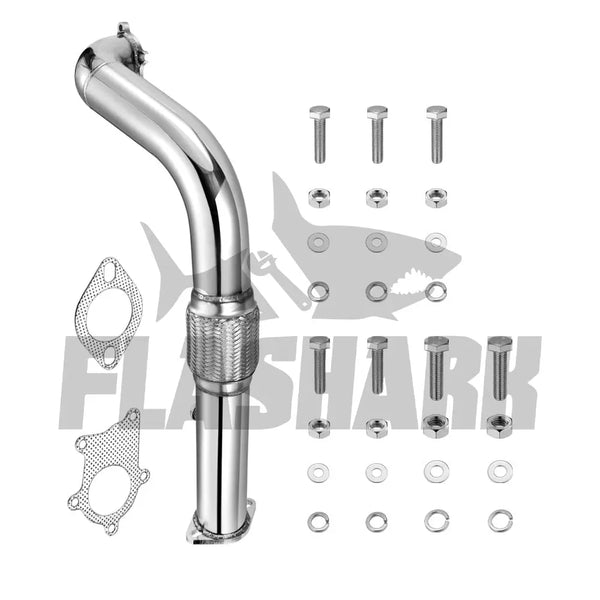
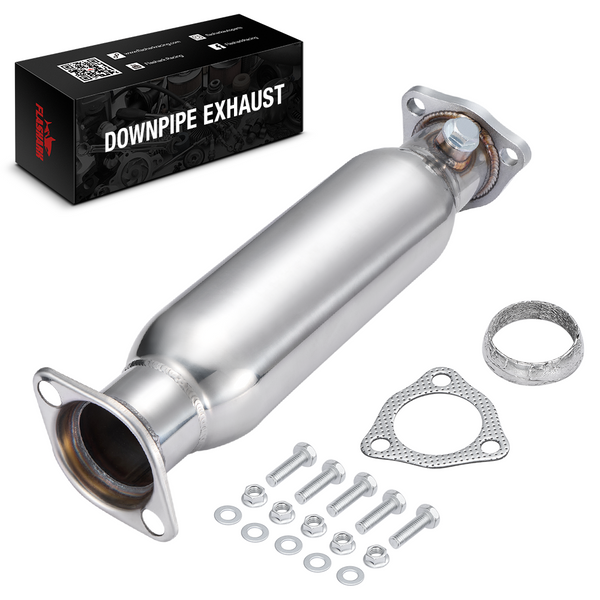
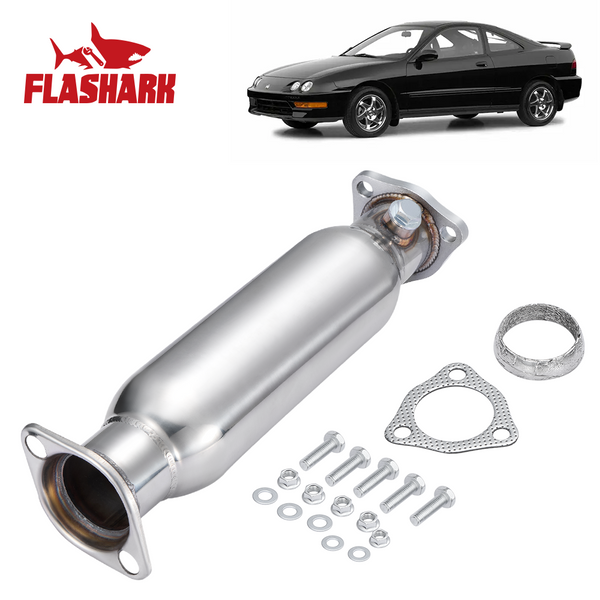
Flashark Honda downpipes and test pipes are built for common enthusiast needs: stainless steel construction, smoother exhaust flow, performance-oriented pipe routing, and fitment for popular older Honda and Acura platforms. On applicable products, features like an O2 bung, gasket, and installation hardware help reduce the small missing-parts problems that ruin an otherwise simple install.
That is the kind of upgrade that makes sense on a budget build. Not fancy talk. Just a cleaner exhaust path that gives the rest of the setup a better chance to work.
Material, Build Quality, and Hardware Details
Exhaust parts live in one of the worst places on the car. They get cooked, soaked, scraped, and heat-cycled over and over. So material and construction matter more than a polished product photo.
Stainless Steel Construction
Stainless steel is a practical choice for a Honda test pipe or downpipe because it handles heat and corrosion better than mild steel. On older Civic, CRX, Del Sol, and Integra builds, this matters because the surrounding exhaust hardware is often already old, rusty, or previously repaired.
Does stainless steel mean it will never discolor? No. Exhaust heat will change the surface over time. But compared with cheap mild steel parts, stainless construction gives you a better foundation for long-term use.
Mirror-Polished Surface Finish
A polished finish looks good, but do not get distracted. The finish is not the power maker. The important things are pipe diameter, flange shape, weld quality, and how well the part lines up with the rest of the exhaust.
That said, a clean polished pipe does make inspection easier during installation. You can spot leaks, rub marks, and contact points faster after the first heat cycle.
Pipe Diameter: 2.25-Inch vs Larger Turbo Downpipe Setups
Pipe size should match the build. A 2.25-inch catless test pipe can make sense on many naturally aspirated or mild Honda setups. It keeps velocity reasonable and pairs well with many street catback systems.
Turbo cars are a different animal. After the turbo, you usually want less restriction. A larger downpipe helps the turbine get rid of exhaust gases faster. For small Honda turbo builds, 2.5-inch to 3-inch exhaust routing is common, depending on power goal, turbo size, boost level, and space under the car.
| Setup Type | Common Pipe Direction | Realistic Result | What to Check |
|---|---|---|---|
| Stock NA D15/D16 | 2.25-inch test pipe or replacement section | Mostly sound and flow; 0-3 whp on a healthy setup | Flange length, catback size, O2 sensor location |
| Header + catback B16/B18 | 2.25-inch to 2.5-inch depending on build | Sharper response; 2-6 whp if old cat was restrictive | Header collector, gasket type, exhaust hanger tension |
| T3/T4 turbo B-series | Usually larger downpipe routing | Can free up 12-25 whp if old downpipe was restrictive | Turbo outlet flange, firewall clearance, wastegate routing |
| CBR600RR mid pipe | Motorcycle-specific mid pipe | Sound and exhaust flow change for the bike | Model year, exhaust layout, street-use rules |
Flange Style, O2 Bung, and Gasket Fitment
The flange is where the install either behaves or turns ugly. A pipe can be the right diameter and still be wrong if the bolt pattern, angle, or length does not match your setup.
O2 bung placement matters too. If the bung is too close to a bend, angled toward the chassis, or positioned where the wire gets pulled tight, you can end up chasing sensor problems that are not really sensor problems.
Specification Consistency Check
When choosing a part, read the product specs carefully. If one listing mentions a 3-inch downpipe but another line lists a different inlet or outlet measurement, verify before ordering. Diameter mismatch is not just a small detail. It affects fitment, flow, clamp choice, and whether the rest of the exhaust bolts up cleanly.
Catted vs Catless Honda Downpipes and Test Pipes
This is where a lot of people get loud online and sloppy in real life. Catted and catless parts are not just two versions of the same thing. They behave differently, smell different, sound different, and carry different legal risk.
What Is a Catted Downpipe?
A catted downpipe keeps a catalytic converter in the exhaust path. That helps reduce emissions and usually keeps exhaust smell more controlled. For street-driven cars, a compliant catted setup is usually the smarter direction, especially in areas with emissions inspection.
A catted setup may not flow as freely as a catless pipe, but it is much more livable for a daily driver. Less smell. Less raw exhaust stink at stoplights. Better chance of keeping the car inspection-friendly when the correct compliant parts are used.
What Is a Catless Downpipe or Test Pipe?
A catless downpipe or test pipe removes the catalytic converter section and gives exhaust gases a straighter path. On a turbo Honda, that can reduce restriction after the turbine. On an NA Honda, it can change sound and reduce restriction in the cat section.
But here is the part people skip: catless parts can trigger a check engine light, increase exhaust odor, make the car raspier, and create emissions compliance problems. If your area checks catalytic converter presence or OBD readiness, do not pretend this is a tiny issue.
Catted vs Catless: Which One Should Honda Owners Choose?
Choose based on how the car is used:
- Daily street car: a compliant catted setup is usually the better choice.
- Track or off-road build: a catless downpipe or test pipe may make sense where legally allowed.
- Turbo Honda build: flow matters more, but clearance, heat, and legality still matter.
- Old NA Civic or Integra: do not oversize everything just because someone on a forum said “bigger is always better.”
Why Catless Pipes Can Trigger CEL
Most OBD-II Hondas monitor catalyst efficiency using oxygen sensor data. When the catalytic converter is removed or changed, the rear O2 sensor may see readings that the ECU does not like. That can trigger codes such as P0420, depending on the vehicle and setup.
The car may still drive fine. That does not mean it is inspection-ready. Driveability and emissions readiness are two different things.
Why “No CEL” Should Never Be the Only Buying Standard
Some guys only ask, “Will it throw a light?” That is too narrow. A car can have no CEL and still be non-compliant. A car can also run strong but fail inspection because monitors are not ready or emissions equipment is missing.
So do not build your decision around tricking a light. Build it around the actual use case: street, track, local laws, inspection rules, and how much smell or noise you are willing to live with.
Hidden Advantages and Hardcore Exhaust Science
Now let’s talk about the stuff that actually separates a useful Honda exhaust upgrade from shiny tubing and online hype.
Exhaust Backpressure vs Exhaust Velocity
People love saying “engines need backpressure.” That is not quite right. What naturally aspirated engines need is properly managed exhaust velocity and scavenging. Too much restriction hurts flow. But an oversized exhaust on a small NA engine can slow gas speed and make the car feel lazy down low.
On a mild D16 street car, huge pipe diameter can be the wrong move. On a turbo B18, less restriction after the turbo is usually a good thing. Context matters. Always.
Why Turbo Hondas Care More About Downpipe Flow
On a turbo setup, the downpipe sits after the turbine. The turbo has already used exhaust energy to spin the wheel. After that point, you want gases to leave efficiently. A restrictive downpipe can increase backpressure, heat, and turbine outlet pressure.
In real terms, that can mean slower spool, higher exhaust gas temperature, and less power at the same boost level. On a T3/T4 B-series setup, the downpipe is not a decoration. It is part of the turbo system.
Heat Management Around the Firewall, Shifter Linkage, and Oil Pan
Honda engine bays are compact. Add a turbo manifold, downpipe, wastegate dump, radiator fan, and old wiring, and suddenly everything is close to everything else.
Check clearance around the firewall, oil pan, axle area, shift linkage, radiator fan, and lower crossmember. If the pipe sits too close to wiring or rubber components, use proper heat management. Do not just wrap everything blindly either. Heat wrap can trap moisture on some materials and can hide cracks or leaks if you never inspect it.
O2 Sensor Placement Matters More Than Beginners Think
An O2 sensor needs to sit where it can read properly and survive. If the sensor is angled badly, the wiring can stretch. If it sits too low, it can get hit. If it sits too close to a leak, readings can get weird.
I have seen people replace sensors three times before realizing the real issue was a tiny exhaust leak near the bung. That is the kind of problem that wastes money fast.
Why Exhaust Leaks Can Feel Like a Bad Tune
A leak near the flange or O2 sensor can make the car act strange. You may smell exhaust, hear ticking, see fuel trims drift, or feel rough idle behavior. Then people blame the tune, injectors, or ECU.
Before you go deep into troubleshooting, check the simple stuff. Flange flatness. Gasket condition. Bolt torque. Hanger alignment. Sensor tightness. The boring checks save the most time.
Popular Honda and Acura Engines, Chassis, and Power Progression
This category is mainly about older Honda and Acura platforms, not every modern Honda ever made. That distinction matters for SEO, fitment, and customer trust. A Civic EF/EG/EK buyer is not the same as a 10th Gen Civic 1.5T buyer.
Honda Civic 1988-2000: EF, EG, and EK Chassis Buyer Notes
EF, EG, and EK Civics are lightweight, cheap to modify, and still popular because the engine bays are friendly to swaps and turbo kits. But because these cars are old, you need to assume the exhaust may have been changed before.
A stock D-series Civic, a B18-swapped EG hatch, and a turbo EK coupe all need different checks. Before ordering, confirm the year, engine, manifold or turbo setup, catalytic converter section, and catback connection.
D15 and D16 Engines: Budget Builds, Daily Drivers, and Mild Turbo Setups
D-series engines are honest little motors. They are not huge power plants without boost, but they respond well to smart supporting mods. A Honda test pipe can improve flow and sound, especially if the old cat section is restricted or the car already has a header and catback.
On a mild NA D16, expect modest gains. On a turbo D16 running around 7-10 psi, the downpipe becomes more important. If the turbo outlet is trying to push through a tiny, badly bent pipe, you are leaving response and power on the table.
B16 Engines: High-RPM Naturally Aspirated and Turbo Builds
The B16 likes rpm. That is the whole personality of the engine. On an NA B16, a test pipe should be matched with the rest of the exhaust so you do not kill midrange just to make noise at the top.
On a turbo B16, downpipe sizing and routing matter more. A clean path after the turbo helps the setup breathe. Check the turbo outlet flange, wastegate routing, radiator fan clearance, and where the downpipe meets the lower exhaust.
B18 Engines: Integra, Swaps, and Stronger Midrange Builds
B18 engines are everywhere in Honda builds: Integra LS, GSR-style setups, Type R-inspired builds, and Civic swaps. That popularity is good, but it also creates fitment confusion.
A B18 in an Integra may not need the same exhaust part as a B18 swapped into an EG Civic. Mounts, header style, collector position, and catback layout can change the fit. Do not buy by engine code alone.
Acura Integra 1990-2001: B-Series Fitment and Test Pipe Intent
Integra owners often look for B18 test pipes, catless pipes, and turbo downpipes because the chassis is a natural home for B-series performance. These cars can respond well to exhaust changes, especially when the old converter section is restrictive.
Still, check trim, year, engine, and exhaust layout. A daily-driven Integra should also think hard about emissions rules before going catless.
Honda CRX 1988-1991: Lightweight Chassis, Tight Fitment, Big Sound
The CRX is light, raw, and loud even when you do not try very hard. A catless pipe can make it sound much more aggressive, but it can also add rasp quickly.
Because the car is short and low, check ground clearance and exhaust hanger position carefully. A pipe that hangs slightly low on a CRX will let you know every time you hit a driveway angle.
Honda Civic del Sol 1993-1997: Swap-Friendly, But Fitment Still Needs Verification
The Del Sol shares a lot with Civic-era Honda parts, but do not treat it like a copy-paste fitment. Engine swaps, aftermarket headers, and old custom exhaust work can change what bolts up cleanly.
If you own a Del Sol with a B-series swap, verify the header or turbo manifold, collector location, and lower exhaust connection before ordering.
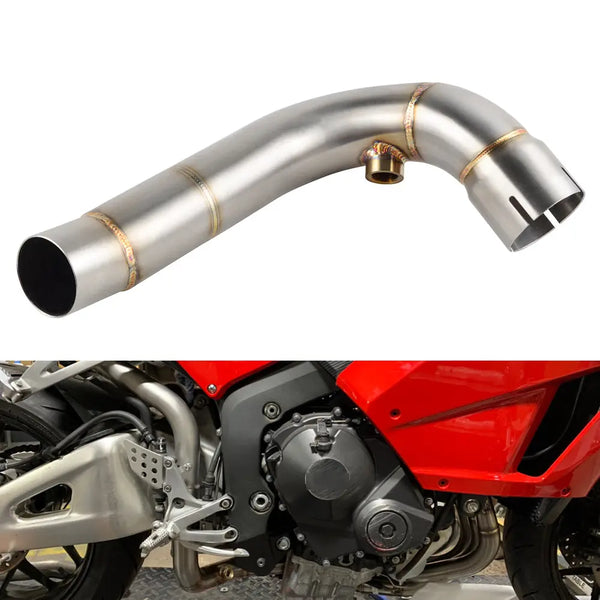
Honda CBR600RR 2007-2020: Motorcycle Mid Pipe Intent
One product in this category may serve CBR600RR motorcycle exhaust shoppers. That is a separate intent from Civic, CRX, Del Sol, and Integra car fitment.
A CBR600RR mid pipe is not a Civic downpipe. Sounds obvious, but mixed-category traffic can confuse buyers. If you own the bike, check the exact model year and exhaust layout. If you own a Honda car, stay with the car-specific parts.
T3/T4 Turbo Honda Setups: What Buyers Need to Check
T3/T4 turbo Honda buyers need to slow down and verify the hard points. Turbo flange compatibility is just step one. The downpipe also has to clear the fan, radiator, firewall, block, oil pan, and lower chassis area.
Before ordering, check:
- Turbine outlet flange pattern and size.
- Downpipe diameter and lower exhaust connection.
- Internal or external wastegate routing.
- O2 bung location and sensor wire reach.
- Radiator fan and firewall clearance.
- Whether the car uses stock mounts, solid mounts, or worn-out mounts that allow extra engine movement.
A turbo Honda moves under load. What clears in the driveway may tap the chassis when the engine torques over. Leave space.
Power Stage Guide: From Stock Replacement to Turbo Build
Think of the Honda downpipe or test pipe as part of a full path, not an isolated part.
- Stage 1 — Stock or near-stock NA: focus on replacing old restriction, fixing leaks, and improving sound. Keep pipe size sensible.
- Stage 2 — Header + test pipe + catback: match the collector, pipe diameter, and catback size. This is where a cleaner exhaust path starts to feel more complete.
- Stage 3 — B-series or D-series swap: verify chassis routing and flange location because the engine may not sit exactly like the original setup.
- Stage 4 — T3/T4 turbo build: prioritize downpipe flow, heat control, O2 placement, and clearance. The downpipe becomes a major performance part here.
Fitment Checklist Before Ordering
Before buying any Honda downpipe exhaust or test pipe, check the car like a mechanic, not like a search result.
Year, Make, Model, and Chassis
Confirm whether you are shopping for a Honda Civic, CRX, Civic del Sol, Acura Integra, or CBR600RR motorcycle. Do not mix car and motorcycle exhaust parts.
Engine Code and Swap Status
Check whether you have a D15, D16, B16, B18, or swapped setup. Then go further. What manifold is on the car? What header? What turbo kit? What mounts? What catback?
Engine code gets you close. The full setup tells you whether the part will actually cooperate.
Turbo or Naturally Aspirated Setup
A turbo downpipe and a naturally aspirated test pipe are not the same thing. A test pipe usually replaces the catalytic converter section. A turbo downpipe usually connects after the turbocharger and routes exhaust toward the rest of the system.
If your car is NA, do not buy a turbo downpipe because the title has your engine code. If your car is turbo, do not assume a basic test pipe solves your downpipe routing.
Pipe Diameter and Existing Catback Size
Measure or verify the rest of the exhaust. A 2.25-inch test pipe connected to a mismatched 3-inch catback may need adapters or custom work. A larger turbo downpipe that necks down too sharply can create a bottleneck.
The exhaust system works as a chain. The worst transition is usually where the problems show up.
O2 Sensor and CEL Risk
Check whether your car uses upstream and downstream O2 sensors, where the sensors mount, and whether the part includes the bung or plug you need. OBD-II cars are more sensitive to catalyst and O2 sensor changes.
Warning: Catless downpipes and test pipes may not be legal for street use in emissions-controlled areas. Removing or bypassing a catalytic converter can trigger a check engine light, fail inspection, and create legal issues. Always check your local rules before installing emissions-related exhaust parts on a road vehicle.
Installation Notes and Practical Warnings
If you have installed old Honda exhaust parts before, you already know the job is usually half wrenching and half negotiation with rust. If you have not, do not underestimate it.
Tools and Prep Before Installation
Have the basics ready before the car is in the air:
- Penetrating oil, sprayed before the job if possible.
- O2 sensor socket or proper wrench.
- Replacement gaskets and hardware.
- Anti-seize for sensor threads where appropriate.
- Jack stands, ramps, or a lift. Not just a floor jack.
- Gloves, eye protection, and patience. Especially patience.
Common Installation Mistakes
The biggest mistake is tightening one side fully before the whole exhaust is loosely aligned. Do not do that. Test-fit everything first. Let the pipe find its natural position, then tighten from the critical flanges outward.
Other mistakes include reusing a crushed gasket, forcing a flange into place, ignoring exhaust hanger tension, twisting the O2 sensor wire, and assuming a small leak will “seal itself.” It will not. It will just get louder and more annoying.
Mechanic’s Note — Do Not Learn This the Hard Way:
I had a young guy bring in an EG Civic after watching a ten-minute video and trying to install a catless test pipe in his driveway. He had the car barely high enough to crawl under, reused the old gasket, and cranked the lower bolts unevenly because one side would not line up. By the time it got to the shop, the flange was leaking, the O2 wire was twisted like a phone cord, and one bolt head was rounded so badly we had to cut it off. The part was not the main problem. The install was. My advice is simple: hang the exhaust loosely first, check the O2 sensor angle, make sure the hangers are not pulling the pipe sideways, then tighten everything in stages.
When Professional Installation Makes Sense
If your bolts are seized, the car is swapped, the turbo kit is custom, or your area has strict inspection rules, paying a shop may be cheaper than fixing a mistake later. This is especially true on turbo Hondas where clearance and heat can create real problems.
Post-Install Checks
After installation, start the car and check for leaks before driving. Listen for ticking at the flanges. Smell for exhaust near the cabin. Watch for rattles as the engine moves. After the first heat cycle, recheck hardware once the system cools down.
Also check ground clearance. A pipe that looks fine in the air may hang too low once the car is back on the ground.
Emissions Compliance, Catalytic Converters, and CEL Avoidance
This section is not here to scare you. It is here because real car people know the difference between a weekend track setup and a street car that has to pass inspection.
Street Use vs Off-Road or Track Use
Catless downpipes and test pipes are often intended for off-road or track use where legally allowed. For street use, emissions laws can be strict, especially when catalytic converters are removed or relocated.
If your car is registered for road use, check your local requirements before installing a catless part. Do not rely on a random forum comment from someone in another state.
Why Catalytic Converter Removal Is a Serious Issue
The catalytic converter is emissions equipment. Removing it can affect tailpipe emissions, OBD readiness, exhaust smell, and inspection results. On many street vehicles, deleting or bypassing emissions equipment is not legal.
That is why Flashark product guidance and responsible category content should make usage clear: know whether the part is for street, track, or off-road use before buying.
California and CARB Considerations
California and CARB-regulated areas are especially strict. If a part affects emissions equipment on a street-driven car, buyers should look for proper compliance information, such as CARB EO approval where applicable.
If there is no emissions approval for your street application, assume risk exists. That is the clean way to think about it.
CEL, Readiness Monitors, and Inspection Failure
A CEL is only one warning sign. The bigger issue is readiness. Some cars may not show a light immediately, but the catalyst monitor may remain incomplete or fail later.
That matters because inspection systems often care about OBD readiness, not just whether the car feels strong on the road.
Tune, O2 Spacers, and Legal Risk
You will see people online talking about tunes, O2 spacers, and other workarounds. I am not going to dress it up: using parts or tuning methods to bypass emissions monitoring on a street vehicle can create legal problems.
For a track-only car, build according to the rules of that environment. For a street car, choose parts that match your local emissions requirements.
What to Pair With a Honda Downpipe or Test Pipe
A downpipe or test pipe works best when the rest of the exhaust system makes sense. One good section cannot fix a badly mismatched system.
Exhaust Headers
On naturally aspirated D-series and B-series builds, headers and test pipes often work together. The header collector, test pipe diameter, and catback size should match the power goal.
If the header outlet is one size and the rest of the exhaust is another, use proper transitions. Do not stack random adapters and expect perfect flow.
Catback Exhaust
A catback completes the path after the converter or test pipe area. If you install a freer-flowing test pipe but keep a tiny or damaged catback, the restriction just moves downstream.
For street cars, the catback also controls tone. A good resonator and muffler choice can make the difference between aggressive and unbearable.
Catalytic Converter Options
If the car is street-driven, consider whether a compliant catalytic converter solution is the better choice. A properly selected catted setup can balance flow, smell control, and emissions requirements better than a catless pipe.
Gaskets, Hardware, and O2 Sensors
Small parts matter. A fresh gasket can stop a leak that would otherwise make the whole job feel cheap. Good hardware helps the flange clamp evenly. A properly installed O2 sensor prevents wiring strain and false troubleshooting.
Do not spend money on the main pipe and then cheap out on the pieces that seal it.
FAQ: Honda Downpipe Exhaust & Test Pipes
Q1: Will a Honda downpipe add horsepower?
A1: It can, but the number depends on the setup. On a healthy stock naturally aspirated Honda, the gain may be small, often 0-3 whp. If the old cat section is restrictive and the car already has headers and a catback, 2-6 whp is more realistic. On turbo B-series or D-series builds, a better-flowing downpipe can be worth much more, sometimes around 12-25 whp when the old downpipe was a serious restriction and the tune supports the change.
Q2: Is a Honda test pipe the same as a downpipe?
A2: Not exactly. A test pipe usually replaces the catalytic converter section on a naturally aspirated exhaust system. A downpipe usually refers to the exhaust pipe after the turbocharger or manifold area. People use the terms loosely, but fitment is not the same.
Q3: Are catless Honda downpipes legal?
A3: Catless downpipes and test pipes may not be legal for street use in emissions-controlled areas because they remove or bypass the catalytic converter. They are commonly treated as off-road or track-use parts where allowed. Always check local laws before installing one on a road vehicle.
Q4: Will a catless downpipe cause a check engine light?
A4: It can. On OBD-II Hondas, removing or changing the catalytic converter can affect rear O2 sensor readings and trigger catalyst efficiency codes such as P0420. The exact result depends on the vehicle, sensor setup, ECU logic, and exhaust configuration.
Q5: Do I need a tune after installing a Honda downpipe?
A5: For a basic naturally aspirated test pipe install, a tune is not always required, but the car may benefit from proper tuning if other modifications are present. For turbo Honda setups, tuning is strongly recommended because downpipe flow can affect boost behavior, air-fuel ratio, and power delivery.
Q6: What size downpipe is best for a B-series Honda?
A6: It depends on the build. Mild naturally aspirated B-series setups often work well with sensible 2.25-inch to 2.5-inch exhaust sizing. Turbo B-series builds commonly need larger post-turbo flow, often in the 2.5-inch to 3-inch range depending on turbo size and power goal.
Q7: Will this fit my 1998 Honda Civic?
A7: Fitment depends on the exact product, chassis, engine, and exhaust setup. A 1998 Civic may have a stock D-series, a B-series swap, or a turbo kit. Check year range, engine code, turbo vs naturally aspirated setup, flange style, and pipe diameter before ordering.
Q8: Will this fit an Acura Integra with a B18 engine?
A8: It may, depending on the product and the vehicle setup. A B18 Integra can be stock, modified, swapped, naturally aspirated, or turbocharged. Confirm the year, trim, manifold or turbo hardware, catalytic converter section, and catback connection.
Q9: What is the difference between 2.25-inch and 3-inch Honda exhaust piping?
A9: A 2.25-inch pipe is often suitable for mild naturally aspirated or replacement-style setups. A 3-inch pipe is more common on higher-flow turbo builds. Bigger is not always better on small NA engines because oversized piping can reduce exhaust velocity and hurt low-rpm response.
Q10: Does a downpipe make a Honda louder?
A10: Usually, yes. A catless pipe or freer-flowing downpipe can make the exhaust louder, sharper, and more aggressive. On small Honda engines, it can also increase rasp, especially with a straight-through catback or no resonator.
Q11: Can I install a Honda downpipe myself?
A11: Yes, if you have the right tools and experience. But old bolts, rust, O2 sensors, tight clearance, and previous exhaust modifications can make the job harder than expected. If the car is swapped or turbocharged, professional installation is often the safer choice.
Q12: Why does my exhaust leak after installing a test pipe?
A12: Common causes include reused gaskets, warped flanges, uneven bolt tightening, wrong hardware, poor hanger alignment, or a pipe being forced into position. Loosen the system, realign it, check the gasket, and tighten the flanges evenly.
Q13: Is a CBR600RR mid pipe the same as a Civic downpipe?
A13: No. A CBR600RR mid pipe is for a motorcycle exhaust system. Civic, CRX, Del Sol, and Integra downpipes or test pipes are car exhaust parts. Always choose by the correct vehicle type and model year.
Final Buying Guide: How to Choose the Right Flashark Honda Downpipe or Test Pipe
If you want the right part, start with the car, not the keyword. A Honda downpipe exhaust for a turbo Civic is not the same job as a test pipe for an Integra, and neither one is the same as a CBR600RR motorcycle mid pipe.
Best for Turbo Civic and Integra Builds
For turbo B-series and D-series setups, focus on turbo outlet flange, downpipe size, O2 bung position, wastegate routing, and heat clearance. This is where a Flashark downpipe can help clean up a restrictive exhaust path and support better turbo response.
Best for Older Civic, CRX, Del Sol, and Integra Exhaust Flow
For older naturally aspirated Honda and Acura builds, focus on test pipe fitment, pipe diameter, gasket sealing, and catback compatibility. If the old cat section is restrictive or leaking, replacing that section can make the car feel cleaner and sound more alive.
Best for CBR600RR Motorcycle Owners
If you are shopping for a CBR600RR mid pipe, stay inside the correct motorcycle fitment. Do not confuse bike exhaust parts with Honda car downpipes. The fitment, purpose, and installation path are completely different.
Final Pre-Purchase Checklist
- Confirm year, make, model, and chassis.
- Confirm engine code: D15, D16, B16, B18, or other swap.
- Confirm naturally aspirated vs turbo setup.
- Check turbo flange or header collector style.
- Check pipe diameter and catback size.
- Verify O2 sensor location and wiring reach.
- Check whether the part is catted or catless.
- Review local emissions rules before installing on a street vehicle.
- Inspect old bolts, gaskets, and exhaust hangers before starting the job.
Bottom line: the right Honda downpipe or test pipe is not about buying the loudest part. It is about matching the pipe to the engine, chassis, exhaust system, and real use case. Do that, and the install goes cleaner. Ignore it, and you are the guy under the car at midnight trying to figure out why the flange is half an inch off.