Fuga del colector de escape vs. taqué ruidoso: 7 verificaciones antes de pagar por un desmontaje del motor
Giras la llave después de que el vehículo ha estado parado toda la noche. El motor arranca, la presión del aceite aumenta y luego lo escuchas: tic-tic-tic-tic.
El sonido sigue la velocidad del motor. Puede parecer más fuerte junto a la aleta que desde el asiento del conductor. Luego, después de tres, cinco o diez minutos, se desvanece en el ruido mecánico normal del motor.
Ese tipo de ruido de tictac al arrancar en frío hace que los propietarios piensen lo peor. Un taqué colapsado. Un lóbulo de leva desgastado. Un problema de balancines. Tal vez un desmontaje del motor.
A veces ese temor está justificado. A menudo, no lo está.
Una fuga de escape en la brida del colector puede sonar sorprendentemente similar al ruido del tren de válvulas, especialmente en camiones V8 donde los pernos del colector rotos y las bridas deformadas son comunes. Lo complicado es que el tictac desaparece cuando el motor se calienta por más de una razón. Las piezas de escape que se expanden pueden cerrar temporalmente una fuga, pero un taqué hidráulico también puede silenciarse después de que la presión del aceite se estabilice.
Así que no vamos a diagnosticar esto por el folclore de internet. Vamos a usar el tiempo, la ubicación, el comportamiento de las RPM, el hollín, el olor a escape, la condición del aceite y la evidencia física real.
Respuesta rápida: ¿Es una fuga de escape o un taqué ruidoso?
- Una fuga en el colector de escape es más probable cuando el tictac es más fuerte cerca del paso de rueda o la brida del colector, se vuelve más silencioso a medida que el motor se calienta, se agudiza bajo carga y está acompañado de hollín, hardware roto u olor a escape.
- Un problema de taqué o tren de válvulas es más probable cuando el ruido se concentra en la tapa de válvulas, permanece después de que el motor alcanza la temperatura de funcionamiento, o aparece con baja presión de aceite, un fallo de encendido, un funcionamiento irregular o un movimiento anormal del balancín.
- El comportamiento del calentamiento por sí solo no es suficiente. Un ruido de tictac que se desvanece después de varios minutos es una pista útil, no un diagnóstico final.
- Los colectores pueden reparar una fuga confirmada en el lado del colector. No pueden reparar un taqué colapsado, un árbol de levas desgastado, una varilla de empuje doblada, un balancín dañado, un problema de sincronización o una baja presión de aceite.
- Si la evidencia es mixta, deje de comprar piezas. Una prueba de humo, una prueba de presión de aceite mecánica, una revisión con escáner o un diagnóstico profesional del ruido cuesta menos que reemplazar el sistema incorrecto.
Lo que realmente te dice un ruido de tictac al arrancar en frío
Un tictac es una descripción de sonido. No es un diagnóstico.
Eso suena obvio, pero aquí es donde comienzan muchos errores costosos. Un tictac rítmico en el área del motor puede provenir de un pulso de escape que se escapa a través de una pequeña abertura, un taqué hidráulico que se ha desinflado durante la noche, el funcionamiento normal del inyector de combustible, una bomba de combustible de alta presión, una bujía floja, un componente de sincronización, una polea accesoria o incluso una placa flexible agrietada.
Varios de esos ruidos se aceleran con las RPM. Varios cambian a medida que el motor se calienta. Más de uno puede sonar como si viniera de la parte superior del motor porque el sonido viaja a través de la culata, los escudos térmicos, el bastidor y el cortafuegos.
Un tictac que dura uno o dos segundos
Un breve tictac inmediatamente después de un arranque nocturno puede estar relacionado con el drenaje de aceite de un componente hidráulico mientras el vehículo está parado. El taqué, el tensor de la cadena de distribución u otra pieza alimentada por presión pueden tardar un momento en rellenarse.
No lo considere normal automáticamente, especialmente si la duración se alarga. Registre el patrón:
- ¿Cuántas horas estuvo parado el vehículo?
- ¿La temperatura exterior era de 20 °F, 50 °F o 80 °F?
- ¿El ruido duró dos segundos o dos minutos?
- ¿Vuelve a ocurrir durante un reinicio en caliente?
- ¿La luz de presión de aceite permaneció encendida más tiempo de lo normal?
Un ruido que dura constantemente más cada semana es más útil para el diagnóstico que un solo arranque en frío aislado.
Un tictac que dura hasta que el motor se calienta
Este patrón eleva una fuga de escape en la lista.
Un colector, una culata, una junta y una brida fríos no se expanden todos exactamente a la misma velocidad. Si un perno está roto o la brida está deformada, una pequeña abertura fría puede permitir que cada pulso de escape se escape con un sonido metálico agudo. A medida que las piezas se calientan, la expansión puede reducir esa abertura y suavizar el ruido.
Aún así, escuche atentamente: el tictac desaparece cuando el motor se calienta no prueba que el colector esté agrietado. La viscosidad del aceite cambia con la temperatura, y un taqué hidráulico puede silenciarse una vez que se rellena y mantiene la presión.
Un tictac que permanece o se vuelve más fuerte cuando está caliente
Un motor caliente con un tictac persistente en la parte superior del motor merece una atención más cercana. El aceite caliente es más delgado que el aceite frío, por lo que las holguras desgastadas o la débil presión de aceite en ralentí en caliente pueden hacerse más evidentes después de que el motor alcanza la temperatura de funcionamiento.
Las posibles fuentes incluyen:
- Un taqué hidráulico atascado o colapsado
- Un lóbulo del árbol de levas desgastado
- Un balancín o cojinete del balancín dañado
- Una varilla de empuje doblada
- Holgura de válvula mecánica incorrecta
- Baja presión de aceite en ralentí en caliente
- Un problema de cadena de distribución, guía o tensor
- Una placa flexible agrietada o hardware del convertidor suelto
Sin embargo, no salte directamente a los taqués. Una fuga de escape más grande puede permanecer audible cuando está caliente, y un protector térmico suelto puede cambiar de tono a medida que se expande.
Fuga del colector de escape vs. taqué ruidoso: comparación lado a lado
La forma más sencilla de abordar la fuga del colector de escape vs. el taqué ruidoso es dejar de buscar un síntoma mágico. Utilice un grupo de pistas.

| Pista de diagnóstico | Fuga del colector de escape | Taqué o ruido del tren de válvulas | Por qué no es concluyente por sí solo |
|---|---|---|---|
| Arranque en frío | A menudo más fuerte cuando el colector y la culata están fríos | Puede ocurrir después de que un taqué se drena durante la noche | Ambos pueden ser sensibles a la temperatura |
| Después del calentamiento | Puede volverse más silencioso a medida que la brida se expande | Puede silenciarse después de que la presión del aceite rellene el taqué | Un motor caliente puede cambiar ambas condiciones |
| Ubicación del sonido | Generalmente más fuerte cerca de un colector, brida o paso de rueda | Generalmente más fuerte encima de una tapa de válvulas | El sonido puede viajar a través de la culata y el cortafuegos |
| Respuesta a las RPM | Los pulsos de escape se vuelven más rápidos con las RPM | El movimiento del tren de válvulas se vuelve más rápido con las RPM | Ambos normalmente siguen la velocidad del motor |
| Bajo carga | A menudo se vuelve más agudo o más fuerte a medida que aumenta el flujo de escape | Puede cambiar con la presión del aceite y la velocidad del motor | Otros ruidos, incluida la detonación, también aparecen bajo carga |
| Hollín negro | Fuerte evidencia física cerca de la junta con fugas | No causado por una falla interna del taqué | Las manchas viejas deben limpiarse y revisarse |
| Olor a escape | Posible cerca del capó, la toma de aire o el HVAC | Normalmente no producido por un problema de taqué | Otras fugas del sistema de escape pueden producir el mismo olor |
| Fallo de encendido o funcionamiento irregular | Posible si el calor daña el cableado o la fuga afecta las lecturas del sensor | Posible con elevación de válvula reducida o un lóbulo del árbol de levas dañado | Todavía se necesita un escaneo y pruebas mecánicas |
| Preocupación por la presión del aceite | Generalmente no relacionado | Altamente relevante para los taqués alimentados por presión | Los indicadores del tablero no siempre son precisos |
Nota del técnico:
No diagnostique el motor a partir de una grabación telefónica de diez segundos reproducida a través de los altavoces de un ordenador portátil. Grabe el mismo vehículo desde la tapa de válvulas, ambos pasos de rueda y la transmisión de accesorios delantera. El cambio de ubicación suele ser más útil que la calidad del sonido en sí misma.
Siga el tiempo: ¿Cuándo comienza y se detiene el tictac?
La hora importa. No solo si el motor está "frío" o "caliente", sino exactamente cuándo comienza el sonido, cuándo cambia y si regresa.
Solo después de que el vehículo esté parado durante la noche
Cuando el ruido aparece solo después de estar parado ocho o doce horas, dos posibilidades ascienden en la lista:
- Una separación de escape fría que se cierra con la expansión térmica
- Un taqué o tensor alimentado por presión que se drena mientras está estacionado
Pruebe una comparación controlada. Arranque el motor en frío y cronometre el ruido. Después de que alcance la temperatura de funcionamiento, apáguelo durante 10 a 15 minutos y luego vuelva a arrancarlo.
Si el arranque en caliente es silencioso pero a la mañana siguiente vuelve a ser ruidoso, ha confirmado que la temperatura o el drenaje importan. Aún no ha confirmado qué componente es el responsable.
Fuerte en frío, más silencioso después de tres a diez minutos
Este es el patrón clásico que hace que la gente busque una fuga en el colector de escape. Merece atención, especialmente en camiones conocidos por tener pernos de colector rotos.
Ahora agregue más evidencia:
- ¿El tictac es más fuerte a través de un paso de rueda?
- ¿Suena más como una especie de soplo agudo al lado del colector?
- ¿Falta la cabeza de un perno?
- ¿Puede ver un rastro de carbono negro seco?
- ¿El olor se vuelve perceptible cerca del capó o la entrada del calentador?
Si varias de esas señales aparecen juntas, el diagnóstico de escape se vuelve mucho más fuerte.
Silencio en frío, más fuerte en ralentí en caliente
Este no es el patrón habitual de pequeña fuga en el colector. Pone la presión de aceite en caliente, la holgura del tren de válvulas, el estado del balancín, el ruido de la placa flexible y los componentes accesorios más arriba en la lista.
No añada aceite más espeso solo para ver si el sonido desaparece. Cambiar la viscosidad antes de la prueba puede enmascarar el patrón que está intentando diagnosticar, y puede ser incorrecto para el sistema de lubricación del motor.
El tictac vuelve durante la aceleración
Una pequeña fuga de escape puede ser difícil de escuchar en ralentí en caliente, pero vuelve durante una aceleración ligera o una subida gradual. El flujo de masa de escape y la presión del cilindro son mayores bajo carga.
No lo confunda con el picado de bielas. La detonación suele sonar más como un traqueteo metálico o canicas en una lata bajo carga, en lugar de un pulso limpio ligado a una bancada específica.
Localice el sonido antes de tocar una llave
Esta es la parte que la gente se salta. Escuchan un tic desde el asiento del conductor, abren el capó e inmediatamente deciden que proviene de la tapa de válvulas.
Los compartimentos del motor son lugares horribles para escuchar. El sonido se refleja en los protectores térmicos, los guardabarros interiores, el cortafuegos y el capó. Acérquese a cada posible fuente, pero hágalo de forma segura.

Cuando el tictac es más fuerte cerca del paso de rueda
Escuche desde ambos lados del vehículo durante el primer arranque en frío. En muchos camiones, el paso de rueda proporciona una ruta más clara al colector de escape que la parte superior del compartimento del motor.
Preste especial atención a:
- Los puertos de escape traseros cerca del cortafuegos
- Los pernos del colector más externos
- Protectores térmicos sueltos
- La brida del colector a la culata
- La conexión del colector o del tubo descendente
- Los bungs del sensor de oxígeno y las soldaduras cercanas
Una fuga a menudo tiene un ligero soplo debajo del tictac metálico. Una vez que escuchas esa diferencia al lado del paso de rueda, es difícil olvidarla.
Cuando el tictac es más fuerte en la parte superior de la tapa de válvulas
Un tictac concentrado en una sección de la tapa de válvulas genera preocupación por el balancín, la varilla de empuje, el taqué, el lóbulo de la leva o la holgura de la válvula de ese cilindro.
Compare ambos lados. Luego compare la parte delantera, central y trasera de la misma tapa. Un estetoscopio mecánico puede ayudar en una superficie metálica estacionaria, pero mantenga la sonda, las mangas y las manos alejadas de las correas, las poleas, los ventiladores y las piezas de escape calientes.
Cuando el sonido está en la parte delantera o en la campana del embrague
No fuerce cada tictac en la discusión de fuga de escape versus taqué. Verifique los otros imitadores comunes:
- Inyectores de combustible
- Una bomba de combustible de alta presión de inyección directa
- Guías o tensores de la cadena de distribución
- Una polea tensora o un tensor de correa
- Una bujía floja
- Una placa flexible agrietada
- Pernos del convertidor sueltos
- Un protector térmico vibrante
Caso en primera persona: El "trabajo de taqués" que no lo fue
Esta es una composición de un patrón de diagnóstico recurrente visto en videos de clientes y casos de reparación de camiones.
Recuerdo haber revisado un video de arranque en frío de un propietario de una Silverado 5.3L de 2008 que ya había comenzado a cotizar taqués y un árbol de levas. Desde el interior de la cabina, el sonido parecía un ruido de la parte superior del motor. Era agudo, rítmico y coincidía perfectamente con la velocidad del motor.
Luego lo grabó de nuevo desde el paso de rueda del lado del pasajero.
El carácter cambió por completo. En lugar de un golpeteo metálico seco, se podía escuchar un pequeño soplo detrás de cada tic. Una linterna mostró que faltaba la cabeza del perno del colector trasero y había una mancha de carbono en forma de abanico en el borde del protector térmico.
No fue necesario abrir el motor. Necesitaba que se extrajera un perno roto, se revisara la brida y se reparara la junta de escape.
La lección: nunca apruebe una reparación interna del motor hasta que alguien haya escuchado desde el lado del escape y haya inspeccionado el hardware.
Observe cómo el tictac cambia con las RPM y la carga
¿El tictac se acelera suavemente con las RPM?
Sí, una fuga de escape generalmente se acelera con las RPM del motor. También lo hace un tictac de taqués.
Esa prueba por sí sola dice muy poco.
En su lugar, mantenga el motor brevemente entre 1.200 y 1.800 RPM después de confirmar que es seguro hacerlo. Escuche los cambios en el tono y el volumen:
- ¿El sonido se vuelve más como un soplido presurizado?
- ¿Permanece concentrado en un puerto de escape?
- ¿Se vuelve más fuerte sin que el motor funcione de forma irregular?
- ¿El ruido permanece igualmente fuerte en la parte superior de la tapa de válvulas?
- ¿Aparece otro traqueteo solo en un rango estrecho de RPM?
Un escudo térmico o soporte a menudo resuena dentro de una banda de RPM específica. Un pulso de escape o un tictac del tren de válvulas generalmente sigue las RPM de forma más continua.
¿Es más ruidoso bajo carga que en punto muerto?
Una pequeña fuga puede ser silenciosa al acelerar en vacío y más ruidosa durante una aceleración ligera o una subida gradual. El flujo de masa de escape y la presión del cilindro son mayores bajo carga.
No realice pruebas de carga agresivas si el vehículo tiene baja presión de aceite, una luz de "revisar motor" parpadeante, una falla grave de encendido, sobrecalentamiento o escape entrando en la cabina.
¿Cambia el patrón después de un reinicio en caliente?
Grabe tres clips cortos:
- El primer arranque después de estar parado toda la noche
- Ralentí en caliente después de una conducción normal
- Un reinicio de 10 a 15 minutos después de apagarlo
Mantenga el teléfono en aproximadamente la misma posición para cada grabación. Esos clips le dan a un técnico mucha más información útil que "a veces hace un sonido de tictac".
Busque evidencia física de una fuga en el colector de escape
El ruido es subjetivo. El carbón, los herrajes rotos y el escape que se escapa no lo son.
Hollín negro alrededor del colector o la junta
Con el motor completamente frío, use una linterna, un espejo de inspección o la cámara del teléfono para mirar alrededor de la brida del colector.
Compruebe:
- Donde cada puerto de escape se une a la culata
- Los extremos exteriores del colector
- El borde de la junta
- Soldaduras de brida
- La conexión del colector
- Bung de los sensores de oxígeno
- Escudos térmicos de las bujías cercanas
Una marca seca de color negro o gris oscuro que se extiende desde una junta es una evidencia significativa. Limpie las manchas antiguas antes de una reparación e inspecciónela de nuevo después de varios ciclos de calor. Esto evita que una fuga antigua se confunda con una actual.

Cabezas de pernos faltantes y espárragos rotos
Una cabeza de perno faltante no significa que todo el perno se haya caído. La sección roscada aún puede estar rota al ras o por debajo de la superficie de la culata.
Eso importa porque la instalación de colectores no hace desaparecer el espárrago roto. El perno restante aún debe extraerse sin dañar la cabeza de aluminio o mover el agujero del centro.
Advertencia de taller:
Muchos aficionados a la mecánica ven un video de extracción de pernos, colocan un taladro contra un cortafuegos estrecho y comienzan a cortar. Si la broca se introduce en el aluminio o entra en una camisa de agua, una reparación del colector puede convertirse en una sustitución de la culata. Si el espárrago está roto por debajo de la superficie y no puede fijar el taladro en ángulo recto, deténgase.
Olor a escape cerca del capó, el cubrebocas o la cabina
El olor a escape crudo cerca de la parte trasera del motor o a través de las rejillas de ventilación del HVAC no solo es molesto. Significa que los gases se están escapando aguas arriba y pueden estar llegando al compartimento de pasajeros.
El monóxido de carbono en sí mismo es incoloro e inodoro, por lo que la ausencia de un olor fuerte no prueba que la cabina sea segura.
Advertencia de seguridad
Si el olor a escape entra en la cabina, deje de tratar el problema como un ruido inofensivo. Ventile el vehículo, evite el ralentí prolongado y haga inspeccionar la fuga antes de continuar con la conducción normal.
¿Una fuga de escape siempre encenderá la luz de "Revisar motor"?
No.
Una pequeña fuga puede que nunca genere un código, especialmente si está ubicada donde tiene poco efecto en las lecturas del sensor de oxígeno aguas arriba. Una fuga más grande aguas arriba de un sensor puede contribuir a recortes de combustible anormales, actividad del sensor de oxígeno, códigos de catalizador o un código de condición de mezcla pobre.
La ausencia de una luz de "revisar motor" no exime al colector. La presencia de un código tampoco identifica la ubicación exacta de la fuga.
Descarte problemas de elevadores y tren de válvulas antes de comprar colectores
Aquí es donde una empresa de repuestos honesta tiene que trazar una línea dura. Los colectores no son una medicina para el motor.
Verifique el nivel de aceite, el estado del aceite y la viscosidad correcta
Empiece con las comprobaciones básicas:
- Estacione en un terreno nivelado.
- Siga el procedimiento de comprobación de aceite del fabricante del vehículo.
- Confirme que el nivel está dentro del rango marcado.
- Verifique la viscosidad especificada para el motor y la temperatura de funcionamiento.
- Compruebe cuándo se cambiaron por última vez el aceite y el filtro.
- Busque contaminación, dilución de combustible, lodos o residuos metálicos.
No vierta un aceite más pesado o un aditivo aleatorio simplemente porque alguien en línea dijo que "arregló" su tic. Más silencioso no siempre significa reparado.
Compruebe la presión del aceite, especialmente cuando está caliente
Un indicador en el tablero puede mostrar una tendencia, pero puede estar amortiguado o ser impreciso. Si el tic persiste en caliente, puede ser necesario realizar una prueba mecánica de la presión del aceite.
No aplique una regla universal de PSI a cada motor. La presión requerida depende del diseño del motor, la temperatura del aceite, la velocidad de ralentí, las holguras de los cojinetes y las especificaciones del fabricante.
Si la luz de advertencia de baja presión de aceite permanece encendida después del arranque o se ilumina mientras el motor está funcionando, apague el motor. Ese no es el momento para otra prueba de sonido.

Busque fallas de encendido, funcionamiento irregular o movimiento reducido de las válvulas
Un lóbulo de leva desgastado o un elevador defectuoso pueden producir algo más que ruido. Pueden reducir la elevación de la válvula y afectar el llenado del cilindro.
Las señales de advertencia incluyen:
- Una falla de encendido específica de un cilindro o aleatoria
- Ralentí irregular después del calentamiento
- Una pérdida notable de potencia
- Compresión anormal
- Un balancín que se mueve menos que los otros
- Residuos metálicos en el aceite o el filtro
No retire una tapa de válvulas y ponga en marcha el motor a menos que comprenda los riesgos, los requisitos de control de aceite y el tren de válvulas en movimiento. Una inspección profesional es más barata que dejar caer piezas en un motor abierto.
Cuando el diagnóstico requiere un taller profesional
Solicite pruebas específicas en lugar de una suposición:
- Una prueba de humo de escape a baja presión
- Diagnóstico electrónico con "oído de chasis" o estetoscopio
- Una prueba mecánica de presión de aceite
- Contadores de fallas de encendido de la herramienta de escaneo y revisión de recortes de combustible
- Pruebas de compresión o fugas
- Inspección de la tapa de válvulas
- Inspección de árboles de levas y levantaválvulas cuando la evidencia lo respalde
Un buen diagnóstico reduce la reparación. Un mal diagnóstico solo reemplaza conjuntos costosos hasta que el ruido desaparece por casualidad.
Árbol de diagnóstico de tictac al arranque en frío de siete pasos

Paso 1: Grabar el primer arranque en frío
Anote la temperatura ambiente, cuánto tiempo estuvo parado el vehículo, cuándo comienza el tictac y cuántos segundos o minutos dura.
Paso 2: Comprobar las señales de advertencia
Detenga la prueba si observa una advertencia de presión de aceite, una luz de "revisar motor" parpadeante, una falla grave de encendido, sobrecalentamiento, un golpe fuerte, una pérdida repentina de potencia o escape entrando en la cabina.
Paso 3: Comparar cuatro posiciones de escucha
Escuche en el paso de rueda izquierdo, el paso de rueda derecho, el área de la tapa de válvulas y el accionamiento de accesorios delantero. No coloque su cuerpo o herramientas cerca de piezas móviles.
Paso 4: Inspeccione el colector mientras está frío
Busque hollín, cabezas de perno faltantes, protectores sueltos, soldaduras agrietadas, holguras en las bridas, botas de cables de bujías quemadas y conexiones de colector dañadas.
Paso 5: Comparar ralentí en frío, ralentí en caliente y reinicio en caliente
Documente qué cambia. Utilice el comportamiento del calentamiento como una rama del diagnóstico, no como el veredicto final.
Paso 6: Comparar RPM ligeras y carga ligera
Escuche un resoplido de escape más agudo, un golpeteo de la tapa de válvulas que permanece caliente o una vibración que aparece solo dentro de un rango estrecho de RPM.
Paso 7: Elegir la rama basada en la evidencia
- Posible fuga de escape: ubicación del guardabarros o la brida, hollín, herrajes rotos, olor a escape y un patrón más marcado en frío.
- Posible problema en el tren de válvulas: ubicación de la tapa de válvulas, persistencia en caliente, preocupación por la presión del aceite, falla de encendido o movimiento anormal de las válvulas.
- Evidencia mixta: no pida piezas todavía; programe una prueba de humo, una prueba de presión de aceite o un diagnóstico profesional de ruido.
Lo que los colectores pueden (y no pueden) arreglar
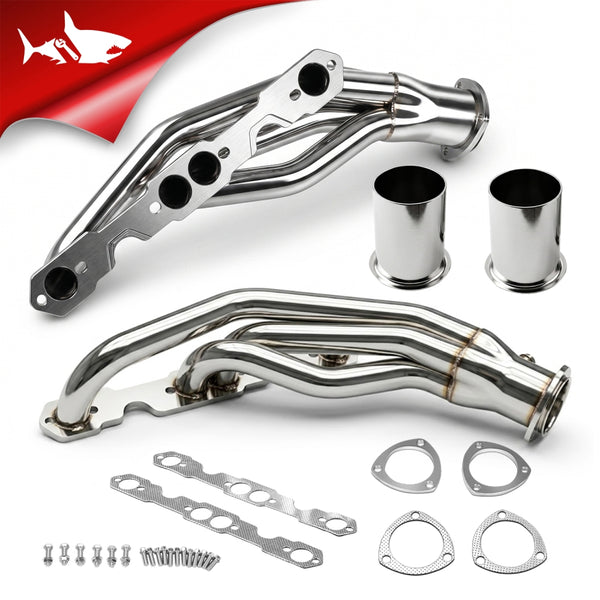
Una vez que se ha confirmado el lado del escape, reemplazar un colector de fábrica defectuoso con colectores de escape de rendimiento correctamente instalados puede ser una reparación práctica y una ruta de mejora.
Las palabras clave son una vez confirmado.
Problemas que los colectores pueden solucionar
- Un colector de escape agrietado
- Una brida del colector deformada
- Una junta del colector con fugas
- Un colector de fábrica dañado que ya no sella
- Una fuga en el lado del colector causada por herrajes de montaje defectuosos
- Una fuga recurrente donde es apropiado un sistema de reemplazo correctamente instalado
La superficie de la culata, los orificios de los pernos, los espárragos restantes y las conexiones posteriores deben repararse correctamente. Un nuevo colector atornillado a roscas dañadas o a una superficie de sellado sucia también tendrá fugas.
Problemas que los colectores no pueden solucionar
- Un elevador hidráulico colapsado
- Un lóbulo de árbol de levas desgastado
- Un balancín dañado
- Una varilla de empuje doblada
- Holgura de válvula incorrecta
- Baja presión de aceite
- Un conducto de aceite bloqueado
- Un problema con la cadena de distribución o el tensor
- Ruido del inyector de combustible
- Un plato flexible agrietado
- Golpe de biela o cojinete
- Fallo de una polea de accesorio o tensor de correa
| Parámetro | Colector de escape de fábrica | Colector corto (Shorty Header) | Colector de tubo largo (Long-Tube Header) |
|---|---|---|---|
| Propósito principal | Diseño compacto, costo, retención de calor, integración de emisiones | Reemplazo del colector con modesta mejora del flujo | Sistema de rendimiento de mayor flujo |
| Disposición de los tubos | Compactos o conductos fundidos cortos | Tubos primarios cortos separados | Tubos primarios sintonizados más largos antes del colector |
| Ajuste posterior | Conexión de fábrica | A menudo diseñado para conexiones estilo fábrica; verifique cada SKU | Puede requerir un tubo en Y, tubo intermedio o fabricación a medida |
| Cambio de potencia típico sin ajuste | Referencia | A menudo 0–10 WHP dependiendo del motor y la restricción | Puede ser limitado sin cambios de escape y ajuste a juego |
| Potencial de potencia típico soportado | No está diseñado como una mejora de rendimiento | Suele ser modesto en un motor casi de serie | Aproximadamente 10–30+ WHP es posible en algunas combinaciones de V8 de aspiración natural con piezas de apoyo y calibración |
| Requisitos de ajuste | Calibración de fábrica | A menudo funciona sin ajuste cuando las ubicaciones de los sensores y el catalizador permanecen sin cambios, pero verifique la aplicación | Con frecuencia se beneficia o requiere cambios de calibración |
| Impacto en las emisiones | Configuración certificada de fábrica | Depende de la certificación del producto y del equipo retenido | Puede reubicar o eliminar equipos de emisiones; se debe verificar la legalidad |
| Riesgo de instalación | El hardware de fábrica roto aún puede complicar la extracción | Moderado; el espacio libre y el sellado siguen siendo importantes | Mayor; puede implicar la dirección, el motor de arranque, el cableado, los sensores de O2 y la distancia al suelo |
Los rangos de potencia no son garantías. Los resultados reales dependen del desplazamiento del motor, el árbol de levas, las culatas, los convertidores catalíticos, el diámetro del escape, el ajuste, la pérdida de la transmisión, el método de prueba y la condición de la línea base.
Colectores cortos vs. Colectores de tubo largo para una fuga confirmada
Para un vehículo de uso diario que necesita reemplazar un colector de fábrica defectuoso, un colector corto puede conservar un diseño de conexión más parecido al de fábrica. Esto puede reducir la cantidad de piezas posteriores que deben cambiarse.
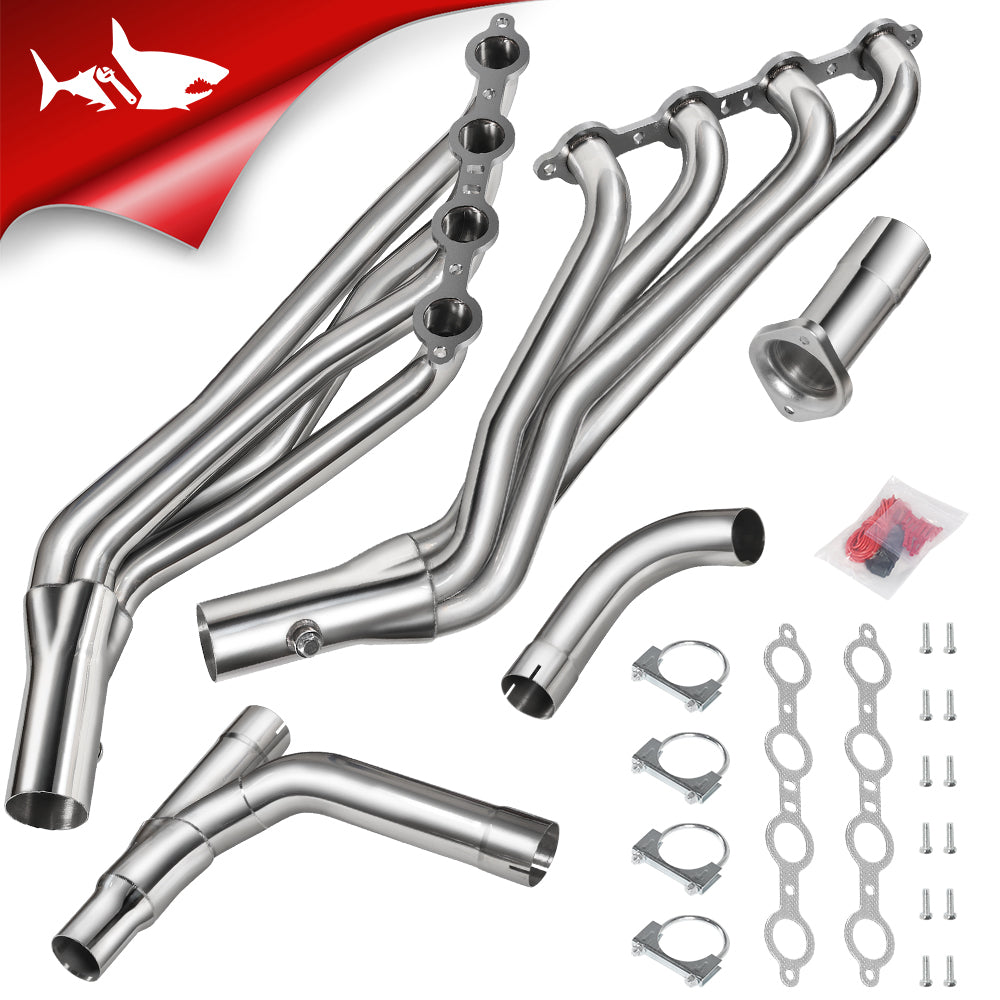
Los colectores de tubo largo son una decisión diferente. Son principalmente una modificación de rendimiento. Pueden cambiar la ubicación del colector, la ubicación del convertidor catalítico, la posición del sensor de oxígeno, la distancia al suelo, las necesidades de ajuste y el cumplimiento de las emisiones.
No elija tubos largos simplemente porque el motor hace tictac. Elíjalos porque la fuga ha sido confirmada y el plan completo de escape del vehículo los soporta.
Cómo encaja Flashark en la reparación
Flashark ofrece opciones de colectores para múltiples aplicaciones de camiones y coches de alto rendimiento, pero el ajuste debe verificarse por año exacto, motor, chasis, transmisión, diseño de tracción y configuración del escape posterior.
Antes de realizar el pedido, responda a estas preguntas:
- ¿La fuga está realmente en el colector o en la brida del colector?
- ¿Hay pernos rotos dentro de la culata?
- ¿El kit conserva los convertidores catalíticos y los sensores de oxígeno requeridos?
- ¿Se conectará al tubo en Y o al tubo intermedio existente?
- ¿El vehículo requiere conexiones EGR o de inyección de aire?
- ¿El producto es adecuado para el uso previsto del vehículo en la calle, fuera de carretera o en competición?
Elija la reparación correcta después de encontrar la causa
Reparación de la junta o de la tornillería suelta
Un reemplazo de junta puede ser suficiente cuando el colector es plano, la brida no está agrietada, las roscas están sanas y la falla se limita al material de sellado.
No apriete simplemente cada perno con más fuerza. Si la brida está deformada o el sujetador se ha estirado, un mayor par de apriete puede dañar las roscas sin restaurar una superficie de sellado plana.
Perno roto o reparación de rosca dañada
Este es a menudo el verdadero trabajo en un trabajo de colector. El colector puede salir en una hora; un espárrago trasero roto puede consumir el resto del día.
Dependiendo del acceso y la ubicación de la rotura, la reparación puede implicar:
- Soldar una tuerca a un espárrago que sobresale
- Usar una guía de taladro rígida
- Taladrar en el centro y extraer con cuidado el sujetador
- Reparar las roscas dañadas con un inserto adecuado
- Retirar componentes adicionales para un acceso directo
Adivinar con un taladro manual en ángulo no es un plan de reparación.
Rectificado o reemplazo del colector de fábrica
Un colector de fábrica puede ser reutilizable si es estructuralmente sólido y puede restaurarse a una superficie de sellado plana. El reemplazo tiene más sentido cuando está agrietado, gravemente distorsionado, muy corroído o forma parte de un patrón de falla recurrente.
Sustitución del colector por colectores de escape
Cuando se instala:- Retire todo el material de la junta vieja sin dañar la culata.
- Compruebe la superficie de sellado con una regla recta donde el acceso lo permita.
- Repare todos los orificios de los pernos dañados.
- Compruebe el espacio libre de la dirección, el motor de arranque, la varilla de nivel, el cableado y las bujías.
- Confirme la alineación del colector y el escape aguas abajo.
- Dirija el cableado del sensor de oxígeno lejos de las tuberías calientes.
- Utilice el procedimiento de juntas y fijaciones especificado para la aplicación.
- Vuelva a inspeccionar el sistema después de los primeros ciclos de calor, si las instrucciones del hardware así lo requieren.
Reparación de un problema de levantaválvulas o tren de válvulas
Si las pruebas apuntan al interior del motor, la reparación puede involucrar el levantaválvulas, el árbol de levas, el balancín, la varilla de empuje, el muelle de válvula, el sistema de lubricación o el hardware de desactivación de cilindros.
Eso es trabajo de motor. La instalación de colectores no cambiará el componente defectuoso, incluso si el nuevo escape es más ruidoso y temporalmente hace que el tictac original sea más difícil de escuchar.
Cuando un ruido de tictac significa que debe dejar de conducir
No todos los tictacs requieren una grúa. Algunos sí.
Apague el motor u organice una inspección inmediata si el ruido aparece con:
- Una luz de advertencia de presión de aceite
- Una luz de verificación del motor parpadeante
- Un fallo de encendido grave o continuo
- Un golpe profundo en lugar de un tictac ligero
- Pérdida repentina de potencia
- Sobrecalentamiento
- Gases de escape que entran en la cabina
- Un ruido que empeora rápidamente
- Escombros metálicos visibles en el aceite o el filtro
Si el motor suena normal excepto por un breve tictac del lado del colector, no hay necesidad de entrar en pánico. Tampoco hay razón para ignorarlo durante seis meses mientras el escape caliente sigue escapando junto al cableado, las mangueras o la entrada de HVAC.
Diagnósticos erróneos comunes que desperdician dinero
"Todo tictac en frío es un levantaválvulas"
No. Una fuga de escape puede ser casi indistinguible de un ligero golpeteo del tren de válvulas cuando se escucha desde la cabina o la parte superior del compartimiento del motor.
"Si se desvanece en caliente, debe ser una fuga de escape"
Tampoco. El comportamiento de calentamiento es útil, pero tanto las holguras de escape como los componentes hidráulicos cambian con la temperatura y la presión del aceite.
"El tictac sigue las RPM, por lo que está dentro del motor"
Los pulsos de escape también siguen las RPM. Esta pista no separa los dos sistemas.
"Una botella de aditivo lo arregló"
Un aditivo puede alterar la viscosidad, limpiar un componente pegado o simplemente cambiar el sonido. No prueba que un lóbulo de leva desgastado, una baja presión de aceite o un levantaválvulas dañado estén sanos.
"Los nuevos colectores cubrirán el perno roto"
El colector todavía necesita una superficie plana y una fuerza de sujeción adecuada. Un espárrago roto, un orificio pelado o una superficie de la culata deformada deben corregirse primero.
"Los tubos largos siempre son mejores"
¿Mejor para qué?
Un sistema de tubos largos puede soportar más potencia, pero también puede requerir una tubería en Y diferente, cambios de calibración, enrutamiento alterado del sensor de oxígeno, menor distancia al suelo y decisiones sobre las emisiones. Para un conductor diario de serie que necesita un reemplazo de colector simple, eso puede ser más sistema de lo que el propietario necesita.
Patrones comunes de vehículos: úsalos como pistas, no como pruebas
Algunas plataformas desarrollan patrones reconocibles de falla del colector de escape. Esos patrones pueden guiar la inspección, pero no la reemplazan.
Camionetas Chevy y GMC V8
Los propietarios de camionetas GM comúnmente reportan un tictac en el arranque en frío asociado con los pernos del colector, la fuga de la brida y los sujetadores traseros difíciles de alcanzar. Para una mirada más cercana a los síntomas específicos de la plataforma, lea nuestra guía sobre los síntomas de fuga del colector de escape de Silverado.
Una vez confirmada la fuente y el ajuste, los colectores de escape Chevy específicos para la aplicación se pueden evaluar en comparación con un reemplazo de colector de serie.
Camionetas Ford y motores modulares
Las aplicaciones de Ford pueden desarrollar fugas en el colector, el espárrago, la junta o la brida que son especialmente notorias cerca del paso de rueda. El acceso exacto y la dificultad de reparación varían mucho entre los motores y las generaciones de chasis, por lo que inspeccione ambos lados antes de pedir los colectores de escape Ford.
RAM 1500 y motores HEMI 5.7L
La frase "tictac HEMI" es demasiado amplia para ser útil por sí sola. Algunas camionetas RAM tienen un tictac en el lado del escape relacionado con el hardware del colector. Otros tienen un problema interno de levantaválvulas o árbol de levas. Nuestro diagnóstico del tictac HEMI de RAM 1500 explica las diferencias específicas de la plataforma.
No seleccione los colectores de escape Dodge hasta que haya confirmado que el sonido proviene del lado del escape.
Camionetas Nissan Titan 5.6L
Los propietarios de Titan de primera generación también reportan problemas en el colector y en el área del catalizador que pueden crear un tictac en el arranque en frío. Consulte la comparación de ruido de tictac del Nissan Titan y falla del colector de escape para una ruta de inspección específica del modelo.
Veredicto final: diagnostique la fuente antes de comprar piezas
Aquí está la conclusión honesta.
- Tictac fuerte en frío más hollín, hardware roto, olor a escape y ubicación en el paso de rueda: inspeccione primero el colector de escape, la junta, la brida y los pernos.
- Tictac de la tapa de válvulas que permanece caliente con baja presión de aceite, falla de encendido o movimiento reducido de las válvulas: investigue el tren de válvulas y el sistema de lubricación.
- Solo una pista, como un tictac que se desvanece en caliente: no hay suficiente evidencia para autorizar colectores o una reparación interna del motor.
Un colector correctamente ajustado puede reemplazar un colector defectuoso o restrictivo. Puede mejorar el flujo de escape y soportar una combinación de rendimiento más amplia. Lo que no puede hacer es diagnosticar el motor por usted.
Encuentre la fuente. Inspeccione el hardware. Pruebe la presión del aceite cuando sea necesario. Luego, compre la pieza que resuelva el problema que realmente tiene.
Preguntas frecuentes sobre el ruido de tictac en el arranque en frío
P1: ¿Es normal un ruido de tictac en el arranque en frío?
R1: Algunos inyectores, bombas de combustible de alta presión y componentes del motor alimentados a presión emiten breves sonidos de tictac durante el arranque. Un tictac nuevo, que empeora, inusualmente fuerte o duradero debe ser inspeccionado, especialmente si aparece con baja presión de aceite, un fallo de encendido, hollín u olor a escape.
P2: ¿Por qué mi motor hace tictac cuando está frío y se detiene cuando está caliente?
R2: Una holgura de escape fría puede reducirse a medida que el colector y la culata se expanden. Un levantaválvulas hidráulico también puede silenciarse después de que la presión del aceite lo rellene. Debido a que ambas condiciones pueden cambiar durante el calentamiento, también se deben verificar la ubicación y la evidencia física.
P3: ¿Puede una fuga del colector de escape sonar como un tictac de levantaválvulas?
R3: Sí. Cada cilindro produce un pulso de escape, y el gas que escapa a través de una pequeña holgura de brida o junta puede crear un tictac rítmico agudo que se asemeja mucho al ruido del tren de válvulas.
P4: ¿Cómo puedo distinguir una fuga del colector de escape de un tictac de levantaválvulas?
R4: Compare dónde el sonido es más fuerte, cómo cambia en caliente y en frío, y si encuentra hollín, pernos rotos u olor a escape. Una fuga del colector a menudo es más fuerte cerca del paso de rueda o la brida. Un tictac de levantaválvulas suele estar más concentrado en la tapa de válvulas y puede permanecer después del calentamiento.
P5: ¿El tictac del levantaválvulas desaparece cuando el motor se calienta?
R5: Puede. Un levantaválvulas hidráulico que se ha vaciado puede silenciarse una vez que se rellena con aceite a presión. Es por eso que un ruido que se desvanece en caliente no se puede usar por sí solo para descartar un problema de levantaválvulas.
P6: ¿Una fuga del colector de escape siempre se vuelve más silenciosa cuando está caliente?
R6: No. Una pequeña holgura en frío a menudo se vuelve más silenciosa a medida que las piezas se expanden, pero una grieta grande, una brida muy deformada, una junta defectuosa o un sujetador roto pueden continuar goteando a la temperatura de funcionamiento.
P7: Si el tictac se acelera con las RPM, ¿es un levantaválvulas?
R7: No necesariamente. El movimiento del tren de válvulas y los pulsos de escape aumentan con la velocidad del motor. La respuesta a las RPM debe combinarse con la ubicación del sonido, el comportamiento en caliente versus en frío, la presión del aceite y la inspección física.
P8: ¿Qué significa el hollín negro alrededor del colector de escape?
R8: Un rastro de carbono negro seco cerca de un puerto, borde de junta, grieta o brida a menudo indica escape de gases. Limpie las manchas antiguas y vuelva a revisarlas para no confundir una fuga anterior con una actual.
P9: ¿Puede un perno del colector de escape roto causar un ruido de tictac?
R9: Sí. Un perno roto reduce la fuerza de sujeción y puede permitir que se abra una holgura en frío entre el colector, la junta y la culata. Cada pulso de escape puede entonces escapar a través de esa holgura.
P10: ¿Puede una fuga del colector de escape causar una luz de verificación del motor?
R10: Puede, especialmente cuando la fuga está aguas arriba de un sensor de oxígeno y afecta la lectura del sensor. Las pequeñas fugas no siempre activan un código, por lo que la ausencia de una luz de verificación del motor no descarta una fuga del colector.
P11: ¿Puede una fuga del colector de escape causar humos dentro de la cabina?
R11: Sí. El escape que escapa cerca del cortafuegos o la entrada de HVAC puede entrar en el compartimiento de pasajeros. Debido a que el monóxido de carbono es incoloro e inodoro, el olor en la cabina debe tratarse como una advertencia de seguridad en lugar de una molestia menor.
P12: ¿Es seguro conducir con un ruido de tictac en el arranque en frío?
R12: Depende de la causa. Deje de conducir si el ruido aparece con baja presión de aceite, una luz de verificación del motor parpadeante, un fallo de encendido severo, sobrecalentamiento, golpeteo profundo, pérdida repentina de potencia o humos de escape en la cabina. Un breve tictac del colector puede no requerir remolque inmediato, pero aún así debe ser inspeccionado.
P13: ¿Los colectores de escape arreglarán un ruido de tictac en el arranque en frío?
R13: Los colectores pueden arreglar el ruido cuando proviene de un colector agrietado o deformado, una brida con fugas, una junta defectuosa o un problema de hardware del colector. No arreglarán un problema de levantaválvulas, árbol de levas, balancín, varilla de empuje, sincronización, cojinete o presión de aceite.
P14: ¿Debo usar colectores cortos o largos para arreglar una fuga del colector?
R14: Un colector corto suele ser más parecido a un reemplazo de colector de fábrica y puede preservar más del diseño original del escape. Los tubos largos son principalmente una mejora del rendimiento y pueden requerir un tubo intermedio a juego, cambios en el sensor de oxígeno, ajuste y revisión de emisiones.
P15: ¿Podrían los inyectores, las poleas o una cadena de distribución causar un tictac similar?
R15: Sí. Los inyectores y las bombas de combustible de alta presión pueden hacer sonidos de clic normales, mientras que las poleas, los tensores de correa, los componentes de sincronización, las bujías sueltas y las placas flexibles pueden producir tictacs anormales. Verificar la ubicación exacta es esencial antes de reemplazar piezas de escape o del tren de válvulas.

Steven Chen
Especialista en rendimiento automotriz | Sistemas de motor y escape
Steven se centra en el rendimiento práctico del motor, el ajuste del escape y las rutas de actualización del mundo real para vehículos clásicos y modernos para entusiastas. Revisa aplicaciones de Ford de bloque pequeño, LS, camiones y de calle/pista con un objetivo en mente: ayudar a los constructores a elegir piezas que realmente funcionen juntas. Su filosofía: "Una buena potencia comienza con la combinación correcta, no con la pieza más grande."