Supra owners can spend hours comparing horsepower screenshots and still buy the wrong combination. One car runs different fuel. Another has a different turbo. Someone quietly leaves out the baseline.
Honestly, the useful question is bigger than “How much power?” Your A90/A91 needs compatible hardware, sensible calibration, working diagnostics, and enough cooling to repeat the result. Start with your 3.0-liter B58’s condition and intended use. Spend money after that.
1. B58 Downpipe and Tune HP: What Does the Number Actually Mean?
Separate wheel horsepower from actual gains
Wheel horsepower, abbreviated whp, describes output measured through the driven wheels. Engine horsepower describes output at the crankshaft. Mixing those measurements makes an ordinary result look spectacular.
Consider a simple calculation: 440 whp after modification minus 350 whp before modification equals 90 whp gained. Those are illustrative numbers, not a test result. Both measurements still need comparable conditions.
Fixed drivetrain-loss percentages add another trap. Multiplying every Supra result by the same correction does not establish its crankshaft output.
Compare stock hardware, tune only, and downpipe plus tune
| Parameter | Stock hardware and calibration | Tune only | Downpipe plus matching tune |
|---|---|---|---|
| Catalyst hardware | Factory catalyst | Factory catalyst retained | Changes with the selected downpipe |
| Engine control targets | Factory targets | Revised for specified fuel and hardware | Revised for the complete combination |
| Power comparison | Establish the baseline | Compare against the same car’s baseline | Compare against both baseline and tune-only results |
| Diagnostic checks | Existing faults and readiness | Fueling, boost, temperatures, and faults | Same checks, plus exhaust sealing and catalyst monitoring |
Lower restriction can change turbocharger operation, but the engine controller still manages torque. A louder exhaust does not demonstrate a measurable power increase.
Put a real Supra result into context
National Speed’s 2020 Supra downpipe and custom-tune build reached 417.32 whp with an existing Injen intake, an Extreme Turbo Systems downpipe, and EcuTek calibration. Fuel octane limited that particular result.
National Speed gave 440–460 whp as its usual range for the combination on its dynos. Neither figure guarantees what another Supra will produce.
If I were choosing between those two outcomes, I would ask about fuel before ordering another part. A fuel-limited combination needs a fuel-and-calibration discussion, not a shopping spree.
2. B58 Catted vs Catless Downpipes: Follow the Exhaust Path
Locate the turbo outlet, catalyst, and oxygen sensors
B58 exhaust drives the turbine before passing through the downpipe and downstream exhaust. The catalyst treats exhaust gases; oxygen sensors support engine control and emissions monitoring.
A cat-back starts farther downstream. Changing its mufflers can alter sound considerably without duplicating a downpipe’s effect on pressure immediately after the turbine.
Reducing turbine-outlet pressure can improve the turbine’s available pressure ratio. Actual engine output still depends on airflow, fueling, ignition, and control limits.

Compare power, smell, sound, and catalyst function
Catless hardware removes the catalyst from that section. Expect stronger untreated-exhaust odor, especially during cold starts and low-speed operation. Keeping factory rear mufflers does not restore exhaust treatment.
A high-flow catted pipe retains a catalyst, but “catted” alone tells you little about its conversion efficiency, durability, or legal application.
Power comparisons need the same fuel and comparable calibration. A catless car running more boost cannot establish the horsepower difference between two downpipes.
Garage advice: choose the legal application first. Then compare catalyst quality, control compatibility, sound, and cost. Do not reverse that order because one pipe is cheaper.

Look beyond catalyst cell count
A 200-cell description is not a complete specification. Catalyst volume, substrate construction, precious-metal loading, temperature limits, and installation location also matter.
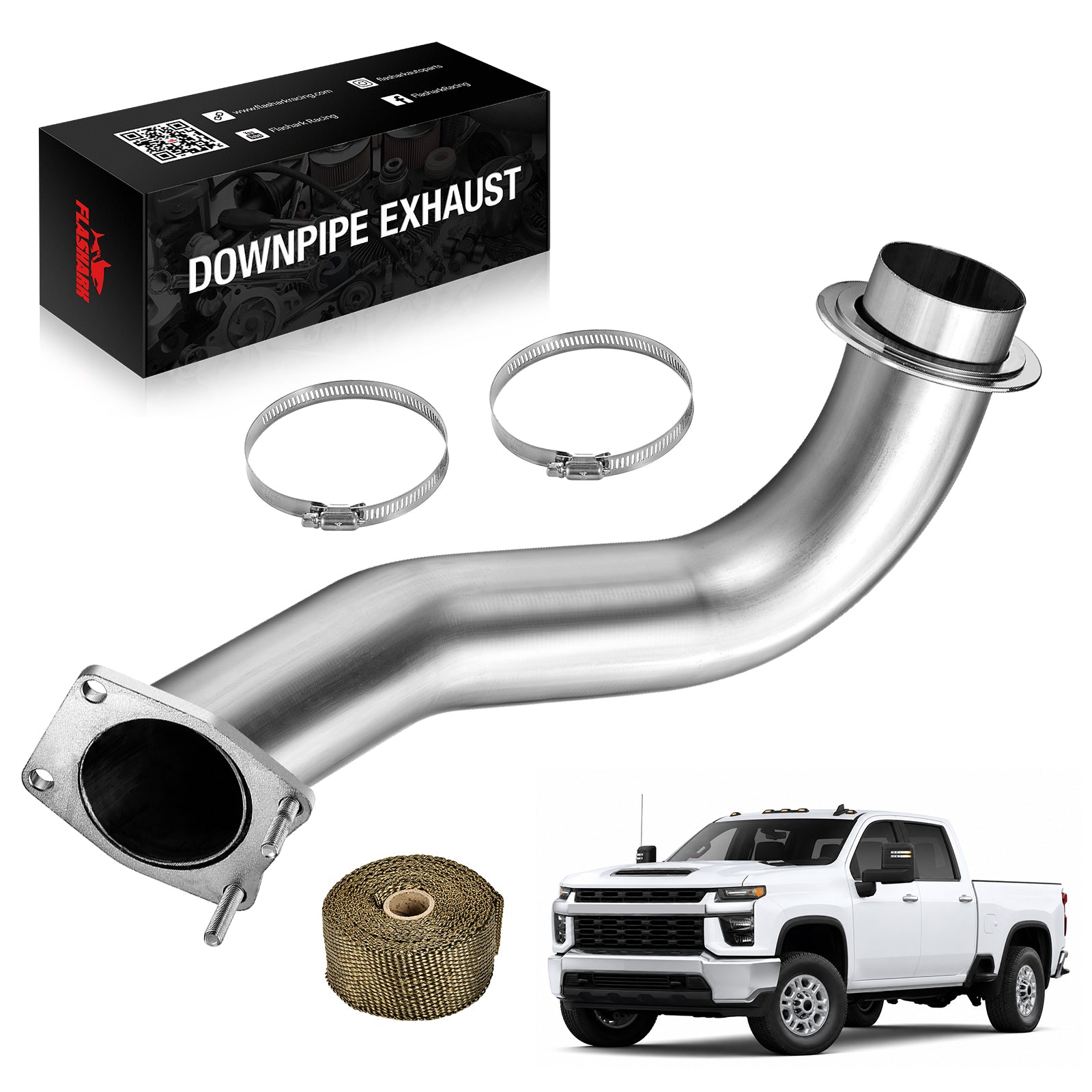
Flashark’s catless downpipe for the 2020–2024 Supra 3.0 B58 belongs to the catalyst-free category. Compare it as that type of hardware, not as a replacement high-flow catalyst.
3. Supra Downpipe Tuning, CEL Risk, and Road-Use Requirements
Match the DME and calibration to your actual car
BMW’s Digital Motor Electronics, or DME, controls the B58. Confirm its hardware and software identifiers with your calibration provider before purchasing programming services.
Registration year alone does not establish programming access. A replaced control unit or software revision can change the required procedure.
“Stage 2” is a vendor label, not an engineering standard. Ask specifically which fuel, downpipe configuration, transmission, and torque targets the calibration supports.
US pump fuel uses the Anti-Knock Index, or AKI. A 93-AKI calibration is not permission to fill with 91 AKI and hope. Ethanol blends need their own compatible fueling strategy.
Separate catalyst faults from boost-control problems
A check-engine light, or CEL, tells you to investigate. Read the diagnostic trouble codes, or DTCs, before clearing anything.
Catalyst-efficiency faults, sensor-heater faults, and boost-control faults describe different problems. P0420 concerns catalyst efficiency; it does not identify every cause of reduced power.
Suppose my Supra developed hesitation immediately after exhaust work. I would save the codes and freeze-frame information, inspect disturbed connections, and check for leaks before blaming the tune.
A loose sensor connector needs an electrical repair. A leaking joint needs proper sealing. Neither problem disappears because someone changes a warning-light setting.

Keep CEL status, readiness, and compliance separate
On-board diagnostics, or OBD, includes emissions monitors that require specific operating conditions to complete. Clearing faults can reset readiness without fixing the underlying problem.
US Environmental Protection Agency, or EPA, anti-tampering requirements cover emissions equipment and control strategies. Review the EPA vehicle emissions tampering policy before changing emissions-related hardware.
California Air Resources Board, or CARB, Executive Orders apply to specified modifications and vehicles. Match the actual application through CARB aftermarket-parts requirements.
No CEL does not mean street legal. A catalyst brand name, a software setting, or a competition-use sticker does not change that distinction.
4. Supra Heat Management: Exhaust Temperature Is Only Half the Story
Protect nearby wiring and components from exhaust heat
Downpipe surfaces radiate heat toward nearby components. Inspect oxygen-sensor wiring, clips, hoses, and clearances before the first heat cycle.
Exhaust movement matters too. A wire that clears the pipe while parked can touch it when the drivetrain moves under load.
Retain applicable heat protection and follow the selected part’s installation requirements. Ceramic coatings and wraps are not interchangeable fixes; wrapping can change metal temperatures and affect product warranty conditions.
Less restriction does not prove every nearby component runs cooler. Surface construction, shielding, catalyst activity, and engine load all affect the result.
Track charge-air temperature across repeated pulls
B58 charge cooling uses a liquid-to-air cooler integrated into the intake manifold. A front heat exchanger rejects heat from that cooling circuit.
Intake air temperature, or IAT, can climb when repeated load adds heat faster than the system sheds it. Exhaust wrap does not increase that circuit’s cooling capacity.
Compare IAT, ignition corrections, requested and actual boost, and oil and coolant temperatures across repeated runs. Record the cooling interval as well.
One short street acceleration and a sustained track session impose different demands. Choose cooling upgrades for your workload, not somebody else’s parts list.

5. Five Dyno Checks That Make Supra Horsepower Comparisons Useful
Record fuel, calibration, dyno setup, conditions, and baseline
Comparing B58 downpipe and tune hp becomes useful only when these five checks line up:
- Fuel: record AKI and measured ethanol content where relevant.
- Configuration: list the turbo, intake, exhaust hardware, and exact calibration revision.
- Dyno setup: record machine type, gear, and Society of Automotive Engineers, or SAE, correction setting.
- Conditions: note ambient temperature, airflow, starting temperatures, and cooling intervals.
- Baseline: use the same car under comparable conditions, preferably on the same machine.
Correction factors help account for atmospheric differences. They do not erase heat soak, fuel changes, wheel slip, or inconsistent test procedures.
Read the torque curve and repeatability
A single peak hides a lot. Compare output at matching engine speeds and inspect whether the curve stays smooth through the usable range.
Run-to-run consistency deserves attention. A sharp first pull followed by steadily falling output calls for investigation, not automatic approval of the highest number.
Torque delivery also matters to the driveline. Manual clutch capacity cannot be established from peak whp alone; low-speed torque, clutch condition, and driving technique affect the load.
Request a calibration that suits the car’s use. Chasing the hardest possible midrange hit is not always the quickest way around a circuit—or the easiest setup to drive.
6. A90/A91 Downpipe Fitment, Installation, and Total Cost
Complete six fitment checks before removing the stock pipe
Check these details before lifting the car:
- Model year, vehicle identification number, and 3.0-liter B58 engine.
- Market specification and emissions equipment.
- Transmission application and surrounding clearance.
- Turbo-outlet flange and clamp compatibility.
- Downstream connection, diameter, and any required adapter.
- Sensor locations, brackets, and heat-protection arrangements.
Let the exhaust cool fully. Support the vehicle at approved points with suitable equipment; never work beneath a car supported only by a jack.
Disconnect sensor wiring before rotating sensors. Inspect sealing surfaces and follow the vehicle and component instructions for replacement seals, fasteners, and tightening torque.
If I found a joint that only aligned when pulled sideways with a clamp, I would stop and reposition the assembly. Clamps hold aligned joints together; they are not tools for correcting a mismatched exhaust path.
Finish with a leak check, wiring inspection, and clearance check. Investigate any new rattle after a heat cycle.
Budget for the complete combination and judge the result
Hardware is only one line on the bill. Include installation, seals, necessary programming access, software, calibration, and diagnostic time.
Add cooling components when temperatures and use justify them. Keep a repair allowance for damaged fasteners or existing faults discovered during installation.
For a street-driven Supra, start with a compliant combination. For sustained high-load use, prioritize repeatable temperatures and controlled torque. For a limited budget, fix existing problems before adding load.
B58 downpipe and tune hp should describe a usable result. A properly matched setup starts cleanly, drives predictably, seals correctly, and manages sustained load. Give those qualities the same attention as the dyno number.
Supra B58 Downpipe and Tune FAQ
Q1: What B58 downpipe and tune hp should I expect?
A1: Expect a configuration-dependent result, not a fixed gain. Fuel, calibration, turbo hardware, and test conditions change wheel output. Establish a baseline before modification; subtract comparable before-and-after measurements to calculate the actual gain.
Q2: Why does my Supra lose power on repeated dyno pulls?
A2: Rising charge-air temperatures can contribute, but fuel quality, ignition corrections, boost control, and test consistency also matter. Compare logs and starting temperatures before assuming a larger heat exchanger will fix the problem.
Q3: Is catted or catless better for a daily-driven Supra?
A3: A daily driver needs a legally applicable emissions configuration. A suitable catalyst also treats exhaust gases that a catless pipe leaves untreated. Compare approval, fitment, catalyst quality, and calibration compatibility before sound or price.
Q4: Can I keep the stock tune with a high-flow catted downpipe?
A4: Physical installation and calibration compatibility are separate questions. Check the specific downpipe’s requirements and your vehicle configuration. Do not assume that retaining a catalyst guarantees fault-free operation, additional power, or legal road use.
Q5: Should I buy a downpipe, tune, or cooling upgrade first?
A5: Start with vehicle health and a legally applicable plan. Then establish calibration compatibility and your intended workload. Temperature logs should guide cooling purchases; a complete budget should guide the hardware and software sequence.
Q6: What should I check before removing the factory downpipe?
A6: Confirm application, installation instructions, tools, vehicle support, and replacement sealing requirements. Let the exhaust cool, protect sensor wiring, and identify how the turbo-side and downstream connections release before loosening the assembly.
Q7: What causes a leak or rattle after downpipe installation?
A7: Inspect joint alignment, sealing surfaces, clamps, brackets, and nearby contact points. Exhaust movement and thermal expansion can expose clearance problems. Do not keep tightening hardware to compensate for a joint that does not fit correctly.
Q8: Does a tune make a catless Supra legal if the CEL stays off?
A8: No. Warning-light status does not establish emissions compliance. Software does not replace catalyst function. Check federal and state requirements for the actual vehicle, hardware, and calibration before modifying emissions-related equipment.
Q9: Does a manual Supra need different tuning checks?
A9: Confirm that the calibration specifically supports the manual application. Review torque delivery, boost behavior, and clutch condition. A horsepower figure from an automatic Supra does not establish a suitable torque limit for your manual car.
Q10: Why do catted Supra downpipes vary so much in price?
A10: Catalyst construction, materials, manufacturing, application support, and warranty terms all affect cost. Compare the complete installed combination. A high price or a no-CEL promise does not independently establish emissions approval or superior performance.