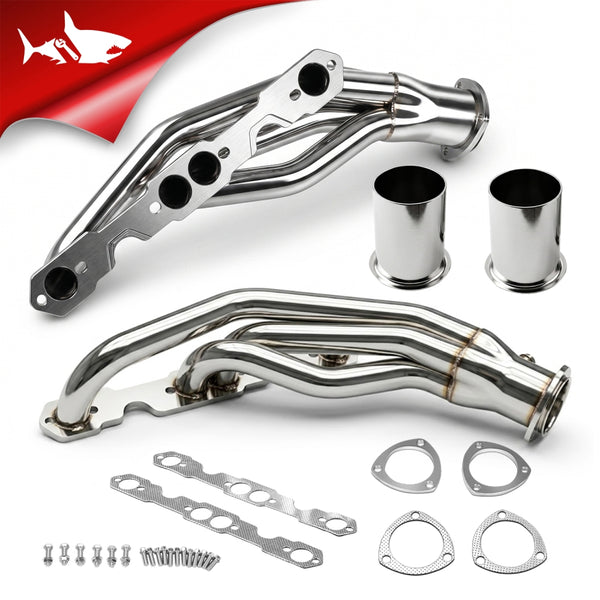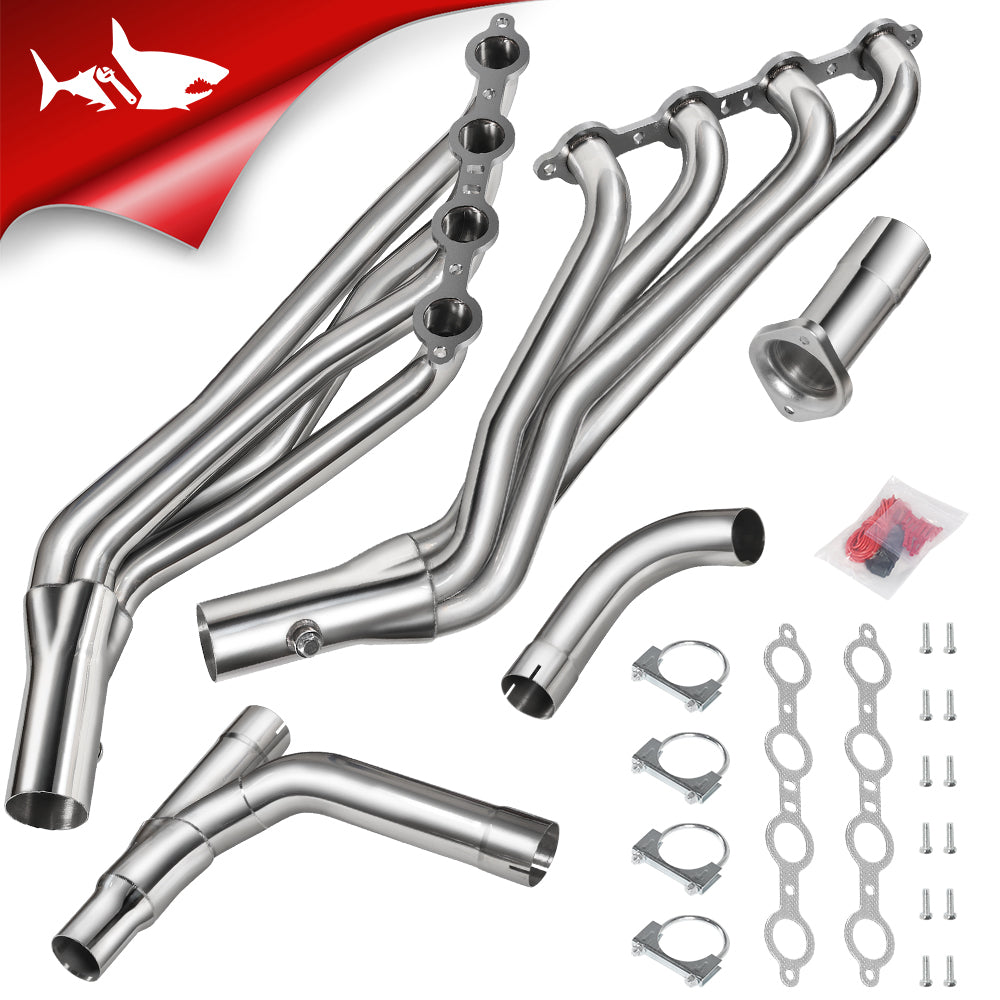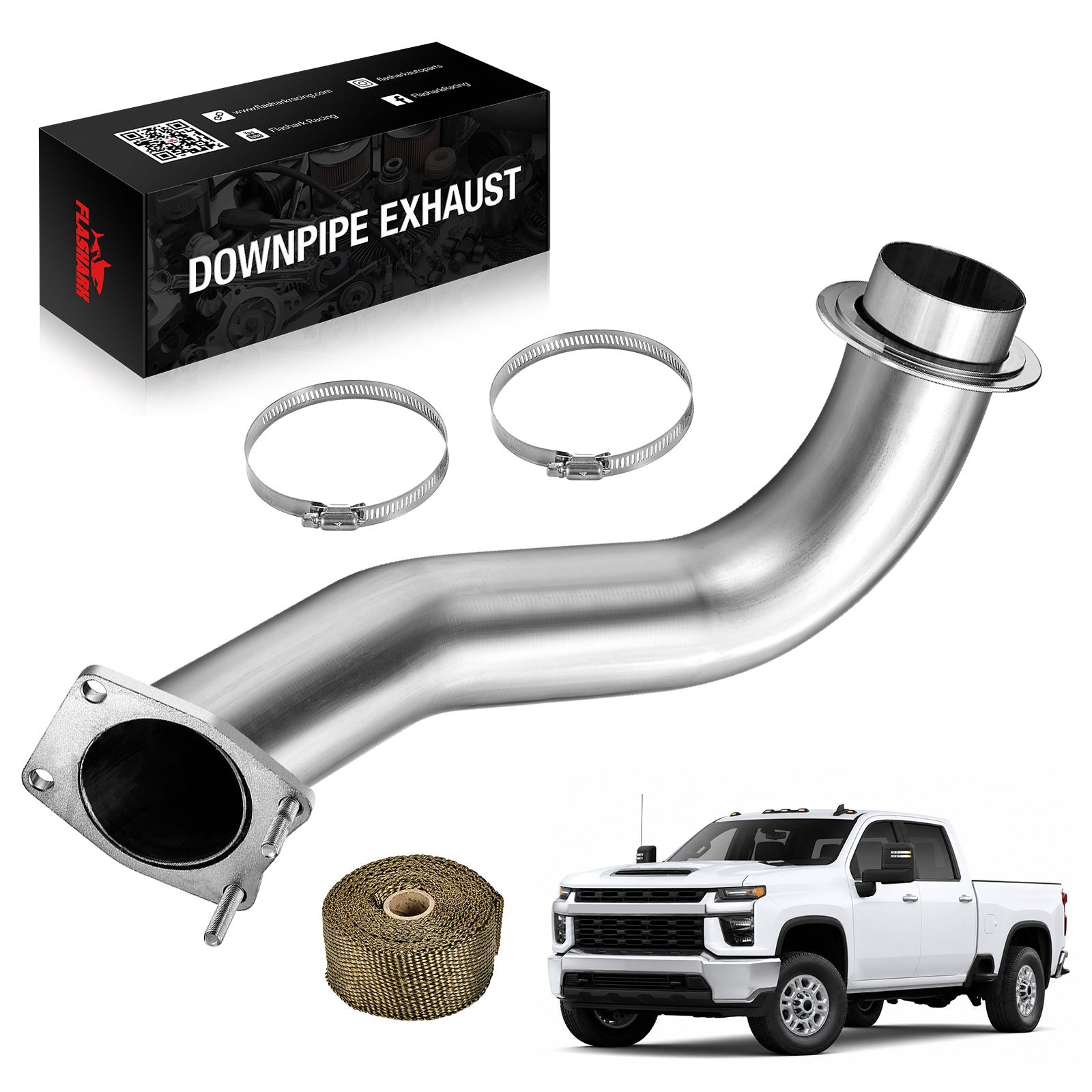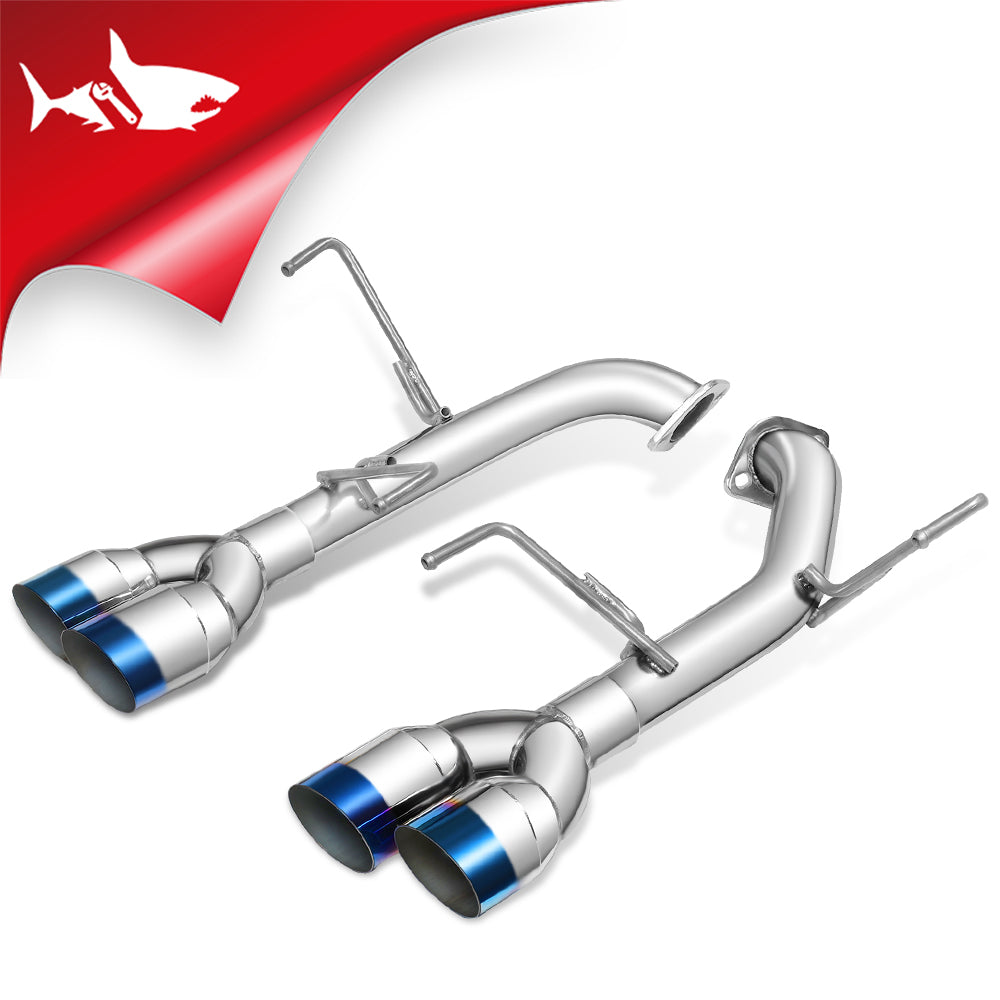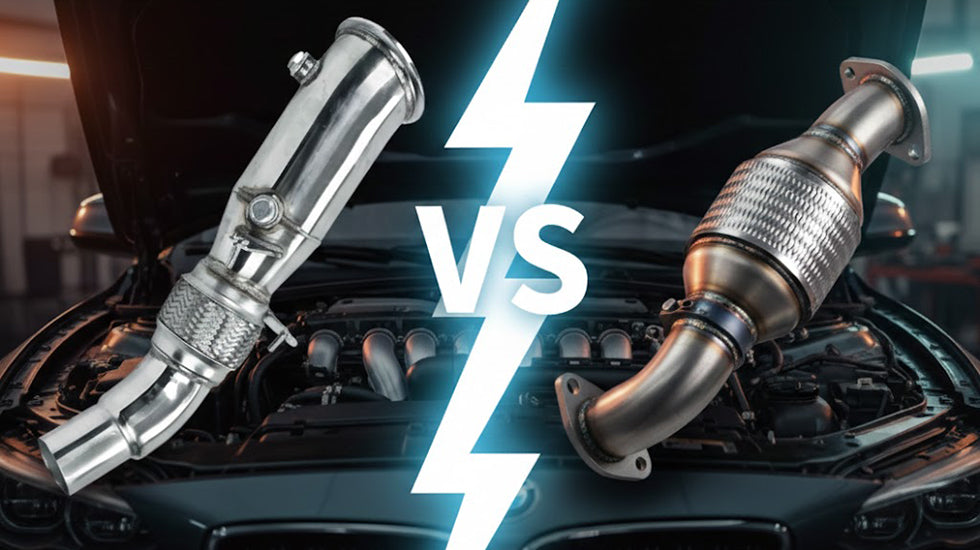
Choosing between a catted and catless downpipe comes down to more than exhaust flow. The right choice depends on how the vehicle is used, how sensitive you are to exhaust odor and noise, how the engine management system monitors catalyst efficiency, and what emissions rules apply where the vehicle is driven.
This comparison applies to turbocharged vehicles that use a downpipe between the turbocharger and the rest of the exhaust system. Exact fitment, check-engine-light behavior, installation requirements, and calibration needs vary by vehicle, engine, ECU strategy, and downpipe design.
- Choose a high-flow catted downpipe when lower exhaust odor, a more controlled sound, and a lower risk of catalyst-efficiency warnings matter more than removing every possible restriction.
- Consider a catless downpipe only for an appropriate non-road application where removing emissions equipment is permitted. It produces more exhaust odor, usually increases volume, and can trigger catalyst-efficiency faults.
- A catted downpipe is not automatically street legal. Approval depends on the exact part, vehicle, engine, model year, emissions configuration, and jurisdiction.
- Do not assume one calibration rule applies to every vehicle. Tune requirements vary with the platform, installed hardware, and ECU monitoring strategy.
- Check fitment before ordering. Match the part to the vehicle year, engine, drivetrain layout, emissions equipment, and connection design.
What Is a Downpipe and Why Does It Matter?
On a turbocharged engine, the downpipe carries exhaust gas away from the turbocharger and into the next section of the exhaust. Depending on the factory design, the catalytic converter may be built into this section or positioned close to it.
Changing the downpipe can reduce restriction after the turbine, but that does not guarantee a specific horsepower increase. The result depends on the engine, turbocharger, pipe design, catalyst construction, calibration, fuel, supporting hardware, and condition of the complete exhaust system.
A bigger pipe is not automatically the right pipe. Flange alignment, sensor placement, transition shape, catalyst quality, clearance, and compatibility with the rest of the system can matter more than a large advertised diameter.
Understanding the Difference Between Catted and Catless Downpipes
A catted downpipe contains a catalytic converter. Aftermarket versions often use a less restrictive catalyst than the original component, but catalyst construction and approval status vary by product. The presence of a catalyst can reduce exhaust odor and emissions compared with a catless pipe, although it does not guarantee inspection compliance or the absence of a check engine light.
A catless downpipe removes the catalytic converter from that exhaust section. This creates a more open flow path, but it also allows untreated exhaust to pass through the system. The usual tradeoffs are stronger exhaust odor, more noise, higher emissions, and a greater chance of catalyst-efficiency faults.
Terms can become confusing on vehicles that do not use the same exhaust layout. A downpipe normally refers to the section after a turbocharger. A header connects to the cylinder head, while a test pipe, front pipe, or mid-pipe describes a different section of the exhaust. These parts should not be treated as interchangeable simply because each one can contain or replace a catalytic converter.

Catted vs Catless Downpipe Comparison
| Decision Factor | High-Flow Catted Downpipe | Catless Downpipe |
|---|---|---|
| Catalytic converter | Retained in the downpipe | Removed from the downpipe section |
| Exhaust odor | Generally lower than a catless setup | Raw exhaust odor is more noticeable, especially during cold starts and idling |
| Sound | Usually more controlled | Usually louder and more aggressive |
| Flow restriction | The catalyst remains in the exhaust path | No catalyst is present in that section |
| CEL risk | Still possible because an aftermarket catalyst may behave differently from the factory unit | Higher because the ECU may detect that catalyst operation is missing |
| Calibration | Depends on the vehicle, hardware, and ECU strategy | Depends on the vehicle, hardware, ECU strategy, and permitted use |
| Road-use status | Depends on product-specific approval and local rules | Removing emissions equipment can violate road-use laws |
| Best matched use | Drivers prioritizing lower odor, more controlled sound, and emissions-equipment retention | Appropriate non-road applications where the configuration is permitted |
Performance, Throttle Response, and Turbo Behavior
Reducing restriction after the turbocharger can change how quickly exhaust gas leaves the turbine housing. On a suitable combination, that can support improved turbo response and airflow. The amount of change cannot be separated from the rest of the setup, however.
Pipe diameter alone does not predict the result. Turbo size, boost target, catalyst design, exhaust diameter, mufflers, fuel quality, engine condition, and calibration all affect the outcome. This is why a fixed horsepower claim should never be applied to every catted or catless downpipe.
A catless pipe has no catalyst in the flow path, but that does not make it the correct choice for every build. A well-matched catted system can be the more practical option when the vehicle spends most of its time on the street and the driver values lower odor and a less aggressive exhaust note.
Sound, Smell, and Daily Driving Comfort
Removing the catalyst usually makes the exhaust louder and less filtered. The exact tone depends on the engine, turbocharger, resonators, mufflers, pipe diameter, and the rest of the exhaust. A downpipe can increase volume without producing a tone every driver will enjoy.
The odor difference is easier to predict. A functioning catalyst helps process pollutants in the exhaust stream. Without it, raw exhaust smell is more noticeable during a cold start, while idling, or when air moves from the rear of the vehicle toward the cabin.
For a daily driver, that smell can become more important than a small difference in exhaust restriction. It also matters for vehicles that regularly sit in traffic, operate near enclosed spaces, or carry passengers who are sensitive to fumes.
Are Catless Downpipes Illegal?
For vehicles operated on public roads in the United States, removing or rendering a factory emissions-control device inoperative can violate federal anti-tampering law. A catless downpipe that replaces a factory catalytic converter should not be treated as a street-legal part simply because a local inspection is limited or unavailable. The U.S. Environmental Protection Agency explains the federal restrictions on catalytic-converter removal and emissions tampering.
A catted downpipe is not automatically legal either. In California, an aftermarket catalytic converter must have the applicable exemption and must match the specific vehicle application. Make, model, model year, engine size, and test group can all matter. Owners can review the California Air Resources Board guidance for aftermarket catalytic converters.
Requirements differ outside the United States and can also vary by vehicle category and intended use. Review local emissions and road-use requirements before modifying emissions-related equipment.
Check Engine Lights, O2 Sensors, and Tuning
Modern vehicles often use oxygen sensors before and after the catalytic converter. The ECU compares those signals to monitor catalyst operation. When the catalyst is removed—or when an aftermarket catalyst behaves differently from the factory component—the ECU may store a catalyst-efficiency fault and illuminate the check engine light.
A catted downpipe can still produce a warning on some vehicles. Catalyst cell construction, sensor location, exhaust leaks, operating temperature, ECU thresholds, and calibration all influence the result. No responsible recommendation can promise “no CEL” across every vehicle.
Tune requirements vary by vehicle and installed hardware. A calibration should not be used merely to hide an emissions fault or disable required monitoring. If a warning appears after installation, inspect for leaks, damaged wiring, contaminated sensors, incorrect sensor placement, and part compatibility before assuming software is the answer.
What to Check Before Installation
- Match the downpipe to the exact vehicle year, engine, turbo configuration, and emissions equipment.
- Compare the flange design, outlet connection, sensor locations, and available clearance with the original component.
- Check the selected configuration and package contents before taking the vehicle apart.
- Inspect gaskets, clamps, studs, nuts, and sensor threads before installation.
- Review local emissions and road-use requirements.
- Use vehicle-specific service information for lifting points, fastener procedures, and torque specifications.
Installation Practices That Prevent Problems
- Allow the exhaust and turbocharger area to cool fully before beginning work.
- Support the vehicle with equipment rated for its weight and use the specified lifting points.
- Disconnect and protect sensor wiring before rotating or removing an oxygen sensor.
- Start fasteners by hand and leave connections slightly loose until the downpipe and adjoining exhaust sections are aligned.
- Check clearance around heat shields, wiring, hoses, the body, and nearby drivetrain components.
- Tighten hardware using the correct vehicle- and part-specific procedure.
- After startup, inspect for exhaust leaks and confirm that wiring is clear of hot or moving parts.
Honestly, this is where many installs go wrong: every clamp is tightened before the system is aligned. That can pull the outlet sideways, preload a flange, or place the next exhaust section under tension. Take a minute before tightening that clamp.
How to Choose Between a Catted and Catless Downpipe
Start with how the vehicle is actually used. A daily-driven street car has different priorities from a vehicle built for an appropriate non-road application.
Choose a Catted Downpipe When
- You want to retain a catalytic converter in the downpipe.
- Lower exhaust odor is important.
- You prefer a more controlled exhaust note.
- You want a lower catalyst-efficiency fault risk than a fully catless configuration, while understanding that a warning is still possible.
- You can identify a product with the correct fitment and any approval required for your vehicle and location.
Consider a Catless Downpipe Only When
- The vehicle is being used in an application where the configuration is permitted.
- You understand the increased exhaust odor, noise, and emissions.
- You have checked how the vehicle monitors catalyst operation.
- You accept that a catalyst-efficiency warning may occur.
- The exact pipe matches the vehicle, engine, turbo layout, sensor arrangement, and adjoining exhaust connection.

Drivers comparing available configurations can browse Flashark’s downpipe exhaust and test pipe collection. Select the required configuration before ordering, and match it to the vehicle year, engine, emissions equipment, and connection layout.
Conclusion: Match the Downpipe to the Vehicle and Its Use
For many street-driven vehicles, a correctly matched catted downpipe is the more practical choice because it retains a catalyst and usually provides better control of exhaust odor and sound. That does not guarantee road legality, inspection compliance, or a warning-free dashboard.
A catless downpipe removes the catalyst from the section and brings predictable compromises: more untreated exhaust odor, more emissions, and a greater chance of catalyst-monitoring faults. It should only be considered for a permitted application after fitment, operating conditions, and local rules have been checked.
Whichever configuration you choose, fitment matters more than the marketing number. Match the hardware to the complete vehicle and exhaust combination, install it without stressing the adjoining components, and investigate any leak or warning rather than treating it as normal.
Frequently Asked Questions About Catted and Catless Downpipes
Q1: What is the main difference between a catted and catless downpipe?
A1: A catted downpipe contains a catalytic converter, while a catless downpipe removes the catalyst from that exhaust section. The catless design has no catalyst restriction there, but it produces more untreated exhaust, usually creates more odor and noise, and carries greater emissions and CEL concerns.
Q2: Are catless downpipes illegal?
A2: On public-road vehicles in the United States, removing or disabling factory emissions equipment can violate federal anti-tampering law. Rules vary by country and application, so review the requirements that apply to the vehicle and where it will be used.
Q3: Is a catted downpipe automatically street legal?
A3: No. Having a catalytic converter does not automatically make an aftermarket downpipe street legal. Approval can depend on the exact part, vehicle, model year, engine, emissions configuration, and jurisdiction.
Q4: Will a catless downpipe cause a check engine light?
A4: It can. Removing the catalyst changes what the downstream oxygen sensor detects, and the ECU may store a catalyst-efficiency fault. The result depends on the vehicle’s monitoring strategy, sensor arrangement, exhaust condition, and installed hardware.
Q5: Can a catted downpipe still trigger a check engine light?
A5: Yes. An aftermarket catalyst may not behave exactly like the factory unit. Catalyst construction, operating temperature, sensor placement, exhaust leaks, and ECU thresholds can all affect whether a warning appears.
Q6: Do I need a tune after installing a downpipe?
A6: Tune requirements vary by vehicle and installed hardware. Use platform-specific guidance and do not use a calibration simply to conceal an emissions fault or disable required monitoring.
Q7: How much power does a downpipe add?
A7: There is no reliable universal number. Any change depends on the engine, turbocharger, catalyst design, pipe dimensions, calibration, fuel, supporting modifications, test method, and condition of the complete exhaust system.
Q8: Is a catless downpipe louder than a catted downpipe?
A8: It usually is, but final sound depends on the engine, turbocharger, resonators, mufflers, pipe diameter, and the rest of the exhaust. Removing the catalyst can also make the tone sharper or less refined.
Q9: Why does a catless downpipe smell?
A9: Without a catalytic converter in that section, more untreated exhaust leaves the system. The odor is often most noticeable during cold starts, while idling, or when airflow carries exhaust toward the cabin.
Q10: Which downpipe is better for a daily driver?
A10: A correctly matched catted downpipe is usually the more practical option when lower odor, more controlled sound, and emissions-equipment retention are priorities. Product approval, fitment, and local road-use rules still need to match the vehicle.
Q11: Is a downpipe the same as a catalytic converter?
A11: No. A downpipe is an exhaust section located after the turbocharger. A catalytic converter is an emissions-control device that may be built into that section, but the two terms do not describe the same component.
Q12: What should I check when choosing a replacement downpipe?
A12: Match the pipe to the exact vehicle year, engine, turbo layout, emissions equipment, sensor arrangement, flange design, outlet connection, and intended use. Check the selected configuration and package contents before installation.

Steven Chen
Automotive Performance Specialist | Engine & Exhaust Systems
Steven focuses on practical engine performance, exhaust fitment, and real-world upgrade paths for classic and modern enthusiast vehicles. He reviews small-block Ford, LS, truck, and street/strip applications with one goal in mind: helping builders choose parts that actually work together. His philosophy: "Good power starts with the right combination, not the biggest part."