Buying the coilovers is only part of the budget. The install can also involve four-corner suspension labor, ride-height setup, an alignment, replacement hardware, and—on performance-focused cars—corner balancing. That is why two shops can quote very different prices for what both call a “coilover install.”
For many straightforward passenger cars, professional coilover installation labor can land around $300–$800. Once ride-height setup and alignment are added, a realistic shop budget can move closer to $500–$1,000 or more. Vehicle design, local labor rates, corrosion, alignment hardware, and the amount of setup work can move the final number in either direction.
Quick Answer
- Professional installation labor: A useful planning range for many straightforward cars is roughly $300–$800.
- Install plus setup and alignment: Budget roughly $500–$1,000 or more when ride height and alignment are part of the job.
- Corner balancing: Usually an additional performance-oriented service rather than a requirement for every street car.
- The coilover kit is separate: Parts pricing depends on vehicle fitment, damper design, adjustment features, top mounts, spring configuration, and brand.
- Do not compare quotes by the headline price alone: Ask whether ride-height setup, alignment, hardware, and follow-up checks are included.
- Fitment matters: Match the kit to the vehicle year, make, model, drivetrain, suspension layout, and any application-specific restrictions before ordering.
How Much Does It Cost to Install Coilovers?
A coilover installation cost can mean two very different things. One shop may quote only the labor required to remove the original suspension and bolt in the new assemblies. Another may include ride-height adjustment, alignment work, a road check, and additional setup.
That difference matters. A lower labor quote is not automatically the cheaper job once the car still needs to go somewhere else for alignment and setup.
| Cost Item | Planning Range / Cost Level | Usually Needed? | What Can Change the Price? |
|---|---|---|---|
| Professional coilover installation labor | About $300–$800 for many straightforward applications | Yes, unless installing the kit yourself | Suspension design, access, rust, seized hardware, local labor rates |
| Ride-height setup | May be included or charged as additional setup labor | Usually | Requested height, adjustment design, repeated measuring and correction |
| Wheel alignment | Often roughly $100–$200 in current U.S. shop examples | Plan for it after a meaningful ride-height or geometry change | Alignment type, available adjustment range, additional correction parts |
| Corner balancing | Additional performance setup cost | Optional for most street cars | Vehicle use, amount of adjustment, alignment requirements |
| Replacement hardware or related suspension parts | Vehicle dependent | Only when required | Corrosion, worn mounts, damaged fasteners, limited alignment range |
These figures are budgeting ranges, not fixed nationwide prices. A clean car with easy suspension access may stay toward the lower end. An older chassis with corroded hardware, awkward rear top-mount access, or additional alignment work can cost considerably more.
Technician’s Note
Ask what the quote actually includes. “Install four coilovers” is not the same service as “install, set ride height, check clearances, align the car, and correct the setup.” Compare the work, not just the number at the bottom of the estimate.

What Are You Actually Paying a Shop to Do?
The basic mechanical job is straightforward in concept: support the vehicle safely, remove the original shock or strut and spring arrangement as required by the suspension design, install the new assemblies, reconnect anything that was moved, and tighten the suspension hardware correctly.
The details are where the labor grows.
Removing the Factory Suspension
Front strut-type suspensions may have relatively direct access. Other vehicles can require additional work around sway-bar links, control arms, brake-hose brackets, ABS wiring, rear interior trim, or tightly packaged upper mounts.
Age matters too. A suspension bolt that comes out cleanly is one job. A seized eccentric bolt or corroded lower mount is another.
Setting the Initial Ride Height
A proper install should not end with four new units bolted to the chassis at random adjustment positions. Left-to-right height should be measured, tire and wheel clearance should be checked, and the coilovers should stay inside the adjustment limits specified for that kit.
The height-adjustment method also varies. Some coilovers change overall assembly length through a threaded lower mount. Others rely more heavily on spring-perch position. Two similar-looking kits are not automatically adjusted the same way.
Setting Preload and Damping Where Applicable
Preload, ride height, and damping are separate adjustments even though they are often discussed as if they were one setting.
On a coilover using a linear-rate spring, adding preload does not turn that spring into a higher-rate spring. It changes the initial force in the spring and can change available droop or how the assembly behaves around its installed position. The correct setup depends on the damper and spring arrangement.
Damping adjustment is also kit-specific. Some coilovers provide an external adjustment; others do not. Where adjustment is available, use the manufacturer’s recommended baseline rather than assuming that the stiffest position is the fastest or safest setting.
For a deeper explanation of preload, see the coilover preload guide.
Checking Brake Hoses, ABS Wiring, and Tire Clearance
This is one of those details that is easy to miss while the car is in the air. Brake hoses and wheel-speed sensor wiring should not be stretched, twisted, pinched, or routed where a tire or suspension component can contact them.
Wheel and tire clearance also needs to be checked through steering movement and suspension travel. Lowering the body does not guarantee that every wheel-offset and tire-size combination will clear.
Why Coilover Installation Costs Vary
The same coilover install can be a quick suspension job on one chassis and a much more involved project on another. Shops usually price the work around expected labor and setup—not simply around the fact that the box contains four dampers.
Vehicle and Suspension Design
A MacPherson-strut car with accessible upper mounts can require a different amount of work than a chassis using separate rear springs and dampers, multi-link suspension, or difficult interior access to the rear mounting points.
Vehicles equipped with electronic dampers or other suspension electronics can add another layer of work. Hardware compatibility and warning-light behavior depend on the specific vehicle and kit, so those systems should be considered before installation rather than treated as an afterthought.
Rust, Corrosion, and Seized Hardware
Older cars can turn a predictable suspension swap into a longer job. Rusted fasteners, seized alignment eccentrics, damaged threads, or worn mounts may need attention before the new suspension can be installed correctly.
A shop may not know the full extent of that work until the vehicle is lifted and the original hardware is inspected.
How Low You Want the Car
Changing ride height changes more than appearance. Depending on the suspension layout, lowering can alter camber, toe, roll-center position, available bump travel, axle angles, tie-rod angles, and tire-to-body clearance.
A moderate street setup can be easier to align than an aggressive drop that pushes factory adjustment to its limit. If the target alignment cannot be reached with the vehicle’s available adjustment, additional suspension hardware may be required.
Local Labor Rates
The same mechanical job will not cost the same in every city. Shop overhead, technician rates, alignment equipment, regional demand, and local market conditions all affect the estimate.
That is why an online average should be used to build a budget—not to argue that every shop should charge the same amount.
What Should a Coilover Installation Quote Include?
Before approving the job, ask the shop to separate installation from setup. A useful quote should make it clear which of the following are included and which are additional:
- Removal of the original suspension components
- Installation of all four coilover assemblies
- Initial ride-height adjustment
- Preload setup where the coilover design requires it
- Baseline damping adjustment on adjustable dampers
- Brake-hose and ABS-wire clearance check
- Wheel and tire clearance check
- Wheel alignment
- Corner balancing, if requested
- Replacement of damaged or seized hardware, if necessary
- A post-install inspection or hardware recheck
A low quote that covers only removal and installation can end up costing more after alignment and setup are added separately. On the other hand, there is no reason to pay for race-oriented corner balancing when the car is a normal street build and the service does not match how the vehicle will be used.
Wheel Alignment After Installing Coilovers
Changing ride height can change suspension geometry, especially camber and toe. Toe is particularly important because a car can look visually “straight” while still scrubbing a tire across the pavement every mile.
Plan on having the alignment checked after the final ride height has been established. If the vehicle cannot reach the intended alignment range, the answer is not to force the adjustment beyond its hardware limits. The suspension configuration needs to be reviewed.
Do Not Skip This Check
If the steering wheel is off-center, the car pulls, a tire rubs, a brake hose is tight, an ABS wire is stretched, or the suspension makes a new metal-on-metal contact noise, stop and inspect the setup. Lower ride height should never be used to excuse a clearance or installation problem.
Do You Need Corner Balancing?
Not every street car does.
Corner balancing measures the load carried at each tire and uses available suspension adjustments to improve how weight is distributed across the four contact patches. It becomes more useful when the vehicle is being set up for autocross, track use, competition, or a more controlled performance balance.
For a normal street car, a sensible ride height and a good alignment usually deserve priority before paying for a more involved corner-weight setup.
DIY vs. Professional Coilover Installation
Installing coilovers yourself can save labor cost, but this is not the place to learn basic vehicle support procedures under a car held up by a jack.
A DIY installer should already be comfortable lifting and securely supporting the vehicle, handling suspension components, using a torque wrench, identifying alignment-sensitive hardware, and checking hose, wire, tire, and chassis clearance.
| Factor | DIY Installation | Professional Installation |
|---|---|---|
| Labor cost | Can reduce paid labor | Adds shop labor to the budget |
| Tools | You supply lifting equipment, stands, hand tools, torque wrench, and application-specific tools | Shop supplies normal installation equipment |
| Ride-height setup | You measure and adjust each corner | Can be included when specified in the quote |
| Alignment | Usually still requires alignment equipment afterward | May be performed in-house or quoted separately |
| Unexpected problems | You handle seized bolts, damaged threads, worn mounts, and clearance issues | An experienced suspension shop is better equipped to deal with complications |
Torque specifications should come from the correct vehicle service information and the instructions supplied for the selected suspension components. Do not borrow torque numbers from another chassis because the fasteners look similar.
What Are Coilovers and Why Do Drivers Choose Them?
A coilover combines a coil spring and damper into a compact suspension assembly. Depending on the design, it can offer ride-height adjustment and may also provide damping, preload, or top-mount adjustment.
That adjustability is the main reason enthusiasts use them. A street car may need a modest drop and enough suspension travel for broken pavement. A track-oriented setup may put more emphasis on damper control, spring selection, alignment range, repeatability, and corner weights.
Coilovers are not automatically better simply because they are stiffer or lower. The suspension still has to keep the tire working against the road. Excessive spring rate, insufficient travel, poor damping, or an alignment that no longer suits the vehicle can make a car less predictable instead of more capable.
If you are still deciding whether a coilover is the right suspension format, the guide on coilovers, shocks, and struts explains how the layouts differ.
How to Choose the Right Coilovers for Your Car
Price is only one part of the decision. Fitment, driving use, adjustment range, serviceability, spring and damper design, and the rest of the suspension matter just as much.
Daily Street Driving
A street car lives on expansion joints, potholes, driveways, parking ramps, and uneven pavement. Enough bump and droop travel matters. So does corrosion resistance, predictable damping, and a ride height that does not force constant contact with tires, underbody components, or the road.
Do not assume that the lowest setting is the correct street setting simply because the threaded body allows it.
Spirited Street and Performance Driving
Drivers who want more control may value damping adjustment, a suitable spring-rate combination, more alignment flexibility, and a chassis height that keeps useful suspension travel.
Here is the part that matters: a higher spring rate by itself does not guarantee more grip. Spring rate, damper valving, tire construction, anti-roll bars, suspension geometry, road surface, and alignment work together.
Track or Competition Use
Track-focused cars can place more value on repeatable damping, temperature control, spring options, serviceability, alignment adjustment, and corner balancing. That usually means budgeting for setup work as well as the hardware.
A track-oriented setup that has never been aligned or measured is still an unfinished setup.
Ride-Height Adjustment
Check how the specific coilover changes height. On some designs, height can be adjusted through the lower mount with less effect on spring preload. On others, spring-perch position is more involved in the process.
Do not apply instructions from one coilover design to another just because both have threaded collars.
Damping Adjustment
Some kits provide multiple external damping settings; some are fixed. An adjustment knob also does not automatically mean separate control of compression and rebound. The actual function depends on the damper design.
Start from the recommended baseline for the selected kit and make small changes rather than jumping directly to the hardest setting.
Vehicle Compatibility
Not all coilovers fit all versions of a model. Match the suspension to the vehicle year, model, drivetrain, suspension layout, and any application-specific chassis differences. If the vehicle uses electronic suspension hardware, that also needs to be considered before parts are ordered.
Two kits can look nearly identical in a product photo and still use different lower mounts, top mounts, lengths, brackets, or clearance geometry.
How Much Should You Spend on Coilovers?
The right parts budget depends on what you need the suspension to do. Spending more only makes sense when the additional features solve a real requirement.
| Use Case | Prioritize | Do Not Pay for a Feature Just Because... |
|---|---|---|
| Daily street car | Correct fitment, usable ride height, adequate travel, predictable ride, durable hardware | It has the largest adjustment number on the product page |
| Street performance build | Fitment, damper control, suitable spring rates, alignment range, repeatable adjustment | A stiffer spring is advertised as more aggressive |
| Track or autocross build | Damper behavior, spring options, serviceability, alignment capability, corner setup | The car can simply be lowered farther |
Do not spend the entire suspension budget on the coilover box and leave nothing for installation, alignment, worn suspension parts, tires, or setup. A less expensive kit installed and aligned correctly can make more sense for a normal street build than a more complicated kit that never gets properly set up.
Additional Expenses to Plan For
The original installation quote is not always the end of the budget. Depending on the vehicle and target setup, additional costs can come from:
- Wheel alignment: Important after changes that affect ride height or alignment geometry.
- Corner balancing: Useful for more performance-focused setups where cross-weight matters.
- Alignment correction hardware: Required on some vehicles when factory adjustment cannot reach the desired settings.
- Replacement mounts or hardware: Old components may be worn, corroded, seized, or unsuitable for reuse.
- Wheel and tire changes: Aggressive lowering can expose clearance problems that were not present at factory ride height.
- Follow-up setup: Ride height may need to be rechecked after initial driving and after any subsequent adjustment.
If you adjust the suspension again later, remember that a significant ride-height change can alter the alignment you just paid for.
Choosing a Flashark Coilover Kit
Flashark offers coilover kits for multiple vehicle applications. The exact specifications vary by selected kit, so choose by vehicle fitment first and then compare the features that matter for how the car will be used.
Before ordering, check the selected listing for details such as:
- Supported vehicle years and models
- Drivetrain or chassis restrictions
- Ride-height adjustment method and range
- Whether damping adjustment is provided
- Spring and top-mount configuration
- Required reuse of original components
- Package contents
You can compare available applications in the Flashark coilovers collection.

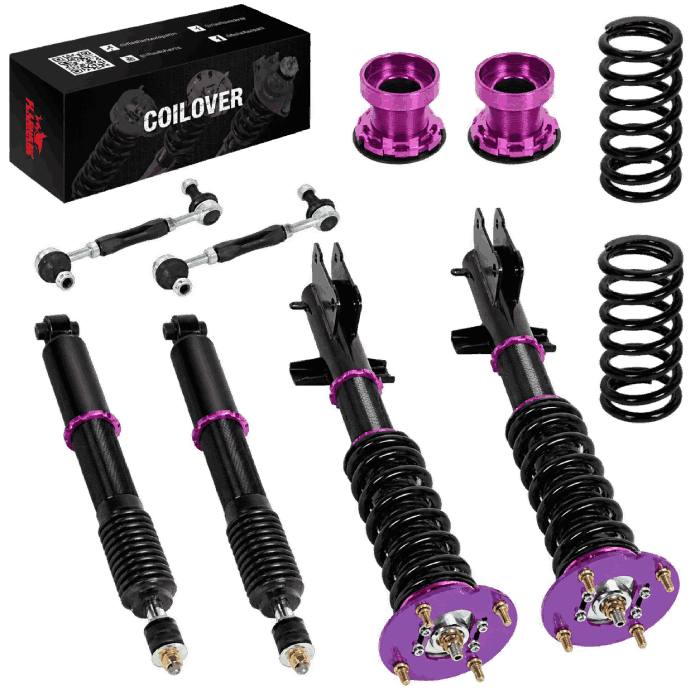
The image above illustrates a four-corner coilover layout. Actual suspension architecture, mounting points, adjustment mechanisms, and component shapes vary by vehicle.
Are Coilovers Worth It?
They can be—when adjustability solves a problem you actually have.
Coilovers make sense for drivers who need to change ride height, want more control over suspension setup, or are building toward a specific street, autocross, or track goal. They make less sense when the only objective is to replace worn factory dampers on an otherwise stock daily driver and no adjustment is needed.
They also do not create better handling by themselves. Tires, alignment, available suspension travel, damping, spring selection, bushings, anti-roll bars, chassis condition, and driver use all affect the final result.
That is why the real question is not simply, “How expensive should my coilovers be?” It is, “What suspension setup does this car need, and how much will it cost to install and set up correctly?”
Before You Pay a Coilover Installation Quote
Take a minute and run through this checklist:
- Is the quoted price labor only, or does it include setup?
- Is the installation for all four corners?
- Will the shop set and measure ride height?
- Is alignment included or separate?
- Does the car need additional alignment hardware?
- Is corner balancing actually useful for how the car will be driven?
- How will the shop handle seized or damaged original hardware?
- Will brake-hose, ABS-wire, tire, wheel, and chassis clearance be checked?
- Does the selected coilover kit match the exact vehicle configuration?
- Are there electronic suspension components or warning-light considerations on the vehicle?
Those questions tell you far more about the quality of a quote than comparing two labor prices with no context.
Final Takeaway
For many straightforward cars, a practical starting budget for professional coilover installation is around $300–$800 in labor. Once ride-height setup and alignment are added, the shop total can move toward $500–$1,000 or more, before the price of the coilovers themselves.
Do not treat that range as a fixed rate. Chassis design, rust, access, local labor, requested ride height, alignment needs, and performance setup can all change the bill.
More important, budget for the complete job. A coilover is an adjustable suspension component, not a “bolt it on and forget it” part. Correct fitment, safe installation, usable suspension travel, clearance checks, and alignment determine whether the money you spend actually produces a suspension setup you can use.
Frequently Asked Questions
Q1: How much does it cost to install coilovers?
A1: For many straightforward passenger cars, professional installation labor can be roughly $300–$800. Installation plus ride-height setup and alignment can bring the shop bill closer to about $500–$1,000 or more. The coilover kit itself is separate, and local labor rates, vehicle design, corrosion, and additional setup can change the final price.
Q2: How much do shops charge to install coilovers?
A2: Shop pricing varies because some estimates cover only the mechanical installation while others include ride-height setup, alignment, clearance checks, and follow-up work. Compare what each quote includes rather than choosing only by the lowest headline number.
Q3: Is wheel alignment included in coilover installation?
A3: Not always. Some suspension shops can bundle installation and alignment, while others quote them separately. Ask before approving the work so the final budget includes the alignment needed after the suspension geometry or ride height has been changed.
Q4: Do I need an alignment after installing coilovers?
A4: Plan on an alignment check after the final ride height is established. Ride-height changes can affect camber and toe, and incorrect toe can cause poor tracking and rapid tire wear even when the wheels do not look visibly misaligned.
Q5: Can I install coilovers myself to save money?
A5: An experienced DIY installer can avoid some labor cost, but the job requires safe vehicle support, suitable tools, a torque wrench, mechanical knowledge, and careful clearance checks. A professional alignment will usually still be needed after the suspension is set to its final height.
Q6: How much do coilovers themselves cost?
A6: Coilover kit prices vary widely by vehicle, damper design, materials, spring configuration, top mounts, adjustment features, and serviceability. Compare the exact fitment and useful features rather than assuming that a higher price or a larger number of adjustment clicks automatically makes a kit better for your car.
Q7: Is corner balancing necessary after installing coilovers?
A7: Not for every street car. Corner balancing is more useful on autocross, track, competition, or carefully set-up performance cars where cross-weight distribution matters. A normal street build should first have sensible ride height, safe clearances, and a correct alignment.
Q8: Does lowering a car farther increase coilover installation cost?
A8: It can. A more aggressive ride height may require additional adjustment, clearance work, or alignment correction if the factory adjustment range is no longer sufficient. The suspension also needs enough usable travel for the way the vehicle is driven.
Q9: Should I use spring preload to set coilover ride height?
A9: That depends on the coilover design. Some systems provide a separate lower mount for changing assembly length, while others use different adjustment arrangements. Preload and ride height should not automatically be treated as the same adjustment. Follow the procedure for the selected kit.
Q10: Do coilovers always improve handling?
A10: No. Handling depends on the complete suspension setup, including spring rate, damping, alignment, suspension travel, tires, anti-roll bars, chassis condition, and road surface. A poorly chosen or poorly adjusted coilover setup can reduce grip or make the car harder to control.
Q11: Are more expensive coilovers always worth the extra money?
A11: Not automatically. Extra cost makes sense when it buys features your build actually needs, such as suitable damping control, spring options, serviceability, alignment flexibility, or vehicle-specific hardware. A daily street car and a track car do not require the same suspension specification.
Q12: Can coilovers cause uneven tire wear?
A12: Coilovers do not automatically cause uneven tire wear, but changing ride height can change camber and toe. Excessive toe or an unsuitable alignment can wear tires quickly. Set the final ride height first, then have the alignment checked.
Q13: Do coilovers need time to settle after installation?
A13: Hardware, bushings, spring seating, and ride height can show small changes after the vehicle is driven. Recheck ride height and inspect the installation according to the suspension manufacturer’s instructions. Do not rely on a fixed mileage that is not specified for the selected kit.
Q14: Do all coilover kits include top mounts and adjustment tools?
A14: No universal assumption should be made about package contents. Top mounts, adjustment tools, brackets, and reused factory parts can differ by kit. Review the selected configuration and package contents before starting the installation.

Steven Chen
Automotive Performance Specialist | Engine & Exhaust Systems
Steven focuses on practical engine performance, exhaust fitment, and real-world upgrade paths for classic and modern enthusiast vehicles. He reviews small-block Ford, LS, truck, and street/strip applications with one goal in mind: helping builders choose parts that actually work together. His philosophy: "Good power starts with the right combination, not the biggest part."