A used exhaust pops up at the right price. The seller says it came off a G35, your car is also a G35, and the flanges look close enough in the photos. Easy bolt-on, right?
Not so fast.
Two cars can share an engine family, a badge, and plenty of suspension parts while using exhaust systems that differ in length, routing, hanger position, muffler shape, and tip location. Add AWD to the equation and the transfer case can turn a harmless-looking Y-pipe bend into a hard interference point.
Listen to me on this one: “same platform” is a useful starting clue, but it is not a fitment guarantee. You need to identify the chassis, drivetrain, body style, and exact exhaust section before spending money.
Quick Answer: Will the Exhaust Actually Fit?
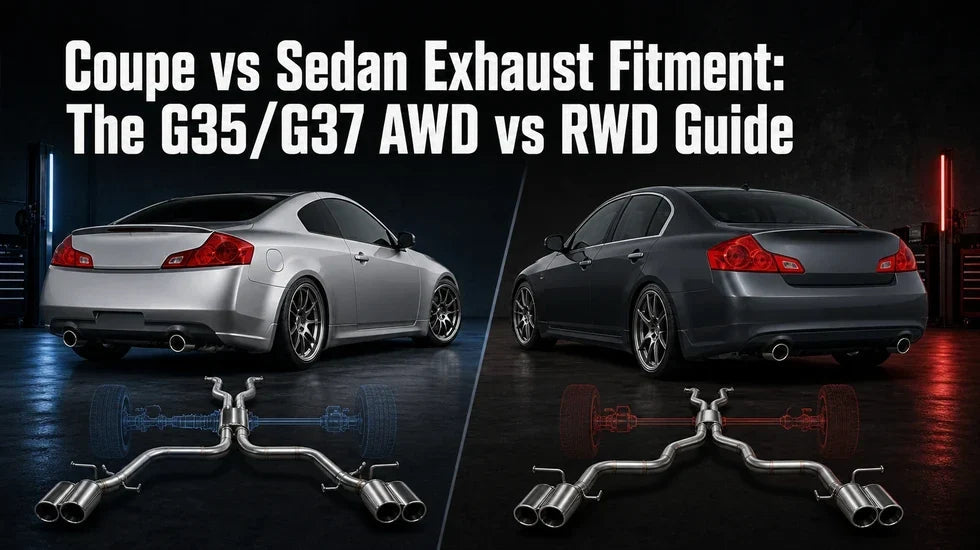
- Coupe vs sedan exhaust fitment: The biggest differences are usually mid-pipe length, rear-floor clearance, muffler packaging, hanger position, and where the tips meet the bumper.
- AWD vs RWD exhaust fitment: The critical area is often farther forward. An AWD transfer case and front driveshaft can require a different Y-pipe shape and more clearance around the drivetrain.
- G35 exhaust fitment AWD: Do not assume a RWD G35 Y-pipe will clear a G35x. Match the part to the chassis generation, engine, drivetrain, and connection points.
- 350Z-to-G35 swaps: Shared FM-platform hardware does not erase differences in exhaust length and rear-body packaging. Some combinations need an extension; others require cutting, welding, or a different rear section.
- A flange that bolts up proves only one thing: that the flange bolts up. It does not prove that the pipe clears the chassis, the hangers sit naturally, or the tip lands in the bumper opening.
Why the Same Model Name Does Not Guarantee Exhaust Fitment
The badge on the trunk is not enough. “G35 exhaust” can refer to several different vehicles: an early V35 sedan, a G35 coupe, an AWD G35x, or a later V36-based sedan. Those cars do not automatically share one complete exhaust layout.
Start With the Chassis, Not the Engine Cover
The VQ35DE, VQ35HR, and VQ37VHR are related engines, but the exhaust does not stop at the cylinder head. It passes the transmission, drivetrain, floor braces, rear subframe, spare-tire area, muffler pocket, and bumper.
That is why “it has the same VQ” is not a complete answer. The engine may help you narrow down header or catalytic-converter connections. It cannot tell you whether a six-foot-long rear section will place its hangers and tailpipe in the right spots.
Mechanic’s note: When someone asks whether “the exhaust” fits, my first question is always, “Which part?” A Y-pipe, mid-pipe, axle-back, and complete cat-back can have four different answers.
Break the System Into Sections
Work from the engine toward the bumper:
- Exhaust manifolds or headers: Bolt to the cylinder heads and route around the engine bay and steering hardware.
- Catalytic converters or test pipes: Connect the manifolds to the front merge section and can involve oxygen sensors and emissions equipment.
- Y-pipe: Merges the two cylinder banks. On an AWD car, its path may be constrained by the transfer case and front driveshaft.
- Mid-pipe or resonator section: Establishes much of the system’s overall length and passes beneath the floor.
- Axle-back or muffler section: Must clear the rear subframe, body, bumper, and any spare-tire well or rear storage structure.
- Exhaust tips: Need the correct spacing, height, angle, and projection for the bumper opening.
If you are still learning where each piece begins and ends, the 350Z stock exhaust system and cat-back layout guide gives you a clear front-to-rear breakdown.
Coupe vs Sedan Exhaust Fitment: Where the Differences Show Up
People often blame wheelbase alone. That can be misleading. Some coupe and sedan variants share a wheelbase yet still use different rear exhaust packaging. Overall body length, floor stamping, fuel-system placement, bumper depth, and muffler space matter just as much.

Pipe Length and the Location of Each Bend
A length difference is not always solved by adding one straight extension. Suppose the front flange sits correctly, but the bend that should pass behind a brace is now three inches too far forward. Making the pipe longer at the rear does nothing for that bend.
The useful measurements are:
- Front flange to the first hanger
- Front flange to the resonator
- Front flange to the rear-subframe crossing point
- Subframe crossing point to the muffler inlet
- Muffler outlet to the bumper reference line
- Center-to-center distance between dual tips
Measure from fixed features such as flange faces and hanger pins. Do not measure from a curved bumper edge in one photo and a muffler shell in another. That is how a supposed eight-inch difference turns into an expensive pile of tubing on the shop floor.
Rear-Floor and Muffler Packaging
The back half of the car causes plenty of trouble. A coupe may have room for a wide transverse muffler where the sedan has a different floor shape, storage well, heat shield, or evaporative-emissions hardware. A compact aftermarket single-exit muffler may fit where a large factory coupe muffler will not, but that does not make every single-exit system interchangeable.
Check the entire muffler envelope—not just the pipe:
- Top of the muffler to the body
- Inner edge to the spare-tire or trunk-floor structure
- Front edge to the rear subframe
- Tip to the bumper or diffuser
- Hanger pin to rubber-isolator alignment
Hangers Should Support the Exhaust, Not Force It Into Shape
I have a hard rule in the shop: if a rubber isolator must be stretched sideways to catch the hanger, stop tightening. The exhaust is not aligned.
Forcing the hanger can create several problems:
- A flange that never seats evenly
- A gasket that begins leaking after a few heat cycles
- A pipe that knocks against a brace under acceleration
- A muffler that sits too high when hot
- A tailpipe that keeps moving back to a crooked position
A small error at the front connection becomes a much larger movement at the tip. If your rear alignment is already wrong, use this seven-step cat-back tip alignment process before bending hangers or cutting pipe.
The Bumper Is Part of Fitment
A system can clear the suspension and still look terrible. Coupe and sedan bumpers may place their outlets at different widths or depths. A tip that sits two inches inside the opening will stain the bumper. A tip that sticks out too far can look unfinished and become a burn hazard.
Set tip position with the vehicle sitting level. Check:
- Vertical clearance above the tip
- Side clearance inside the opening
- Tip projection from a repeatable bumper reference
- Left-to-right height on dual-exit systems
- Clearance after the exhaust reaches operating temperature
AWD vs RWD Exhaust Fitment: Why the Y-Pipe Matters
The rear differential does not tell the whole story. The important AWD hardware is up front: the transfer case sends power toward the front axle, and the front driveshaft takes away space that a RWD exhaust can sometimes use.
The Transfer Case Creates a Hard Clearance Limit
A RWD Y-pipe may use a straighter or tighter route through the transmission area. Put that same shape under an AWD car and it can contact the transfer-case housing, pass too close to the driveshaft, or hang lower than the chassis.
Do not “solve” that problem by crushing the tube flat with a press or hammer. That creates an abrupt restriction and usually leaves an ugly stress point next to a weld. Use a part shaped for the available space or have a competent exhaust fabricator build a smooth transition.

Stop-Work Warning
If the Y-pipe touches the transfer case, front driveshaft, transmission crossmember, or body while the vehicle is stationary, do not drive it to “see if it clears.” Engine movement and road load will make the contact worse.
Can an AWD Exhaust Fit a RWD Car?
Sometimes an AWD-shaped front section has enough clearance on a RWD chassis, but that is not permission to assume every AWD system fits every RWD car. The flange angle, pipe diameter, merge position, body style, and rear section still need to match.
Also be precise about what is being transferred. An AWD axle-back may share rear mounting geometry with a RWD version even when the Y-pipes differ. That does not make the two complete systems identical.
How to Check AWD Clearance
With the exhaust loosely installed and safely supported:
- Center the front flanges without using the bolts to pull them sideways.
- Check clearance around the transfer-case housing.
- Rotate the driveshaft by hand where the service procedure allows and look for nearby pipework.
- Inspect the transmission crossmember, braces, and heat shields.
- Move the exhaust by hand in every direction the rubber hangers allow.
- Confirm that no section can strike the drivetrain at the limit of that movement.
- Recheck after a full heat cycle and complete cooldown.
If you are replacing the merge section rather than the rear system, compare vehicle-specific options in the Nissan Y-pipe, downpipe, and test-pipe collection. Match the selected part to your year, engine, drivetrain, emissions equipment, and downstream flange before ordering.
G35 Exhaust Fitment AWD: The G35x Trap
The search phrase G35 exhaust fitment AWD sounds narrow, but it still covers more than one underbody layout. An early G35x sedan and a later V36-based G35x should not be treated as the same car just because both wear a G35 badge.
Do Not Mix V35 and V36 Conclusions
Model names overlap across a major chassis change. That affects engine configuration, front exhaust connections, floor routing, and the relationship between the Y-pipe and drivetrain.
Before buying, write down all six items:
- Model year
- Production date
- Body style
- Engine code
- AWD or RWD
- The exact section being replaced
A Real-World G35x Failure Pattern
Garage case: The failure pattern I keep an eye out for is a RWD-style Y-pipe that appears correct while hanging below the car. Both front flanges can be started. The rear flange can also be pulled into place. Then the center branch sits against the transfer-case area.
The beginner move is to tighten the rear flange and let the exhaust bend under tension. Do that, and the pipe may clear while the car is cold on a lift. Once the engine twists under load, it knocks against the drivetrain.
My response is simple: loosen the entire assembly and let it sit naturally. If the interference returns, it is a routing problem—not a bolt-tightening problem.
“It Fits the G35” Is Not Enough Information
A useful parts listing needs to distinguish coupe from sedan, AWD from RWD, and one chassis generation from another. If the seller cannot identify the donor car, ask for the stamped part number, full-system photos, and measurements.
If you want a matched rear system instead of adapting an unknown used assembly, browse Nissan cat-back exhaust systems for 350Z, G35, G37, and related platforms. Select by the actual vehicle configuration, not by the closest-looking product photo.
G35, G37 and 350Z Exhaust Fitment Compared
The G35, G37, and 350Z belong to the same broad enthusiast family, so some components and connection patterns overlap. But the 350Z’s shorter two-seat body, the G coupe, and the sedan do not give the exhaust identical distances to cover.
| Fitment Area | Factory Vehicle-Specific Layout | Common Aftermarket Layout | What You Must Check |
|---|---|---|---|
| Pipe diameter | Sized for factory sound, packaging, durability, and emissions configuration | Often larger, with fewer restrictions and less room around braces | Inside diameter, outside diameter, flange opening, and reducer location |
| Mid-pipe length | Matched to one body and floor layout | May be shared across platforms with a separate extension | Flange-to-hanger and flange-to-subframe measurements |
| Y-pipe routing | Shaped around the original drivetrain | May use a wider merge, larger tubing, or a different bend radius | AWD transfer-case and driveshaft clearance |
| Muffler layout | Designed around the factory rear floor and bumper | Single-exit, dual-exit, compact canister, or transverse muffler | Body clearance, heat shielding, and bumper openings |
| Hanger position | Places isolators close to their neutral position | Can vary by manufacturer and system configuration | Pin angle, spacing, height, and rubber preload |
| Sound control | Multiple chambers and conservative resonator tuning | Freer-flowing resonators and smaller or fewer mufflers | Cruising drone, VQ rasp, leaks, and cabin resonance |
When an Extension Pipe Can Work
An extension is a reasonable fix when the system has the correct routing, flange style, hanger geometry, muffler shape, and tailpipe position—but is short by a known amount between compatible connections.
The extension must match:
- Pipe diameter
- Flange type and bolt pattern
- Flange rotation
- Gasket style
- Required installed length
- Available space around the floor and braces
Do not choose an extension length from a random forum comment. Different commenters may be discussing a 350Z, G35 coupe, early sedan, later sedan, or a system that has already been cut.
When an Extension Will Not Save the Swap
An extension cannot correct a muffler that hits the trunk floor, a Y-pipe that contacts the transfer case, or tips that exit on the wrong side of the bumper. It also cannot fix hangers welded several inches away from the chassis isolators.
At that point, you are not installing an exhaust. You are fabricating one.
How to Confirm Exhaust Fitment Before Buying
Ask the Seller Better Questions
“Will it fit my G35?” is too broad. Ask:
- What year, body style, engine, transmission, and drivetrain did it come from?
- Is this a full cat-back, Y-pipe-back, mid-pipe, axle-back, or muffler section?
- Has any pipe, flange, or hanger been cut or rewelded?
- What is the manufacturer part number?
- What is the front flange bolt spacing?
- What is the pipe diameter at the inlet?
- What is the distance from the inlet flange to each hanger?
- Can the seller photograph the system beside a tape measure?
Use a Fitment Measurement Sheet
Measure your car before the part arrives. Once the factory system is removed, record the same points on both assemblies. A difference of half an inch at a slip joint may be adjustable. A bend positioned four inches away from the required subframe crossing is not.

Used-Exhaust Red Flags
- “Fits every G35 and 350Z” with no chassis details
- A missing or ground-off part number
- Fresh paint hiding weld repairs
- Flanges cut off for shipping
- Hanger pins bent sharply toward one side
- Crushed tubing near the Y-pipe
- Only rear-quarter photos with no front connection shown
- A sedan system advertised as a coupe system because the engine is the same
Installation: Bolt-On, Adaptable, or Full Fabrication?
What Direct Bolt-On Should Mean
A proper bolt-on system should install without cutting or welding. Its flanges should meet without being dragged sideways by the bolts. Its hangers should enter the rubber isolators without heavy preload. The pipes should clear the drivetrain and chassis, and the tips should align with the bumper.
“I got the bolts started” is not the same thing.
Loose-Fit the Whole System First
Many new installers tighten the first flange completely, then fight every section behind it. That traps the entire assembly at one angle.
Use this sequence:
- Clean both flange faces.
- Install the correct gaskets.
- Hang every exhaust section loosely.
- Start all bolts and clamps by hand.
- Rotate the pipes to remove hanger preload.
- Center the muffler and tips.
- Snug the system progressively from front to rear.
- Check clearance after each connection is tightened.
- Run one heat cycle, allow a complete cooldown, and inspect again.
For a full G35 installation sequence, see the G35 cat-back installation guide for preventing leaks and crooked tips.

Check Clearance Under Load, Not Just on the Lift
I have seen exhausts sit quietly while hanging from a lift, then knock as soon as the car is back on its wheels. Suspension position changes. Rubber isolators settle. The engine and transmission rotate slightly under torque. Hot tubing expands.
After installation, listen during:
- Cold start
- Idle with the transmission engaged
- Low-rpm acceleration
- Driveway transitions
- Steady cruising between roughly 1,500 and 2,500 rpm
- Deceleration with the drivetrain loaded in the opposite direction
A metallic tap that appears only under throttle often points to movement-related contact. A sharp ticking near a flange usually suggests leakage. A deep cabin hum at a narrow rpm range is more likely resonance or drone.
Sound, Flow, and the Cost of Making the Wrong System Fit
Fitment comes before power claims. A beautifully polished three-inch system is not an upgrade if an installer has to flatten the pipe beside the transfer case or pull a flange crooked enough to leak.
Pipe Size Is Only One Part of the Combination
Flow depends on diameter, bend quality, merge design, resonator construction, muffler restriction, engine output, and the rest of the exhaust. Bigger is not automatically better for every street-driven VQ.
Without testing the same vehicle on the same dyno, under the same conditions, a specific wheel-horsepower promise is just noise. For a fitment-focused build, the immediate targets are more practical:
- No leaks
- No crushed transitions
- No drivetrain contact
- Stable hanger position
- Controlled rasp and drone
- Correct tip alignment
Calculate the Real Installed Price
A cheap used exhaust can stop being cheap quickly. Add the full cost:
- Purchase price
- Freight or local pickup
- Extension or adapter
- Replacement flanges and gaskets
- Hanger fabrication
- Cutting and welding
- Tip repositioning
- Leak or rattle correction
If fabrication pushes the total close to a vehicle-specific system, buy the correct system. You will save time, preserve resale value, and avoid turning every future exhaust repair into another custom job.
Do Suspension Changes Affect Exhaust Clearance?
They can. Lowering the body does not normally move the exhaust relative to body-mounted hangers, but it reduces ground clearance. It can also change how often the exhaust approaches ramps, speed bumps, and driveway transitions.
Worn engine mounts, transmission mounts, differential bushings, and exhaust isolators matter too. They allow more drivetrain or exhaust movement, which can turn a narrow static gap into contact under load.
If ride height is part of the build, compare height-adjustable performance coilovers for street and track builds while keeping the lowest exhaust section, resonator, and Y-pipe in mind. Set the vehicle height around real road clearance—not around a parked photo.
Final Exhaust Fitment Checklist
- Identify the chassis generation.
- Match coupe or sedan body style.
- Match AWD or RWD drivetrain.
- Confirm the engine and transmission configuration.
- Identify the exact exhaust section.
- Compare part numbers and physical measurements.
- Check Y-pipe clearance around AWD hardware.
- Inspect the rear floor, muffler pocket, and subframe crossing.
- Confirm hanger position without stretching the isolators.
- Set tip alignment before final tightening.
- Include adapters and fabrication in the total cost.
- Recheck the system after one complete heat cycle.
The rule is simple: match the chassis, drivetrain, body, and exhaust section—not just the badge. Do that and a G35, G37, or 350Z exhaust project stays a weekend upgrade. Skip it, and the “cheap bolt-on” may spend the next month leaning against a garage wall.
Frequently Asked Questions
Q1: Will a G35 Coupe exhaust fit a G35 Sedan?
A1: Do not assume a complete coupe system will bolt onto a sedan. The mid-pipe length, rear-floor space, muffler layout, hangers, and bumper outlets can differ. A specific section may be adaptable even when the complete system is not.
Q2: Is G35 exhaust fitment different on AWD models?
A2: Yes. The AWD transfer case and front driveshaft can change the required Y-pipe path. The difference may be concentrated in the front section, so identify whether you are buying a Y-pipe, mid-pipe, axle-back, or full cat-back.
Q3: Will a RWD G35 Y-pipe fit a G35x?
A3: A RWD Y-pipe should not be treated as G35x-compatible unless its routing provides the required AWD drivetrain clearance. Matching flanges do not prove that the center branch clears the transfer case.
Q4: Can an AWD exhaust fit a RWD G35 or G37?
A4: Some AWD-shaped components can physically clear a RWD chassis, but compatibility still depends on body style, chassis generation, flange angle, pipe diameter, hanger location, and rear-section length.
Q5: Are G35 Coupe and Sedan exhausts the same length?
A5: Not as a universal rule. Compare the specific system from flange to flange and record the position of its bends, resonator, hangers, and rear-subframe crossing. Overall vehicle length alone is not enough.
Q6: Will a G37 Coupe exhaust fit a G37 Sedan?
A6: A complete coupe system should not automatically be treated as a sedan bolt-on. The mid-pipe and rear section can differ in length and packaging. Check each exhaust section separately.
Q7: Will a 350Z exhaust fit a G35 Coupe?
A7: Some 350Z-based systems can be adapted to selected G35 Coupe configurations with the correct extension and compatible hanger layout. The required extension is specific to the system and vehicle.
Q8: Will a 350Z exhaust fit a G35 Sedan?
A8: It may require more than an extension. The sedan’s rear-floor shape, muffler space, hangers, and bumper outlet must also work with the selected system. A compact single-exit layout can present different challenges from a wide factory-style muffler.
Q9: How long should a G35 exhaust extension pipe be?
A9: There is no universal extension length. Measure the installed gap between compatible connections while the exhaust is supported in its natural position. Match the pipe diameter, flange, gasket, and rotation.
Q10: Are G35 and G37 Y-pipes interchangeable?
A10: Not across every year, engine, and drivetrain. Compare the DE, HR, or VHR connection layout, inlet spacing, outlet flange, merge position, and AWD clearance.
Q11: Is an axle-back interchangeable between AWD and RWD?
A11: It can be on some applications because the major AWD clearance issue is farther forward. Body style, rear flange, muffler layout, hanger positions, and bumper outlets still need to match.
Q12: Why do the flanges line up when the exhaust still does not fit?
A12: Flanges only locate the connection. The system can still have the wrong length, bend position, hanger geometry, muffler shape, or tailpipe location. It may also contact the drivetrain or chassis once tightened.
Q13: Can an exhaust shop make a coupe exhaust fit a sedan?
A13: A competent shop can alter pipe length, flange angle, hangers, and tailpipe position. The swap becomes less sensible when the muffler cannot clear the rear floor or the front section conflicts with AWD hardware.
Q14: Does changing exhaust length affect power or sound?
A14: It can affect tone, resonance, and the position of the resonator or muffler. Power depends on the complete combination, including pipe diameter, merge design, restrictions, engine output, leaks, and calibration.
Q15: Why does my exhaust rattle after a fitment conversion?
A15: Common causes include hanger preload, a pipe touching a brace, inadequate transfer-case clearance, a loose heat shield, poor flange alignment, or movement from worn engine and transmission mounts.
Q16: What does “fits G35/G37” mean in an exhaust listing?
A16: By itself, not much. A useful application must identify the year range, chassis, engine, body style, drivetrain, and exhaust section. Match all of those details before ordering.

Steven Chen
Automotive Performance Specialist | Engine & Exhaust Systems
Steven focuses on practical engine performance, exhaust fitment, and real-world upgrade paths for classic and modern enthusiast vehicles. He reviews small-block Ford, LS, truck, and street/strip applications with one goal in mind: helping builders choose parts that actually work together. His philosophy: "Good power starts with the right combination, not the biggest part."