


 Need car parts? Shop by vehicle
(Select the exact fit for your vehicle)
Need car parts? Shop by vehicle
(Select the exact fit for your vehicle)
Admisión de aire frío para Ford Mustang
Comprar tomas de aire frío Ford: Todas las tomas de aire frío Ford
Comprar por modelo: Tomas de aire frío Ford F-150 | Tomas de aire frío Ford Mustang | Tomas de aire frío Ford F-250 | Tomas de aire frío Ford F-350
Comprar una toma de aire frío para Mustang se vuelve confuso rápidamente porque el emblema se mantuvo igual mientras que el compartimento del motor no. Esta colección cubre aplicaciones seleccionadas del Ford Mustang de 1996 a 2009, incluyendo el V6 de 3.8L de 1999 a 2004, el GT 4.6L 2V de 1996 a 2004, el GT 4.6L 3V de 2005 a 2009 y modelos Bullitt seleccionados de 2008 a 2009.
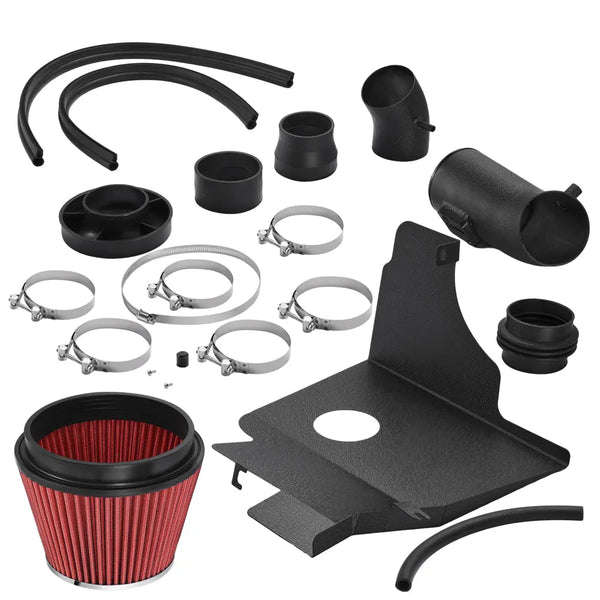
Los kits a continuación utilizan tubos, provisiones de sensores, acopladores, filtros y diseños de protectores térmicos específicos para cada motor. Eso es importante. Una toma de aire New Edge V6 no se ajusta a un New Edge GT, y un kit de 4.6L 2V temprano no es intercambiable con un sistema S197 4.6L 3V.
Elija el producto que coincida con su año de modelo exacto, versión y motor. Luego, abra la página del producto individual y confirme cada nota de ajuste antes de realizar el pedido. Flashark ofrece varios acabados y diseños de filtros, así que compare el hardware real, no solo la foto o el precio.




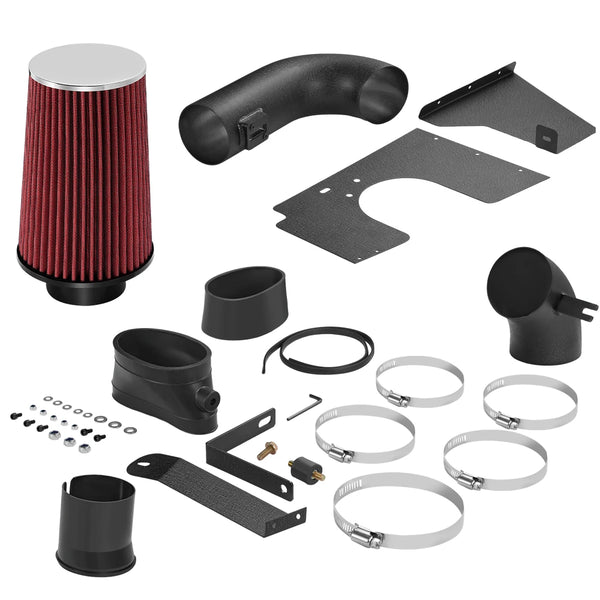
Comprar tomas de aire frío Ford: Todas las tomas de aire frío Ford
Comprar por modelo: Tomas de aire frío Ford F-150 | Tomas de aire frío Ford Mustang | Tomas de aire frío Ford F-250 | Tomas de aire frío Ford F-350
Comprar una toma de aire frío para Mustang se vuelve confuso rápidamente porque el emblema se mantuvo igual mientras que el compartimento del motor no. Esta colección cubre aplicaciones seleccionadas del Ford Mustang de 1996 a 2009, incluyendo el V6 de 3.8L de 1999 a 2004, el GT 4.6L 2V de 1996 a 2004, el GT 4.6L 3V de 2005 a 2009 y modelos Bullitt seleccionados de 2008 a 2009.
Los kits a continuación utilizan tubos, provisiones de sensores, acopladores, filtros y diseños de protectores térmicos específicos para cada motor. Eso es importante. Una toma de aire New Edge V6 no se ajusta a un New Edge GT, y un kit de 4.6L 2V temprano no es intercambiable con un sistema S197 4.6L 3V.
Elija el producto que coincida con su año de modelo exacto, versión y motor. Luego, abra la página del producto individual y confirme cada nota de ajuste antes de realizar el pedido. Flashark ofrece varios acabados y diseños de filtros, así que compare el hardware real, no solo la foto o el precio.
Cómo elegir la toma de aire frío adecuada para tu Ford Mustang
Una toma de aire frío para Ford Mustang debe coincidir con el motor que se encuentra debajo del capó, no solo con el nombre del modelo estampado en el maletero. Esto parece obvio, pero la adaptación de la toma de aire del Mustang es donde muchos pedidos salen mal. Ford utilizó diferentes motores, posiciones del cuerpo de aceleración, configuraciones de MAF, conexiones de respiradero y rutas de admisión en las generaciones SN95, New Edge y S197.
La colección actual de Flashark se centra en aplicaciones seleccionadas del Mustang de 1996 a 2009. Cubre el V6 de 3.8L, el GT de 4.6L SOHC de 2 válvulas y los posteriores GT y Bullitt de 4.6L SOHC de 3 válvulas. Actualmente no cubre todas las generaciones de Mustang, y no debe tratarse como una lista universal para los modelos EcoBoost, Coyote, Cobra, Mach 1 o Shelby.
Antes de comprar
- 1999–2004 3.8L V6: Utilice el kit específico para V6. No comparte la adaptación de la toma de aire con el 4.6L GT.
- 1996–2004 Mustang GT: Busque un kit diseñado para el motor 4.6L SOHC 2V.
- 2005–2009 Mustang GT: Estos modelos S197 utilizan el motor 4.6L SOHC 3V y requieren una disposición de toma de aire diferente.
- 2008–2009 Bullitt: Confirme que el listado de producto individual incluye específicamente la adaptación para Bullitt.
- Modelos EcoBoost y 5.0L: No son compatibles con los productos válidos que se muestran actualmente en esta colección.
Haga coincidir la toma de aire con la generación y el motor de su Mustang
Aquí está la parte que la gente se salta: el mismo año del modelo puede tener más de una disposición de toma de aire. Un Mustang V6 de 2002 y un Mustang GT de 2002 pueden compartir la mayor parte de la carrocería, pero no comparten el motor, el cuerpo de aceleración, la carcasa del MAF o el tubo de admisión. Intentar elegir solo por año es una forma rápida de obtener una caja de piezas que nunca encajarán.
El Mustang GT de 1996 a 2004 utiliza el V8 4.6L SOHC de 2 válvulas de Ford. Esa aplicación abarca los estilos de carrocería SN95 y New Edge tardíos, pero permanece separada de los modelos Cobra y Mach 1. Esos coches utilizan un hardware de motor diferente y no deben incluirse en la misma afirmación de compatibilidad simplemente porque también llevan la insignia de Mustang.
El Mustang GT de 2005 a 2009 pasó al chasis S197 y al V8 4.6L SOHC de 3 válvulas. La ruta de admisión, la ubicación del sensor y el empaquetado del compartimento del motor cambiaron. En un lenguaje de taller sencillo: una etiqueta de 4.6L no es suficiente. Aún necesita saber si el motor es un 2V o un 3V.
| Años del modelo | Aplicación Mustang | Motor | Plataforma | Configuración de admisión | Nota importante de compatibilidad |
|---|---|---|---|---|---|
| 1999–2004 | Mustang 3.8L V6 | 3.8L Essex V6 | New Edge | Tubo único, filtro cónico, escudo térmico | Específico para V6. No intercambiable con una admisión de 4.6L GT. |
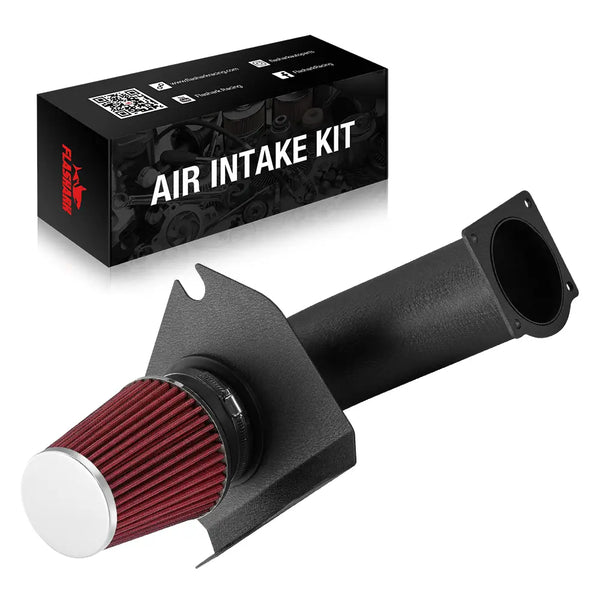
| 1996–2004 | Mustang GT 4.6L V8 | 4.6L SOHC 2V V8 | SN95 y New Edge | Tubo único de 3.5 pulgadas, filtro seco, escudo térmico | Solo aplicación GT. No asuma la compatibilidad con Cobra, Mach 1 o V6. |
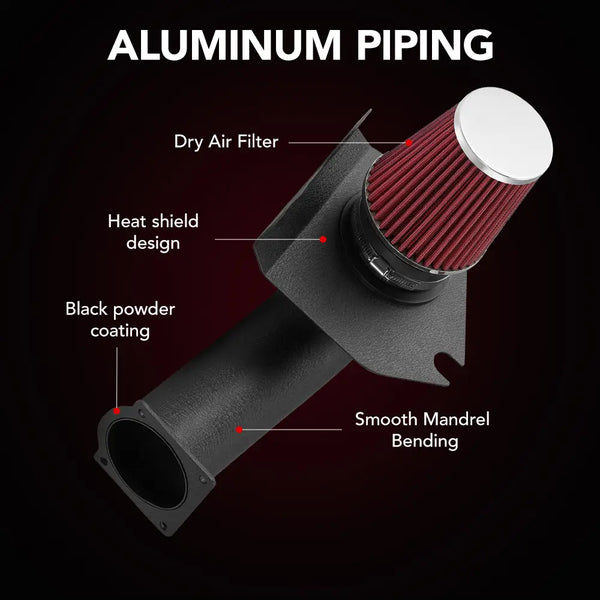
| 2005–2009 | Mustang GT 4.6L V8 con tubo de admisión pulido | 4.6L SOHC 3V V8 | S197 | Tubo de aluminio pulido, filtro cónico lavable, escudo térmico | Confirme el año exacto, las disposiciones del sensor y el hardware incluido en la página del producto. |
| GT seleccionado de 2006–2009 y Bullitt de 2008–2009 | Mustang GT y Bullitt con tubo de admisión negro | 4.6L SOHC 3V V8 | S197 | Tubo negro de 3.5 pulgadas, filtro seco, escudo térmico, retención de conducto inferior | Revise cuidadosamente el listado individual porque la cobertura del año S197 debe coincidir con la revisión exacta del producto. |
Encuentre la toma de aire adecuada para su Mustang según el año y el motor
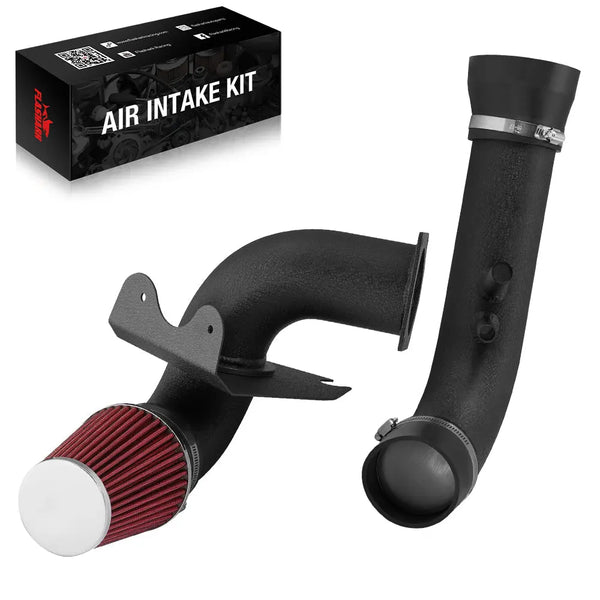
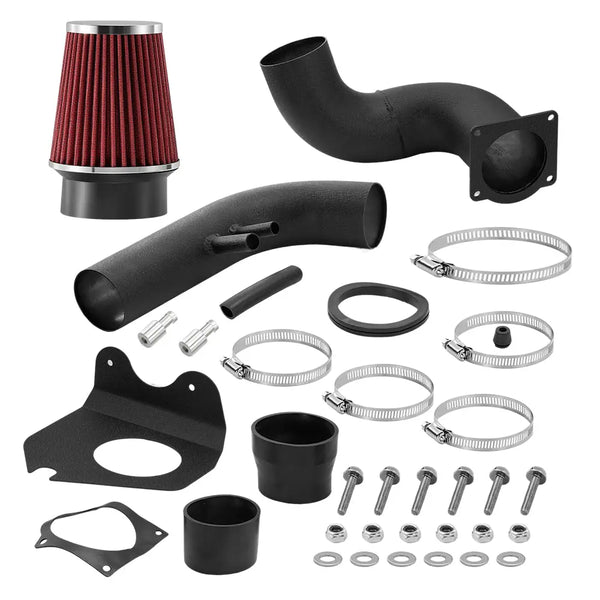
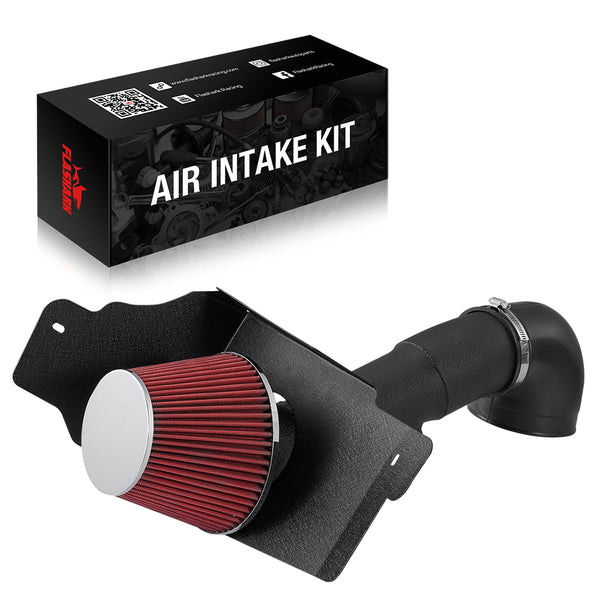
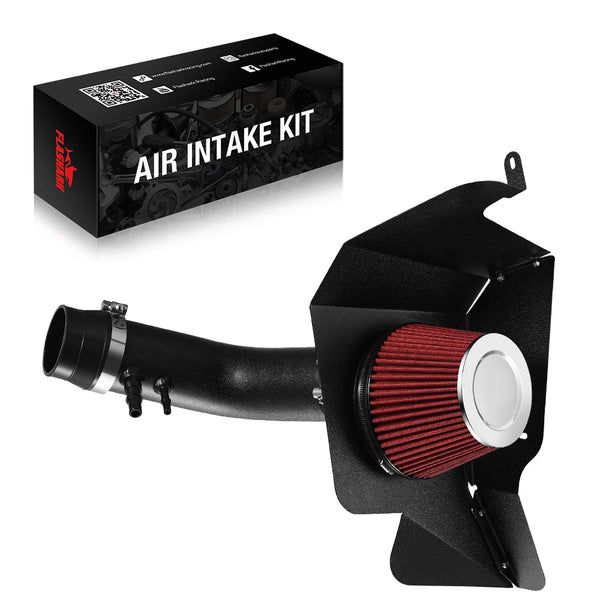
Ninguno de los productos Mustang válidos de esta colección utiliza una configuración de doble admisión. Todos son sistemas de un solo tubo que alimentan un solo cuerpo de mariposa. Las diferencias significativas radican en la forma del tubo, el acabado del tubo, el medio filtrante, el blindaje térmico, las disposiciones de los sensores y cómo el kit extrae o guía el aire desde la parte delantera o inferior del compartimento del motor.
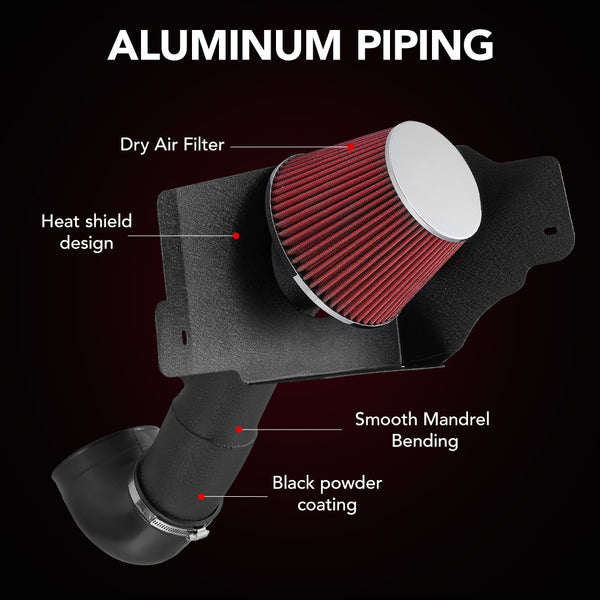
Algunos conductores quieren un tubo de aluminio pulido porque están limpiando el compartimento del motor y quieren que la admisión destaque. Otros prefieren un tubo con recubrimiento de polvo negro que se integre con los plásticos de fábrica. Ninguno de los acabados corrige un ajuste incorrecto. Las curvas, los tamaños de los acopladores, los soportes, la ubicación de los sensores y las conexiones del respiradero importan mucho más que el color.
- Filtro lavable: Diseñado para la limpieza y reutilización repetidas, pero debe mantenerse correctamente y dejarse secar completamente antes de la instalación.
- Filtro seco: Generalmente más fácil de mantener porque no requiere aceite para filtros.
- Escudo térmico: Ayuda a separar el filtro del calor directo del compartimento del motor, aunque no convierte el compartimento del motor en una caja de aire refrigerado sellada.
- Retención del conducto de aire inferior: Permite que los kits seleccionados sigan utilizando una ruta de fábrica que lleva aire exterior más frío hacia el área del filtro.
No imponga una discusión de "aire frío vs. conducto corto" a estos productos. Los kits actuales de Mustang se comparan mejor por su posición real del filtro y la gestión del calor, no por la etiqueta que se utilice en un foro.
Qué esperar del sonido y la conducción diaria
Seamos honestos: el primer cambio que la mayoría de los conductores notan es el sonido. Al abrir el acelerador, la admisión se vuelve más ruidosa. Normalmente se escuchará un silbido más agudo de aire y una nota de inducción más profunda, especialmente a medida que aumentan las revoluciones del motor. Con el acelerador ligeramente pisado, el coche puede seguir siendo bastante discreto. Pero si pisa el acelerador a fondo, el sistema se hará notar.
Las afirmaciones de rendimiento requieren más moderación. Una toma de aire puede reducir las restricciones delante del cuerpo de aceleración, pero el resultado depende del sistema de fábrica, la calibración del MAF, la temperatura ambiente, la configuración del escape, la estrategia de la ECU y el estado del motor. Un V6 de 3.8L de serie, un GT 4.6L 2V y un GT 4.6L 3V tuneado no responderán de forma idéntica.
Ignore a cualquiera que prometa una cifra fija de potencia en rueda para cada Mustang de esta colección. Sin una comparación del mismo coche, el mismo día, el mismo dinamómetro, una afirmación precisa es marketing, no evidencia. Compre la toma de aire por su ajuste correcto, hardware utilizable, sonido de inducción y una ruta de flujo de aire más limpia. Trate cualquier cambio de potencia como dependiente del vehículo.
Comprobaciones de ajuste, MAF e instalación
Antes de retirar la caja de aire de fábrica, coloque cada componente de Flashark sobre una mesa de trabajo limpia y compárelo con la lista de productos. Verifique las curvas del tubo, los acopladores de silicona, las abrazaderas, el filtro, el escudo térmico, los soportes, los soportes de goma, la abertura del sensor y los accesorios del respirador. Un pequeño accesorio faltante puede detener la instalación con la misma eficacia que un tubo de admisión incorrecto.
Preste mucha atención al sensor MAF. Su dirección y posición importan. Un flujo de aire que pase el sensor incorrectamente puede producir ajustes de combustible inestables, un ralentí irregular, vacilaciones o una luz de "revisar motor". No gire el sensor porque el conector parezca más fácil de alcanzar. Instálelo en la orientación que se muestra en las instrucciones del producto.
- Confirme el año del modelo, el acabado y el motor antes de abrir el embalaje.
- Inspeccione el sello del sensor MAF y asegúrese de que su junta tórica o empaque esté plano.
- Vuelva a conectar todas las mangueras de PCV, respiradero y vacío retiradas durante la instalación.
- Asiente cada acoplador completamente antes de apretar las abrazaderas.
- Evite que el tubo de admisión toque el protector del ventilador, la transmisión por correa, el capó o la carrocería.
- Vuelva a comprobar el filtro y las abrazaderas después de los primeros ciclos de calentamiento.
Nota de diagnóstico del mecánico
Cuando un Mustang desarrolla un ralentí irregular o la luz de "revisar motor" inmediatamente después de la instalación de una toma de aire, empiece por lo que se tocó. Compruebe el conector del MAF, la orientación del sensor, las mangueras de ventilación, el asiento del acoplador y todas las abrazaderas entre el filtro y el cuerpo del acelerador. Una pequeña fuga después del MAF puede introducir aire que la ECU no midió.
No empiece por comprar un ajuste o reemplazar sensores. Primero, devuelva la toma de aire a una configuración sellada conocida. Borre la falla solo después de corregir el problema físico, luego deje el motor en ralentí y vuelva a verificar las conexiones antes de conducir.
Ajuste, CEL, emisiones y exposición al agua
Si una toma de aire frío para Mustang requiere ajuste depende del kit específico y de cuán de cerca su carcasa MAF coincida con las características de flujo de aire esperadas por la calibración de fábrica. Algunos diseños están destinados a funcionar con el ajuste de serie. Otros pueden alterar lo suficiente la transferencia MAF como para que sea necesaria una calibración. No hay una respuesta honesta para toda la colección.
Lea las instrucciones individuales del producto antes de la instalación. Si la página del producto no indica claramente el requisito de ajuste, no asuma que un ajuste es obligatorio o innecesario. La misma regla se aplica al cumplimiento de las emisiones. Que una pieza sea físicamente instalable no la hace automáticamente legal para todas las carreteras, programas de inspección o jurisdicciones.
Advertencia importante de ajuste y uso
No haga pedidos solo por el estilo de carrocería o la cilindrada del motor. Una toma de aire de 4.6L 2V no es compatible con un motor de 4.6L 3V, y una toma de aire de 3.8L V6 no es compatible con un GT. Las aplicaciones Cobra, Mach 1, Shelby, EcoBoost y 5.0L Coyote requieren sus propios listados de productos confirmados.
Después de la instalación, deténgase e inspeccione el sistema si el motor desarrolla una luz de revisión del motor (CEL), un ralentí inestable, caladas o un comportamiento anormal de los ajustes de combustible. No siga conduciendo con fuerza asumiendo que la ECU "aprenderá a sortear" una fuga de aire o un sensor MAF instalado incorrectamente.
Evite conducir a través de agua estancada profunda. La lluvia normal no es lo mismo que sumergir un filtro o aspirar agua directamente en la ruta de admisión. Verifique los requisitos locales de emisiones e inspección antes de usar cualquier toma de aire modificada en vías públicas.
¿Qué toma de aire se ajusta a su Mustang?
La forma más clara de elegir es empezar por el código del motor y la generación, luego reducir la elección por el acabado del tubo, el tipo de filtro y el diseño del escudo térmico. Hágalo en ese orden. Comprar el tubo más bonito primero y comprobar el motor después es al revés.
- Para un 3.8L V6 de 1999–2004: Elija la toma de aire frío para Mustang 3.8L V6 de 1999–2004. No sustituya un kit GT incluso si el año del modelo coincide.
- Para un 4.6L GT de 1996–2004: Utilice el kit de admisión de Mustang GT 4.6L 2V. Verifique que el vehículo sea un GT y no un Cobra, Mach 1 o V6.
- Para un 4.6L 3V GT de 2005–2009 con un aspecto de compartimento de motor pulido: Revise la admisión de Mustang GT S197 con tubo pulido.
- Para un S197 GT seleccionado o un Bullitt de 2008–2009: Compare la admisión de Mustang GT y Bullitt con escudo térmico negro y verifique la cobertura exacta del año en la página del producto.
Escuche esto antes de hacer clic en "Añadir al carrito": una toma de aire para Mustang debe atornillarse sin cortes creativos, acopladores estirados, orificios improvisados para sensores o mangueras tensas por el compartimento del motor. Si las piezas no encajan de forma natural, deténgase y vuelva a comprobar la aplicación. Un ajuste correcto debe parecer intencional.
¿Necesita comparar aplicaciones fuera de la línea Mustang? Explore la colección completa de kits de admisión de aire Ford.
Preguntas frecuentes sobre la toma de aire frío para Ford Mustang
P1: ¿Qué años de Ford Mustang están cubiertos actualmente en esta página?
R1: Los productos Mustang válidos cubren actualmente aplicaciones seleccionadas de 1996 a 2009. Eso incluye el V6 de 3.8L de 1999–2004, el GT 4.6L 2V de 1996–2004, el GT 4.6L 3V de 2005–2009 y aplicaciones seleccionadas de Bullitt de 2008–2009. Siempre confirme el listado exacto del producto antes de realizar el pedido.
P2: ¿Una toma de aire frío de Mustang es compatible tanto con los modelos V6 como con los GT?
R2: No. El V6 de 3.8L y el V8 de 4.6L utilizan diferentes posiciones del cuerpo de aceleración, enrutamiento de la admisión, provisiones de MAF y puntos de conexión. Un kit listado para un V6 no debe instalarse en un GT, incluso cuando ambos coches comparten el mismo año de modelo.
P3: ¿Cuál es la diferencia entre una toma de aire de Mustang 4.6L 2V y 4.6L 3V?
R3: El motor 4.6L 2V se utiliza en las aplicaciones Mustang GT de 1996–2004 cubiertas aquí, mientras que el motor 4.6L 3V se utiliza en el S197 GT de 2005–2009. Sus rutas de admisión, diseños del compartimento del motor y configuraciones de sensores difieren, por lo que los kits no son intercambiables.
P4: ¿Por qué hay dos opciones de toma de aire para el Mustang GT S197?
R4: Las opciones del S197 difieren en el acabado del tubo, el material del filtro, la disposición del escudo térmico y cómo funcionan con el conducto de aire inferior. Compare cuidadosamente los listados de tubos pulidos y tubos negros, luego verifique la cobertura exacta del año del modelo y el hardware incluido en cada página de producto.
P5: ¿Estas tomas de aire son compatibles con un Mustang Bullitt?
R5: Solo debe considerarse el producto que liste específicamente las aplicaciones seleccionadas del Bullitt de 2008-2009. No asuma que cualquier toma de aire de Mustang GT 4.6L 3V es automáticamente compatible con el Bullitt sin verificar el listado individual.
P6: ¿Esta colección incluye una toma de aire frío para Mustang EcoBoost?
R6: Actualmente, esta colección no incluye ningún producto Mustang EcoBoost válido. Los productos cubiertos aquí se centran en aplicaciones seleccionadas de Mustang 3.8L V6 y 4.6L V8 de 1996 a 2009.
P7: ¿Necesito un ajuste después de instalar una toma de aire frío en mi Mustang?
R7: Depende del diseño exacto de la toma de aire y la carcasa del MAF. Algunos kits están destinados a ser utilizados con la calibración de fábrica, mientras que otros pueden requerir un ajuste. Siga las instrucciones y la declaración de ajuste en la página del producto individual en lugar de aplicar una respuesta a cada toma de aire de Mustang.
P8: ¿Puede una toma de aire frío provocar que se encienda la luz de "Revisar motor"?
R8: Una admisión correctamente emparejada y debidamente instalada no debería tratarse como un activador automático de la luz de verificación del motor (CEL). Pueden surgir problemas cuando el sensor MAF se instala incorrectamente, un acoplamiento tiene fugas, una manguera de vacío o de ventilación se deja desconectada, o la admisión cambia el flujo de aire más allá de lo que espera la calibración de fábrica.
P9: ¿Cómo cambiará una admisión de aire frío el sonido de mi Mustang?
R9: La admisión generalmente sonará más notable durante la aceleración, con un flujo de aire más agudo y un tono de inducción más profundo. El volumen exacto depende del motor, la posición del filtro, el escudo térmico, el sistema de escape y la apertura del acelerador.
P10: ¿Con qué frecuencia debo revisar el filtro de admisión?
R10: Inspeccione el filtro durante el mantenimiento rutinario y revíselo según su material y el entorno de conducción. Las carreteras polvorientas requieren una atención más frecuente. Los filtros lavables deben limpiarse correctamente y secarse por completo, mientras que los filtros secos no deben aceitarse a menos que sus instrucciones lo requieran específicamente.
P11: ¿Son legales en cuanto a emisiones estas admisiones de aire frío para Mustang?
R11: No asuma una aprobación general de emisiones. El cumplimiento depende del producto exacto y de las normativas del lugar donde el vehículo está registrado o inspeccionado. Verifique la lista de productos individual y las regulaciones locales antes de usar una admisión modificada en vías públicas.


