


 Need car parts? Shop by vehicle
(Select the exact fit for your vehicle)
Need car parts? Shop by vehicle
(Select the exact fit for your vehicle)
Ford F150 Cold Air Intake
Shop Ford Cold Air Intakes: All Ford Cold Air Intakes
Shop by Model: Ford F-150 Cold Air Intake | Ford Mustang Cold Air Intake | Ford F-250 Cold Air Intake | Ford F-350 Cold Air Intake
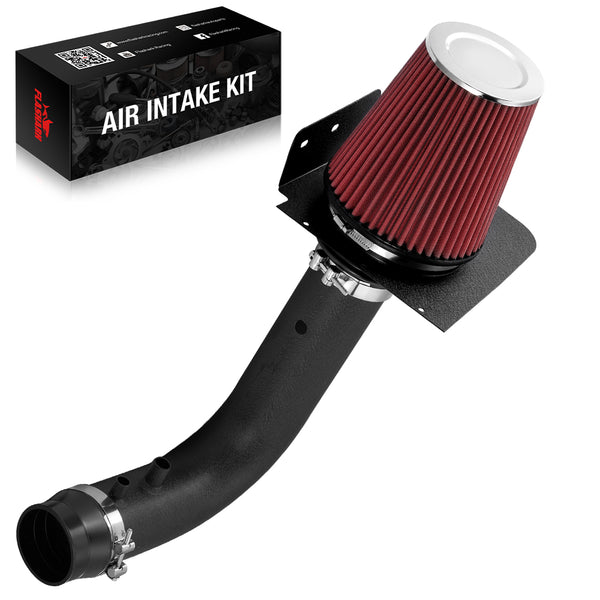
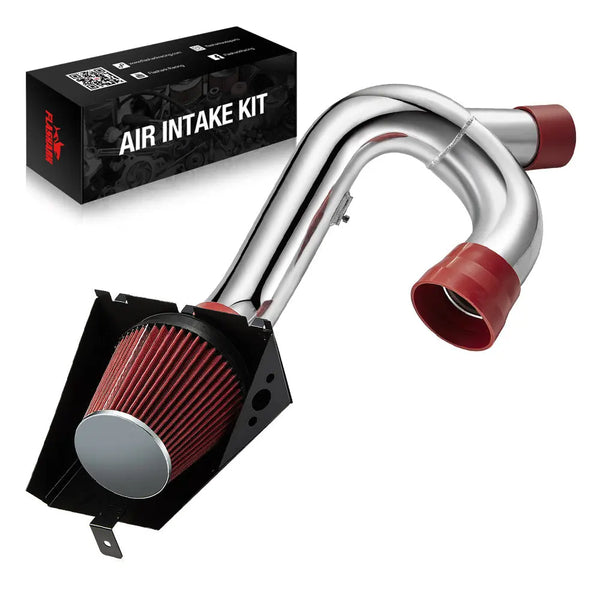
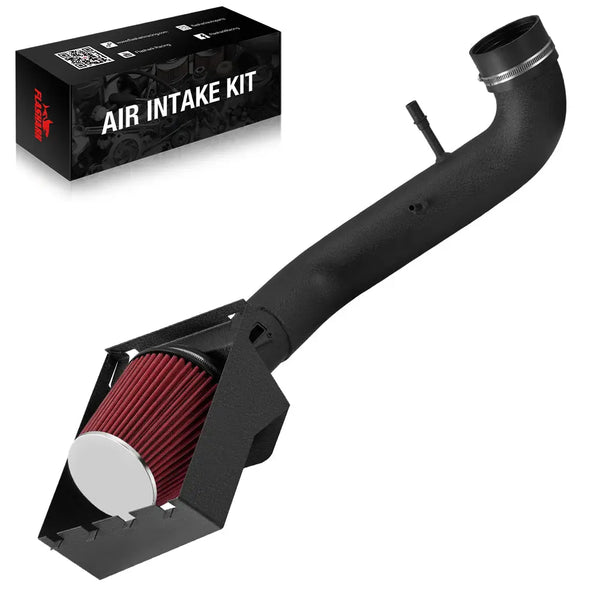
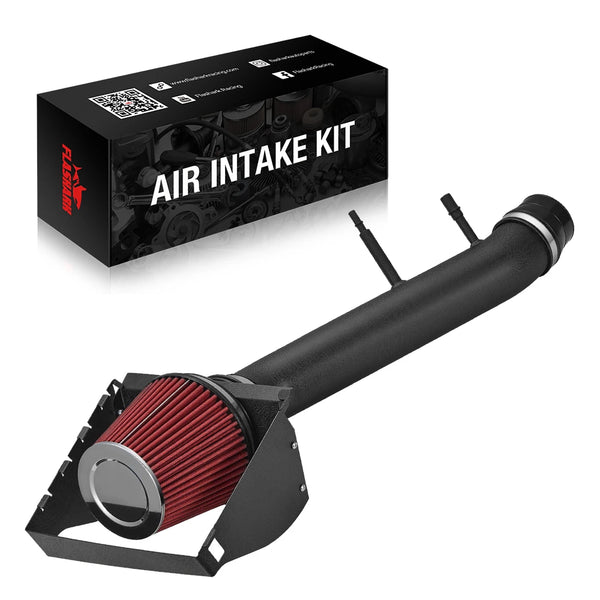
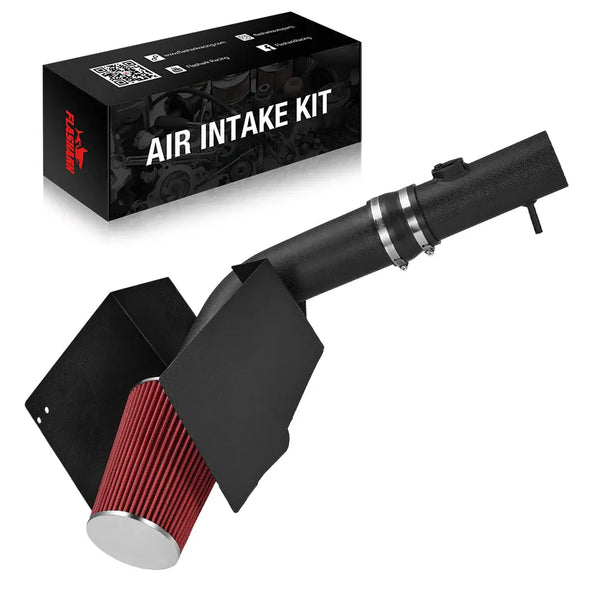
Shop Ford F-150 cold air intake kits for select Triton V8, Coyote V8, and EcoBoost applications. These heat-shielded, open-filter systems are built for drivers who want a cleaner intake path, easier filter access, and a sharper induction sound when the throttle opens without turning a daily-driven truck into an irritating highway drone.
Current coverage includes selected 1997–2020 F-150 applications with 4.6L, 5.4L, and 5.0L V8 engines, along with specific 2.7L and 3.5L EcoBoost configurations. Ford changed airbox locations, MAF housings, hose connections, and pipe routing across these generations, so matching the engine alone is not enough.
Select your exact model year and engine, then confirm the fitment notes and factory intake layout on the individual product page before ordering.


Shop Ford Cold Air Intakes: All Ford Cold Air Intakes
Shop by Model: Ford F-150 Cold Air Intake | Ford Mustang Cold Air Intake | Ford F-250 Cold Air Intake | Ford F-350 Cold Air Intake
Shop Ford F-150 cold air intake kits for select Triton V8, Coyote V8, and EcoBoost applications. These heat-shielded, open-filter systems are built for drivers who want a cleaner intake path, easier filter access, and a sharper induction sound when the throttle opens without turning a daily-driven truck into an irritating highway drone.
Current coverage includes selected 1997–2020 F-150 applications with 4.6L, 5.4L, and 5.0L V8 engines, along with specific 2.7L and 3.5L EcoBoost configurations. Ford changed airbox locations, MAF housings, hose connections, and pipe routing across these generations, so matching the engine alone is not enough.
Select your exact model year and engine, then confirm the fitment notes and factory intake layout on the individual product page before ordering.
Choosing the Right Ford F-150 Cold Air Intake Kit
An F-150 intake looks simple when it is sitting on a workbench: a pipe, a filter, a few couplers, and a heat shield. Under the hood, things get less forgiving. Ford moved sensors, changed throttle-body connections, revised crankcase ventilation plumbing, and altered the available space around the airbox several times during the years represented in this collection.
Here is the practical answer: shop by model year, engine, and factory intake layout. Do not buy by displacement alone. Two trucks may both carry a 3.5L badge and still require different tubing, sensor provisions, hose ports, and mounting hardware.
Before You Buy
- Match the kit to the exact model year, engine, and body style—not just the F-150 name.
- The current products are primarily single-filter, heat-shielded, open-element intake systems.
- A 2004 F-150 Heritage uses the earlier body and intake layout; it should not be treated like every other 2004 truck.
- Different 3.5L EcoBoost generations should not be assumed interchangeable without checking the MAF housing, hose ports, and pipe routing.
- A tune is not normally required for a correctly matched, stock-style MAF intake, but modified trucks may need a different approach.
Find the Right Intake for Your F-150 Year and Engine
The table below is a shopping guide, not a substitute for the individual product fitment list. Some years appear under more than one intake design, and several older listings also mention related Ford or Lincoln platforms. That does not mean every kit shares identical brackets or engine-bay clearance.
| Model Years | Engine | Typical Kit Structure | Important Fitment Check |
|---|---|---|---|
| 1997–2003 | 4.6L or 5.4L Triton V8 | Single aluminum tube, cone filter, heat shield, factory MAF transfer | Check the exact hose connections and whether the listing includes 2004 Heritage. |
| 2004–2008 | 5.4L Triton 3V V8 | Heat-shielded open filter with aluminum intake piping | Confirm whether a 2004 truck is the Heritage body or the newer body style. |
| 2011–2014 | 5.0L Coyote V8 | Single-filter system with heat shield and factory sensor provision | Do not use the kit on 3.5L EcoBoost, 3.7L V6, or 6.2L V8 trucks. |
| 2012–2014 | 3.5L EcoBoost V6 | Heat-shielded single-filter intake with application-specific tubing | Do not assume later EcoBoost tubing or sensor layouts are the same. |
| 2015–2017 | 3.5L EcoBoost V6 | Single dry cone filter, aluminum pipe, and heat shield | Check the production year carefully; do not assume automatic 2018-and-later compatibility. |
| 2015–2020 | 5.0L Coyote V8 | Large-diameter pipe, open cone filter, and heat shield | Verify the product's stated end year and compare the MAF boss and breather fittings. |
| Selected 2015-and-later applications | 2.7L or 3.5L EcoBoost V6 | Single-filter heat-shielded system, sometimes retaining part of the factory lower inlet | Confirm the exact year, engine, sensor housing, hose ports, and product-page exclusions before ordering. |
What These F-150 Intake Kits Actually Include
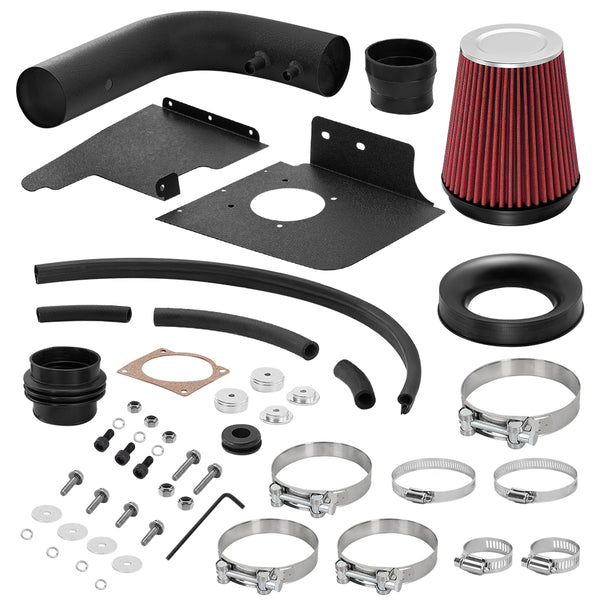
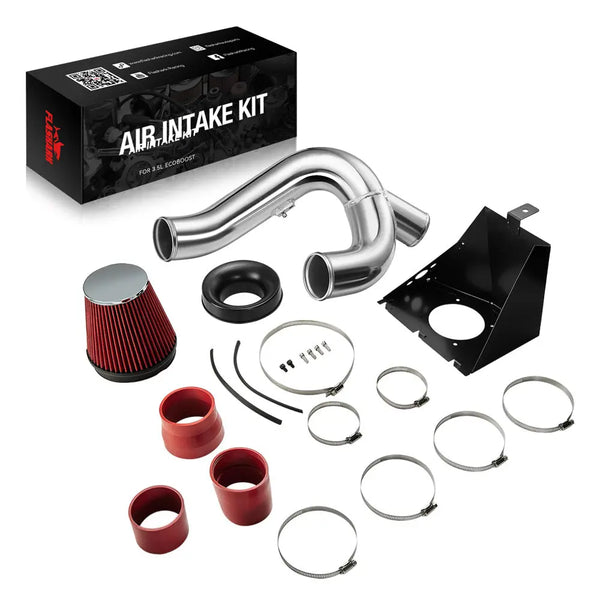
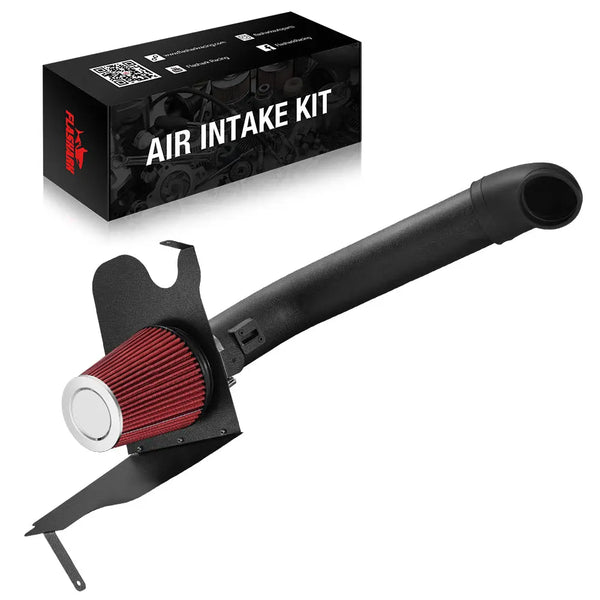
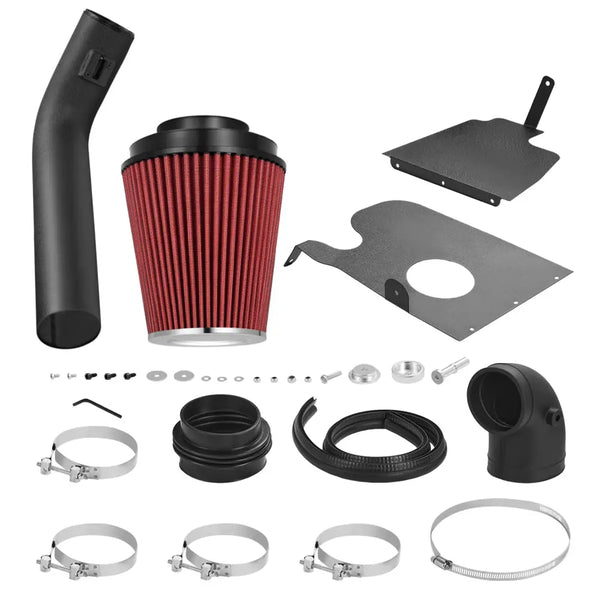
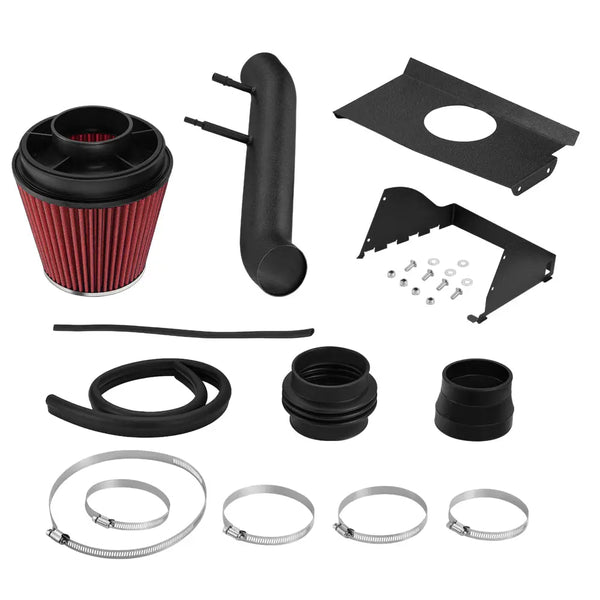
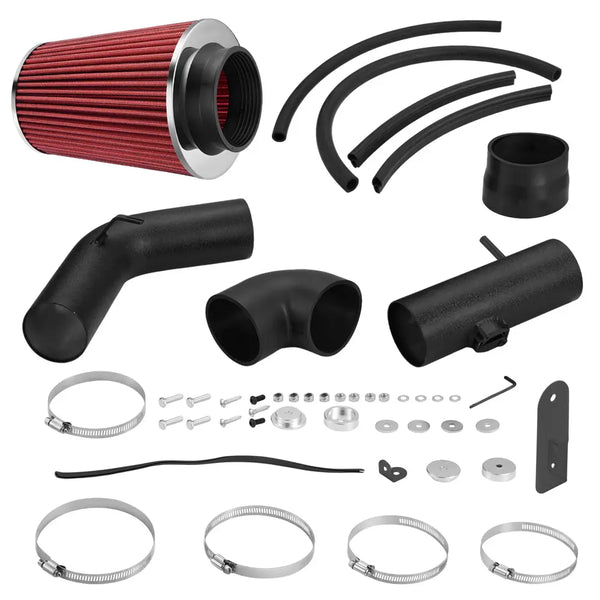
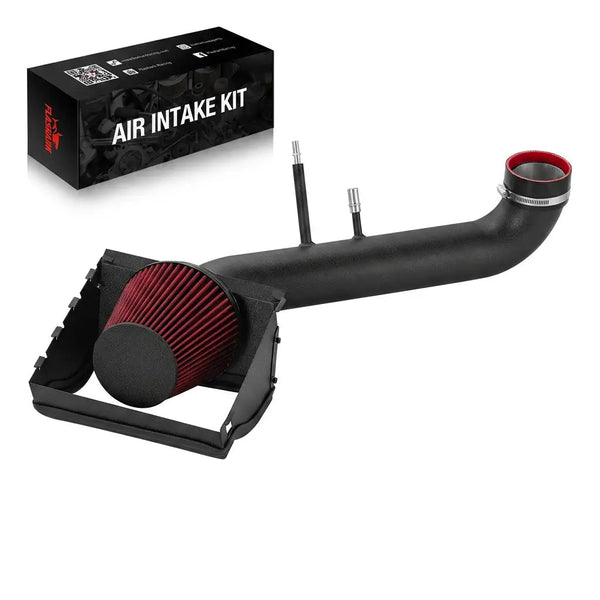
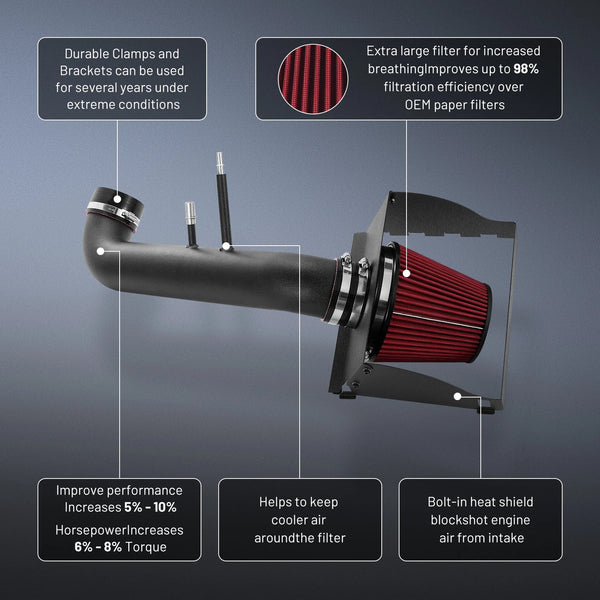
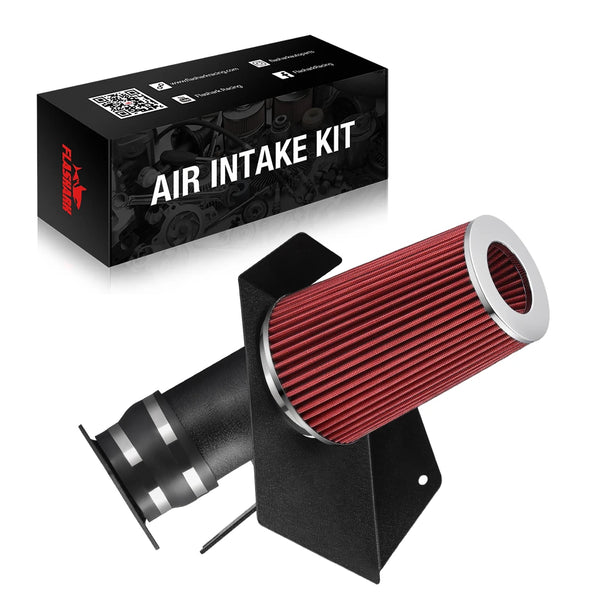
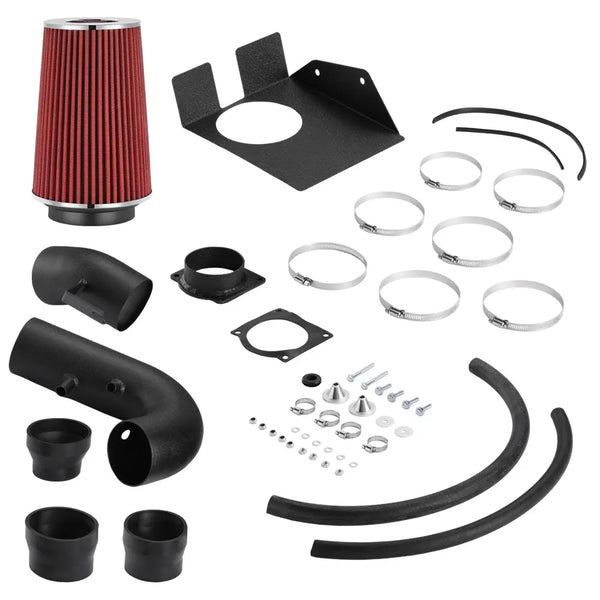
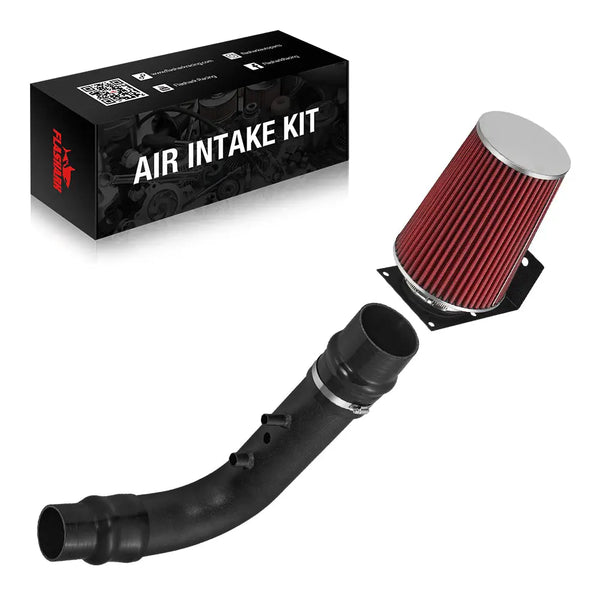
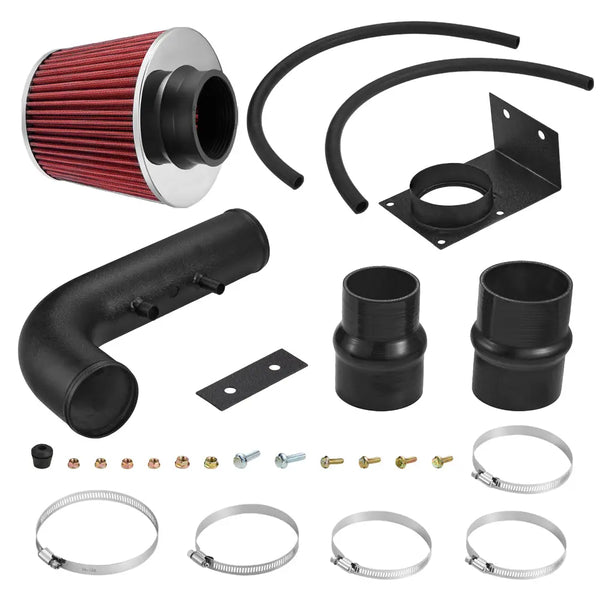
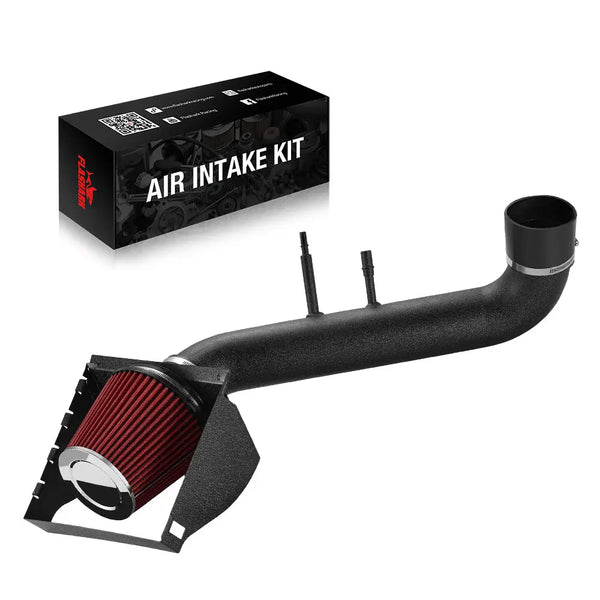
Most products in this collection use the same broad recipe: an aluminum intake tube, a large cone-style filter, silicone couplers, clamps, mounting hardware, and some form of heat shield. The shield separates the filter from part of the engine bay, while the open filter makes the intake sound much easier to hear under load.
Do not confuse “EcoBoost” with a dual-filter intake. The engine may use two turbochargers, but the kits currently represented here are generally single-filter systems feeding the factory intake path. They are not twin independent intake assemblies, and they should not be marketed as such.
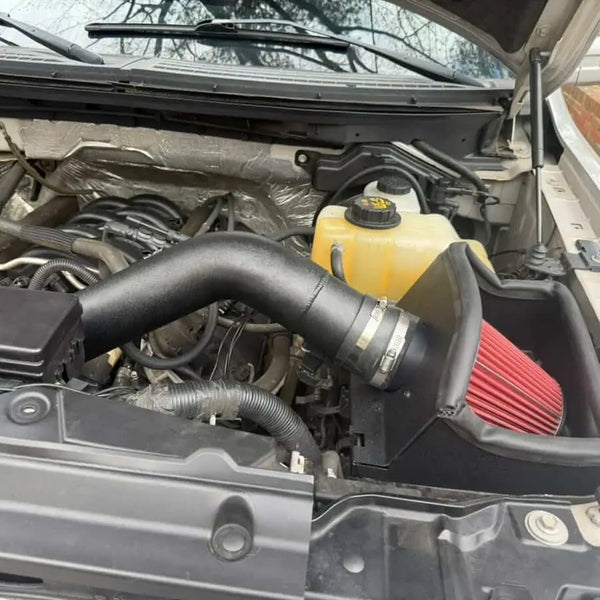
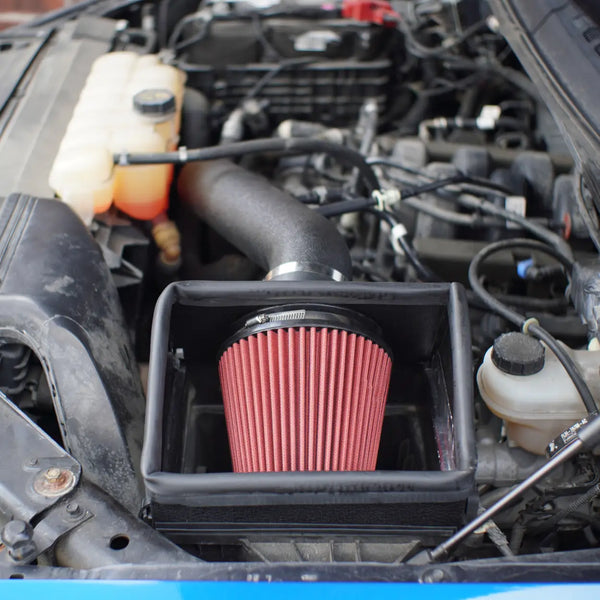
These products are also different from a traditional long-tube intake that places the filter deep behind the bumper. The filters shown in this collection normally remain high in the engine compartment. That makes routine inspection easier and reduces direct splash exposure, although it does not make the filter waterproof.
Why the Model Year and Engine Generation Matter
Here is where people get burned: they see “5.0L F-150,” click the first tube that looks close, and assume every Coyote truck uses the same intake arrangement. It does not. The 2011–2014 trucks and the 2015-and-later trucks use different engine-bay layouts, airbox positions, pipe routing, and supporting hardware.
The EcoBoost applications demand even more attention. Ford revised sensor locations, inlet connections, crankcase ventilation fittings, and packaging around the turbo inlet system. A 2012–2014 3.5L EcoBoost intake should not automatically be treated as a match for a 2015–2017 truck, and neither should be assumed to fit every later 3.5L application.
The 2004 model year deserves its own warning. A 2004 F-150 Heritage is essentially the previous body generation carried into one more model year. The newer 2004 F-150 uses a different platform and engine-bay layout. Look at the factory airbox and body style before buying. The registration year by itself can send you toward the wrong kit.
Important Fitment Warning
Do not order an intake solely because the engine displacement appears in the product title. Confirm the complete model year, engine family, body style, factory MAF housing, breather-hose arrangement, and tube routing. Pay particular attention to 2004 Heritage trucks and to the different 3.5L EcoBoost generations.
What to Expect from Sound and Daily Driving
The most obvious change is usually sound. At light throttle, the truck can remain fairly civil. Press deeper into the pedal and the filter becomes easier to hear, especially on a naturally aspirated 5.0L or 5.4L engine. EcoBoost trucks may add more airflow noise along with sharper turbo and bypass-valve sounds.
Be realistic about power. An intake can remove restrictions in the factory path, but the result depends on the engine, factory calibration, tube geometry, filter condition, weather, fuel, and the rest of the truck's modifications. Without a same-truck, same-day dyno test, no honest collection page should promise a fixed wheel-horsepower number.
The same goes for fuel economy and throttle response. Some drivers may notice a change in pedal feel or driving sound. Others simply press the throttle harder because the truck now sounds better, then wonder why the fuel gauge is moving faster. That is driver behavior, not a defect in the laws of physics.
Fitment and Installation Checks Before Ordering
Before removing the factory airbox, compare the Flashark product photos and fitment notes against the truck sitting in front of you. A few minutes spent checking connections can save an hour of trying to force the wrong pipe into place.
- Confirm the complete model year and engine displacement.
- Identify the engine family, not just the displacement badge.
- Check whether the truck is a 2004 Heritage or the newer 2004 body style.
- Compare the factory MAF sensor shape and mounting pattern.
- Count the PCV, breather, and vacuum hose connections on the original tube.
- Check throttle-body diameter and coupler size.
- Confirm clearance around the fan shroud, coolant tank, wiring, and hood.
- Inspect the product page for engine, trim, or production-date exclusions.
For representative applications, review the 1997–2003 F-150 4.6L/5.4L V8 intake, the 2011–2014 F-150 5.0L intake, the 2012–2014 F-150 3.5L EcoBoost intake, or the 2015–2020 F-150 5.0L Coyote intake. Compare the tube shape, hose ports, sensor mount, and included hardware rather than relying on the product name alone.
Mechanic's Note: Check the Intake for Unmetered Air
A rough idle or check-engine light immediately after installation does not automatically mean the ECU needs a tune. The first suspect is usually air entering after the MAF sensor. That air has not been measured, so the ECU cannot calculate fuel correctly.
Shut the engine off and inspect the MAF seal, sensor orientation, coupler behind the sensor housing, throttle-body clamp, breather hoses, and every unused port. A clamp can feel tight while the coupler underneath is folded. A breather hose can also sit against a fitting without fully locking onto it. Fix the physical leak first, clear the code, and then reassess the truck before changing the calibration.
MAF Sensors, Tuning, Emissions, and Water Exposure
Many vehicle-specific intake kits are designed to reuse the factory MAF sensor and stay within the range of the original ECU calibration. On an otherwise stock truck, a tune is usually not required when the correct tube diameter, MAF housing, and sensor position are retained. That statement stops being reliable when the intake is mismatched, the MAF section is altered, or the truck already has larger turbos, revised fueling, an aggressive tune, or other airflow changes.
Never install the MAF backward. Follow the airflow arrow or match its original orientation. Keep the sensing element clean, and do not soak it with filter oil or spray cleaner intended for throttle bodies. Use only a cleaner specifically approved for MAF sensors when cleaning is necessary.
Most filters in this collection remain relatively high in the engine bay, so normal rain is not the same as submerging a low-mounted filter. Still, avoid deep standing water, direct pressure-washer spray, and driving with a missing splash shield. Inspect the filter after severe weather or off-road use.
Emissions requirements vary by location. A product being physically installable does not automatically make it emissions legal. Look for a valid CARB Executive Order or other applicable compliance statement on the individual product page. When no exemption is listed, confirm local requirements before using the kit on a street-driven truck.
Choosing an Intake for Your F-150 Build
For a daily driver or work truck, prioritize exact fitment, secure MAF placement, filter service access, and a heat shield that mounts without rubbing hoses or wiring. A properly installed system should sit firmly in the engine bay. It should not depend on a coupler being stretched sideways to make the brackets line up.
For a naturally aspirated 4.6L, 5.4L, or 5.0L truck, the main appeal is usually a more direct intake path and a deeper induction sound under acceleration. For an EcoBoost truck, listen for air leaks after installation and watch for hesitation, unstable idle, or fuel-trim codes. Boosted engines are less forgiving of loose connections.
Heavily modified trucks need a broader plan. An intake should be selected alongside the turbo setup, tuning strategy, fuel system, intercooler, exhaust, and intended airflow range. Do not assume that the best intake for a stock commuter is automatically the best choice for a tuned towing build or a high-output street truck.
Looking for another Ford platform? Browse all Ford air intake kits before narrowing the selection by model, year, and engine.
Ford F-150 Cold Air Intake FAQ
Q1: What Ford F-150 years and engines are covered by this collection?
A1: The collection currently includes selected 1997–2020 applications with 4.6L, 5.4L, and 5.0L V8 engines, plus specific 2.7L and 3.5L EcoBoost applications. Some listings claim a wider year range, so the exact product-page fitment and factory intake layout must be checked before ordering.
Q2: Is a Ford F-150 cold air intake worth installing on a daily driver?
A2: It can be worthwhile when you want a more noticeable induction sound, a reusable filter, and a less restrictive intake path. The upgrade makes the most sense when the kit fits correctly, seals properly, and does not create sensor or hose-connection problems.
Q3: How much louder will the intake sound?
A3: The largest change is usually heard during moderate or heavy acceleration. Steady-speed cruising can remain relatively quiet, while naturally aspirated V8 trucks gain a deeper intake growl and EcoBoost trucks may produce more turbo and bypass-valve sound.
Q4: Does an F-150 cold air intake require a tune?
A4: A tune is usually not required for a correctly matched kit that retains the factory MAF sensor and uses suitable sensor-housing geometry. A mismatched intake or a truck with larger turbos, fueling changes, or an existing performance calibration may require additional tuning.
Q5: Will a 4.6L intake fit a 5.4L F-150?
A5: Some 1997–2003 product listings cover both engines because certain factory intake connections are shared. That does not make every 4.6L and 5.4L kit interchangeable, so confirm the listed years, hose ports, throttle-body connection, and included brackets.
Q6: Which intake fits a 2004 F-150 Heritage?
A6: The 2004 F-150 Heritage uses the previous-generation body and intake layout. It may fit a kit listed for the 1997–2003 platform when the product specifically includes the Heritage model, but it should not be matched to a newer-body 2004 kit without verification.
Q7: Are 2012–2014 and 2015–2017 3.5L EcoBoost intake kits interchangeable?
A7: They should not be assumed interchangeable. Ford changed intake routing, sensor placement, hose connections, and engine-bay packaging between generations, so use a kit that explicitly lists the truck's exact model years.
Q8: Can one intake fit both the 2.7L and 3.5L EcoBoost?
A8: Certain products may be engineered for both engines, but shared turbocharging does not guarantee shared fitment. Verify the MAF housing, pipe routing, hose ports, coupler sizes, and exact year range stated on the product page.
Q9: What can cause a check-engine light or rough idle after installation?
A9: Common causes include a backward MAF sensor, a damaged MAF seal, a loose coupler, an open breather or vacuum connection, a folded silicone sleeve, contaminated sensor elements, or an intake tube that does not match the ECU's expected airflow characteristics.
Q10: How should the reusable intake filter be cleaned?
A10: Follow the cleaning instructions for the specific filter. Remove loose dirt gently, wash only with an approved filter cleaner when permitted, rinse from the clean side outward, and allow the filter to dry completely before reinstalling it. Do not oil a dry filter unless the manufacturer specifically requires it.
Q11: Are these intake kits safe in rain and legal for street use?
A11: The filters generally remain high in the engine bay, so normal rain is different from submerging the filter in deep water. Avoid direct pressure-washer spray and standing water. Street legality depends on local emissions rules and whether the specific product has the required approval or CARB exemption.


