Usually, yes—but the difference is mainly intake noise under acceleration, not a permanently louder exhaust. A less-muted intake path can expose more of the engine’s induction sound when airflow and throttle opening increase. At idle or during steady cruising, the change may be small.
How noticeable it becomes depends on the intake design, the factory airbox and resonators, engine load, RPM, engine configuration, turbocharging, and the amount of sound insulation around the engine bay. An open-element intake may sound very different from a sealed cold air intake that retains much of the factory ducting.
- A cold air intake often makes induction noise louder during moderate or hard acceleration.
- The change is usually less noticeable at idle and during steady, light-throttle cruising.
- It does not directly change the mufflers, catalytic converters, resonators, or tailpipes, so it does not directly make the exhaust system louder.
- Open filters generally expose more intake sound than closed airboxes, although the result varies by vehicle and system design.
- Naturally aspirated engines may develop a stronger intake growl, while turbocharged engines may reveal more air-rush, compressor, or bypass-valve sound.
- A louder hiss, rattle, whistle, or unstable idle after installation may indicate a loose clamp, intake leak, sensor issue, or another installation problem.
- Power, fuel economy, Tune requirements, and warning-light behavior depend on the vehicle, intake design, sensor arrangement, calibration, and installation quality.

Introduction to Cold Air Intake Systems
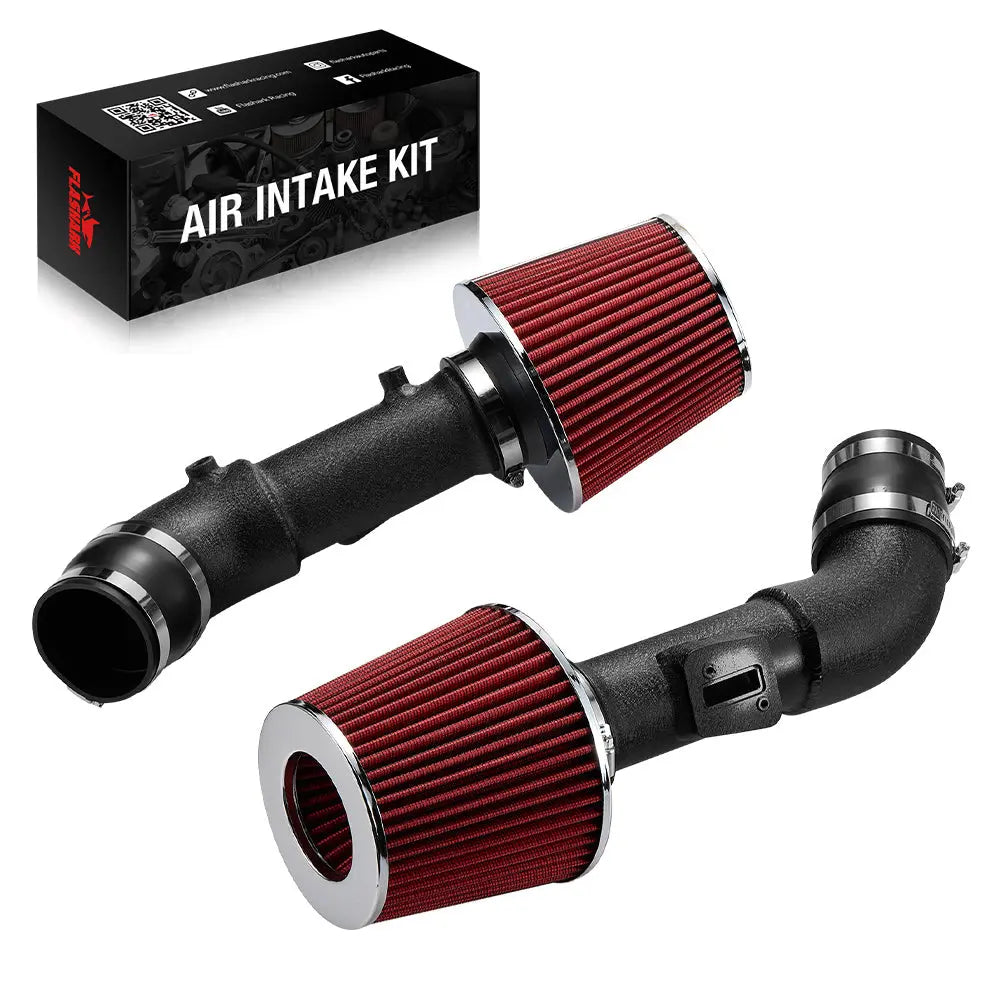
A cold air intake, often shortened to CAI, replaces part of the factory intake path with a different filter, tube, airbox, heat shield, or combination of those parts. The general goal is to give the engine a cleaner or less restrictive path to outside air while controlling heat from the engine bay.
Not every aftermarket intake is a true cold air intake. A full-length CAI may place the filter farther from engine heat, while a short ram intake usually uses a shorter tube with the filter inside the engine compartment. Some systems use an open filter and heat shield. Others use a sealed airbox connected to factory ducting.
Those structural differences matter because factory intake systems often use resonators, chambers, thick molded tubing, and enclosed airboxes to reduce induction noise. Replacing or bypassing those sound-control features can make airflow through the filter, tube, throttle body, or turbo inlet easier to hear.
If you want a broader explanation of intake layouts, heat control, water-ingestion risk, and performance limits, read what a cold air intake does and how it works.
Do not judge an intake only by pipe size or filter color. Filter location, airbox sealing, heat shielding, tube diameter, sensor placement, coupler alignment, and clearance around nearby components all affect how the system behaves.
How a Cold Air Intake Affects Engine Sound
A cold air intake primarily changes the sound on the inlet side of the engine. When the throttle opens and the engine draws more air, less-restricted tubing and a more exposed filter can make that airflow easier to hear.

The Influence of Intake Airflow on Sound
Under acceleration, the sound may be described as an induction growl, roar, rush, or suction noise. The exact character depends on the engine and intake layout. Removing a factory resonator can reveal frequencies that the original system was designed to suppress, while an open filter can transmit more sound directly into the engine bay.
This does not mean every system will produce the same result. A sealed intake that retains factory ducting may remain relatively restrained. A short intake with an open filter close to the throttle body or turbo inlet may be more audible, particularly when the throttle is opened quickly.
Low RPM, Cruising, and Hard Acceleration
At idle, airflow demand is low, so the difference may be subtle. During steady cruising, the throttle is usually only partly open and a well-isolated system may remain fairly quiet. The change tends to become more obvious as engine load, throttle opening, RPM, and airflow increase.
| Driving Condition | Likely Sound Change | What Controls the Result |
|---|---|---|
| Idle | Often small or difficult to notice | Filter exposure, airbox design, engine-bay insulation, and intake leaks |
| Light-throttle cruising | Usually mild | Throttle opening, engine load, road noise, and cabin insulation |
| Moderate acceleration | A clearer induction growl or air-rush sound may appear | Engine load, RPM, intake tube layout, resonators, and filter type |
| Wide-open throttle or high RPM | The difference is often most noticeable | Airflow demand, engine configuration, turbocharging, and intake restriction |
| Throttle lift on some turbocharged vehicles | Bypass-valve or recirculation sound may become easier to hear | Turbo and valve design, intake routing, calibration, and factory sound control |
Vehicle speed alone is not the main cause of a louder intake. A car can be moving quickly with little throttle and relatively low airflow demand. Conversely, hard acceleration at a lower road speed may produce a strong intake sound because engine load and airflow are high.
What Determines How Much Louder the Intake Becomes?
Open Filter vs. Closed Airbox
An open-element filter usually allows more induction sound to escape into the engine bay. A closed airbox can reduce that sound, especially when it uses thick walls, seals against the hood or body, and retains factory ducting.
That does not automatically make an open system the better choice. A poorly shielded filter may draw warmer engine-bay air while the vehicle is stopped or moving slowly. A sealed design may provide better heat isolation but produce less of the sound some owners want.

Intake Tube, Resonators, and Materials
Factory resonators and side chambers are often designed to suppress specific intake frequencies. Removing them can have a greater effect on sound than changing the tube material alone.
Tube length, diameter, wall construction, bends, mounting points, and couplers can also influence resonance. Metal and molded plastic tubes may produce different acoustic characteristics, but material should not be considered in isolation. A thick, well-supported metal tube can behave differently from a thin tube with long unsupported sections.
A bigger pipe is not automatically the right pipe. Tube diameter and sensor housing geometry can affect airflow speed and sensor readings. The intake should be designed for the engine and its control system rather than selected only for appearance or sound.
Engine Configuration
An inline-four, V6, or V8 does not simply become louder in proportion to engine size. Displacement, cylinder arrangement, firing behavior, intake manifold design, cam timing, RPM range, and factory sound insulation all affect the final tone.
A naturally aspirated engine may produce a deeper induction growl as the throttle opens. A turbocharged engine may reveal more turbo spool, compressor noise, or airflow through the inlet. These turbo-related sounds should not be applied to naturally aspirated vehicles.
Vehicle Packaging and Cabin Insulation
Filter location and engine-bay construction also matter. A filter positioned close to the cabin may be easier to hear inside the car. Thick firewall insulation, a sealed engine cover, or a well-isolated airbox may reduce the cabin difference even when the system sounds louder from outside.
Two similar-looking vehicles can produce different results if they use different engines, airboxes, turbo inlets, resonators, or sound insulation. Match the intake to the exact vehicle year, engine, sensor arrangement, and selected configuration before ordering.
Cold Air Intake vs. Stock Airbox vs. Short Ram Intake
| Intake Layout | Sound Tendency | Air-Temperature Consideration | What to Inspect |
|---|---|---|---|
| Factory airbox | Usually the quietest because sound control is part of the design | Often uses factory outside-air ducting and heat isolation | Filter condition, damaged ducts, loose clips, and cracked hoses |
| Closed cold air intake | May add sound while remaining more controlled than an open filter | Can isolate the filter from engine heat when the enclosure and ducting seal correctly | Airbox seal, duct alignment, filter clearance, and sensor position |
| Open-element intake with heat shield | Often more audible under acceleration | Heat control depends on shield coverage, outside-air supply, and vehicle movement | Shield sealing, filter location, hot-component clearance, and mounting stability |
| Short ram intake | Often produces a strong, direct induction sound | May be more exposed to engine-bay heat at low vehicle speed | Filter location, heat shielding, sensor housing geometry, and coupler support |
| Full-length low-mounted cold air intake | Sound varies with filter location and enclosure | Can access cooler outside air but may face greater water-ingestion exposure | Ground clearance, splash protection, drainage, filter access, and pipe security |
Once you understand which layout suits your sound and heat-management goals, browse cold air intake kits by vehicle application. Match the system to the exact year, engine, sensor arrangement, filter position, and selected configuration before ordering.
Does a Cold Air Intake Make the Exhaust Louder?
Not directly. A cold air intake changes the inlet side of the engine. Exhaust volume and tone are controlled mainly by the exhaust manifolds or headers, catalytic converters, connecting pipes, resonators, mufflers, valves, tailpipes, and any leaks in that path.

The Difference Between Induction and Exhaust Sound
Induction sound usually comes from the front of the vehicle or engine bay. It becomes stronger when the throttle opens and the engine draws more air. Exhaust sound travels through the exhaust system and exits near the tailpipe, although some noise can also radiate through pipes and the vehicle body.
A louder intake can change the way the complete vehicle sounds to the driver. It may add a stronger front-of-car growl that blends with the exhaust. In some cases, the new induction sound can make the exhaust seem quieter by comparison. That is a change in perceived sound balance, not a direct increase in exhaust-system volume.
Why Intake and Exhaust Modifications Should Not Be Confused
If the goal is more induction growl, filter and airbox design are important. If the goal is a deeper or louder tailpipe note, the exhaust layout matters more. Modifying both systems can change the overall sound, but each part should be evaluated separately.
Do not remove an air filter, leave an intake joint loose, or create an unmetered-air leak to make the system louder. Dirt ingestion, unstable sensor readings, rough idle, lean operation, and engine damage are not acceptable tradeoffs for more sound.
Will a Cold Air Intake Make a Turbo Louder?
It can, depending on the vehicle and intake arrangement. Factory turbocharged vehicles often use enclosed airboxes, resonators, and long molded inlet paths that suppress compressor and airflow noise. A more open intake may make turbo spool and air movement easier to hear.
Some vehicles may also produce a clearer recirculation or bypass-valve sound when the throttle closes. The exact result depends on how that valve is routed, the turbo inlet design, factory sound-control components, and the calibration. An intake should not be described as creating a blow-off-valve sound on every turbocharged vehicle.
If a new whistle is unusually sharp, appears at idle, or is accompanied by poor response, unstable idle, or a warning light, inspect the installation rather than assuming the sound is normal.
How to Make Intake Sound Louder Without Creating Problems
The safest approach is to choose a system whose design naturally exposes more induction sound while remaining suitable for the vehicle. An open filter, reduced intake resonator volume, or shorter sound path may make the engine easier to hear, but each choice carries heat, water, clearance, and sensor considerations.
- Choose an intake designed for the exact vehicle and engine.
- Compare open-element and closed-airbox designs before ordering.
- Inspect the filter position and its exposure to engine heat or road splash.
- Keep the air filter installed and properly secured.
- Retain required sensors and place them in the intended orientation.
- Use the correct couplers, clamps, brackets, and mounting points.
- Keep the intake clear of belts, fans, wiring, hot exhaust parts, and sharp edges.
- Do not assume that a wider tube is compatible with the factory sensor calibration.
Here is the part that matters: a louder intake should still be a sealed, filtered, mechanically supported system. Sound is not a substitute for correct airflow measurement or heat control.
Installation Checks That Affect Sound and Drivability
Many intake problems begin at a coupler, clamp, sensor flange, breather connection, or mounting bracket. Take a minute before tightening that clamp. Make sure the tube is fully seated and not pulling against another component.
- Inspect every connection. A coupler should sit squarely over both mating surfaces without folding or pinching.
- Check sensor orientation. A sensor installed in the wrong direction or position can affect airflow readings on sensitive applications.
- Reconnect all required hoses. Breather, vacuum, or recirculation connections must be routed as intended for the vehicle.
- Align the complete intake before final tightening. Tightening one joint too early can place the tube or filter under tension.
- Check surrounding clearance. Look for contact with the hood, radiator fan, belts, battery terminals, wiring, brake components, and hot exhaust parts.
- Inspect the filter position. A low-mounted filter needs appropriate protection from standing water and road splash.
- Start the engine and listen. A steady induction sound is different from a sharp leak, metallic rattle, or repeated contact noise.
- Recheck the system after a short drive. Heat and vibration can reveal movement that was not obvious during installation.
Normal Sound or Installation Problem?
| Observation | Possible Interpretation | What to Inspect |
|---|---|---|
| Deeper growl only under acceleration | Often a normal induction-sound change | Confirm that all joints remain secure |
| Air-rush sound at large throttle openings | Can be normal with a more exposed filter | Filter seating, shield clearance, and tube support |
| Sharp hiss at idle | May indicate an air or vacuum leak | Couplers, hoses, clamps, caps, and sensor seals |
| Metallic rattle or knocking | May indicate contact or an unsupported component | Brackets, tube clearance, heat shields, and fasteners |
| Rough idle, hesitation, or warning light | May involve a leak, sensor reading, wiring issue, or calibration mismatch | Complete installation, sensor placement, wiring, and vehicle-specific requirements |
If the engine begins hunting, shaking, stalling, or hesitating immediately after the intake installation, work through this cold air intake rough-idle troubleshooting checklist before replacing sensors or other parts.
Does a Cold Air Intake Add Power or Improve Fuel Economy?
A well-designed intake can reduce unnecessary restriction and help supply the engine with outside air, but that does not guarantee a specific power increase. The result depends on how restrictive the factory system was, the engine’s airflow demand, filter and tube design, sensor housing geometry, engine condition, supporting modifications, and calibration.
On some stock vehicles, the sound change may be more obvious than any measurable performance change. On others, an intake may support a larger combination that also includes engine, turbocharger, exhaust, or calibration changes. Without controlled before-and-after testing, it is not responsible to assign a fixed horsepower or torque result.
Fuel-economy improvement is also not guaranteed. Engine management, driving conditions, vehicle load, tire pressure, gearing, and throttle use all affect fuel consumption. Drivers who accelerate more often to hear the intake may use enough additional fuel to offset any theoretical efficiency benefit.
Does a Cold Air Intake Require a Tune or Cause a Check Engine Light?
Tune requirements vary by vehicle and installed hardware. Some systems preserve the factory sensor housing geometry and operate within the ECU’s expected range. Others change tube diameter, sensor position, airflow characteristics, or the complete engine combination enough to require calibration work.
For a closer look at MAF housing changes, ECU adaptation, supporting modifications, and symptoms that may call for calibration work, see whether a cold air intake requires a Tune.
A warning light is not an automatic result of installing an intake, but it should never be dismissed. Loose clamps, unmetered-air leaks, disconnected hoses, contaminated or incorrectly installed sensors, damaged wiring, and calibration differences can all affect operation.
If the vehicle develops rough idle, hesitation, abnormal fuel trims, reduced response, or a warning light after installation, inspect the hardware and sensor connections first. Use vehicle-appropriate diagnostic procedures rather than replacing parts based only on the sound.
Is a Cold Air Intake Right for You?
If the goal is to hear more of the engine under acceleration, a properly selected cold air intake can be a sensible option. Expect the change to be strongest when engine load and airflow rise. Do not expect every vehicle to become loud at idle, and do not expect an intake to create the same tailpipe tone as an exhaust modification.
Choose the system by structure and fitment, not only by a marketing description. Check the airbox style, filter location, heat shielding, water exposure, sensor arrangement, engine configuration, and available clearance. A well-matched system should provide filtered air, stable mounting, correct sensor integration, and a sound character that suits the way the vehicle is used.
Cold Air Intake Sound FAQs
Q1: Does a cold air intake make your car louder?
A1: It often makes the engine’s induction sound louder during acceleration. The difference may be small at idle or during steady cruising, and the amount of change depends on the intake design, engine, factory resonators, and vehicle insulation.
Q2: Will a cold air intake make my exhaust louder?
A2: Not directly. A cold air intake changes the inlet side of the engine, while exhaust volume and tone are controlled mainly by the headers or manifolds, catalytic converters, pipes, resonators, mufflers, valves, and tailpipes.
Q3: What does a cold air intake sound like?
A3: A naturally aspirated engine may develop a deeper induction growl or roar under load. A turbocharged engine may reveal more air-rush, compressor, spool, or bypass-valve sound, depending on its hardware and intake routing.
Q4: Is a cold air intake louder at idle?
A4: The difference at idle is often small because airflow demand and throttle opening are low. A strong hiss, unstable idle, or unusual whistle should be inspected because it may indicate an installation problem.
Q5: Why is my cold air intake louder when accelerating?
A5: Acceleration increases engine load, throttle opening, and airflow demand. A less-muted intake path allows more of that airflow and induction noise to reach the engine bay and cabin.
Q6: Will a cold air intake make my turbo louder?
A6: It may make turbo and inlet sounds easier to hear if the factory airbox and resonators previously suppressed them. The result depends on the turbo inlet, valve routing, intake enclosure, engine load, and vehicle calibration.
Q7: Which intake design is usually the loudest?
A7: Open-element and short intake layouts are often more audible than sealed airboxes because less material surrounds the filter. Heat control, water exposure, sensor compatibility, and fitment still matter more than sound alone.
Q8: Can I remove the filter or loosen a connection to make the intake louder?
A8: No. The intake must remain filtered, sealed where required, and securely mounted. Removing the filter or creating an air leak can allow contamination into the engine and may cause poor sensor readings or drivability problems.
Q9: Does a cold air intake require a Tune?
A9: Tune requirements vary by vehicle and intake design. Changes to sensor housing geometry, airflow characteristics, forced-induction hardware, or the wider engine combination can affect whether calibration work is appropriate.
Q10: Can a cold air intake cause a check engine light?
A10: A warning light can occur if there is an intake leak, disconnected hose, sensor installation problem, wiring issue, contamination, or calibration mismatch. Diagnose the vehicle and inspect the complete installation instead of assuming the light is normal.
Q11: Does a cold air intake add horsepower?
A11: It may reduce intake restriction on some applications, but a fixed power increase cannot be assumed. Results depend on the factory intake, engine airflow demand, sensor design, supporting hardware, calibration, and test conditions.
Q12: Can a cold air intake improve gas mileage?
A12: Better fuel economy is not guaranteed. Vehicle load, driving conditions, engine management, and throttle use have a major effect, and accelerating more often to enjoy the intake sound can increase fuel consumption.
Q13: How can I tell normal intake noise from an air leak?
A13: A deeper growl or air-rush sound that appears mainly under acceleration can be normal. A sharp hiss at idle, rough running, hesitation, unstable idle, or a warning light calls for an inspection of the couplers, hoses, clamps, sensor seals, and wiring.
Q14: What should I check before buying a cold air intake?
A14: Match the system to the vehicle year, engine, sensor arrangement, filter location, available clearance, and selected configuration. Also consider airbox sealing, heat shielding, water exposure, maintenance access, and vehicle-specific Tune requirements.

Steven Chen
Automotive Performance Specialist | Engine & Exhaust Systems
Steven focuses on practical engine performance, exhaust fitment, and real-world upgrade paths for classic and modern enthusiast vehicles. He reviews small-block Ford, LS, truck, and street/strip applications with one goal in mind: helping builders choose parts that actually work together. His philosophy: "Good power starts with the right combination, not the biggest part."