


 Need car parts? Shop by vehicle
(Select the exact fit for your vehicle)
Need car parts? Shop by vehicle
(Select the exact fit for your vehicle)
Honda RSX Header
Shop Headers by Brand: Honda Exhaust Header
Shop by Model: Honda Civic Headers | Honda Accord Headers | Acura Integra Headers | Acura RSX Headers | Honda Prelude Headers
Improve the exhaust side of your RSX build with a stainless steel header selected for supported 2002–2006 Acura RSX Base and Non-Type-S 2.0L models. The current Flashark listing replaces the factory exhaust manifold with individual runners designed to support a freer-flowing exhaust path and a more performance-focused tone. It may suit drivers replacing an aging manifold or coordinating an intake, exhaust, and tuning package, but results will depend on the rest of the vehicle’s setup. This collection does not cover the RSX Type-S. Before ordering, confirm your trim and engine application, then check the collector connection, O2 sensor arrangement, catalytic-converter location, and available chassis clearance against the product photos and your existing exhaust.
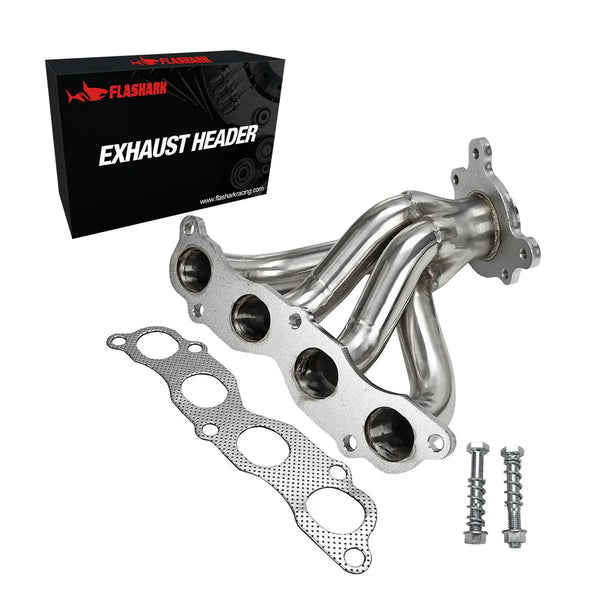
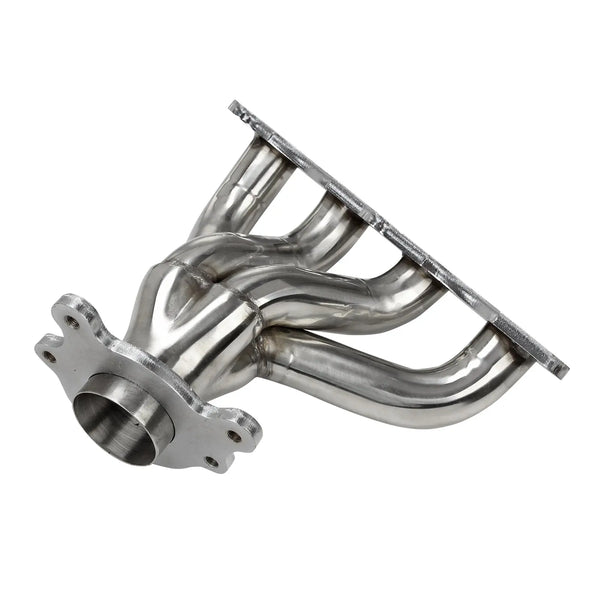
Shop Headers by Brand: Honda Exhaust Header
Shop by Model: Honda Civic Headers | Honda Accord Headers | Acura Integra Headers | Acura RSX Headers | Honda Prelude Headers
Improve the exhaust side of your RSX build with a stainless steel header selected for supported 2002–2006 Acura RSX Base and Non-Type-S 2.0L models. The current Flashark listing replaces the factory exhaust manifold with individual runners designed to support a freer-flowing exhaust path and a more performance-focused tone. It may suit drivers replacing an aging manifold or coordinating an intake, exhaust, and tuning package, but results will depend on the rest of the vehicle’s setup. This collection does not cover the RSX Type-S. Before ordering, confirm your trim and engine application, then check the collector connection, O2 sensor arrangement, catalytic-converter location, and available chassis clearance against the product photos and your existing exhaust.
Choosing a Header for Your Acura RSX
This collection currently contains one header listing for the 2002–2006 Acura RSX Base or Non-Type-S with a 2.0L inline-four engine. It is a focused fitment page rather than a catalog for every RSX configuration, so the vehicle year alone is not enough to confirm compatibility.
The listed header is described as stainless steel with a mirror-polished surface. Those details can help buyers compare its basic construction with an aging factory manifold, but the current information does not establish a specific 4-1 or 4-2-1 layout or confirm whether it should be classified as a long-tube or shorty header. Buyers searching for one particular runner layout should verify the physical design before purchasing.
RSX Base and Type-S Fitment Are Not Interchangeable
The current product listing is limited to the RSX Base or Non-Type-S configuration and specifically excludes the Type-S. Different RSX trims can use different engine and exhaust arrangements, so shared model years and a common body style do not make their headers interchangeable.
Confirm the trim from the VIN or vehicle documentation instead of relying only on exterior badges. The listing identifies a 2.0L inline-four application, but the exact engine-code coverage should be confirmed before treating the part as compatible with every engine carrying a K-series name.
Header Layout and Collector Connection
A header must match both ends of the installation: the cylinder-head flange and the downstream exhaust connection. Runner routing also has to clear nearby components as the engine moves under load. The current listing confirms a header for the supported RSX application, but it does not clearly document the runner layout, collector style, flange pattern, or connection angle.
The published specifications also use more than one outlet-related measurement. Because those figures may refer to different measuring points, do not assume that every number describes the collector’s outside diameter. Confirm the actual outlet diameter and where it was measured before ordering a gasket, adapter, catalytic converter, or mid-pipe.
O2 Sensors, Catalytic Converter, and Check-Engine Lights
Header installation can affect O2 sensor placement and the relationship between the sensors and catalytic converter. The current product information does not confirm the number of O2 bungs, their thread specification, whether an extension is needed, or whether the original catalytic converter stays in its factory position.
Those details matter because an incompatible sensor arrangement, exhaust leak, or change in catalyst operation may trigger a check-engine light. No claim should be made that this header is catless, catted, emissions compliant, or guaranteed not to cause a CEL until the product configuration is documented.
Chassis Clearance and Installation Planning
A correct cylinder-head bolt pattern does not confirm clearance through the full exhaust path. Before installation, compare the product routing with the oil pan, subframe, heat shields, nearby wiring, and downstream exhaust. Confirm that the collector can meet the existing system without placing the pipes or hangers under tension.
Fresh gaskets and suitable hardware may be needed even when a header is described as bolt-on. Corroded fasteners, previous exhaust work, engine swaps, aftermarket mounts, and nonstandard mid-pipes can all change the job. If the vehicle has been modified, inspect and measure the connection rather than relying on the original model description alone.
Performance, Sound, and Tuning Expectations
Changing the runner and collector design may alter exhaust flow, throttle response, and exhaust tone, but the result depends on the intake, catalytic converter, downstream exhaust, engine condition, and ECU calibration. This product does not have verified before-and-after testing that supports a fixed horsepower or torque claim.
A tune should not be presented as universally required or unnecessary. The need for calibration depends on how the installed header changes airflow, sensor readings, catalyst operation, and the rest of the engine setup. Diagnose any leak or sensor fault before assuming that tuning alone will correct a CEL.
Frequently Asked Questions
Q1: Does this header fit an Acura RSX Type-S?
A1: No. The current product listing is for 2002–2006 Acura RSX Base or Non-Type-S 2.0L models and specifically excludes the Type-S.
Q2: Which engine does the current RSX header fit?
A2: The verified listing identifies a 2.0L inline-four application for the RSX Base or Non-Type-S. Confirm the vehicle’s engine identification before purchase because the listing does not establish compatibility with every K-series engine.
Q3: Is this a long-tube or shorty header?
A3: The current product information does not clearly confirm a long-tube or shorty classification. Verify the runner layout and overall dimensions if a specific header structure is required for your build.
Q4: Is the header a 4-1 or 4-2-1 design?
A4: The current listing does not clearly document a 4-1 or 4-2-1 configuration. Use confirmed product dimensions or detailed product photos rather than assuming the layout from the vehicle application.
Q5: Does this header connect directly to the factory exhaust?
A5: The listing describes a bolt-on application, but the collector flange, connection angle, and downstream compatibility are not documented well enough to guarantee a modification-free connection. Compare the existing exhaust with the product before installation.
Q6: Does the header retain the factory catalytic converter?
A6: The available product information does not confirm whether the factory catalytic converter remains in its original location or whether another exhaust component is required. Verify the complete exhaust path before ordering.
Q7: Are factory O2 sensors supported?
A7: O2 sensor count, bung position, thread specification, and wiring requirements are not clearly listed. Confirm these details against the vehicle before installation.
Q8: Will installing this header cause a check-engine light?
A8: A CEL cannot be ruled out or guaranteed. Sensor placement, catalyst operation, exhaust leaks, wiring, and ECU calibration can all affect whether a fault code appears.
Q9: Does the RSX need a tune after header installation?
A9: Tuning needs depend on the header configuration and the vehicle’s intake, exhaust, catalyst, sensors, and ECU setup. The current product evidence does not support a universal tune requirement or a no-tune guarantee.
Q10: What should I measure before ordering?
A10: Confirm the vehicle trim and engine, then compare the cylinder-head flange, collector outlet, flange pattern, connection angle, O2 sensor locations, catalytic-converter position, and nearby chassis clearance.