


 Need car parts? Shop by vehicle
(Select the exact fit for your vehicle)
Need car parts? Shop by vehicle
(Select the exact fit for your vehicle)
Honda Accord header

Shop Headers by Brand: Honda Exhaust Header
Shop by Model: Honda Civic Headers | Honda Integra Headers | Honda RSX Headers | Honda Prelude Headers
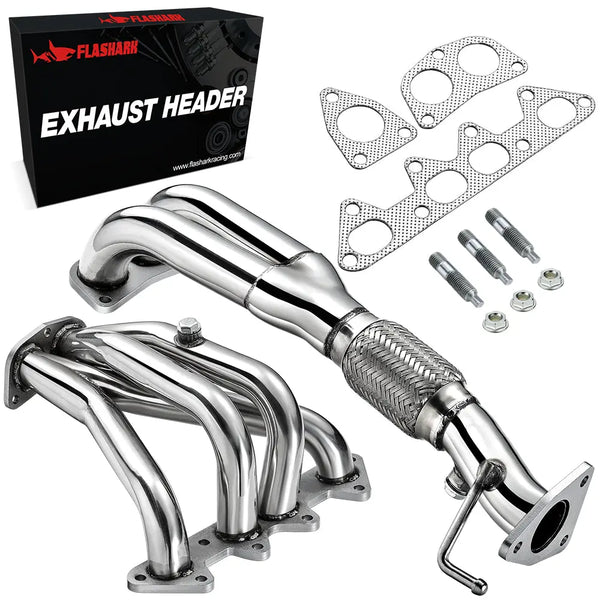
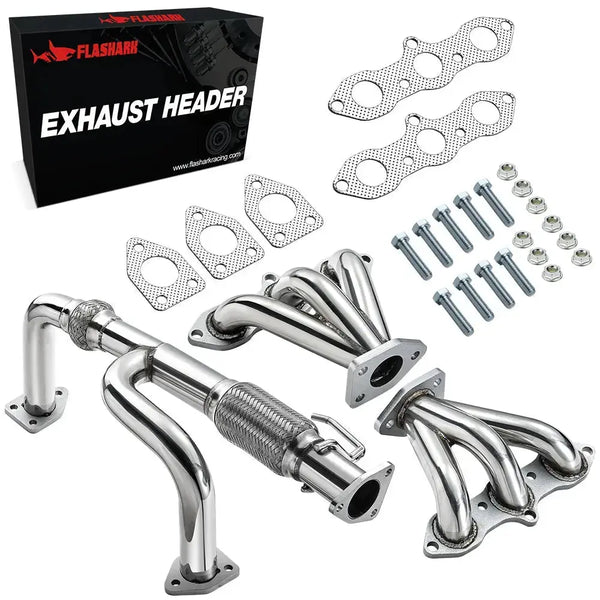
Choose a Flashark exhaust header for compatible 1998–2002 Honda Accord applications without relying on model year alone. This collection includes a stainless 4-2-1 header for listed 2.3L inline-four models with F23A1, F23A4, or F23A5 engines, plus a separate header set for the 3.0L J30 V6. Replacing the factory manifold with the correct header may support freer exhaust flow, a more responsive feel, and a sportier exhaust note, although the result depends on the engine, exhaust system, and installation. Before ordering, confirm the engine code, cylinder layout, catalytic-converter location, O2 sensor arrangement, and connection points on your current exhaust.
Recently viewed
Choose the Right Header for Your Honda Accord
The two header options on this page fit different engine layouts and are not interchangeable. A 1998–2002 Accord may use a 2.3L inline-four or a 3.0L V6, so the model year by itself is not enough to choose the correct part.
- Confirm whether the engine is a 2.3L inline-four or a 3.0L V6.
- For the inline-four option, verify the F23A1, F23A4, or F23A5 engine code.
- Compare the existing flange, catalytic-converter location, and lower exhaust connection with the product photos.
- Inspect the O2 sensors, wiring, studs, nuts, and gasket surfaces before disassembly.
- Contact fitment support before ordering for an engine-swapped or previously modified exhaust system.
Compare the Available Header Options
The inline-four product has a confirmed 4-2-1 layout. The V6 product is a separate multi-piece header set with different inlet, outlet, and routing requirements. Details that are not confirmed below should be checked against the selected product and the vehicle before purchase.
| Option | Listed Application | Confirmed Design Information | Checks Before Ordering |
|---|---|---|---|
| F23A 2.3L 4-2-1 Header | 1998–2002 Honda Accord with a listed F23A1, F23A4, or F23A5 2.3L inline-four engine | Stainless 4-2-1 layout, O2 sensor bung, 2.00-inch outlet, and three-bolt mounting connection | Engine code, body and chassis details, catalytic-converter position, O2 sensor wiring, and lower flange alignment |
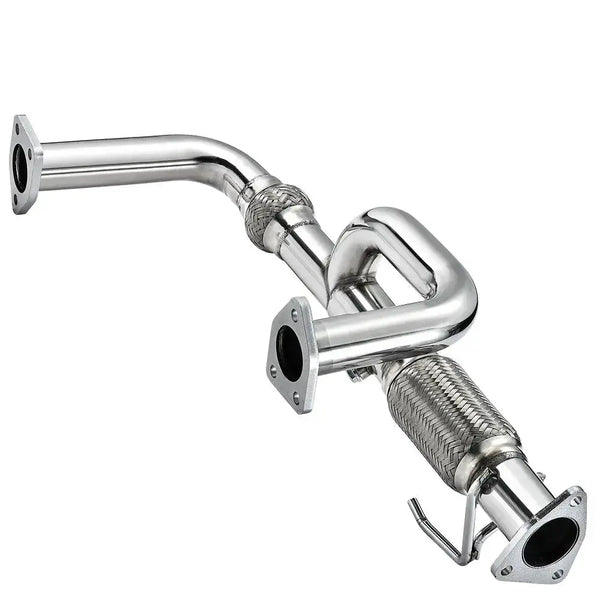
| J30 3.0L V6 Header | 1998–2002 Honda Accord with the listed J30 3.0L V6 engine | Stainless V6 header set with flex-pipe construction; the precise collector arrangement requires confirmation | Engine code, body configuration, available clearance, O2 sensor locations, catalytic-converter layout, and downstream connections |
What a Header Upgrade May Change
A header replaces the factory exhaust-manifold section and changes how exhaust pulses leave the cylinders. The 4-2-1 layout offered for the F23A applications is commonly selected for a street-oriented balance of exhaust flow and usable response. The V6 option follows a different routing path because it must collect exhaust from two cylinder banks.
On a compatible, properly maintained Accord, a header may contribute to a more responsive feel and a stronger exhaust character. Results depend on engine condition, exhaust restrictions, catalytic-converter condition, intake setup, sensor operation, calibration, and the quality of the installation. No fixed horsepower, torque, fuel-economy, or sound-level result should be expected from the header alone.
Check the Collector and Exhaust Connections
Header shape is only one part of fitment. The outlet must also meet the vehicle's catalytic converter or lower exhaust section at the correct location, angle, and flange pattern. The F23A option lists a three-bolt mounting connection and a 2.00-inch outlet, but that does not confirm compatibility with every replacement catalytic converter or previously modified front pipe.
The V6 header uses a different multi-piece layout and includes flex-pipe construction. Confirm the collector routing and downstream connection on the selected product before removing the original manifolds. Do not assume that a custom cat-back system, replacement catalytic converter, or earlier exhaust repair retained the factory connection position.
O2 Sensors, Catalytic Converters, and Check-Engine Lights
The F23A header lists an O2 sensor bung, but buyers should still confirm the number and position of the sensors on the vehicle. The available information for the V6 header does not fully establish every sensor bung and connector location, so those details require verification before purchase.
An exhaust leak, damaged sensor, altered catalytic-converter arrangement, wiring problem, or unexpected sensor position can contribute to a check-engine light. A header should not be presented as guaranteed CEL-free. Inspect the sensors and wiring before installation, and diagnose any warning light rather than assuming it is a normal result of the new part.
Do not assume that either header preserves factory emissions compliance. Catalytic-converter placement and local regulations vary, and the available product information does not establish CARB approval or 50-state legality. Confirm the product configuration and applicable requirements before using the vehicle on public roads.
Will the Accord Need a Tune?
A tune is not automatically required for every header installation, but it cannot be ruled out for every vehicle. The answer depends on whether the catalytic-converter and O2 sensor arrangement changes, how the rest of the exhaust is configured, and whether the engine has other modifications. Engine swaps and custom intake or exhaust combinations require more careful evaluation than a stock-layout vehicle.
After installation, check for leaks, secure wiring away from hot tubing, and monitor how the engine runs. Persistent fuel-trim problems, drivability changes, or diagnostic codes should be investigated before the car is driven hard.
Installation and Clearance Checks
Older exhaust hardware may be rusted, seized, or previously repaired. Inspect the cylinder-head studs, nuts, gasket surfaces, sensor threads, brackets, and downstream flange before installation. Replacement gaskets or hardware may be needed depending on their condition, but package contents should be confirmed on the individual product page.
Available space also differs between the inline-four and V6 engine bays. Confirm clearance around wiring, hoses, brackets, and nearby heat-sensitive components. Final alignment should be checked before every fastener is fully tightened so the header does not place unwanted stress on the cylinder-head flange or downstream exhaust.
As a general installation rule, match the header to the engine and the existing exhaust path, not just the year printed on the registration. Compare the manifold ports, sensor locations, flange orientation, and lower connection while the original parts are still on the vehicle. This is especially important when the engine, catalytic converter, or front exhaust section has been replaced.
Frequently Asked Questions
Q1: Which headers are available for the 1998–2002 Honda Accord?
A1: This collection includes a 4-2-1 header for listed 2.3L inline-four applications with F23A1, F23A4, or F23A5 engines and a separate header set for listed 3.0L J30 V6 applications.
Q2: Will the F23A 4-2-1 header fit a V6 Accord?
A2: No. The F23A header is listed for the specified 2.3L inline-four engines and is not interchangeable with the J30 V6 header set.
Q3: How can I identify the correct engine before ordering?
A3: Verify the engine code and cylinder layout using the vehicle information label, service records, or another reliable vehicle-specific source. Do not select a header from the model year alone.
Q4: Will these headers connect to my existing exhaust?
A4: Compatibility depends on the flange pattern, pipe routing, catalytic-converter location, and any previous exhaust modifications. Compare the existing connection points with the selected product before ordering.
Q5: Do these headers retain the factory catalytic converter?
A5: The available collection information does not confirm the catalytic-converter arrangement for every listed application. Check the selected product's routing and your vehicle's current converter location before purchase.
Q6: Are O2 sensor bungs included?
A6: The F23A 4-2-1 header lists an O2 sensor bung. The number and position of the sensor connections on the V6 header require confirmation, so compare them with the vehicle before ordering.
Q7: Can installing a header cause a check-engine light?
A7: A check-engine light is possible if the installation introduces an exhaust leak, changes sensor or catalytic-converter operation, damages wiring, or uses incompatible connection points. CEL-free operation cannot be guaranteed.
Q8: Will I need a tune after installing a header?
A8: Not every installation requires a tune, but the need depends on the sensor arrangement, catalytic-converter configuration, supporting modifications, and how the engine responds. Modified or engine-swapped vehicles may need additional calibration work.
Q9: Are these headers legal for street use?
A9: Street-use and emissions rules vary by location, and the available information does not establish CARB approval or 50-state legality. Confirm the product configuration and local requirements before installation.
Q10: What should I inspect before installing the header?
A10: Inspect the studs, nuts, gasket surfaces, O2 sensors, wiring, catalytic converter, lower flange, brackets, and nearby heat-sensitive components. Also confirm that earlier repairs have not changed the factory exhaust routing.