Detén el Tictac: 7 Síntomas de Fuga en el Múltiple de Escape de Silverado y Cómo Repararlos Definitivamente
Conoces la rutina. Sales a tu camioneta en una mañana helada, giras la llave y ahí está. Un ruido de tictac agudo y rítmico que resuena bajo el capó, sonando menos como un Chevy V8 y más como la máquina de coser antigua de tu abuela. Muchos intentan convencerse de que es solo un levantaválvulas ruidoso. Déjame ser honesto: si conduces un Vortec de 4.8L, 5.3L o 6.2L, es casi seguro que se trate de un múltiple agrietado o un perno roto.
Honestamente, he metido las manos en los compartimentos del motor de más GMT800s y K2XXs de los que puedo contar físicamente. Esto no es solo una molestia menor; es un fallo de diseño evidente de fábrica. Hoy, vamos a disipar el ruido. Vamos a desglosar los verdaderos síntomas de fuga en el múltiple de escape de Silverado, lo que significan para la salud de tu motor y cómo solucionar este problema de forma permanente para que nunca más tengas que taladrar otro espárrago roto contra un cortafuegos estrecho.
Resumen Rápido: El Fondo del Asunto
¿Te preguntas si tu escape realmente tiene una fuga? Aquí tienes la respuesta directa basada en las condiciones de funcionamiento:
- Si escuchas un tictac que desaparece después de 5-10 minutos de conducir: Esto es una clásica brecha por expansión térmica. Definitivamente tienes una fuga en el múltiple.
- Si hueles a gases de escape crudos dentro de la cabina con la calefacción encendida: La fuga es grave y se encuentra cerca del cortafuegos (típicamente en el Cilindro 8).
- Si notas una caída de combustible de 2-3 MPG acompañada de un código P0171/P0174: El sensor de O2 recibe oxígeno no medido, lo que obliga a la ECU a inyectar exceso de combustible.
- La Solución Permanente: Evita reinstalar los restrictivos múltiples de hierro fundido de serie. La única forma de evitar que las bridas deformadas y los pernos rotos arruinen tu fin de semana es actualizar a colectores tubulares del mercado de accesorios con herrajes de alta resistencia.
7 Síntomas Innegables de Fuga en el Múltiple de Escape de Silverado
No ignores las señales de advertencia. Lo que comienza como un tictac menor puede escalar rápidamente a cables de bujía quemados y sensores de O2 destruidos. Aquí están los 7 síntomas exactos a los que debes prestar atención en tu camioneta Chevy o GMC.
1. El Notorio Sonido de Tictac al Arrancar en Frío
Esta es la pista definitiva. Enciendes la camioneta en frío y escuchas un distintivo "tic-tic-tic" que coincide con las RPM del motor. ¿Por qué desaparece cuando el motor se calienta? Por la expansión térmica. A medida que el múltiple de hierro fundido se calienta, se expande y sella temporalmente el espacio contra la culata del cilindro. Si fuera un problema mecánico del tren de válvulas, seguiría haciendo tictac incluso a la temperatura de funcionamiento completa.
2. Fuerte Olor a Escape en la Cabina
Advertencia de seguridad aquí. Si estás parado en un semáforo y tu cabina comienza a oler a gasolinera, estás respirando monóxido de carbono. Debido a que el punto de fallo más común es la parte trasera del lado del pasajero, el sistema HVAC aspira fácilmente esos gases que se escapan directamente a tus ventilaciones.

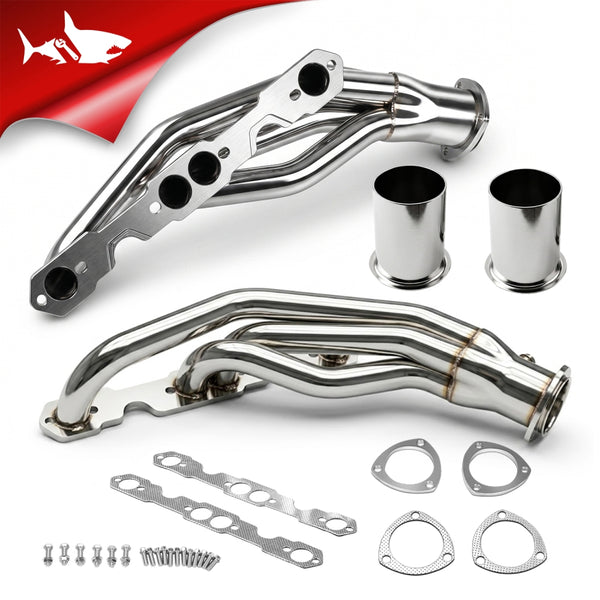
Colectores Cortos Flashark (2000-2006 4.8L/5.3L)
Detén los gases de escape y gana hasta 20 CV extra. Fabricados en acero inoxidable pulido a espejo con bridas de salida de 3/8" para un sellado a prueba de balas.
$149.99 Ver Detalles3. Luz de "Check Engine" (CEL) y Códigos de Mezcla Pobre
Tus sensores de O2 esperan un sistema perfectamente sellado. Cuando se abre una brecha en la brida del múltiple, el pulso de escape crea un efecto de vacío, succionando aire fresco hacia el tubo. El sensor lee este oxígeno extra, se altera y le dice a la computadora que el motor está funcionando peligrosamente pobre. Espera que aparezca una luz de "Check Engine" con un código P0171 o P0174.
4. Caída Inexplicable en el Rendimiento de Combustible (MPG)
Continuando con ese código de mezcla pobre, ¿qué hace la computadora cuando cree que el motor está hambriento de combustible? Inyecta una cantidad masiva de gasolina en los cilindros. Notarás que tu V8, ya de por sí sediento, de repente consume de 2 a 3 millas por galón menos. Los datos de ajuste de combustible en un escáner mostrarán correcciones positivas que superan el +15% o más.
5. Aceleración Lenta y Pérdida de Potencia
Cuando la relación aire-combustible se desequilibra por una fuga, el rendimiento general se desploma. La camioneta se sentirá perezosa al arrancar. Si estás remolcando una embarcación o un remolque pesado cuesta arriba, la falta de contrapresión y la ECU confundida resultarán en una notable pérdida de potencia.

Colectores Flashark con Válvula EGR (1999-2006 V8)
¿Necesitas mantener intacto tu equipo de emisiones? Estos colectores de acero inoxidable 201 mantienen la funcionalidad EGR mientras evitan la interferencia de escape entre cilindros.
$249.99 Ver Detalles6. Hollín Visible Alrededor de los Puertos de Escape
Toma una linterna e inspecciona el múltiple de escape donde se monta en la culata de aluminio. ¿Ves hollín negro y pulverulento manchando el metal o los protectores térmicos de las bujías? Eso es carbono crudo saliendo directamente de la junta. Es una prueba física innegable de un fallo.

7. Cables de Bujías Quemados o Componentes Derretidos
Si ignoras estos síntomas de fuga en el múltiple de escape de Silverado durante demasiado tiempo, las cosas se ponen caras rápidamente. El gas de escape que sale de la fuga supera los 1.200°F. Lo he visto quemar completamente los capuchones de los cables de las bujías hasta convertirlos en cenizas, lo que provoca cilindros muertos y fallos de encendido masivos.
¿Por Qué Siguen Fallando los Múltiples de Escape de Chevy Silverado?
GM fabrica un bloque V8 notablemente sólido, pero el diseño de su múltiple de escape es un punto débil bien documentado. Los múltiples de hierro fundido de fábrica absorben un calor inmenso. A lo largo de miles de ciclos de calor, el metal se deforma, encogiéndose y separándose físicamente del bloque en los extremos.

Escúchame por un segundo. En '18, un tipo trajo una Silverado 5.3L del 2015 impecable a nuestro taller. Estaba aterrorizado de que su parte baja estuviera golpeando. Tomé mi luz de taller, la apunté cerca del cortafuegos del lado del pasajero y le mostré la cruda verdad. El perno trasero del cilindro 8 no solo estaba suelto; la cabeza del perno estaba completamente cortada al ras con la culata de aluminio. El múltiple deformado actuó como unas tijeras industriales y simplemente guillotinó el perno. Pasamos tres horas agotadoras con un taladro de ángulo recto y una plantilla extractora solo para sacar ese único espárrago. No dejes que el tuyo llegue a este punto.
Cómo Solucionarlo: Reemplazo de Serie vs. Colectores Mejorados
Cuando finalmente decidas solucionar esto, tienes dos caminos. Puedes comprar un múltiple OEM de reemplazo (que eventualmente se deformará de nuevo), o puedes hacer lo que les recomiendo literalmente a todos mis clientes: actualizar a colectores tubulares de acero inoxidable del mercado de accesorios.

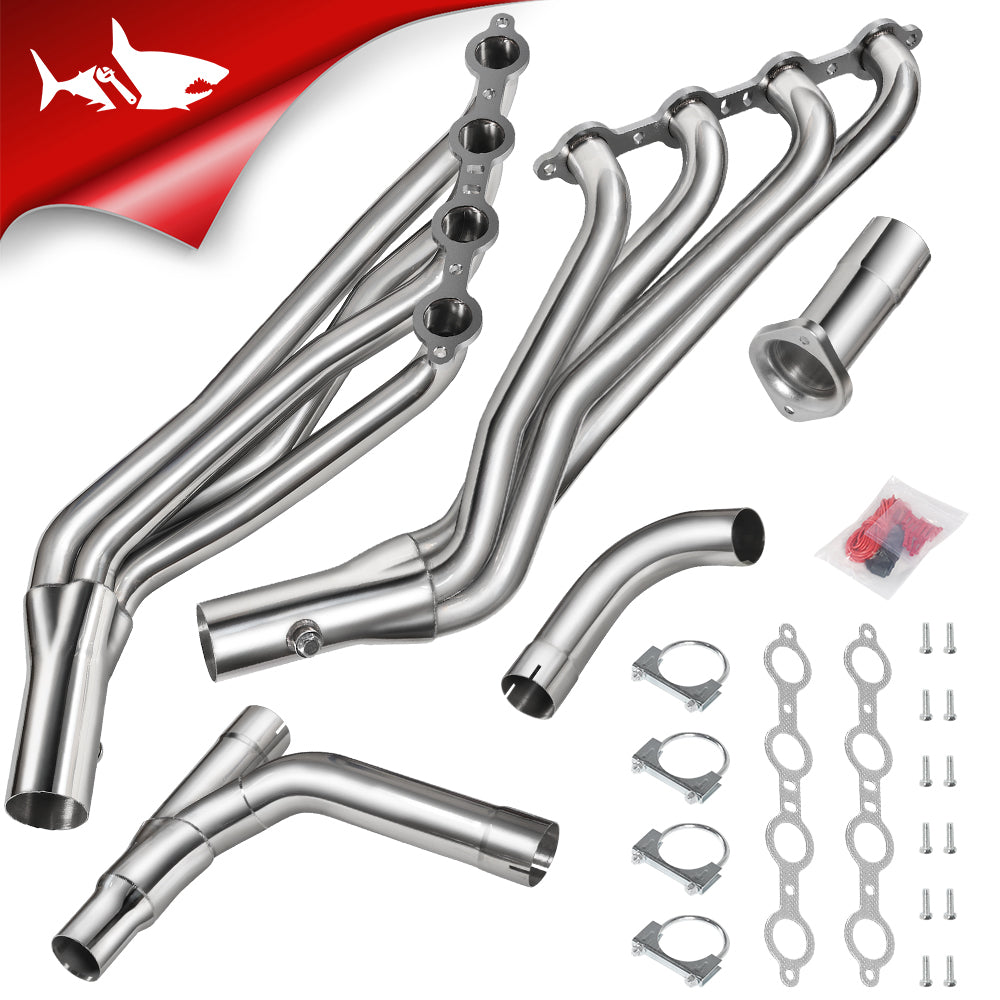
Colectores de Tubo Largo Flashark (2007-2014 Vortec)
Libera la máxima potencia y ese profundo sonido V8. Cuenta con tubos primarios de 1.7" y bridas de culata gruesas de 7/16" para eliminar completamente los problemas de deformación.
$309.99 Ver DetallesAquí está la verificación de la realidad sobre el rendimiento y la durabilidad al comparar las dos opciones:
| Característica | Múltiple de Hierro Fundido OEM | Colectores de Rendimiento Flashark |
|---|---|---|
| Material | Hierro Fundido Pesado y Frágil | Acero Inoxidable 201/304 de Alta Calidad |
| Resistencia a la Deformación por Calor | Pobre (Propenso a encogerse) | Excelente (Bridas gruesas mecanizadas por CNC) |
| Ganancias de Rendimiento | Ninguna (Flujo altamente restrictivo) | Aumento de hasta 20-25+ CV (con ajuste) |
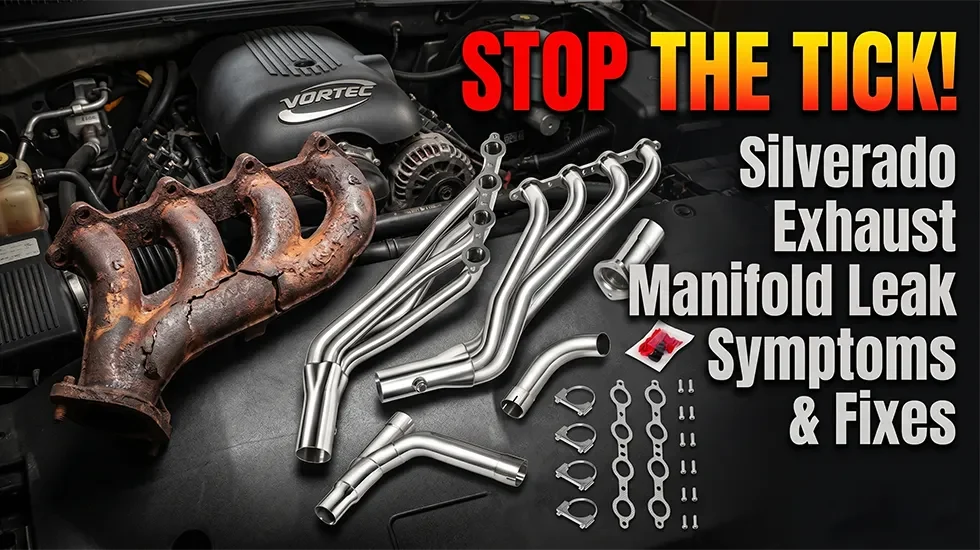
Si estás trabajando en una camioneta más antigua, instalar un juego de colectores de tubo largo de alto flujo para Silverado 1999-2006 es una obviedad. Cuentan con bridas CNC masivas y pueden despertar tu 5.3L con 25 caballos de fuerza adicionales. Si no quieres meterte con el resto de tu sistema de escape, un juego de colectores cortos para GMC/Chevy 2000-2006 se atornillará directamente a tus catalizadores de fábrica, resolviendo por completo el problema de la fuga.

Colectores de Tubo Largo y Tubo en Y Flashark (99-06 5.3L)
La mejora de potencia definitiva para GMT800s. Gana más de 25 CV y un par masivo en todo el rango de potencia. Soldado TIG para una máxima resistencia a la corrosión.
$269.99 Ver DetallesPara los usuarios de NNBS que buscan maximizar el flujo, nuestros colectores de tubo largo para Chevy 5.3L 2007-2014 proporcionan una sintonización superior con curvatura de mandril. Y no pienses que los motores EcoTec3 más nuevos son inmunes. Si conduces un K2XX, cambiar a colectores mejorados para Silverado 5.3L/6.2L 2014-2017 fabricados con acero inoxidable 304 de calibre 16 no solo ahorra 10 libras de peso, sino que añade más de 5 caballos de fuerza brutos sobre los de serie sin siquiera intentarlo. Ah, y si vives en un estado con estrictas normas de emisiones, también tenemos colectores compatibles con EGR para 99-06 para mantener todo legal en la calle.

Colectores de Tubo Largo Flashark (2014-2017 5.3L/6.2L)
Fabricados con acero inoxidable 304 de calibre 16 de primera calidad con un diseño de tubería 8-2-1. Ahorra 10 libras de peso en tu camioneta y mejora drásticamente la capacidad de remolque.
$309.99 Ver DetallesPreguntas Frecuentes (FAQ)
Constantemente veo a la gente haciendo las mismas preguntas en Reddit y en foros de camiones sobre estos mismos síntomas de fuga en el múltiple de escape de Silverado. Aquí está la verdad.
P1: ¿Puedo conducir mi Silverado con una fuga en el múltiple de escape?
R1: Para un viaje rápido a la tienda, sí. Pero conducirlo durante meses conlleva el riesgo de quemar las válvulas de escape, derretir los arneses de cableado adyacentes y reducir drásticamente el rendimiento de la gasolina debido a lecturas sesgadas del sensor de oxígeno.
P2: ¿Cuánto cuesta típicamente reparar una fuga en el múltiple de escape de Silverado?
R2: Si pagas a un concesionario, prepárate para gastar entre $600 y más de $1,500. El costo se dispara agresivamente si el técnico tiene que pasar horas extrayendo pernos rotos. Comprar colectores Flashark y hacerlo tú mismo ahorra una cantidad masiva de dinero.
P3: ¿Una fuga en el múltiple de escape causará directamente un código de fallo de encendido?
R3: Absolutamente. Los gases de escape calientes pueden derretir literalmente las botas de las bujías justo al lado de la brida, causando una falla de encendido instantánea y activando un código de falla de encendido aleatorio P0300.
P4: ¿Por qué desaparece el ruido de tictac del Silverado cuando el motor se calienta?
R4: Dinámica térmica básica. El colector de hierro fundido se calienta, se expande ligeramente y cierra el espacio contra el bloque. Este sellado térmico es la prueba definitiva de que su tictac es una fuga de escape, no un levantador defectuoso.
P5: ¿Son tan comunes los pernos del colector rotos en los bloques 5.3L y 6.2L?
R5: Excepcionalmente común. Es esencialmente un rito de iniciación inevitable para los propietarios de motores Chevy LS y LT. Los pernos traseros del lado del pasajero (Cilindro 8) son casi siempre los primeros en ceder.
P6: ¿Cómo se extrae un perno de colector de escape roto en un Silverado?
R6: Si sobresale suficiente rosca, puede soldar cuidadosamente una tuerca y retirarla. Si se ha roto al ras con la cabeza, debe montar una plantilla de taladro especializada para perforar perfectamente el centro y usar un extractor de pernos de calidad.
P7: ¿Necesito una reprogramación después de instalar colectores de escape del mercado de accesorios?
R7: Si instala colectores de escape "Shorty" que se atornillan a sus convertidores catalíticos de fábrica, no es estrictamente necesaria una reprogramación. Si instala colectores de escape "Long Tube", necesita absolutamente una reprogramación para ajustar la relación aire/combustible y desactivar las advertencias del sensor de O2 trasero.
P8: ¿Puede una fuga grave de escape causar problemas de cambio de transmisión?
R8: Sorprendentemente, sí. La ECU utiliza datos del flujo de masa de aire (MAF) y del sensor de O2 para calcular el torque total del motor. Si una fuga proporciona a la ECU datos de O2 falsos, esta calcula erróneamente el torque, lo que provoca cambios de transmisión notablemente bruscos o retrasados.
P9: ¿Debo reemplazar ambos lados si solo el colector del lado del conductor tiene fugas?
R9: Sí, reemplace ambos simultáneamente. Si los pernos de un lado tienen fatiga metálica por los ciclos de calor, el lado opuesto está funcionando con tiempo prestado. Actualice ambos a colectores de acero inoxidable y listo.
P10: ¿Los colectores de escape del mercado de accesorios anulan la garantía de mi Chevy Silverado?
R10: Según la Ley de Garantía Magnuson-Moss, un concesionario no puede anular la garantía de su vehículo completo simplemente porque instaló colectores de escape del mercado de accesorios. Legalmente, tienen que probar que los colectores causaron directamente la falla específica del componente que usted reclama.