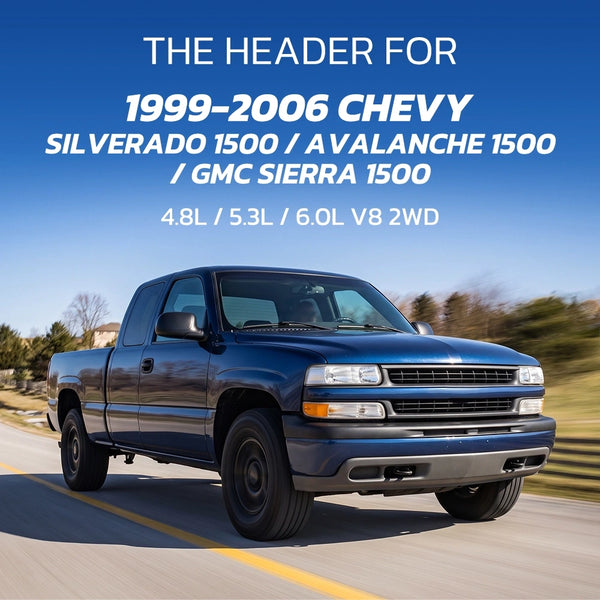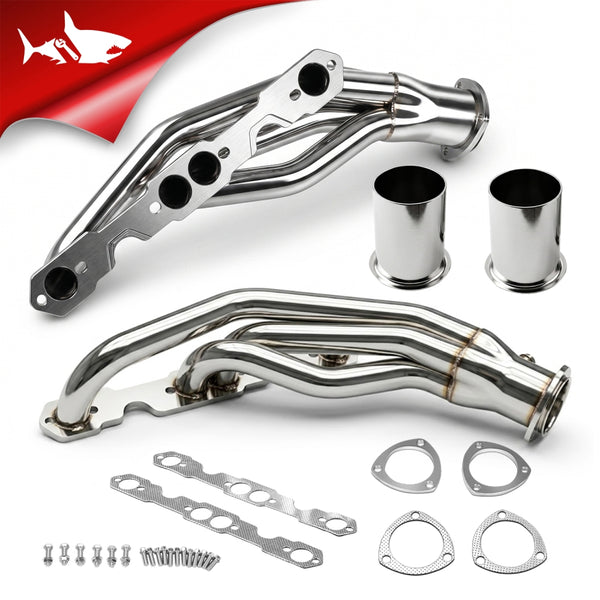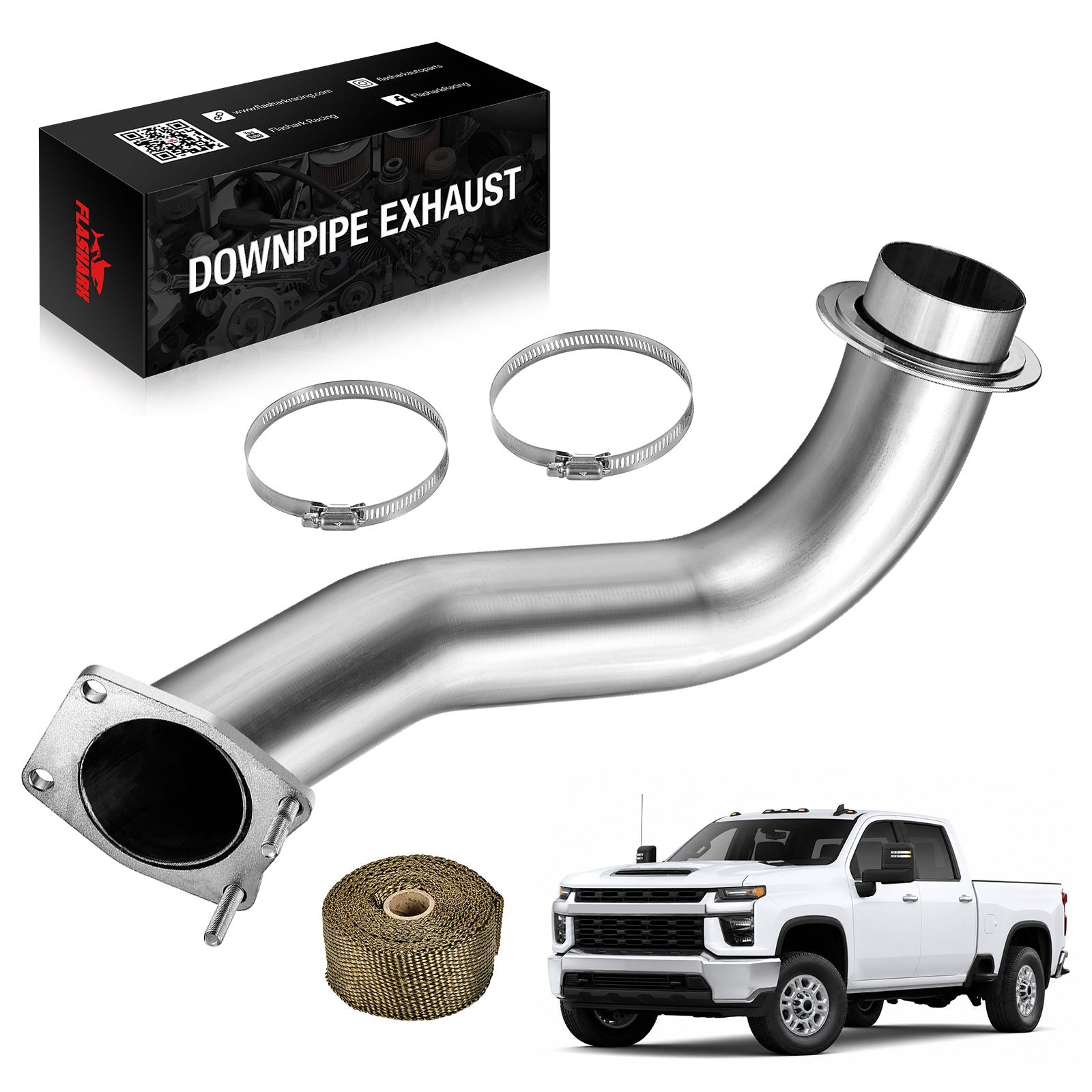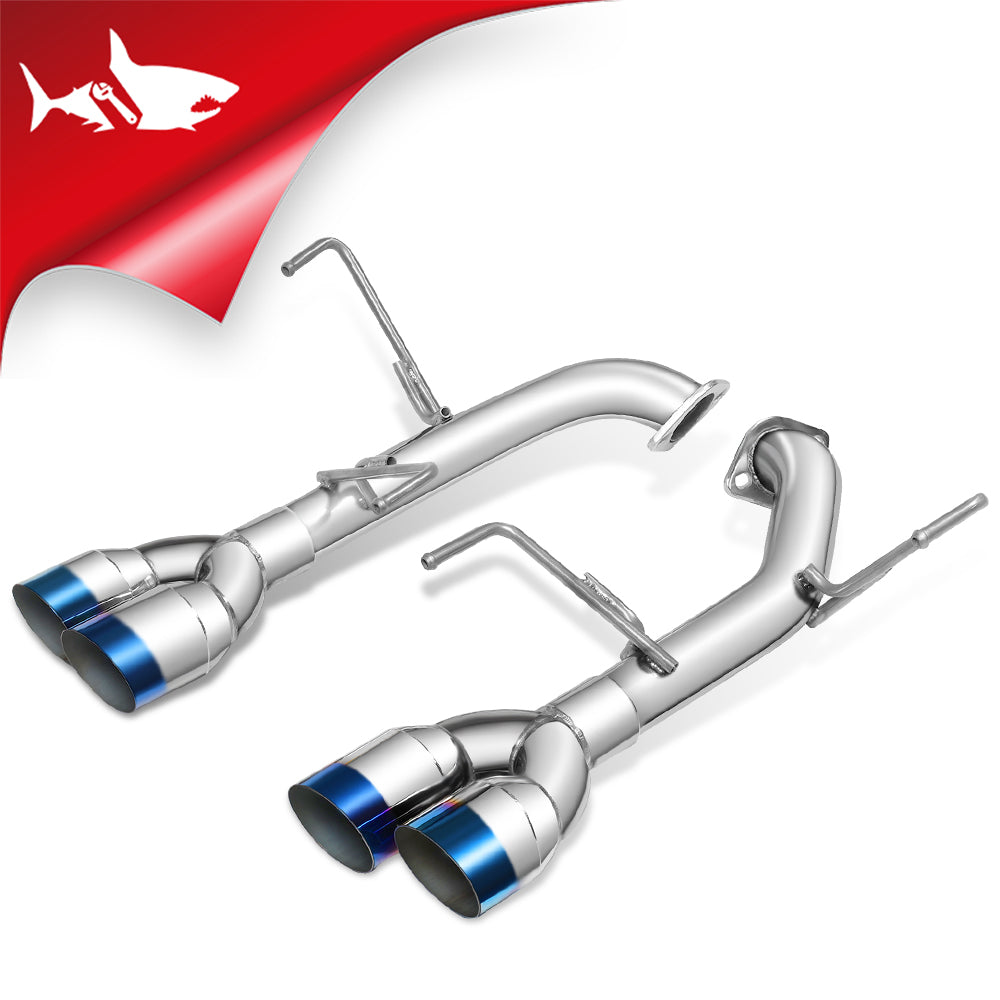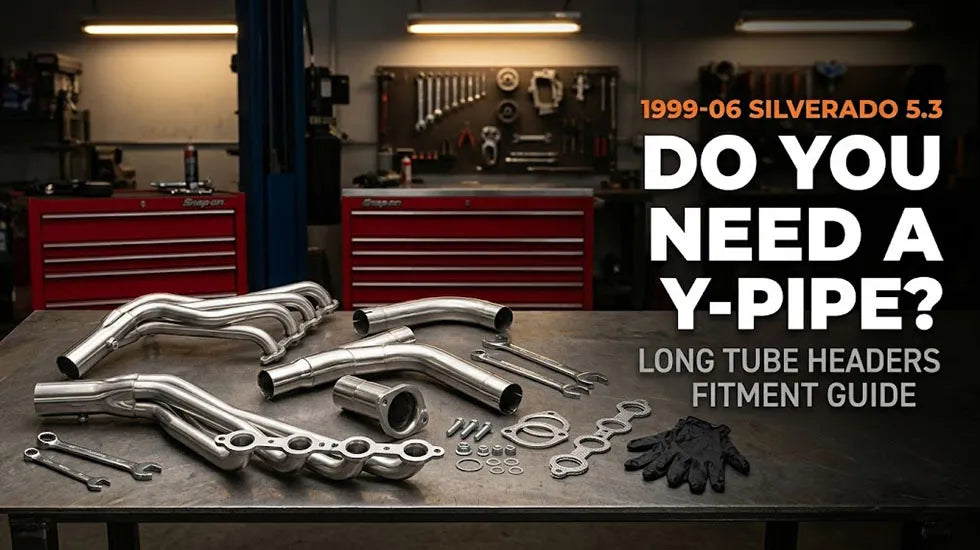
Seamos honestos. Muchos propietarios de Silverado 5.3 de 1999-2006 compran colectores de escape de tubo largo pensando que la parte difícil son los tubos brillantes debajo del capó. Por lo general, no lo es. El verdadero dolor de cabeza comienza debajo del camión, donde los colectores deben unirse al tubo en Y, los sensores de O2 deben alcanzar, y el escape tiene que librar el travesaño, la transmisión y, a veces, el eje de transmisión delantero.
He visto esto pasar muchas veces. Los colectores se atornillan a las cabezas sin problemas, luego el tipo se mete debajo y se da cuenta de que el tubo en Y de fábrica ni siquiera está cerca. Ángulo incorrecto. Longitud incorrecta. Colector más atrás. Ahora el camión está atascado en caballetes y la tienda de silenciadores es la única que sonríe.
Así que esta guía está escrita para el propietario que busca colectores de tubo largo y tubo en Y para silverado 99-06, o tratando de encontrar el tubo en Y correcto para colectores de tubo largo 5.3. Vamos a ser realistas: qué encaja, qué no suele encajar, qué pueden esperar los propietarios de 2WD, qué deben revisar los propietarios de 4WD, y cuándo un kit de colectores y tubo en Y a juego te ahorra dinero incluso si cuesta más al principio.
- La mayoría de los colectores de tubo largo de Silverado 5.3 de 99-06 necesitan un tubo en Y a juego o un tubo en Y de fábrica modificado.
- El tubo en Y de fábrica generalmente no se atornilla directamente a los colectores de tubo largo porque la ubicación del colector, el ángulo y la longitud del tubo cambian.
- Los camiones 2WD suelen ser más fáciles. Los camiones 4WD necesitan atención extra alrededor del eje de transmisión delantero, la caja de transferencia y el travesaño.
- Un kit de colectores de tubo largo y tubo en Y a juego suele ser la ruta más limpia si quieres menos sorpresas durante la instalación.
- Si vas a mantener los catalizadores, pasar la inspección o conducir el camión a diario, planifica la elección del tubo en Y antes de comprar los colectores.
¿Qué hace el tubo en Y en una Silverado 5.3 de 99-06?
El tubo en Y no es solo un tubo de escape cualquiera colgado debajo de la cabina. En una Silverado o Sierra GMT800, conecta los lados izquierdo y derecho del escape después de los múltiples o colectores y dirige todo hacia el resto del sistema. En un camión 5.3 de fábrica, eso significa que los múltiples de fábrica se descargan en el tubo en Y de fábrica, luego en el área del catalizador y el escape trasero.
Una vez que instalas colectores de tubo largo, esa configuración cambia. Los colectores se asientan más atrás que las salidas de los múltiples de fábrica. A veces más abajo. A veces con un ángulo diferente. Ese único cambio es la razón por la que el tubo en Y se convierte en la parte decisiva del trabajo.

Disposición del múltiple de fábrica vs. colector de tubo largo
| Área | Configuración de múltiple de fábrica | Colectores de tubo largo + tubo en Y |
|---|---|---|
| Posición de salida | Corta y cerca de la ubicación del tubo en Y de fábrica | El colector generalmente se asienta más atrás |
| Longitud del tubo | Corredores de múltiple muy cortos | Tubos primarios más largos para una mejor evacuación |
| Ganancia típica | Potencia de salida base de fábrica | Las configuraciones comunes de calle suelen ver alrededor de 8-12 whp con afinación y trabajo de escape de apoyo |
| Riesgo de instalación | Tornillos oxidados y fugas en el múltiple | Alineación del tubo en Y, cableado de O2, holgura de 4WD, fugas de escape |
| Mejor uso | Conducción diaria silenciosa | Rendimiento, sonido más fuerte, mejor respiración a altas revoluciones |
¿Se puede usar el tubo en Y de fábrica con colectores de tubo largo?
Por lo general, no. No sin cortar, soldar, adaptar o ser creativo con la tubería de escape. Sé que esa no es la respuesta que los constructores con presupuesto quieren escuchar, pero es mejor que descubrirlo después de que el camión ya esté desmontado.
El tubo en Y de fábrica fue diseñado alrededor de los múltiples de hierro fundido de fábrica. Los colectores de tubo largo mueven el punto de salida. Eso significa que el tubo en Y de fábrica puede ser demasiado corto, demasiado largo en la sección incorrecta, angulado incorrectamente o colocado en un lugar donde quiere chocar con el chasis o el travesaño de la transmisión.
Por qué el tubo en Y de fábrica generalmente no se atornilla

- La ubicación del colector cambia: los colectores de tubo largo se asientan más atrás que las salidas de los múltiples de fábrica.
- El ángulo del colector cambia: incluso un pequeño desajuste de ángulo puede crear fugas o aplicar tensión a la brida.
- Los cambios de diámetro del tubo: muchas configuraciones de tubo largo utilizan tuberías más grandes que la conexión de fábrica.
- La posición del sensor de O2 cambia: el buje del sensor puede moverse lo suficiente como para que el arnés de fábrica no alcance.
- La ubicación del catalizador cambia: mantener los catalizadores puede requerir una colocación personalizada.
- La holgura de 4WD cambia: el área del eje de transmisión delantero puede volverse muy ajustada rápidamente.
Un tubo en Y que está "casi alineado" no está alineado. Si lo colocas en su lugar con pernos, puedes precargar el escape, aplastar una junta, crear una fuga en el colector o hacer que todo el sistema vibre una vez que el camión complete los ciclos de calor.
Cuando modificar el tubo en Y de fábrica tiene sentido
Hay casos en los que modificar el tubo en Y de fábrica está bien. Tal vez ya tengas un buen taller de escapes cerca. Tal vez quieras mantener tus catalizadores existentes. Tal vez tu camión ya tiene un escape cat-back personalizado y nada de lo que hay en el mercado se alinea perfectamente.
Pero haz los cálculos primero. Una compra barata solo de colectores puede convertirse en:
- adaptadores de colector
- mano de obra de corte y soldadura
- reubicación de buje de O2
- reubicación de catalizador
- nuevas juntas y abrazaderas
- tiempo extra en un elevador
Por eso, un kit de colectores de tubo largo y tubo en Y sin catalizador para Silverado 99-06 a juego a menudo tiene más sentido para una instalación en garaje normal. Los colectores y el tubo en Y están construidos para funcionar juntos, por lo que no estás tratando de unir piezas aleatorias debajo del camión con una amoladora y una plegaria.
Colectores de tubo largo y tubo en Y para Silverado 99-06: ajuste según la configuración del camión
No todos los camiones GMT800 te dan la misma cantidad de espacio. Una cabina regular 2WD y una cabina extendida 4WD pueden tener un 5.3, pero por debajo no son la misma batalla. Ahí es donde la gente se quema.
Silverado 1500 5.3 2WD de 1999-2006
En un camión 2WD, la instalación suele ser más sencilla. Sin eje de transmisión delantero que esquivar. Menos drama con la caja de transferencia. Más espacio para encaminar el tubo en Y de forma limpia. Eso no significa que cada kit encaje en su lugar, pero en comparación con el 4WD, es el camión más fácil de trabajar.
Para un conductor diario 2WD, la configuración más inteligente suele ser:
- colectores de tubo largo
- tubo en Y a juego
- buenas juntas de colector multicapa o de tipo grafito
- nuevas piezas de unión del colector
- extensiones de O2 si el kit las requiere
- una afinación después de la instalación
Silverado 1500 5.3 4WD / 4x4 de 1999-2006
Ahora llegamos a la parte que separa "encaja" de "encaja sin enojarte". En los camiones 4WD, el eje de transmisión delantero y el área de la caja de transferencia importan. La ruta del tubo en Y importa. El ángulo del colector importa. A veces el propio colector encaja, pero el tubo en Y queda demasiado cerca del eje de transmisión o del travesaño.

Recuerdo una Silverado 1500 5.3 4x4 de 2004 que llegó al taller hace años. El propietario había comprado colectores en línea y pensó que el tubo en Y de fábrica podría "hacerse funcionar". Quitamos los múltiples, atornillamos los colectores y los colectores se veían bien desde arriba. Luego nos metimos debajo. Otra historia. El colector del lado del pasajero descargaba justo donde el viejo tubo en Y no quería estar. La holgura del eje de transmisión delantero era ajustada y el ángulo del tubo era feo. Terminamos cortando el tubo en Y, cambiando el ángulo, soldando una nueva sección y moviendo un soporte. El camión sonaba muy bien después de la afinación, pero gastó más en mano de obra de escape de lo que esperaba.
Por eso les digo a los propietarios de 4WD: no solo pregunten: "¿Se atornillarán los colectores al motor?" Pregunten: "¿Despejará el tubo en Y la transmisión?"
Ajuste de Silverado vs Sierra 1500
Las Silverado 1500 y Sierra 1500 de esta época comparten la plataforma GMT800, por lo que muchos componentes de escape son intercambiables. Aún así, verifique el tamaño del motor, la transmisión, el estilo de la cabina, la configuración de emisiones y si su camión usa EGR. Un camión de 1999 y uno de 2006 pueden tener diferentes detalles de emisiones.
Para una investigación más amplia sobre el ajuste de escapes Chevy, la colección de colectores de escape Chevy es un camino interno más limpio que saltar entre listados universales aleatorios.
Notas sobre Tahoe, Yukon, Avalanche, Suburban y Escalade
Muchos SUV GMT800 utilizan la misma familia de motores: V8 Vortec de 4.8L, 5.3L y 6.0L basados en LS. Pero no asuma que la trayectoria del escape es idéntica. La distancia entre ejes, la posición de la caja de transferencia, la disposición del catalizador y el enrutamiento del escape trasero pueden cambiar la instalación.
Si su SUV está rebajado, elevado o ya tiene un escape de posventa, mida antes de pedir. En serio. Diez minutos con una cinta métrica son mejores que tres horas luchando contra un tubo que quiere ocupar el mismo espacio que su travesaño.
Tubo en Y con o sin catalizador para colectores de tubo largo 5.3
Aquí es donde la gente se exalta en los foros. Algunos quieren el tubo en Y todoterreno más barato. Algunos quieren catalizadores porque el camión es de uso diario. Algunos viven en estados con inspección. Otros no. La respuesta correcta depende de cómo se use el camión.

¿Qué es un tubo en Y con catalizador?
Un tubo en Y con catalizador mantiene los convertidores catalíticos en el sistema. Para una Silverado 5.3 de uso diario, eso generalmente significa menos olor a escape, menos sonido estridente y una configuración más amigable para la calle. También puede ayudar a reducir la posibilidad de dolores de cabeza en la inspección, dependiendo de su estado y las regulaciones locales.
No lea eso como una promesa legal general. Las leyes de emisiones varían. California no es lo mismo que Texas. Un juguete rural todoterreno no es lo mismo que un camión de uso diario que tiene que pasar la inspección todos los años.
¿Qué es un tubo en Y todoterreno?
Un tubo en Y todoterreno generalmente elimina los convertidores catalíticos. Fluye bien, suena más agresivo y es común en configuraciones de carreras o todoterreno. También puede provocar un olor a escape más fuerte, más volumen, luces de verificación del motor y problemas legales para su uso en la calle.
Si su camión se conduce por la calle, consulte las leyes locales de emisiones antes de elegir un tubo en Y sin catalizador. No asuma que "todo el mundo en línea lo usa" significa que es legal donde vive.
¿Cuál debería elegir un propietario de Silverado 5.3?
- Vehículo de uso diario: tubo en Y con catalizador, silenciador suave, afinación limpia.
- Camión de fin de semana: configuración con o sin catalizador según las necesidades de inspección.
- Uso todoterreno/carreras: el tubo en Y todoterreno puede tener sentido, con una afinación adecuada.
- Construcción económica: no olvide la afinación, las extensiones de O2, las abrazaderas, las juntas y la posible mano de obra del taller.
¿Necesitan una afinación los colectores de tubo largo y el tubo en Y en una Silverado 5.3?
¿Puede el camión funcionar sin afinación? A veces, sí. ¿Deberías dejarlo sin afinar después de los tubos largos y el tubo en Y? Yo no lo haría, especialmente si cambiaste la configuración del catalizador o el comportamiento del sensor de O2 trasero.
Los colectores de tubo largo cambian la velocidad de escape, el barrido y la ubicación del sensor de O2. La computadora puede ajustar algunas cosas, pero no es magia. Una afinación adecuada puede limpiar los ajustes de combustible, mejorar la respuesta del acelerador, ajustar el tiempo, reducir la gestión del torque y hacer que la transmisión se comporte mejor.
Expectativas de potencia realistas
En una Silverado 5.3 casi de serie, no esperes un aumento de fantasía de 40 caballos solo por los colectores. Un rango más honesto suele ser de alrededor de 8-12 caballos de fuerza en la rueda con tubos largos, un tubo en Y decente y afinación en un camión sano. Con admisión, cat-back, árbol de levas y una mejor afinación, las ganancias pueden acumularse.
¿Lo que más notan la mayoría de los propietarios? El camión se siente menos ahogado en el rango de revoluciones superiores. Suena más limpio. La respuesta del acelerador se agudiza. Ya no parece que el escape esté agarrando al motor por el cuello.
Cuando una afinación se vuelve más importante
- Colectores de tubo largo más tubo en Y sin catalizador
- Códigos de sensor de O2 trasero después de la instalación
- Actualización del árbol de levas
- Combinación de admisión de aire frío y cat-back
- El camión se siente perezoso después de la instalación
- El comportamiento de cambio de la transmisión se siente extraño
Diferencia de sonido: solo colectores vs. colectores y tubo en Y
Los tubos largos cambian el sonido. No hay forma de evitarlo. El camión suele volverse más profundo, más nítido al acelerar y más agresivo en el arranque en frío. Con un tubo en Y de flujo libre, puede despertar a todo el camión.
Pero la calidad del sonido depende del sistema completo. Colectores y un tubo en Y con un silenciador terrible pueden resonar como locos. Colectores con un buen silenciador y un enrutamiento de tubería adecuado pueden sonar imponentes sin hacer que la conducción en carretera sea miserable.
¿Resonará?
La resonancia depende de:
- diseño del silenciador
- diámetro del tubo del cat-back
- si se mantienen los catalizadores
- configuración de la cabina
- relación de transmisión
- tamaño de los neumáticos
- dónde sale el escape
Para un vehículo de uso diario, preferiría usar tubos largos, un tubo en Y limpio y un silenciador controlado que una configuración ruidosa y descuidada que haga vibrar la cabina a 1,800 rpm.
Problemas comunes de ajuste con colectores de tubo largo y tubo en Y para Silverado 99-06
El colector no se alinea con el tubo en Y
Este es el problema clásico. El colector es de una marca. El tubo en Y es de otra. El ángulo de la brida del colector es similar, pero no lo suficiente. Ahora los tornillos tiran de las bridas lateralmente, y aparece una fuga después del primer ciclo de calentamiento.
Fuga de escape en la brida del colector o en el colector
El 5.3 ya es famoso por los tornillos del múltiple rotos y las fugas de escape con sonido de tictac. Al instalar los colectores, limpie la superficie de la cabeza, use las juntas adecuadas y vuelva a apretar después de los ciclos de calentamiento si el hardware lo requiere.
Cable del sensor de O2 demasiado corto
Los colectores de tubo largo cambian la ubicación del sensor de O2. A veces, el cableado de fábrica llega. A veces no. No estire el arnés a través de tubos calientes. Utilice las extensiones de O2 adecuadas si es necesario.
Holgura del eje de transmisión delantero en 4WD
En camiones 4WD, verifique la holgura con la suspensión cargada si es posible. Un tubo que se despeja con el camión en caballetes puede asentarse de manera diferente una vez que el camión vuelve al suelo.
El tubo en Y cuelga demasiado bajo
Un tubo en Y que cuelga demasiado bajo puede rozar los topes de velocidad, los senderos, las entradas y los brazos elevadores. También puede verse mal. Un tubo en Y correctamente ajustado debe quedar limpio y evitar tensiones innecesarias en el resto del escape.
Antes de comprar: Lista de verificación de colectores de tubo largo y tubo en Y para Silverado 99-06
Antes de hacer clic en comprar, tómese su tiempo. Aquí es donde se ahorrará un fin de semana de maldiciones.
- Confirme que su camión es un Silverado/Sierra GMT800 de 1999-2006.
- Confirme el motor: V8 Vortec de 4.8L, 5.3L o 6.0L.
- Confirme la transmisión: 2WD o 4WD.
- Verifique si su camión tiene EGR.
- Verifique si el kit incluye un tubo en Y.
- Verifique si se incluyen o se requieren extensiones de O2.
- Verifique si el tubo en Y tiene catalizador o es todoterreno.
- Verifique a qué se conecta la parte trasera del tubo en Y.
- Presupueste para una afinación.
- Presupueste para el trabajo del taller de escapes si mezcla piezas.
Si ya tienes un plan de escape personalizado o tu taller de escapes local te construirá la sección de la tubería en Y, una opción de solo colector como el colector de escape para Chevy Silverado 1500 5.3L V8 1999-2006 y el kit de tubería en Y con catalizador puede tener sentido. Simplemente no compres los colectores primero y la tubería en Y después. Ahí es donde la mayoría de los proyectos de bajo presupuesto empiezan a encarecerse.
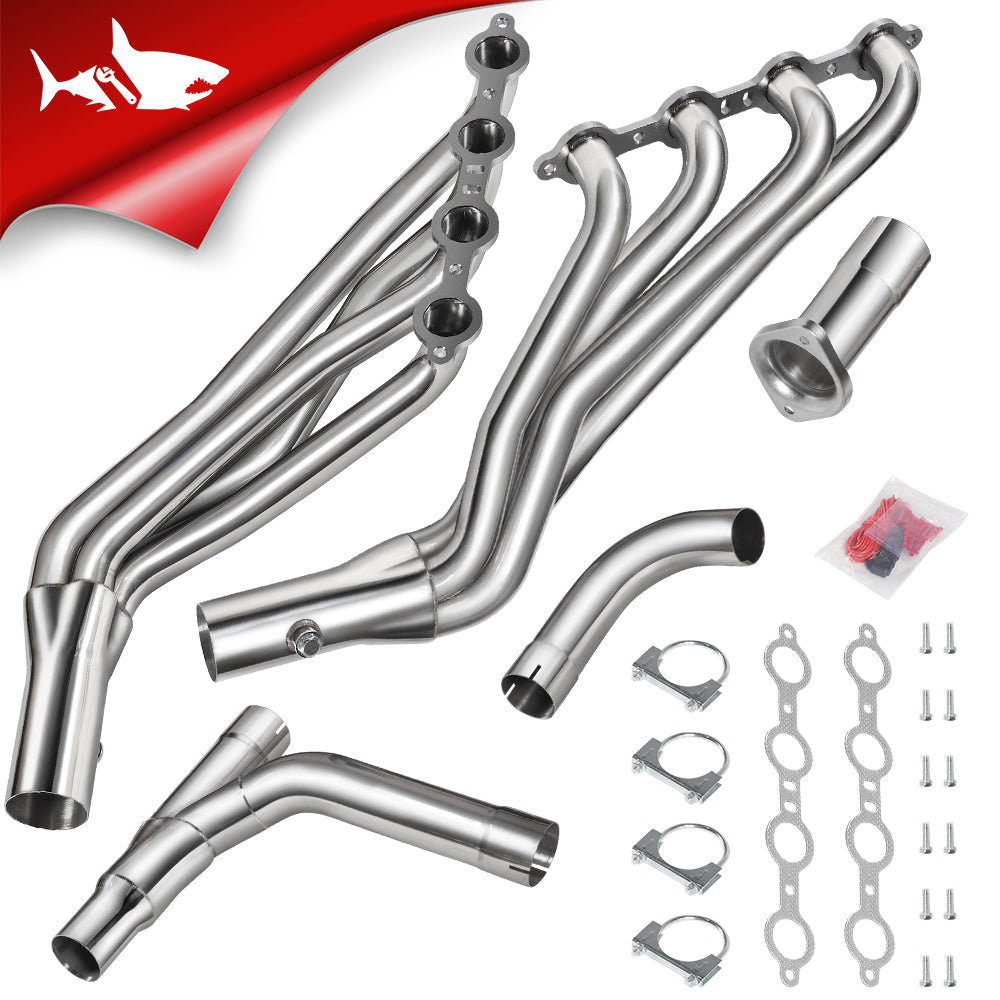
Colectores Flashark de tubo largo y kit de tubería en Y sin catalizador
Diseñados para Chevy/GMC Silverado, Sierra, Avalanche 1500 de 1999-2006 con motores Vortec de 4.8L, 5.3L y 6.0L. Un mejor ajuste para los propietarios que desean que los colectores y la tubería en Y coincidan desde el principio.
$269.99 $399.99
Ver compatibilidad
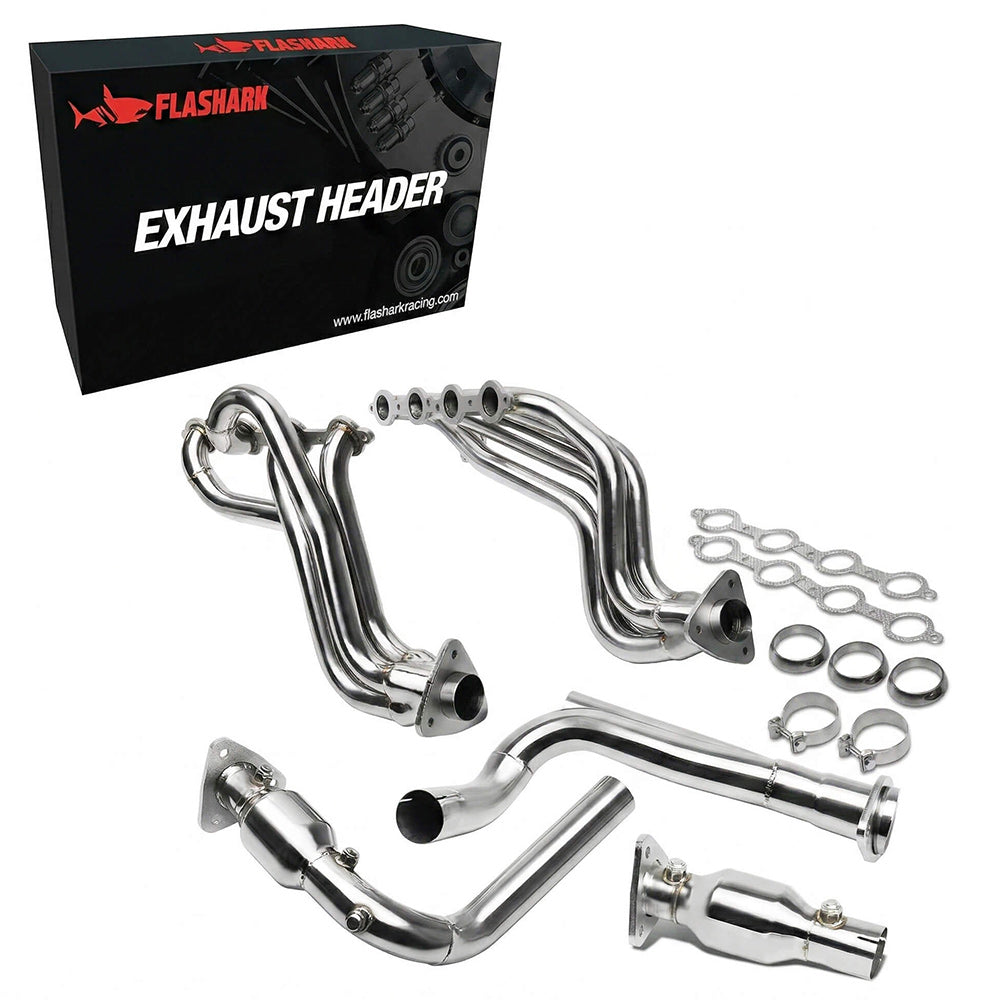
Kit de colector de escape Flashark 5.3L V8 Silverado y tubería en Y con catalizador
Una opción centrada en el colector para construcciones de Chevy Silverado 1500 5.3L V8 de 1999-2006. Ideal para compradores que ya tienen un plan para la tubería en Y o el soporte de un taller de escapes personalizado.
$219.99 $399.99
Ver opción de colector
Resumen de la instalación: qué esperar
Esto no pretende sustituir un manual de servicio completo, pero aquí está el camino general. Y sí, los tornillos oxidados decidirán qué tan bueno es tu día.
- Desconecta la batería.
- Retira los colectores de fábrica y la tubería en Y de fábrica.
- Limpia las superficies de sellado de la culata.
- Prueba el ajuste de los colectores de tubo largo de forma holgada.
- Prueba el ajuste de la tubería en Y antes de apretar todo por completo.
- Instala los sensores de oxígeno y las extensiones si es necesario.
- Alinea el escape de adelante hacia atrás.
- Comprueba el espacio libre alrededor del chasis, el travesaño, la transmisión y el eje de transmisión.
- Arranca la camioneta y comprueba si hay fugas.
- Vuelve a comprobar después de los primeros ciclos de calentamiento.
Dónde la mayoría de los instaladores aficionados tienen problemas
- tornillos del colector trasero rotos
- herrajes del colector oxidados
- espacio libre reducido en el lado del pasajero
- cableado del sensor de oxígeno demasiado cerca del calor
- alineación de la tubería en Y con el escape cat-back de posventa
- espacio libre del eje de transmisión 4WD
Muchos novatos ven un video y creen que pueden forzar el escape a su lugar con abrazaderas. No lo hagas. He visto ese error quemar juntas, crear fugas y forzar todo el sistema. El escape debe colgar de forma natural. No torcido. No tirado. No encajado contra el chasis.
¿Valen la pena los colectores de tubo largo y la tubería en Y en una Silverado 5.3?
Para la camioneta adecuada, sí. El Vortec 5.3 responde bien a un mejor flujo de escape, especialmente cuando el resto del sistema no lo restringe. Los tubos largos ayudan a la extracción. Una tubería en Y adecuada mantiene el camino de flujo limpio. Una afinación lo une todo.
¿La desventaja? Más trabajo de instalación que los colectores cortos. Más sonido. Más calor. Más posibilidades de tener problemas de emisiones o de ajuste si no planificas con antelación.
Si aún estás aprendiendo la diferencia entre los estilos de colectores, esta guía de colectores de escape Chevy vale la pena leerla antes de pedir piezas.
Perfil del mejor comprador
- Quieres un tono de escape más profundo y agresivo.
- Ya estás planeando una afinación.
- Quieres una mejor respiración a altas RPM.
- Estás reemplazando los colectores de fábrica con fugas.
- Estás construyendo una camioneta de calle/pista, todoterreno o para el fin de semana.
¿Quién debería pensarlo dos veces?
- Quieres un sonido de fábrica totalmente silencioso.
- Vives en una zona con inspecciones de emisiones estrictas.
- No quieres afinación.
- No quieres posibles costes de mano de obra en el taller de escapes.
- Estás mezclando colectores y tuberías en Y al azar sin medir.
Configuración recomendada para la mayoría de las camionetas Silverado 5.3 de 99-06
Para la mayoría de los propietarios, lo mantendría simple: compra piezas que estén diseñadas para funcionar juntas. Un paquete de colectores y tubería en Y a juego suele ser más limpio que comprar los colectores primero y esperar que el resto del sistema se comporte más tarde.
Para una navegación más a nivel de categoría, la colección principal de colectores de escape de rendimiento es útil si estás comparando plataformas, mientras que la página dedicada a las opciones de ajuste de colectores de escape para camionetas Chevy mantiene la búsqueda más específica para las construcciones de GM.
Configuración para uso diario
- Colectores de tubo largo
- Tubería en Y con catalizador si la inspección y el olor son importantes
- Silenciador de calidad
- Extensiones de sensor de oxígeno si es necesario
- Afinación conservadora para calle
Configuración de bajo presupuesto
- Colectores de tubo largo y tubería en Y a juego
- Reutiliza el cat-back compatible si se alinea
- Planifica juntas, abrazaderas y cableado del sensor de oxígeno
- No olvides el costo de la afinación
Configuración de rendimiento / todoterreno
- Colectores de tubo largo
- Tubería en Y para todoterreno donde sea legal para el uso previsto
- Cat-back de flujo libre
- Afinación adecuada
- Protección térmica alrededor del cableado y los componentes cercanos
Veredicto final: ¿realmente necesitas una tubería en Y?
Para la mayoría de las instalaciones de colectores de tubo largo en una Silverado 5.3 de 1999-2006, sí, necesitas una solución de tubería en Y. Puede ser una tubería en Y de posventa a juego, una tubería en Y de fábrica modificada a medida o una sección de escape personalizada completa. Pero pretender que la tubería en Y de serie siempre encajará es la forma en que las camionetas terminan atascadas en el garaje.
La respuesta más clara para la mayoría de los propietarios que buscan colectores de tubo largo y tubería en Y para Silverado 99 06 es esta: compra un kit a juego cuando sea posible, especialmente si quieres menos sorpresas. Si solo compras colectores, asegúrate de tener ya un plan para la tubería en Y, los catalizadores, los sensores de oxígeno y la conexión del escape trasero.
Escucha, la Silverado 5.3 es una gran plataforma. Suena bien, acepta bien las modificaciones y tiene suficiente espacio para trabajar. Simplemente no escatimes en la parte del escape que conecta todo. La tubería en Y no es una ocurrencia tardía. Es la parte que decide si la instalación se siente limpia o se convierte en un fin de semana largo.
Preguntas frecuentes
P1: ¿Los colectores de tubo largo de Silverado 99-06 necesitan una tubería en Y?
R1: En la mayoría de los casos, sí. Los colectores de tubo largo mueven la ubicación del colector en comparación con los colectores de fábrica, por lo que la tubería en Y de serie generalmente no encajará sin modificaciones.
P2: ¿Puedo usar la tubería en Y de serie con colectores de tubo largo en una Silverado 5.3?
R2: Generalmente no como una instalación directa. Algunos propietarios modifican la tubería en Y de serie cortando, soldando y cambiando ángulos, pero una tubería en Y a juego suele ser más limpia.
P3: ¿Qué tubería en Y encaja con los colectores de tubo largo en una Silverado 5.3 99-06?
R3: La opción más segura es una tubería en Y diseñada para el mismo kit de colectores. Mezclar marcas puede crear problemas de ángulo del colector, longitud y alineación de la brida.
P4: ¿Los colectores de tubo largo encajan en una Silverado 5.3 4WD 99-06?
R4: Algunos kits encajan en camionetas 4WD, pero se debe verificar el espacio libre alrededor del eje de transmisión delantero, la caja de transferencia, el travesaño y el enrutamiento de la tubería en Y.
P5: ¿Los colectores de tubo largo encajarán en una Silverado 1500 5.3 de 2005?
R5: Una Silverado 1500 5.3 de 2005 está dentro del rango común de ajuste GMT800, pero aún así debes confirmar la configuración 2WD/4WD, la configuración EGR, el diseño de emisiones y la conexión del escape.
P6: ¿Necesito una afinación después de instalar colectores de tubo largo y tubería en Y?
R6: Se recomienda encarecidamente una afinación. La camioneta puede funcionar sin ella, pero una afinación ayuda a los ajustes de combustible, la sincronización, la respuesta del acelerador, el comportamiento del sensor de oxígeno trasero y la sensación de la transmisión.
P7: ¿Los colectores de tubo largo harán que mi Silverado 5.3 sea más ruidosa?
R7: Sí. Los colectores de tubo largo y una tubería en Y de flujo más libre suelen hacer que la camioneta suene más profunda, más nítida y más ruidosa, especialmente durante los arranques en frío y a acelerador a fondo.
P8: ¿Las tuberías en Y con catalizador son mejores para la conducción diaria?
R8: Para muchos conductores diarios, sí. Una tubería en Y con catalizador suele reducir el olor, el sonido metálico y los problemas relacionados con las emisiones en comparación con una tubería sin catalizador para todoterreno.
P9: ¿Las tuberías en Y sin catalizador son legales en la calle?
R9: No en muchas áreas. Las tuberías en Y sin catalizador están generalmente destinadas para uso todoterreno o de carreras. Consulta las leyes de emisiones locales antes de comprar o instalar una.
P10: ¿Los colectores de tubo largo causarán una luz de verificación del motor?
R10: Pueden, especialmente cuando cambian las ubicaciones de los sensores de oxígeno o se eliminan los convertidores catalíticos. Una afinación adecuada y una configuración correcta de los sensores de oxígeno ayudan a reducir este riesgo.
P11: ¿Necesito extensiones para los sensores de oxígeno?
R11: A menudo, sí. Los colectores de tubo largo pueden alejar los sensores de oxígeno de la ubicación del arnés de fábrica. No estires los cables sobre tubos calientes.
P12: ¿Los colectores de tubo largo son mejores que los colectores cortos para una Silverado 5.3?
R12: Para un sonido más potente y un mejor flujo de RPM medias a altas, los tubos largos suelen superar a los cortos. Los colectores cortos son más fáciles de instalar y se mantienen más cerca del diseño de escape de fábrica.
P13: ¿Puedo instalar colectores de tubo largo y tubería en Y en casa?
R13: Sí, si tienes herramientas, paciencia y experiencia con herrajes de escape oxidados. Pero si la tubería en Y necesita soldadura o una colocación personalizada del catalizador, utiliza un taller de escapes.
P14: ¿Cuál es el mayor error al comprar colectores de tubo largo para Silverado 99-06?
R14: Comprar colectores sin planificar la tubería en Y. El segundo error es ignorar el espacio libre 4WD, las extensiones de O2, la configuración EGR y los requisitos de emisiones.

Steven Chen
Especialista en rendimiento automotriz | Sistemas de motor y escape
Steven se centra en el rendimiento práctico del motor, el ajuste del escape y las rutas de actualización del mundo real para vehículos clásicos y modernos para entusiastas. Revisa aplicaciones de Ford de bloque pequeño, LS, camionetas y de calle/pista con un objetivo en mente: ayudar a los constructores a elegir piezas que realmente funcionen juntas. Su filosofía: "Una buena potencia comienza con la combinación correcta, no con la pieza más grande".