


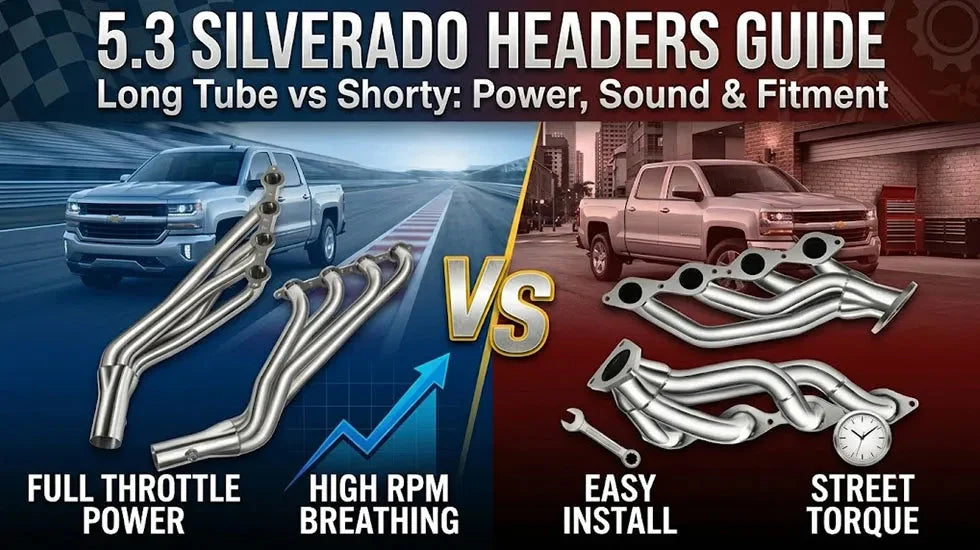
Tubos Largos vs. Múltiples de Escape Cortos (Shorty Headers) para 5.3: Guía de Potencia Real, Sonido, Costo y Ajuste para Silverado
Si eres dueño de una Silverado 5.3, probablemente hayas escuchado el mismo argumento en estacionamientos, grupos de Facebook, foros de Reddit y debajo de puertas de garaje a medio encender: los tubos largos (long tube headers) generan potencia real, los múltiples cortos (shorty headers) son más fáciles y los colectores de fábrica son "suficientemente buenos".
¿Sinceramente? Los tres pueden ser ciertos dependiendo de la camioneta.
He trabajado en suficientes camionetas GM 4.8L, 5.3L y 6.0L para saber una cosa: los múltiples de escape no son tubos mágicos. Son parte de una combinación. Un vehículo de uso diario completamente estándar, un 5.3 con árbol de levas modificado, un vehículo de remolque y una Silverado de fin de semana con una reprogramación no necesitan la misma configuración de escape. Ahí es donde el debate tubos largos vs. múltiples cortos 5.3 se complica.
Esta guía lo desglosa de la misma manera que se lo explicaría a un cliente parado junto a su camioneta: potencia, torque, sonido, dificultad de instalación, luces de verificación del motor, emisiones, reprogramación y qué configuración tiene sentido antes de gastar dinero.
Respuesta Rápida: ¿Qué Configuración Tiene Más Sentido?
- Elige tubos largos (long tube headers) si tu Silverado 5.3 tiene una reprogramación, árbol de levas modificado, admisión, cat-back, o si quieres la mayor potencia a fondo. Espera una mejor respiración a altas RPM y una nota de escape más profunda y ruidosa.
- Elige múltiples cortos (shorty headers) si tu camioneta está mayormente de serie, quieres una instalación más fácil, menos modificaciones al escape y un cambio de sonido más suave sin convertir la modificación en un proyecto completo.
- Para un vehículo de uso diario estándar, los múltiples cortos pueden parecer más limpios y fáciles, pero la ganancia perceptible puede ser modesta. Un cat-back o una reprogramación pueden sentirse más obvios al principio.
- Para un 5.3 con árbol de levas modificado, los tubos largos suelen tener más sentido. El árbol de levas necesita flujo de aire, y los colectores de fábrica o los múltiples cortos pueden convertirse en una restricción.
- Para estados con regulaciones de emisiones estrictas, no te bases solo en las afirmaciones de caballos de fuerza. Confirma la ubicación del convertidor catalítico, las normas de inspección locales y la legalidad para uso en la calle antes de ordenar.
¿Qué Son los Tubos Largos (Long Tube Headers) en una Silverado 5.3?
Los tubos largos (long tube headers) reemplazan los colectores de escape de fábrica con tubos primarios individuales más largos. Cada cilindro tiene su propio tubo, y esos tubos se fusionan más abajo en un colector. Esa longitud adicional del tubo no es solo por estética. Cambia la forma en que los pulsos de escape salen del motor.
En una Silverado 5.3, una configuración típica de tubos largos puede incluir:
- Tubos primarios largos, a menudo de alrededor de 1-5/8 pulgadas o 1-3/4 pulgadas dependiendo del kit
- Un colector más atrás debajo de la camioneta
- Una tubería en Y o tubería intermedia a juego
- Extensiones de sensor de O2 o tomas de sensor reubicadas
- Opciones de tubería con o sin catalizador, según el producto y el uso del vehículo
- Una reprogramación, especialmente si la camioneta tiene problemas con los sensores O2 traseros o la eficiencia del catalizador
Aquí está la versión de taller: los tubos largos ayudan al motor a exhalar con más fuerza. Cuando la longitud del tubo y el colector son los correctos, el escape que sale de un cilindro ayuda a sacar el siguiente pulso. Eso es el efecto de barrido. De ahí viene la potencia.

Nota Técnica: No pienses "tubo más largo = caballos de fuerza automáticos". El diámetro primario, el diseño del colector, la reprogramación, el árbol de levas, la configuración del convertidor catalítico y la elección del silenciador son importantes. Una mala combinación puede hacer que una camioneta suene más fuerte sin que sea mucho más rápida.
Por Qué los Tubos Largos Suelen Generar Más Potencia
En comparación con los colectores de serie o los múltiples cortos, los tubos largos suelen mejorar el flujo de escape a revoluciones más altas. En un 5.3 suave con una reprogramación adecuada, generalmente espero que la ganancia real se sitúe alrededor de 12-25 caballos de fuerza a la rueda, dependiendo de la camioneta, el dinamómetro, el escape, la admisión y la calidad de la reprogramación. En un 5.3 con árbol de levas modificado, la ganancia puede ser más notable porque el motor mueve más aire.
Las camionetas 5.3 de serie son una historia diferente. Si instalas tubos largos sin reprogramación y un escape restrictivo detrás de ellos, la camioneta puede sonar más agresiva, pero no utilizará todo su potencial. La ECU todavía piensa que está trabajando con el flujo de aire y el comportamiento de escape antiguos.
Configuraciones Comunes de Tubos Largos para Camionetas Silverado 5.3
Para la mayoría de las configuraciones de Silverado 5.3 de uso callejero, los dos tamaños primarios comunes son:
- Primarios de 1-5/8 pulgadas: Buenos para camionetas 5.3 suaves, vehículos de uso diario, vehículos de remolque ligeros y propietarios que se preocupan por la respuesta a bajas y medias RPM.
- Primarios de 1-3/4 pulgadas: Mejores para camionetas con árbol de levas modificado, configuraciones de altas RPM, futuras mejoras de potencia o propietarios que quieren más espacio para crecer.
Si estás construyendo una camioneta GMT800 de 1999-2006, una configuración como los tubos largos y tubería en Y para Silverado 5.3 de 1999-2006 es el tipo de categoría de producto que buscas cuando quieres más que un pequeño cambio de tono. Para camionetas de 2007-2014, verifica el ajuste de los kits estilo tubos largos y tubería en Y para Silverado 5.3 de 2007-2014 antes de ordenar.

Recomendado para Construcciones GMT800 con Tubos Largos
Tubos Largos y Tubería en Y para Silverado 5.3L de 1999-2006
Una buena opción para propietarios de Silverado/Sierra 1500 de 1999-2006 que quieren una configuración de tubos largos real en lugar de un reemplazo suave de colectores. Más adecuado para camionetas 5.3 reprogramadas, configuraciones de calle enfocadas en el rendimiento y propietarios que planean futuras mejoras de escape.
$269.99 $399.99
Ver tubos largos y tubería en Y para Silverado 5.3 de 1999-2006
¿Qué Son los Múltiples Cortos (Shorty Headers) o Tubos Cortos (Short Tube Headers) en un 5.3?
Los múltiples cortos (shorty headers), también llamados tubos cortos (short tube headers), son la opción compacta. Reemplazan el colector de fábrica pero mantienen el colector más cerca del motor, generalmente cerca de la ubicación original de la salida del colector.
Esto es importante porque un múltiple corto suele causar menos problemas durante la instalación. Menos cortes. Menos trabajo con la tubería en Y. Menos gatear debajo de la camioneta tratando de alinear los colectores mientras el óxido te cae en los ojos. Pregúntame cómo lo sé.
Múltiples Cortos vs. Tubos Cortos: ¿Es lo Mismo?
La mayoría de las veces, sí. Cuando los propietarios de Silverado buscan tubos cortos 5.3, suelen referirse a los múltiples cortos. Diferente terminología, misma idea básica: tubos primarios más cortos, ajuste más fácil y una instalación más parecida a la de fábrica en comparación con los tubos largos.
Por Qué Algunos Propietarios de Silverado Todavía Eligen los Múltiples Cortos
Los múltiples cortos no son inútiles. Escucho eso mucho en línea, y es un consejo perezoso. Simplemente cumplen una función diferente.
Un buen juego de múltiples cortos puede tener sentido si quieres:
- Un tono de escape más limpio sin volverse loco
- Menos trabajo de instalación
- Una mejor apariencia bajo el capó que los colectores de serie oxidados
- Una mejora suave al reemplazar colectores de fábrica con fugas
- Menos problemas de ajuste de la tubería en Y
- Una configuración más cercana a la de serie para el uso diario
Para camionetas GMT800 más antiguas, los múltiples cortos para camionetas Chevy y GMC 5.3 de 2000-2006 son el tipo de mejora que consideraría cuando el propietario quiere múltiples de acero inoxidable, un sonido más profundo y menos complejidad de instalación que los tubos largos.

Opción Amigable para el Uso Diario
Múltiple Corto para Camionetas Chevy/GMC 5.3L de 2000-2006
Una elección más inteligente para propietarios que desean un tono de escape más limpio, construcción de acero inoxidable y menos trabajo de instalación que los tubos largos. Mejor para vehículos de uso diario suaves, reemplazo de fugas en colectores y camionetas donde mantener la construcción simple es importante.
$149.99 $199.99
Ver múltiples cortos para camionetas Chevy y GMC 5.3 de 2000-2006
Tubos Largos vs. Múltiples Cortos 5.3: Diferencias Clave
Aquí es donde la gente suele querer una respuesta directa. Así que aquí está. Si hablamos de rendimiento puro, los tubos largos suelen ganar. Si hablamos de facilidad, control de costos y modales de uso diario, los múltiples cortos empiezan a parecer mejores.
| Categoría | Tubos Largos (Long Tube Headers) | Múltiples Cortos (Shorty Headers) / Tubos Cortos |
|---|---|---|
| Potencial de Potencia | Mayor, especialmente con reprogramación/árbol de levas | Suave a moderado |
| Ganancia Típica de HP a la Rueda | Alrededor de 12-25 whp en muchas configuraciones suaves de 5.3 reprogramadas | A menudo alrededor de 5-12 whp en configuraciones suaves, a veces menos sin reprogramación |
| Sonido | Más profundo, más ruidoso, más agudo | Tono más limpio, generalmente más suave |
| Dificultad de Instalación | Más difícil; tubería en Y, cableado de O2, holgura | Más fácil; más cercano a la disposición de fábrica |
| ¿Se Necesita Reprogramación? | Generalmente recomendada | A veces opcional, aún útil |
| Mejor Uso | Rendimiento, construcciones con árbol de levas, camionetas reprogramadas | Vehículos de uso diario, mejora de sonido suave, reemplazo más fácil |
Ganancias de Potencia: ¿Qué Se Manifiesta Realmente?
En una Silverado 5.3 de serie, los múltiples cortos pueden mejorar el flujo sobre los colectores de fundición desgastados, especialmente si los originales están agrietados o tienen fugas. Pero no esperes que la camioneta se sienta de repente como si le hubieran puesto un árbol de levas y un convertidor de torque. No funciona así.
En un dinamómetro, he visto configuraciones suaves de múltiples cortos ganar alrededor de 5-12 caballos de fuerza a la rueda cuando el resto del escape no estrangula la camioneta. Los tubos largos, con una reprogramación adecuada, a menudo muestran cerca de 12-25 caballos de fuerza a la rueda en un 5.3 suave. Agrega un árbol de levas, una mejor admisión y un escape decente detrás, y los tubos largos comienzan a distanciarse.
Es por eso que la pregunta de tubos largos vs. múltiples cortos 5.3 no debe ser respondida solo por los caballos de fuerza. Debes preguntar qué está usando la camioneta actualmente.

Torque y Sensación de Conducción Diaria
A la gente le encanta decir: "los múltiples cortos generan torque a bajas revoluciones, los tubos largos generan torque a altas revoluciones". Eso es en parte cierto, en parte ruido de internet.
La respuesta real depende del tamaño primario, el diseño del colector, la sincronización del árbol de levas, la reprogramación, la relación de diferencial trasero, el tamaño de los neumáticos, el convertidor y cómo realmente conduces la camioneta. Un 5.3 suave con tubos de gran tamaño puede sentirse lento a bajas revoluciones. Una configuración de tubos largos de tamaño adecuado con una buena reprogramación aún puede conducir bien en la ciudad.
Para una Silverado pesada con neumáticos de 33 pulgadas y relaciones de diferencial de serie, no elegiría a ciegas el tubo primario más grande disponible. Más grande no siempre significa mejor. Más grande a veces solo significa una respuesta más suave hasta que las revoluciones aumentan.
Diferencia de Sonido
Los tubos largos cambian la actitud de un 5.3. Los arranques en frío se vuelven más ruidosos. Los acelerones se vuelven más agudos. A fondo, tiene más crepitación y profundidad. Si combinas tubos largos sin catalizadores y un silenciador agresivo de paso directo, puede volverse áspero rápidamente.
Los múltiples cortos son más controlados. Todavía obtienes una mejor nota que con los colectores de serie, pero generalmente no obtienes el mismo rugido crudo. Para un vehículo de uso diario que sale del vecindario a las 6:30 a.m., eso puede ser algo bueno.
Requisitos de Reprogramación
Con múltiples cortos, algunas camionetas funcionan bien sin reprogramación. Con tubos largos, recomiendo encarecidamente una reprogramación. No porque la camioneta siempre vaya a explotar sin una. No lo hará. Pero la ECU necesita comprender mejor el cambio de flujo de aire, el comportamiento del sensor de O2 y el modelo de torque.
Una reprogramación puede corregir:
- Relación aire-combustible bajo carga
- Sincronización de encendido
- Gestión de torque
- Calidad de ralentí en camionetas con árbol de levas modificado
- Códigos relacionados con los sensores O2 traseros o el catalizador, dependiendo de la configuración legal
Advertencia: No uses una reprogramación para ocultar la manipulación ilegal de emisiones en una camioneta de uso callejero. Si tu estado verifica el equipo de emisiones, compra primero la configuración legal adecuada. La potencia es divertida. Las multas y las inspecciones fallidas no lo son.
Colectores de Serie vs. Múltiples de Escape: Comparación de Parámetros
Los colectores de fábrica de una Silverado 5.3 son fuertes, compactos, silenciosos y económicos de fabricar. No están diseñados para generar la máxima potencia. Los múltiples de escape cambian la prioridad hacia el flujo.
| Parámetro | Colector de Escape de Fábrica | Múltiples Cortos (Shorty Headers) | Tubos Largos (Long Tube Headers) |
|---|---|---|---|
| Material | Hierro fundido | Normalmente acero inoxidable | Normalmente acero inoxidable |
| Ruta de Flujo | Pasajes compartidos compactos | Conductos individuales cortos | Conductos individuales largos |
| Reducción de Contrapresión | Línea base | Suave | Moderada a fuerte |
| Aumento de Ruido | Más bajo | Leve | Notable |
| Tiempo de instalación | Depende de la reparación | Aproximadamente de 3 a 6 horas en muchos talleres | Aproximadamente de 6 a 10+ horas, dependiendo del óxido y el ajuste |
Opciones de colectores Flashark para modelos Silverado 5.3
Cuando busco colectores para una camioneta, lo primero que me importa es el ajuste, luego el material, la brida, los herrajes incluidos y si el kit coincide con el objetivo real del propietario. Flashark tiene varias opciones de colectores para Silverado/Sierra 5.3 que se adaptan a diferentes tipos de construcción, desde el reemplazo estilo "shorty" hasta configuraciones de tubos largos con opciones de tubería en Y.
Si tu camioneta exacta no aparece en la lista anterior, consulta la colección completa de colectores de escape de alto rendimiento o la página específica de colectores de escape Chevy para Silverado y Sierra antes de adivinar el ajuste.
Ventajas y desventajas de los colectores de tubo largo para una Silverado 5.3
Ventajas de los colectores de tubo largo
- Mayor potencial de potencia: Especialmente notable con una afinación, árbol de levas, admisión y escape más libre.
- Mayor fuerza a altas rpm: La camioneta respira mejor cuando las rpm aumentan.
- Mejor para configuraciones con árbol de levas modificado: Un 5.3 con árbol de levas modificado requiere un buen flujo de escape. Los tubos largos lo soportan.
- Sonido más agresivo: Más profundo, más fuerte, más serio.
- Margen para futuras actualizaciones: Buena base si planeas instalar culatas, árbol de levas, convertidor de par, engranajes o inducción forzada más adelante.
Desventajas de los colectores de tubo largo
- Mayor costo real: Colectores, tubo en Y, juntas, extensiones de O2, afinación, mano de obra del taller y posibles trabajos de escape se suman.
- Instalación más difícil: Tornillos oxidados, espacios reducidos y el empaquetado de la tracción 4x4 pueden poner a prueba tu paciencia.
- Mayor ruido en la cabina: Genial para algunos propietarios. Molesto para otros.
- Posibles problemas de emisiones: Especialmente si cambia la ubicación del catalizador.
- Afinación muy recomendada: Omitirla deja potencia y capacidad de conducción sin aprovechar.
Ventajas y desventajas de los colectores "shorty" para una Silverado 5.3
Ventajas de los colectores "shorty"
- Instalación más sencilla: Generalmente más cerca de la disposición del colector original.
- Sonido más suave: Mejor si quieres un tono sin despertar a tres manzanas.
- Menor aumento total del proyecto: A menudo, menos piezas de soporte que los tubos largos.
- Buena mejora de reemplazo del colector: Tiene sentido cuando los colectores originales tienen fugas o están en mal estado.
- Apto para uso diario: Menos problemas de calor y ruido cuando se elige correctamente.
Desventajas de los colectores "shorty"
- Menor límite de potencia: Generalmente no igualan a los tubos largos en potencia máxima.
- Pueden resultar decepcionantes: Especialmente en una Silverado 5.3 de serie sin afinación.
- El costo por caballo de fuerza no siempre es excelente: Si tu objetivo es la máxima potencia, ahorra para los tubos largos.
- Todavía pueden tener fugas: Juntas defectuosas, bridas deformadas o una mala preparación de los tornillos aún pueden causar problemas.
Escenarios reales de Silverado: ¿Qué configuración deberías elegir?
Escenario 1: Silverado 5.3 de serie para uso diario
Si tu camioneta es de serie y la conduces al trabajo todos los días, los "shorties" pueden tener más sentido. Obtendrás un tono más limpio, menos problemas de instalación y menos posibilidades de convertir un trabajo de sábado en una discusión de tres días con tu camioneta.
Pero si tu único objetivo es el sonido, seré honesto contigo: comienza con un buen silenciador o cat-back primero. Los colectores no siempre son el primer gasto que yo haría en un vehículo de uso diario de serie.
Escenario 2: 5.3 con admisión, cat-back y afinación
Ahora los tubos largos empiezan a tener sentido. La camioneta ya tiene un mejor flujo de aire de entrada y salida. Una afinación puede unir la combinación. Aquí es donde la configuración de tubo largo deja de ser "simplemente más ruidosa" y empieza a sentirse más fuerte por encima de las 3,000 rpm.

Mejor ajuste para camionetas GMT900 afinadas
Colectores de tubo largo para Silverado/Sierra 5.3L 2007-2014
Si tu Silverado o Sierra 2007-2014 ya tiene admisión, cat-back y planes de afinación, esta configuración de tubo largo tiene más sentido que los "shorties". Le da al Vortec 5.3L más espacio para respirar y encaja mejor como parte de una combinación completa de rendimiento.
$309.99 $459.99
Escenario 3: Silverado 5.3 con árbol de levas modificado
Tubos largos. La mayoría de las veces, esa es mi respuesta.
Un 5.3 con árbol de levas modificado necesita flujo de escape. Si el árbol de levas tiene mayor duración y superposición, estrangularlo con colectores restrictivos o "shorties" suaves es como ponerle botas de trabajo a un velocista. Aún puede correr, pero no está feliz.
Escenario 4: Camioneta para remolque o trabajo
No busques aquí los números máximos en el dinamómetro. Una camioneta de trabajo necesita un par utilizable, control de calor, fiabilidad y sin zumbidos molestos a velocidad de autopista con un remolque detrás. Una configuración suave de "shorty" o tubos largos con catalizador de tamaño adecuado pueden funcionar, pero el silenciador y la afinación importan tanto como los colectores.
Escenario 5: Estado con regulaciones de emisiones estrictas
Verifica antes de comprar. California no es Texas. Nueva York no es Florida. Algunas áreas inspeccionan los catalizadores, la preparación del OBD y el equipo visual. Si tu camioneta se conduce en la calle, tu configuración de colectores debe respetar eso.
Puntos débiles de la instalación que los propietarios de Silverado deben conocer
Esta es la parte de la que nadie quiere hablar cuando están emocionados por pedir piezas. Los colectores son divertidos. Los tornillos rotos no lo son.
Tornillos del colector de escape rotos
Recuerdo una Silverado 1500 5.3 de 2006 que llegó al taller hace unos años. El propietario había visto dos videos de YouTube y pensó que instalaría los colectores en medio sábado. Sacó tres tornillos limpios, luego rompió el tornillo del colector trasero del lado del pasajero a ras de la culata. Esa camioneta se quedó allí durante la noche. Tuvimos que calentar, taladrar, extraer, limpiar las roscas y repasar la superficie antes de siquiera comenzar a ajustar el colector.

Eso es normal en las camionetas GM más antiguas. No es divertido. Es normal.
Antes de empezar:
- Rocía aceite penetrante un día antes de la extracción
- Trabaja con el motor frío
- Usa llaves de seis puntas, no chatarra redondeada
- Sé paciente con los tornillos traseros cerca del cortafuegos
- Ten herramientas extractoras listas si la camioneta está oxidada
Fugas en los colectores y elección de juntas
Una fuga en los colectores suena como una máquina de coser con problemas de ira. Un "tic-tic-tic" bajo carga, especialmente en frío. La mayoría de las fugas provienen de un mal contacto de la brida, juntas baratas, tornillos flojos después de ciclos de calor o superficies de la culata sucias.
Mi regla: limpia la superficie de la culata hasta que te canses de limpiarla, luego límpiala de nuevo. Después de los primeros ciclos de calor, vuelve a verificar los tornillos accesibles. Los colectores se mueven. El metal se expande. Los tornillos se aflojan.
Problemas de cables de bujías y calor
Los tubos largos se asientan más cerca de los cables de las bujías. Algunos compartimentos de motor de Silverado tienen suficiente espacio. Algunos te hacen decir palabras que tus hijos no deberían escuchar.
Utiliza:
- Cables de bujía de calidad con buenas fundas
- Fundas térmicas donde sea necesario
- Enrutamiento inteligente de cables lejos de los tubos
- Protección térmica cerca del motor de arranque y el cableado si el espacio es limitado
Problemas con el sensor de O2 y la luz de verificación del motor
Los tubos largos pueden mover los sensores de O2 más abajo. A veces necesitas extensiones. A veces el cableado del sensor se asienta demasiado cerca del calor. A veces una camioneta arroja códigos de eficiencia del catalizador dependiendo de la configuración.
No asumas "CEL no garantizado". Eso es lenguaje de marketing. Las camionetas reales varían.
Ajuste del tubo en Y
Aquí es donde muchas instalaciones caseras se complican. Los colectores de tubo largo a menudo requieren un tubo en Y a juego. Tu cabina, caja, configuración 2WD/4WD, transmisión y año del modelo son importantes. Un kit que se ajusta a una Silverado puede no ajustarse a otra.
Consejo del instalador: Deja todo flojo hasta que el sistema completo esté montado. Tornillos del colector, abrazaderas del colector, uniones del tubo en Y, soportes — todo. Apretar un lado demasiado pronto puede desplazar todo el sistema y crear fugas o problemas de holgura.
Expectativas de rendimiento: ¿Qué ganancias son realistas?
Silverado 5.3 de serie
En una Silverado 5.3 de serie, no esperes milagros. Los colectores tipo "shorty" pueden añadir un poco de respuesta del acelerador y un tono más limpio. Los tubos largos pueden sentirse más fuertes, especialmente con una afinación, pero el resto de la camioneta tiene que cooperar.
Rangos aproximados típicos que he visto en camionetas suaves:
- Colectores "shorty": alrededor de 5-12 hp a la rueda cuando el resto del escape está en buen estado
- Colectores de tubo largo sin una afinación adecuada: a menudo menos impresionantes de lo que el propietario esperaba
- Colectores de tubo largo con afinación: a menudo alrededor de 12-25 hp a la rueda en una configuración 5.3 suave
Silverado 5.3 afinada
Una afinación hace que la camioneta se sienta más completa. La ECU se puede ajustar para el flujo de aire, el encendido, la inyección de combustible, la gestión del par y el comportamiento de los cambios. Es por eso que los mismos colectores de tubo largo pueden sentirse promedio en una camioneta sin afinar y mucho mejor después de la afinación.
Silverado 5.3 con árbol de levas modificado
Aquí es donde los tubos largos justifican su precio. Un 5.3 con árbol de levas modificado mueve más aire y necesita menos restricción de escape. La diferencia no es solo la potencia máxima. El motor se siente más limpio en la parte superior. Acelera en lugar de jadear.
Expectativas de sonido: ¿Profundo, fuerte, áspero o zumbido?
Cómo suenan los tubos largos en un 5.3
Los tubos largos suelen hacer que un 5.3 suene más profundo y fuerte. El arranque en frío tiene más carácter. Bajo carga, la camioneta suena menos amortiguada y más mecánica. Con un buen silenciador y catalizadores de alto flujo, puede sonar excelente. Sin catalizadores y con el silenciador equivocado, puede sonar áspero y barato.
Cómo suenan los colectores "shorty" en un 5.3
Los "shorties" agudizan el tono sin cambiar completamente la personalidad de la camioneta. Escuchas más textura de escape, pero generalmente se mantiene más civilizado. Si tu Silverado es un vehículo familiar de uso diario, eso importa.
Cómo evitar el zumbido
El zumbido no es potencia. El zumbido es un castigo.
- No combines tubos largos con el silenciador más ruidoso solo porque un clip sonó bien en tu teléfono.
- Mantén un resonador si tu camioneta zumba en la autopista.
- Usa un silenciador de calidad que coincida con la longitud de la cabina y la configuración del motor.
- Recuerda que las camionetas de doble cabina pueden zumbar de manera diferente a las de cabina regular.
Guía de compra: Cómo elegir colectores para una Silverado 5.3
Elige el tamaño correcto del tubo primario
Para un 5.3 de calle suave, suelo inclinarme por lo conservador. Un primario más pequeño puede mantener la velocidad y ayudar a la respuesta en calle. Para una construcción con árbol de levas modificado o de altas rpm, un primario más grande puede tener sentido.
No compres el tubo más grande porque internet te dijo que lo más grande siempre es mejor. Así es como la gente construye camionetas perezosas.
Elige acero inoxidable en lugar de acero dulce barato
En estados húmedos o zonas con nieve, el acero dulce barato se estropea rápidamente. El acero inoxidable vale la pena por su longevidad. El pulido espejo no genera caballos de fuerza por sí mismo, pero un mejor material y una mejor construcción importan cuando la pieza soporta ciclos de calor todos los días.
Verifica el grosor de la brida y la calidad de la soldadura
Las bridas delgadas se deforman. Las malas soldaduras se agrietan. Los colectores mal formados tienen fugas. Al comprar en la colección de colectores de escape de alto rendimiento, mira más allá de la foto brillante. Verifica las especificaciones, las notas de ajuste, las reseñas de los clientes y lo que incluye el kit.
Tubo en Y con o sin catalizador
Una configuración con catalizador suele ser mejor para camionetas de calle. Menos olor, menos sonido áspero, mejores probabilidades de pasar la inspección y menos problemas. Las configuraciones sin catalizador son generalmente para uso todoterreno o solo para carreras, dependiendo de la ley local.

Confirma el ajuste antes de comprar
Antes de pedir colectores para una Silverado 5.3, confirma:
- Año
- Silverado, Sierra, Tahoe, Yukon, Suburban o Avalanche
- Tamaño del motor: 4.8L, 5.3L, 6.0L o 6.2L
- 2WD o 4WD
- Configuración de cabina y caja
- Requisito de EGR o no EGR
- Ubicación del catalizador de fábrica
- Si el kit incluye tubo en Y, juntas, tornillos, abrazaderas o extensiones
Errores comunes al comprar colectores para una Silverado 5.3
Error 1: Comprar tubos largos sin presupuestar una afinación
El precio del colector no es el trabajo completo. Agrega el costo de la afinación. Agrega las juntas. Agrega la mano de obra. Agrega el trabajo de escape. Esa pieza de $300 puede convertirse rápidamente en un proyecto mucho más grande.
Error 2: Esperar que los colectores "shorty" se sientan como un cambio de árbol de levas
Los "shorties" son una mejora leve. Pueden sonar mejor y fluir mejor que los colectores de serie desgastados, pero no transformarán la camioneta por sí solos.
Error 3: Ignorar las normas de emisiones
Si tu camioneta se conduce en la calle, ten en cuenta el cumplimiento de las emisiones desde el primer día. No construyas la camioneta dos veces porque la primera configuración no pasó la inspección.
Error 4: Elegir primarios de gran tamaño para un 5.3 suave
El tamaño del tubo debe coincidir con el motor. Un 5.3 de serie no necesita el tamaño de un camión de carreras a menos que el resto de la construcción lo soporte.
Error 5: Combinar tubos largos ruidosos con el silenciador equivocado
Un clip de escape ruidoso en línea no te dice cómo se siente a 70 mph durante dos horas. Elige el silenciador como si realmente tuvieras que vivir con la camioneta.
Configuración recomendada por objetivo
| Objetivo | Configuración de colectores recomendada | Por qué |
|---|---|---|
| Máxima potencia | Colectores de tubo largo + tubo en Y + afinación | Mejor flujo de aire y mayor potencial en la parte superior |
| Conducción diaria | Colectores "shorty" o tubos largos con catalizador | Mejor equilibrio entre sonido, ajuste y comodidad |
| Solo sonido | Primero silenciador/cat-back, luego "shorties" si es necesario | Cambio de sonido más directo con menos trabajo |
| 5.3 con árbol de levas modificado | Colectores de tubo largo | Soporta el flujo de aire necesario para el árbol de levas |
| Mejora de reparación económica | Colectores "shorty" o colectores GMT800 compatibles con EGR | Bueno para reemplazar colectores con fugas sin una construcción completa |
Veredicto final: Colectores de tubo largo vs. "shorty" para una Silverado 5.3
Si me preguntas cuál produce más potencia, casi siempre elegiré los tubos largos. Con la afinación correcta y las piezas de soporte, son los mejores colectores de rendimiento para una Silverado 5.3.
Si te preguntas cuál tiene más sentido para un vehículo de uso diario en su mayoría estándar, los colectores cortos merecen una consideración seria. Son más fáciles de instalar, más silenciosos y, por lo general, menos propensos a convertirse en un proyecto de escape completo.
Así que la verdadera respuesta a colectores largos vs. cortos 5.3 es esta: haz coincidir el colector con el camión, no con la sección de comentarios.
- ¿Diario estándar? Primero colectores cortos o cat-back.
- ¿5.3 con ajuste? Los colectores largos empiezan a tener sentido.
- ¿5.3 con árbol de levas? Los colectores largos suelen ser la opción.
- ¿Estado con emisiones estrictas? El ajuste legal es prioritario antes que la potencia máxima.
- ¿Construcción económica? Cuenta el costo total del proyecto, no solo el precio del colector.
Escuchen, me gusta la potencia tanto como a cualquiera. Pero una buena potencia comienza con la combinación adecuada, no con la pieza más grande.
Preguntas Frecuentes
P1: ¿Valen la pena los colectores de tubo largo en una Silverado 5.3?
R1: Sí, los colectores de tubo largo valen la pena si tu Silverado 5.3 tiene un ajuste, árbol de levas, admisión, cat-back, o si quieres una potencia más fuerte a altas RPM. En una camioneta con un ajuste suave, una ganancia realista suele ser de alrededor de 12-25 caballos de fuerza en las ruedas. En un vehículo de uso diario estándar sin ajuste, la mejora puede parecer menos dramática.
P2: ¿Los colectores cortos añaden caballos de fuerza a un 5.3?
R2: Los colectores cortos pueden añadir caballos de fuerza, pero la ganancia suele ser modesta. Muchas configuraciones de 5.3 suaves pueden ver alrededor de 5-12whp dependiendo del camión, el escape y el ajuste. Son mejores para un sonido suave, una instalación más sencilla y el reemplazo del colector que para la máxima potencia.
P3: ¿Los colectores de tubo corto son lo mismo que los colectores cortos (shorty headers)?
R3: En la mayoría de las discusiones sobre Silverado, sí. Cuando la gente busca colectores de tubo corto 5.3, generalmente se refieren a los colectores cortos (shorty headers). Ambos describen un colector compacto con tubos primarios más cortos que los colectores de tubo largo.
P4: ¿Necesito un ajuste para los colectores de tubo largo en una Silverado 5.3?
R4: Se recomienda encarecidamente un ajuste. Los tubos largos cambian el flujo de escape y el comportamiento del sensor de O2. Un ajuste adecuado puede mejorar la inyección de combustible, la sincronización, la gestión del par, la respuesta del acelerador y la manejabilidad general.
P5: ¿Puedo instalar colectores cortos sin un ajuste?
R5: Muchas configuraciones de colectores cortos pueden funcionar sin un ajuste, especialmente cuando el camión permanece cerca de su estado original. Dicho esto, un ajuste aún puede ayudar a mejorar la respuesta del acelerador y optimizar la combinación.
P6: ¿Los colectores de tubo largo harán que mi Silverado 5.3 sea más ruidosa?
R6: Sí. Los colectores de tubo largo suelen hacer que un 5.3 suene más fuerte, más grave y más agresivo. El sonido final depende en gran medida de los catalizadores, el tubo en Y, el resonador, el silenciador y el diseño del tubo de escape.
P7: ¿Son legales los colectores de tubo largo en una Silverado de uso urbano?
R7: Depende del diseño del colector, la configuración del catalizador y las normas de emisiones de su estado o localidad. Cualquier configuración que elimine o desactive el equipo de emisiones requerido puede generar problemas legales y de inspección para el uso en la calle.
P8: ¿Los colectores cortos pasarán las emisiones?
R8: Los colectores cortos suelen estar más cerca de la configuración de fábrica, pero pasar las emisiones aún depende del producto, los catalizadores, los sensores de O2, las normas de inspección locales y si la camioneta conserva el equipo de emisiones requerido.
P9: ¿Qué tamaño de colectores es mejor para una Silverado 5.3?
R9: Para una Silverado 5.3 de calle suave, los primarios de 1-5/8 pulgadas suelen ser una opción inteligente. Para construcciones con árbol de levas o de mayor potencia, los primarios de 1-3/4 pulgadas pueden tener más sentido. No elija el tubo más grande a menos que el resto de la construcción lo soporte.
P10: ¿Los colectores de tubo largo requieren un nuevo tubo en Y?
R10: La mayoría de las configuraciones de colectores de tubo largo requieren un tubo en Y a juego o una modificación del escape porque la ubicación del colector cambia. Siempre confirme si el kit incluye un tubo en Y y si se ajusta a su año, cabina, tren motriz y diseño de escape.
P11: ¿Los colectores cortos son mejores para remolcar?


- Abre en una nueva ventana.