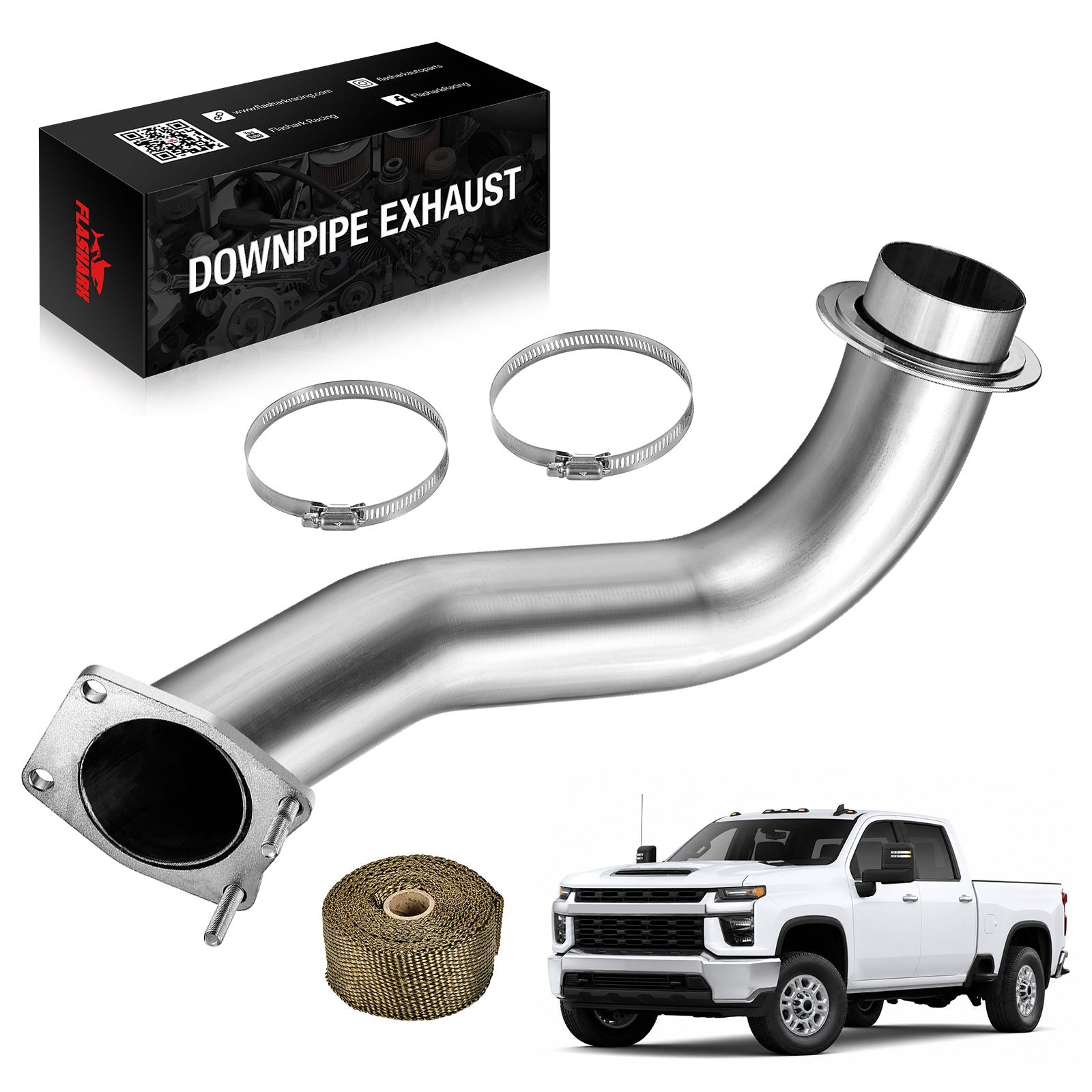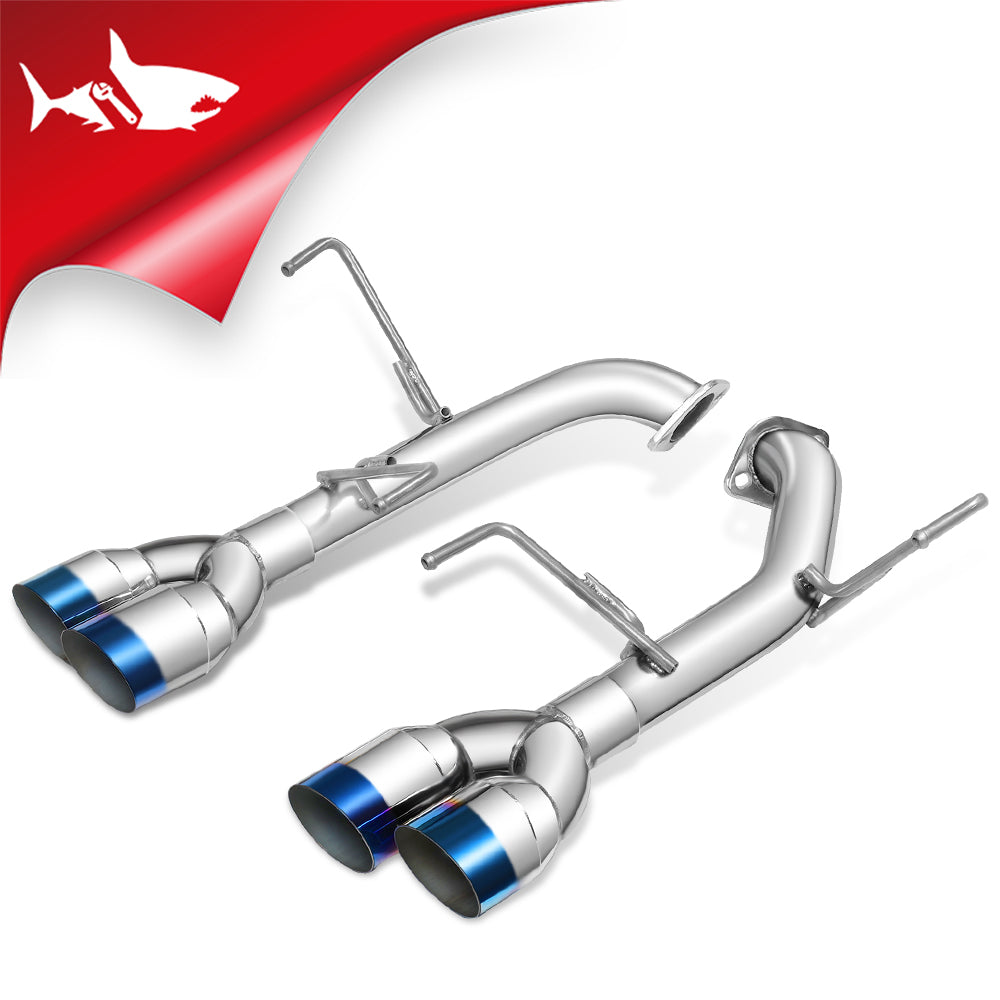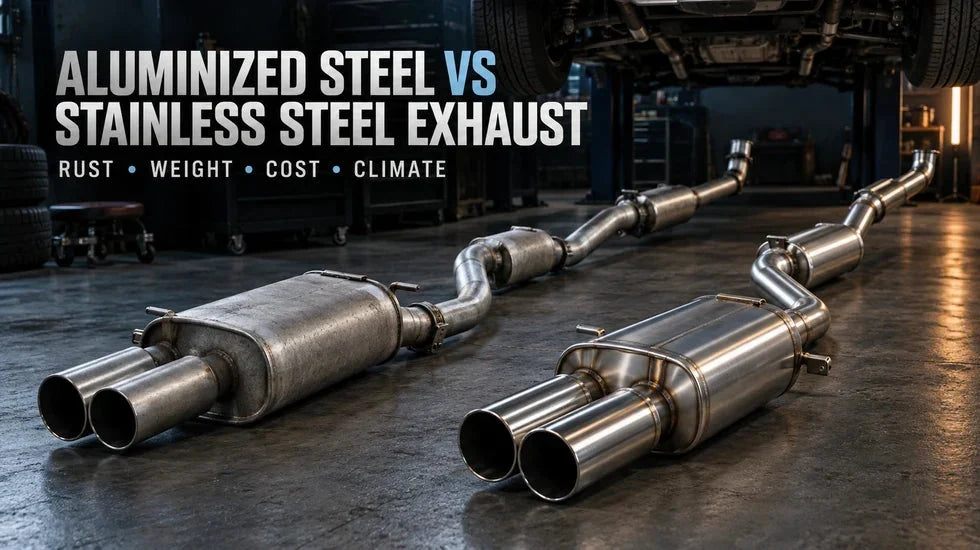
Two cat-back systems can follow the same route, use the same pipe diameter, and look almost identical in product photos—yet one costs hundreds of dollars more. Usually, that price gap comes down to the tubing and muffler material.
That is where the aluminized steel vs stainless steel exhaust argument gets messy. One owner in Arizona may run an aluminized system for years without a serious problem. A Michigan owner may see rust spreading around the welds after a few winters of salted-road driving. Neither result proves that one material is always right or wrong. The vehicle, climate, trip length, fabrication quality, and ownership plan all matter.
Listen to me on this one: do not buy the material badge. Buy the system that makes sense under your car.
Quick Answer: Which Exhaust Material Should You Choose?
- Choose T304 stainless steel when the vehicle sees salted winter roads, coastal air, high humidity, frequent rain, or regular short trips.
- Choose aluminized steel when upfront cost matters most, the vehicle lives in a dry climate, and you do not expect to keep the same exhaust indefinitely.
- For a long-term daily driver, T304 usually becomes easier to justify because corrosion resistance runs through the material rather than depending on a surface coating.
- For a garage-kept weekend car, a well-built aluminized system may meet the owner’s service-life needs.
- Do not choose by weight alone. Pipe gauge, muffler construction, flanges, hangers, and tip design can outweigh the small density difference between the alloys.
- Do not expect a horsepower gain from the alloy itself. Pipe diameter, bends, merges, mufflers, resonators, and the engine combination control flow.

Aluminized Steel vs Stainless Steel Exhaust: What Are You Actually Buying?
An aluminized exhaust is not made from aluminum tubing. An aluminized exhaust uses carbon steel coated with an aluminum-silicon alloy. The coating helps protect the underlying steel from high-temperature oxidation and ordinary exposure while keeping production costs under control.
A T304 stainless steel exhaust pipe takes a different approach. Its corrosion resistance comes from the composition of the metal itself. Because the alloy extends through the entire tube wall, scratching the surface does not expose an underlying layer of ordinary carbon steel.
That distinction matters after years of road grit, clamp movement, heat cycling, and repair work. An aluminized coating works well while it remains intact. Cut through, grind away, or burn back the protective coating during welding, and any exposed area needs protection. T304 is more forgiving when its surface is disturbed, although it can still discolor or develop localized staining.
Mechanic’s note: “Stainless steel” is not a complete material specification. T304 and T409 are both stainless steels, but they do not age the same way. If the listing never identifies the grade, ask what material is used for the pipes, mufflers, flanges, hangers, and tips—not just the shiny part visible behind the bumper.
T304 Stainless Is Not the Same as T409 Stainless
T304 is an austenitic stainless steel commonly chosen when appearance and corrosion resistance are priorities. T409 is a ferritic stainless steel frequently used in original-equipment exhaust construction. It handles exhaust heat and can provide long service, but it often develops brown surface oxidation that makes owners think it is ordinary mild steel.
T409 can be a sensible middle ground. Still, it should not be sold or evaluated as if it were T304. If you are paying a premium specifically for a 304 stainless steel exhaust, the material description should say so clearly.
Rust Resistance: Road Salt Outside, Condensation Inside
Most owners look under the car, see road grime, and assume rust attacks only from the outside. That is half the story.
Gasoline combustion produces water vapor. During a cold start, the pipes and muffler are too cool to keep all of that moisture in vapor form. Water vapor condenses on the internal surfaces. If the vehicle runs long enough, heat can evaporate much of it. Repeated cycles of driving for five to ten minutes, shutting the engine off, and allowing the system to cool can leave moisture inside low sections and muffler chambers.
Now add winter brine outside the pipe. The system is being attacked from both directions.
Where an Aluminized Steel Exhaust Pipe Usually Rusts First
Rust rarely starts as one even blanket across the entire system. It tends to establish itself at small, ugly weak points:
- Cut edges where the protective coating ends
- Weld seams and heat-affected areas
- Clamps that trap saltwater against the tubing
- Hanger welds that flex as the exhaust moves
- Muffler seams and folded shell edges
- Scrapes caused by speed bumps, rocks, or poor ground clearance
- Low sections where internal condensation collects
- Mild-steel hardware attached to otherwise corrosion-resistant tubing

A Rusted Weld Can Hide Behind a Clean-Looking Pipe
Shop-floor case: I remember inspecting a daily-driven Mustang with an aftermarket rear exhaust after several winters. Viewed from beside the car, the main pipes did not look terrible. Once I put it in the air, the story changed. The tube centers were still solid, but orange scale had formed around a muffler inlet weld and underneath a clamp.
I loosened the clamp and a thin crescent of rust came away with it. That was the leak. The owner had been blaming the muffler because the car sounded raspy on cold starts. The muffler was not the first part to fail—the trapped moisture and damaged coating at the joint were. Before judging the entire pipe by its cleanest section, I inspect seams, clamps, and hangers.
Why Salt-Spray Hours Do Not Equal Years on a Car
A laboratory salt-spray number can compare coatings under controlled conditions, but it cannot tell you exactly how many winters a cat-back will survive. A real exhaust expands, contracts, twists in rubber hangers, gets sprayed with road brine, and accumulates condensation internally.
Wall thickness matters. Weld penetration depth is a critical parameter for joint integrity. Drainage matters. Storage conditions also matter, especially when the vehicle sits in a damp garage with salty slush packed around the rear suspension. Treat any fixed lifespan claim as an estimate tied to specific conditions, not a countdown clock.
Welding and Repair: Which Exhaust Is Easier to Live With?

Welding Aluminized Steel Exhaust Pipe
Aluminized tubing is familiar territory for most exhaust shops. It can be cut, bent, and welded with common equipment. The key requirement is surface preparation.
Many beginners run a weld directly over dirt, oxidation, and the aluminized coating, then wonder why the bead spits, contaminates, or leaves a rough porous edge. Do not do that. The joint area needs to be cleaned correctly, and welding fumes need to be controlled with proper ventilation and protective equipment.
After welding, the original continuous coating no longer protects the entire heat-affected zone. A suitable high-temperature corrosion treatment can help the exterior, but it cannot recreate the factory-applied coating inside the tube.
Welding a T304 Stainless Steel Exhaust Pipe
T304 can be welded with MIG or TIG equipment. TIG is popular for clean, visible fabrication, but the process name alone does not guarantee a durable joint. A visually pleasing stack-of-dimes weld can still conceal lack of penetration, severe backside oxidation, or incorrect filler metal.
A competent stainless exhaust repair should address:
- Joint cleanliness: Remove oil, paint, carbon, and embedded ordinary-steel particles.
- Dedicated tools: A wire brush used on rusty carbon steel can transfer iron contamination to stainless steel tubing.
- Suitable filler: Match the filler to the stainless base metal and the materials being joined.
- Heat control: Thin-wall tubing can distort or burn through quickly.
- Backside oxidation: High-quality full-penetration joints may require backside shielding to keep the weld root clean.
- Mixed-material joints: A T304 pipe welded to a mild-steel flange is only as corrosion-resistant as its weakest section.
Expert tip: If you plan to add a universal valve, resonator, or custom tip later, decide that before choosing the cat-back material. Confirm that the fabrication shop can work with the selected alloy and ask what material it will use for the new tube, flange, and filler.
Weight: Is a T304 Cat-Back Automatically Lighter?
No. T304 stainless has a density close to 8.0 g/cm³, while typical carbon steel is roughly 7.85 g/cm³. The raw density difference is small, and T304 is not the lighter material on that basis.
Yet a finished T304 system can still weigh less. Why? A manufacturer may use thinner tubing, compact mufflers, lighter flanges, or fewer heavy slip joints. Another stainless system can weigh more because it uses thick walls, large mufflers, double-wall tips, or heavy bracing.
Compare complete-system weight for the same vehicle and configuration. Do not compare one piece of raw tubing and assume the result applies to the whole cat-back.
| Parameter | Typical Factory Exhaust | Aftermarket Aluminized Cat-Back | Aftermarket T304 Cat-Back |
|---|---|---|---|
| Material | Varies by vehicle; commonly corrosion-resistant steel chosen for cost and service life | Carbon-steel base with an aluminum-silicon protective coating | Corrosion-resistant alloy through the tube wall |
| Pipe Diameter | Sized around factory output, sound, packaging, and emissions targets | Depends on vehicle and system design | Depends on vehicle and system design |
| Corrosion Behavior | Depends on factory alloy, climate, and age | Good value while coating remains intact; cuts and welds need attention | Stronger resistance throughout the metal; staining and localized attack remain possible |
| Finished Weight | Vehicle-specific | Controlled by wall thickness, mufflers, flanges, and tips | Controlled by wall thickness, mufflers, flanges, and tips |
| Sound | Usually tuned for low cabin noise | Mainly determined by pipe and muffler design | Mainly determined by pipe and muffler design |
| Upfront Cost | Built into the vehicle | Usually lower | Usually higher |
| Best Use Case | Quiet, balanced daily use | Budget builds, dry climates, and shorter ownership periods | Salt exposure, coastal use, long ownership, and appearance-focused builds |
Cost and Service Life: When Does T304 Pay Off?
Upfront price is easy to compare. Long-term cost is not.
Suppose the stainless version costs $300 more. That does not automatically make it expensive, and it does not automatically make it a bargain. Spread that premium across eight years of ownership and it is $37.50 per year. Sell the vehicle next summer, and the same upgrade may never return meaningful value.
A useful ownership calculation is:
Material upgrade premium ÷ expected ownership years = annual cost of choosing T304
Then add the costs people forget: replacing rusted clamps, drilling seized hardware, repairing a split muffler seam, and paying for a second installation. Stainless often earns its keep by avoiding repeat work. Aluminized steel earns its keep when the vehicle’s environment and ownership period never demand more.
When Aluminized Steel Is the Smart Buy
- The vehicle is operated in a dry inland climate.
- It is stored in a dry garage and rarely driven in rain or snow.
- You expect to change the exhaust layout again as the build evolves.
- You plan to sell the vehicle within a few years.
- The lower price leaves room for better fitment, a suitable resonator, or professional installation.
When T304 Stainless Is Worth the Premium
- The vehicle is a year-round daily driver in the Snowbelt or Rust Belt.
- Road crews routinely apply deicing agents such as brine and rock salt.
- The vehicle operates near the coast or in consistently humid conditions.
- Short daily trips mean the exhaust rarely stays fully hot.
- You intend to keep the vehicle for many years.
- You care about keeping the tubing and tips presentable.
- The system will be difficult or expensive to remove later.
Best Cat-Back Material for Different U.S. Climates

Rust Belt and Snowbelt
Underbody hardware faces brutal conditions across Michigan, Ohio, Pennsylvania, New York, Wisconsin, Minnesota, and much of New England. A complete T304 system is usually the safer long-term choice here. Pay attention to the clamps and flanges too. Premium tubing connected with cheap mild-steel hardware is a half-finished solution.
Gulf Coast and Atlantic Coast
No snow does not mean no corrosion. In Florida and along the Gulf Coast, exhaust systems face the combined effects of warm humidity, salty air, heavy rain, and condensation triggered by short trips. If the vehicle lives near saltwater and stays outside, move T304 higher on the list.
Pacific Northwest
Frequent moisture matters even where road salt use is limited. A weekend car kept dry may do well with aluminized steel. A daily driver that stays wet, visits mountain roads, or parks outside deserves a more corrosion-resistant setup.
Southwest and Dry Inland Areas
Arizona, Nevada, and other dry inland areas give aluminized steel its best shot. Road salt and standing moisture are less common. Watch for coating damage from rough roads, off-road use, and low ground clearance, though. Dry weather cannot protect steel where a deep scrape has removed the barrier.
| Driving Conditions | Material Lean | Main Reason |
|---|---|---|
| Salted-road daily driver | T304 | External chloride exposure plus internal condensation |
| Coastal vehicle parked outdoors | T304 | Salt-laden air and persistent humidity |
| Dry-climate weekend car | Either | Budget and ownership length become the deciding factors |
| Frequent trips under 10 miles | Lean T304 | More opportunities for moisture to remain inside |
| Short-term budget build | Aluminized | Lower initial cost may match the ownership plan |
How to Tell T304, T409, and Aluminized Steel Apart
Start With the Complete Material Description
Look beyond the word “stainless.” Check whether the pipes, mufflers, resonators, flanges, hangers, clamps, and tips use the same material. A polished T304 tip welded to an aluminized main pipe is still an aluminized exhaust system with a stainless tip.
Use a Magnet Carefully
A magnet is a screening tool, not a final answer. T409 and carbon steel normally attract a magnet strongly. Annealed T304 is generally nonmagnetic or only weakly magnetic, but bending, forming, and welding can make parts of T304 respond to a magnet.
If a supposedly T304 pipe has a slight magnetic pull around a bend, that alone does not prove fraud. If every component grabs the magnet hard and the description is vague, ask more questions.

Do Not Trust Color or Polish Alone
Polish can make several alloys look convincing. Heat can turn stainless gold, blue, purple, or brown. T409 may show brown surface oxidation without losing structural integrity. An aluminized pipe often has a smooth silver-gray finish, but road grime quickly hides that clue.
Do not gouge a new pipe just to inspect the layer underneath. For an expensive custom system or a material dispute, professional alloy identification is more useful than a scratch test.
Does Exhaust Material Change Sound or Horsepower?
Here is the garage answer: material is not the main sound control, and it is not a horsepower part by itself.
Two systems made from different alloys can sound different if their wall thickness, muffler packing, resonator volume, pipe diameter, merge design, or tip construction also differs. That does not mean T304 automatically sounds deeper or aluminized steel automatically sounds quieter.
The same rule applies to power. If two cat-backs have identical internal dimensions and flow paths, changing only the alloy should not create a meaningful wheel-horsepower increase. The engine’s response depends on restriction, gas velocity, pressure behavior, and their combined effect—not the label stamped on the tubing.
If power is the main goal, read how cat-back design affects horsepower. The numbers obtained from a test depend on the vehicle, baseline configuration, pipe sizing, engine output, calibration, and test method.
How to Choose a Cat-Back Without Buying the Wrong System
Before spending money, work through the system from front to rear:
- Identify the starting flange. “Cat-back” does not always mean every kit contains the same sections.
- Match the vehicle. Verify the vehicle configuration: year, model, engine, drivetrain, body style, and exhaust connection.
- Identify every major material. Pipe, muffler, flange, hanger, clamp, and tip all matter.
- Compare complete weight. Do not estimate it from alloy density.
- Check pipe diameter and routing. Bigger is not automatically better, especially on a lightly modified street engine.
- Plan future fabrication. A valve or different resonator changes the welding and material-matching requirements.
- Consider the climate. Salt, humidity, rain, and trip length matter more than state lines.
- Think about ownership length. The best ten-year purchase may not be the best two-year purchase.
If you are still learning where a rear exhaust begins and which parts it replaces, this complete guide to cat-back exhaust systems explains the layout before you order.
When you are ready to compare vehicle-specific options, browse cat-back exhaust systems for performance and sound from Flashark. Match the selected system to your vehicle and review its listed material, pipe layout, connections, and included components rather than assuming every configuration is built the same way.
A Quick Installation Reality Check
Even a good exhaust can hang badly if the installer fully tightens the rear section before the pipes settle into position. Leave the slip joints and flanges loose enough for adjustment, support the mufflers, center the tips, check driveshaft and suspension clearance, then tighten progressively from the front connection toward the rear.
If a tip is misaligned—sitting low or protruding—do not use a pry bar to correct it. A small rotation at a forward joint can move the tip a surprising distance. Use this seven-step cat-back alignment guide to reset the system without bending hangers blindly.
Final Verdict: Buy for the Climate, Not the Badge
The honest conclusion to the aluminized steel vs stainless steel exhaust debate is conditional.
For a daily driver that sees winter brine, coastal air, high humidity, or repeated short trips, T304 is usually the safer long-term investment. For a dry-climate project, garage-kept weekend car, or vehicle you will not keep indefinitely, aluminized steel can be the smarter use of the budget.
Either material can disappoint when the fitment is poor, the welds are contaminated, the clamps are cheap, or the mufflers are badly designed. And either material can make sense when it matches the car’s environment and the owner’s plan.
Choose the whole exhaust system—not just the shiniest pipe.
Frequently Asked Questions
Q1: Is aluminized steel or stainless steel better for an exhaust?
A1: T304 stainless is generally better for corrosion resistance and long ownership. Aluminized steel is often the better value in dry climates, on budget builds, or when the system will not remain on the vehicle for many years.
Q2: How long does an aluminized steel exhaust last?
A2: Its service life depends on coating quality, wall thickness, weld construction, road salt, humidity, trip length, drainage, and storage. A dry-climate weekend car and a salted-road commuter can produce completely different results.
Q3: Will aluminized steel rust in a dry climate?
A3: It can. The risk is lower without road salt and persistent moisture, but internal condensation, damaged coating, cut edges, welds, and clamps can still create localized corrosion.
Q4: Does T304 stainless steel exhaust rust?
A4: T304 is highly corrosion-resistant, not corrosion-proof. Heat discoloration, surface staining, and localized attack can occur, particularly around contaminated welds or under severe chloride exposure.
Q5: Is a 304 stainless steel exhaust worth the extra money?
A5: It is easier to justify on a long-term daily driver, in salted-road or coastal conditions, and when future removal would be expensive. The value is lower when the car is garage-kept in a dry climate or will be sold soon.
Q6: Is stainless steel exhaust lighter than aluminized steel?
A6: Not automatically. T304 is slightly denser than typical carbon steel. Finished weight depends more on tube gauge, muffler construction, flanges, braces, hangers, and tips.
Q7: Does stainless steel sound different from aluminized steel?
A7: Wall thickness has a minor effect on resonance; sound is shaped much more by muffler design, resonators, pipe diameter, routing, and engine configuration.
Q8: Does a T304 cat-back make more horsepower?
A8: T304 does not create power simply because of the alloy. Power changes depend on the complete exhaust design, restriction, pipe sizing, engine airflow, installed hardware, and calibration.
Q9: Can an exhaust shop weld aluminized steel pipe?
A9: Yes. The joint area needs proper cleaning, ventilation, heat control, and exterior protection after welding. The repaired area will not have the same continuous coating as untouched tubing.
Q10: Can a muffler shop weld T304 stainless steel?
A10: Yes, provided the shop uses suitable stainless filler, clean tools, controlled heat, and an appropriate shielding method. Ask how it handles thin-wall stainless before authorizing the repair.
Q11: Why does aluminized exhaust rust near the welds?
A11: Welding disturbs the protective coating and creates a heat-affected area. Contamination, trapped moisture, incomplete exterior protection, and mixed-metal filler or hardware can accelerate corrosion there.
Q12: How can I tell whether an exhaust is really T304?
A12: Check the material description for each major component. A magnet can provide an initial clue, but formed T304 may show some magnetic response. Professional alloy analysis provides a stronger answer when the material is disputed.
Q13: Is T409 stainless steel the same as T304?
A13: No. Both are stainless steels, but T409 is normally magnetic and more likely to develop brown surface oxidation. T304 generally provides better cosmetic and corrosion performance at a higher cost.
Q14: What exhaust material is best for salted winter roads?
A14: T304 is usually the stronger choice. For the best result, the flanges, hangers, clamps, mufflers, and tips should also resist corrosion rather than leaving ordinary-steel weak points.
Q15: Are short trips bad for an exhaust system?
A15: Repeated short trips can leave condensation inside pipes and mufflers because the system does not remain hot long enough to evaporate moisture. This can shorten the life of corrosion-prone components.
Q16: Can high-temperature paint stop aluminized exhaust from rusting?
A16: It can add exterior protection around prepared repair areas, but it cannot restore the original factory coating inside the tube or eliminate corrosion caused by internal condensation.