Choosing headers for a 5.9L Magnum V8 is not simply a matter of buying the largest tubes or the longest design. The right choice must match the vehicle layout, drivetrain, downstream exhaust connection, emissions equipment, and the way the engine is used.
This guide covers the practical differences between header designs, the specifications that matter, and the fitment checks that should happen before parts are ordered or installed.
- The best headers for a 5.9 Magnum are the ones that match the exact vehicle, drivetrain, emissions equipment, and downstream exhaust layout.
- Long-tube and compact header designs do not share the same clearance or connection requirements. Do not choose by the product name alone.
- A larger primary tube is not automatically better. Tube size and collector design must preserve exhaust-gas velocity while reducing unnecessary restriction.
- For SKU FLES08350, the listed construction includes stainless steel tubing, 1.5-inch primary tubes, a 2-inch outlet, and a 3/8-inch outlet flange.
- The Flashark header is intended for selected 2WD Dodge Ram, Dakota, and Durango applications with a factory 5.9L Magnum V8. Match the selected configuration to the vehicle before ordering.
- Performance, sound, tuning needs, and warning-light behavior depend on the complete vehicle and exhaust combination. No single result applies to every truck or SUV.
Understanding the 5.9L Magnum V8 Platform
The 5.9L Magnum, also commonly called the 360 Magnum, is a naturally aspirated pushrod V8 known for useful low-speed torque. Its factory cast-iron exhaust manifolds were designed around packaging, noise control, emissions equipment, cost, and durability rather than maximum exhaust flow.
A header replaces the compact cast manifold with separate primary tubes that direct exhaust pulses toward a collector. When the tube diameter, length, collector, and downstream exhaust work together, the arrangement can improve scavenging and reduce unwanted restriction.
That does not mean the engine simply needs less backpressure everywhere. Exhaust velocity and pulse timing still matter. A bigger pipe is not automatically the right pipe, especially on a street-driven engine that spends most of its time in the low and middle portions of the rpm range.
Why Headers Matter on a 5.9 Magnum Engine
During the exhaust stroke, the engine must push spent gas out of the cylinder. A well-matched header gives each cylinder a more controlled path into the collector. The pressure wave created by one cylinder can also help move exhaust from another cylinder when primary length and firing order work together.
The practical result depends on much more than the header. Engine condition, exhaust leaks, catalytic converters, Y-pipe design, mufflers, tuning, and installation quality all affect how the vehicle responds. Without a controlled before-and-after test, a fixed horsepower or torque claim would not be meaningful.

Long-Tube vs. Compact Headers for a 5.9 Magnum
Many owners search for long tube headers for a 5.9 Magnum, but header names are not always used consistently. Primary-tube routing, collector position, outlet location, and the connection to the Y-pipe tell you more about the installation than a short product label.
| Design consideration | Long-tube layout | More compact layout | What to check |
|---|---|---|---|
| Primary routing | Longer tubes place the collector farther downstream. | Shorter routing keeps the collector closer to the cylinder head. | Frame, steering, transmission, starter, floor, and suspension clearance. |
| Downstream connection | May place the outlet beyond the original manifold connection area. | May remain closer to the original connection area. | Collector position, outlet diameter, Y-pipe alignment, and fabrication needs. |
| Installation space | Usually requires more room around the engine and transmission. | More compact routing can simplify packaging. | Drivetrain, chassis layout, exhaust routing, and access to fasteners. |
| Powerband | Tube length can influence scavenging at different engine speeds. | A compact design can suit builds where packaging and factory-style connections take priority. | Primary diameter, length, collector design, engine combination, and intended use. |
This is one of those jobs where fitment matters more than the marketing number. Compare the header photos, collector location, outlet position, and vehicle configuration before ordering. Two headers described with similar terms can require very different exhaust connections.
What to Look for in the Best Headers for a 5.9 Magnum

Vehicle and drivetrain compatibility
The engine alone does not determine fitment. Ram, Dakota, and Durango chassis layouts differ, and drivetrain configuration can change the space available around the header and collector. Match the part to the exact vehicle rather than assuming that every 5.9L Magnum application is interchangeable.
Primary-tube diameter
Primary diameter affects exhaust velocity as well as total flow capacity. Oversized tubing can weaken pulse energy at lower engine speeds, while tubing that is too restrictive can limit airflow as demand rises. The correct choice depends on the complete engine and exhaust combination.
Collector and outlet position
The outlet must meet the downstream exhaust without pulling the system sideways or placing it under tension. Here is the part that matters: a header can clear the engine and still be wrong for the vehicle if the collector does not align with the Y-pipe or mid-pipe.
Material and flange construction
Material choice affects corrosion resistance, heat cycling, and long-term service. Flange thickness and surface condition also matter because a warped or damaged sealing surface can create an exhaust leak even when the tubes themselves are sound.
Emissions equipment and sensor layout
Header selection must account for the vehicle’s emissions equipment and oxygen-sensor arrangement. Review local emissions and road-use requirements before modifying emissions-related equipment. Do not assume that a mechanically installable part is approved for every use or location.
Flashark Exhaust Header for Selected 5.9L Magnum Applications
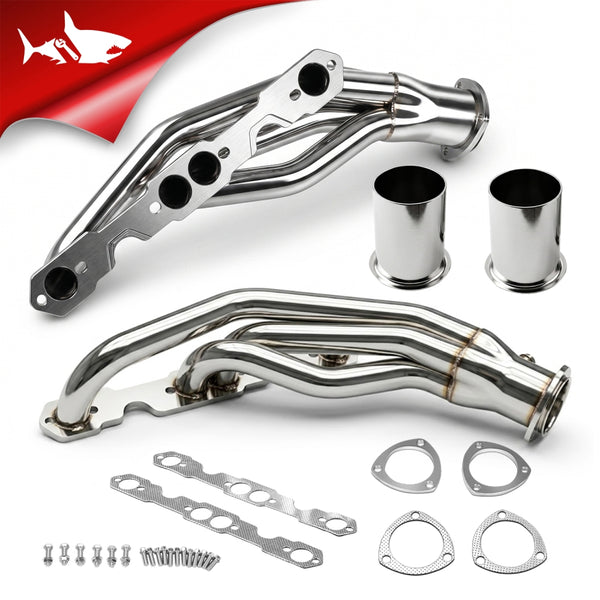
For selected 2WD Dodge Ram, Dakota, and Durango applications with a factory 5.9L Magnum V8, the Flashark 5.2L/5.9L Magnum exhaust header, SKU FLES08350 is one option to consider when replacing an aging cast manifold or planning a matched exhaust upgrade.
The listed construction uses stainless steel, 1.5-inch primary tubes, a 2-inch outlet, and a 3/8-inch outlet flange. Those measurements are useful when comparing the header with the available space and downstream exhaust connection. They are not a substitute for checking the complete vehicle configuration.

| Item | Listed detail | Why it matters |
|---|---|---|
| SKU | FLES08350 | Identifies the header configuration discussed here. |
| Material | Stainless steel | Provides corrosion resistance for exhaust service. |
| Primary-tube diameter | 1.5 inches | Affects exhaust velocity, packaging, and flow capacity. |
| Outlet diameter | 2 inches | Must be matched to the downstream exhaust connection. |
| Outlet flange thickness | 3/8 inch | Supports the outlet connection and sealing surface. |
| Application boundary | Selected 2WD Dodge Ram, Dakota, and Durango configurations with a factory 5.9L Magnum V8 | The vehicle, drivetrain, engine, and exhaust layout must match the selected configuration. |
Drivers comparing other layouts can also browse the Flashark exhaust header collection. Keep the comparison focused on the correct engine and chassis rather than choosing by tube length or appearance alone.
Installation Planning and Common Trouble Spots
Header installation on an older truck or SUV can be straightforward in concept and difficult in practice. Corroded fasteners, damaged threads, tight access, uneven sealing surfaces, and a downstream exhaust that has shifted over time can all complicate the job.
- Let the exhaust cool completely. Hot manifolds, pipes, and fasteners can cause serious burns.
- Support the vehicle correctly. Use stable lifting and support equipment when work must be performed underneath.
- Inspect the full exhaust path. Check the cylinder-head sealing surfaces, collector position, Y-pipe alignment, sensor wiring, and nearby components.
- Start every fastener before final tightening. This leaves enough movement to align the header and downstream exhaust without forcing either part sideways.
- Keep the exhaust free of tension. A system installed under load can shift during heat cycles, contact the chassis, or stress a flange.
- Use the specified tightening sequence and torque. Follow the instructions for the selected hardware and the appropriate vehicle service procedure.
- Check for leaks after startup. Listen around the cylinder-head flanges and collector connections, then inspect the system again after it has cooled.
Do not pull the collector into position with bolts or clamps. Align the complete exhaust first. Tightening a misaligned connection can distort a flange, damage a gasket, or leave the system close enough to the frame or body to make contact after it heats up.
What Headers Can and Cannot Change
A matched header can improve the exhaust path compared with a restrictive or deteriorated cast manifold. It may also change throttle response and exhaust tone. The size of any change depends on engine condition, the downstream exhaust, intake setup, calibration, fuel, and installation quality.
Headers alone do not guarantee a specific horsepower number, fuel-economy change, sound level, or warning-light result. A clogged catalytic converter, leaking gasket, damaged sensor wiring, or poorly aligned Y-pipe can offset the benefit of a new header.
The better question is not simply, “Which header makes the most power?” Ask which design fits the vehicle, connects correctly to the rest of the exhaust, supports the intended operating range, and can be installed without compromising service access or emissions equipment.
Frequently Asked Questions About 5.9 Magnum Headers
Q1: What are the best headers for a 5.9 Magnum?
A1: The best choice matches the exact vehicle, 2WD or 4WD layout, emissions equipment, downstream exhaust connection, and intended use. Tube size and collector position matter more than a broad marketing label.
Q2: Are long tube headers always better for a 5.9 Magnum?
A2: No. Longer primary tubes can change exhaust-pulse behavior, but they also change collector position and clearance requirements. A long-tube layout is only useful when it fits the chassis and connects correctly to the rest of the exhaust.
Q3: Does Flashark SKU FLES08350 fit a 4WD vehicle?
A3: SKU FLES08350 is intended for selected 2WD Dodge Ram, Dakota, and Durango configurations. It should not be treated as a 4WD application.
Q4: Can the Flashark header be used on a 5.2L Magnum?
A4: SKU FLES08350 is listed for selected factory 5.2L and 5.9L Magnum V8 configurations. Match the vehicle, engine, drivetrain, and selected configuration before ordering.
Q5: Do 5.9 Magnum headers require a tune?
A5: Tune requirements vary with the vehicle and installed hardware. The header, sensor arrangement, emissions equipment, intake, and downstream exhaust should be considered as one system.
Q6: Will headers cause a check-engine light?
A6: No single warning-light result applies to every installation. Sensor location, exhaust leaks, wiring condition, emissions equipment, and calibration can all affect system behavior.
Q7: How much horsepower will headers add to a 5.9 Magnum?
A7: There is no responsible fixed number without a controlled test of the exact vehicle and configuration. Engine condition, header design, the complete exhaust, intake, calibration, fuel, and installation quality all influence the result.
Q8: Will headers make a 5.9 Magnum louder?
A8: Headers can change exhaust tone, but the final sound depends heavily on the catalytic converters, Y-pipe, muffler, resonator, tailpipe, and any exhaust leaks. The same header can sound different on two exhaust combinations.
Q9: What should be checked before installing 5.9 Magnum headers?
A9: Check cylinder-head sealing surfaces, fastener condition, steering and chassis clearance, collector position, Y-pipe alignment, sensor wiring, nearby hoses, and the selected vehicle configuration.
Q10: What torque should be used on the header bolts?
A10: Use the tightening sequence and torque specified for the selected hardware and vehicle service procedure. Do not substitute a generic value when bolt material, thread condition, gasket design, or cylinder-head requirements differ.
Q11: Can headers be installed on a vehicle with emissions equipment?
A11: The header must match the vehicle’s sensor and emissions configuration. Review local emissions and road-use requirements before changing any emissions-related component.
Q12: Can headers fix an exhaust-manifold leak?
A12: Replacing a leaking manifold can address the failed component, but a successful repair still depends on clean sealing surfaces, sound threads, correct gaskets, proper alignment, and the specified tightening procedure.

Steven Chen
Automotive Performance Specialist | Engine & Exhaust Systems
Steven focuses on practical engine performance, exhaust fitment, and real-world upgrade paths for classic and modern enthusiast vehicles. He reviews small-block Ford, LS, truck, and street/strip applications with one goal in mind: helping builders choose parts that actually work together. His philosophy: "Good power starts with the right combination, not the biggest part."