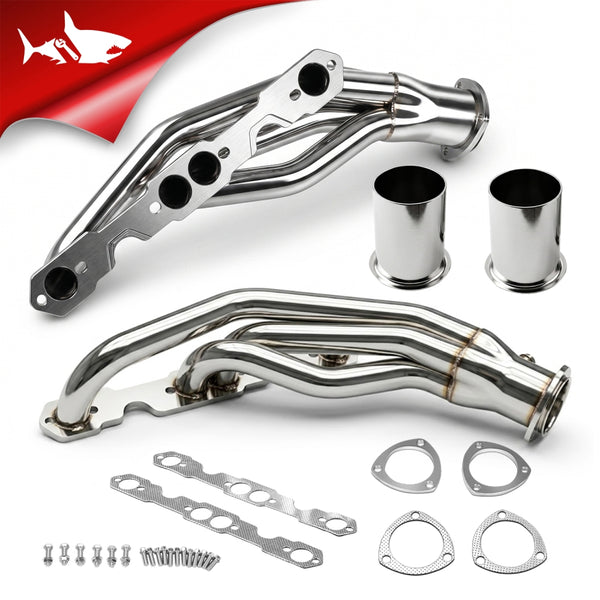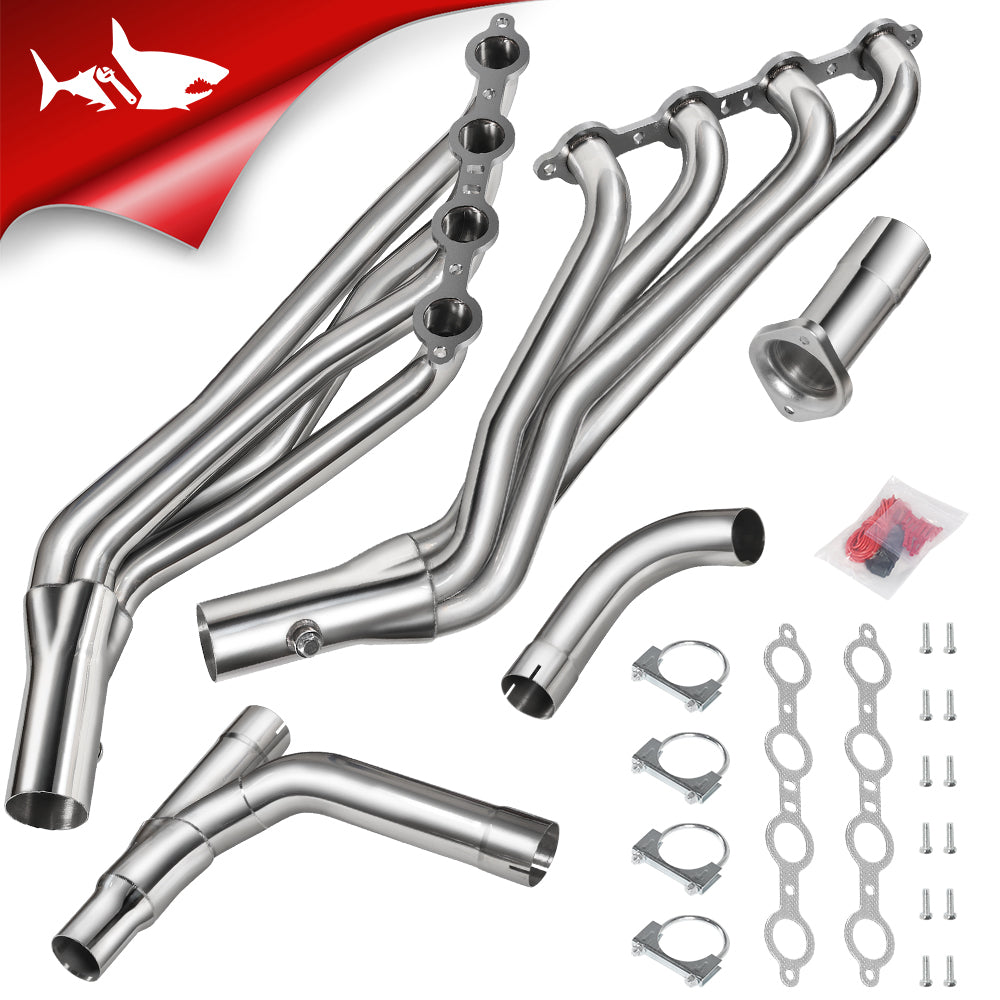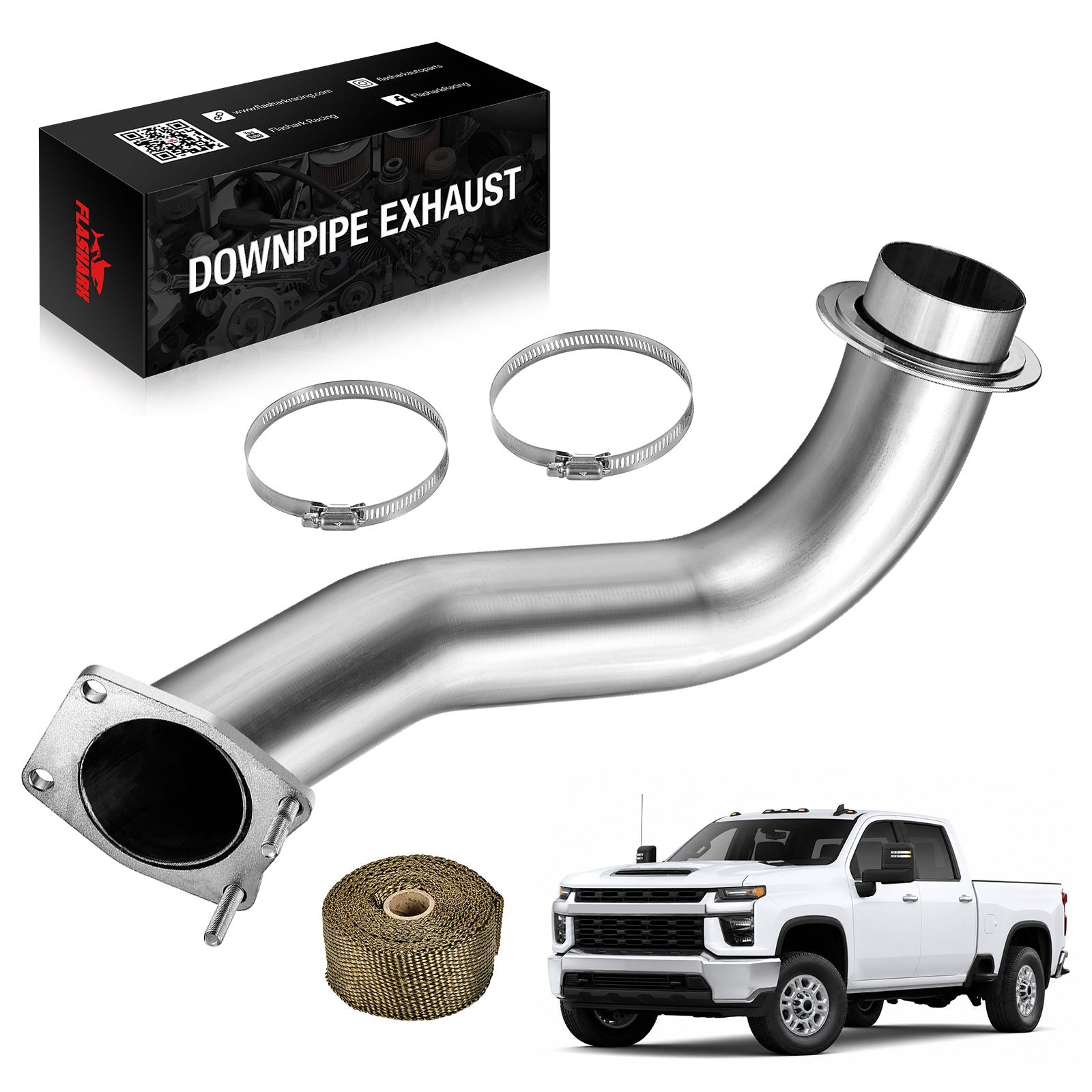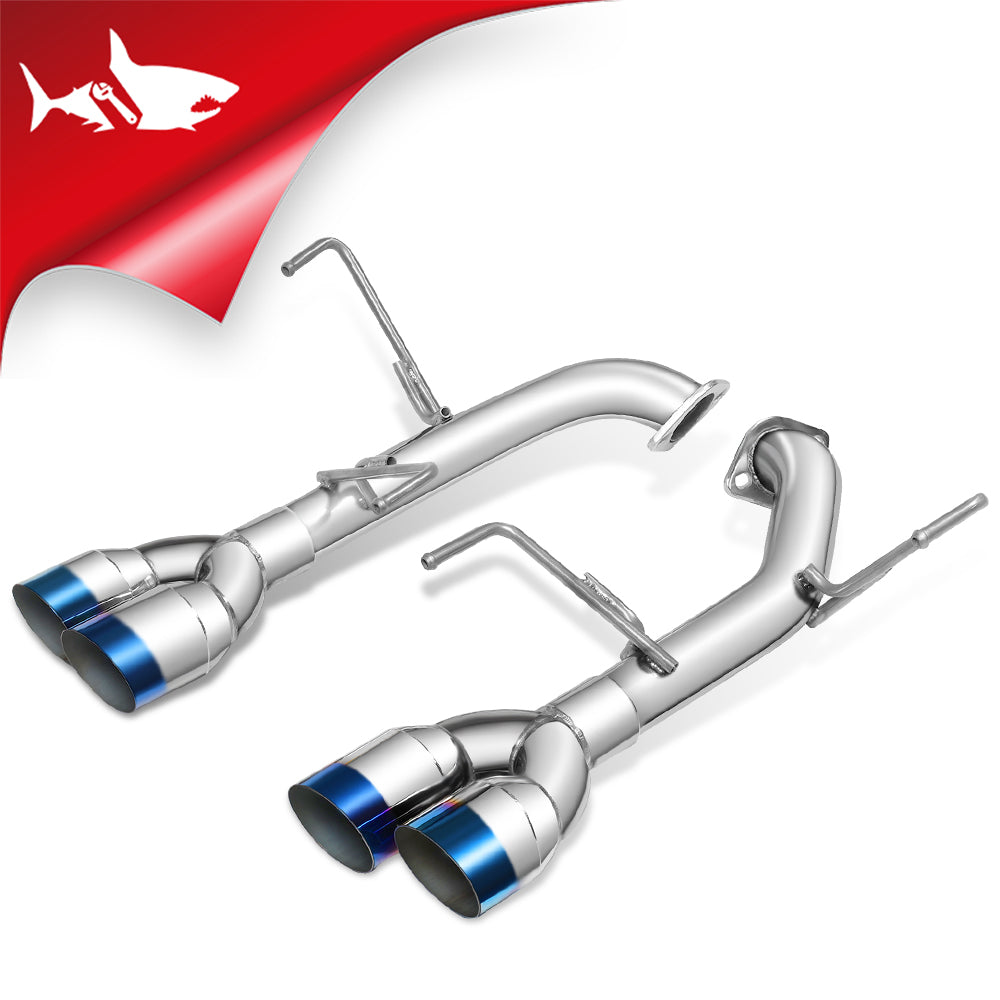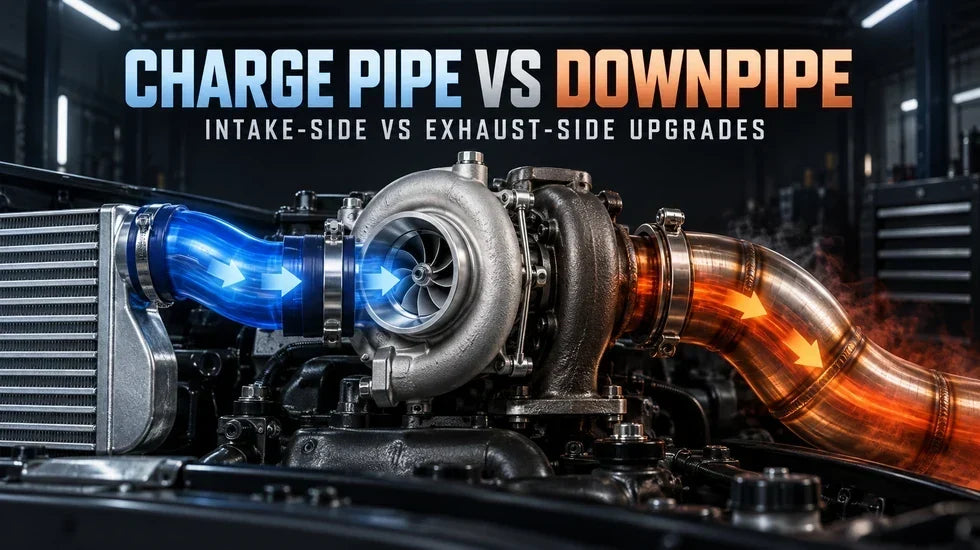
A charge pipe and a downpipe both connect to a turbocharged engine, but that is about where the similarity ends. One handles compressed intake air. The other handles hot exhaust leaving the turbo. Mix them up, and you can easily spend $300 fixing the wrong side of the engine.
Here is the garage-floor version: if the car hisses, loses boost, or blows a plastic connection apart, look at the charge-air side. If the goal is reducing restriction after the turbine, changing exhaust sound, or supporting a higher-flow turbo setup, you are probably looking at the downpipe side.
Technician’s note: Do not choose between these parts by asking which one is “better.” Ask what problem the car has. A sound charge pipe does not repair an exhaust restriction, and a larger downpipe does not seal a boost leak.
The Short Answer
- A charge pipe carries pressurized intake air between the intercooler and the throttle body on many turbocharged engines. Some manufacturers use the term more broadly for several pipes in the charge-air circuit.
- A downpipe carries exhaust gas away from the turbocharger’s turbine outlet and into the next section of the exhaust.
- An upgraded charge pipe is commonly chosen to improve durability, repair a boost leak, or add the correct ports and connections for a modified intake-side setup.
- An upgraded downpipe can reduce restriction after the turbine, but the result depends on the turbo, catalyst, exhaust, engine controls, fuel, and supporting hardware.
- The two parts can be installed on the same vehicle. They work on opposite sides of the turbo and do not replace each other.
- If the vehicle is a street car, retain emissions equipment and review the rules that apply where the vehicle is registered and driven.
Follow the Air: Where the Charge Pipe and Downpipe Sit
The easiest way to settle the charge pipe vs downpipe question is to stop staring at the names and follow the gas through the engine.

Fresh-air and charge-air path
Air Filter → Turbo Inlet → Compressor → Hot-Side Pipe → Intercooler → Charge Pipe → Throttle Body → Engine
Exhaust path
Engine → Exhaust Manifold → Turbine → Downpipe → Mid-Pipe/Cat-Back → Tailpipe
The turbo sits in the middle of both paths. Its compressor wheel packs fresh air into the engine. Its turbine wheel is driven by exhaust gas. That is why one turbo can have intake plumbing on one side and exhaust plumbing on the other without those gases mixing.
Why the Part Names Get Messy
“Charge” means the pressurized air charge headed toward the cylinders. “Downpipe” usually describes the exhaust section that leaves the turbo and travels downward toward the underbody exhaust.
Simple enough—until different manufacturers start naming the neighboring pipes differently. On one platform, “charge pipe” may mean only the cold-side tube from the intercooler to the throttle body. On another, the catalog may group the turbo outlet pipe, intercooler pipes, and throttle-body pipe under “charge piping.”
Downpipe terminology can be just as slippery. Some cars combine the downpipe, front pipe, and catalytic-converter section. Others split them into separate pieces. A naturally aspirated car may use a front pipe or test pipe but have no true turbo downpipe at all.
Match connection points, not just product names. Check the engine, turbo layout, drivetrain, emissions equipment, sensor positions, and downstream flange before ordering.
What Does a Charge Pipe Do?
After the compressor squeezes the incoming air, that air becomes hot and pressurized. It normally passes through an intercooler, sheds some heat, then travels through a charge pipe toward the throttle body or intake manifold.
Under boost, the pipe is not merely an empty tube. Its body, couplers, retaining clips, O-rings, welds, sensor ports, and throttle-body flange all have to contain pressure while the engine moves on its mounts.
Suppose a data log shows an 18 psi boost target but only 11 psi under load. That seven-psi gap does not prove the charge pipe is cracked, but it gives you a reason to inspect the entire pressurized path. The leak could be at a coupler, intercooler end tank, sensor seal, diverter valve connection, or throttle-body flange.
What an Upgraded Charge Pipe Actually Changes
On platforms fitted with a failure-prone plastic pipe, an aluminum replacement can remove a known weak point. That does not mean every metal tube adds meaningful horsepower. If the stock pipe holds pressure and is not restricting the required airflow, replacing it may produce little measurable change on a chassis dyno.
The real benefits are usually more practical:
- Better resistance to split seams and broken plastic flanges
- More secure coupler and clamp connections
- Compatibility with higher boost or a larger intercooler
- Ports for the required sensors or vehicle-specific accessories
- Easier service access when a multi-piece design is used
Listen to me on this one: a pipe that restores lost boost has repaired power; it has not magically created new power. If a leaking car makes 250 whp before the repair and returns to its previous 270 whp afterward, calling that a “20-whp bolt-on gain” would be misleading. The engine was down on power to begin with.
Charge Pipe vs Boost Pipe, Turbo Outlet Pipe, and Inlet Pipe
| Part | Typical Position | What Flows Through It |
|---|---|---|
| Turbo inlet pipe | Air filter to compressor inlet | Filtered air before compression |
| Turbo outlet or hot-side pipe | Compressor outlet to intercooler | Hot, compressed air |
| Charge pipe or cold-side pipe | Intercooler to throttle body | Cooled, compressed air |
| Downpipe | Turbine outlet to downstream exhaust | Hot exhaust gas |
What Does a Downpipe Do?
The downpipe begins where the exhaust leaves the turbine housing. This is a nasty working environment: high heat, rapid thermal cycling, vibration, and very little room around the turbo, firewall, steering components, subframe, transmission, or transfer case.
A factory downpipe is designed as part of a complete system. Noise control, catalyst operation, durability, cold-start emissions, sensor feedback, packaging, and production cost all matter. An aftermarket design may use a different diameter, bend profile, catalyst, or flange arrangement to change flow and sound.
If you want the deeper engineering explanation, start with what a turbo downpipe does and how it affects performance. If your real debate is whether to change the turbo outlet section or the rear exhaust, read this comparison of a downpipe versus a cat-back exhaust.
Catted vs Catless Downpipe
A catted downpipe contains a catalytic converter. A catless design removes the catalyst from that section. That changes much more than flow.
| Decision Point | Factory Downpipe | High-Flow Catted Downpipe | Catless Downpipe |
|---|---|---|---|
| Catalyst | Original emissions configuration | Aftermarket catalyst remains in the path | No catalyst in that section |
| Restriction | Calibrated around the factory system | Depends on catalyst size, cell structure, and pipe design | No catalyst restriction in that section |
| Sound | Most controlled | Usually louder and sharper than stock | Usually the loudest and least filtered |
| Exhaust odor | Lowest when operating correctly | Usually lower than catless | Raw exhaust odor is more noticeable |
| Dashboard warning risk | Lowest with a healthy factory system | Vehicle and catalyst dependent | Greater catalyst-monitoring concern |
| Street use | Original configuration | Depends on part-specific approval and jurisdiction | Not suitable where catalyst removal is prohibited |
For a closer look at the daily-driving tradeoffs, see this catted vs catless downpipe comparison. Do not assume that “catted” automatically means street legal or warning-free. The exact part, vehicle, engine family, model year, emissions configuration, and location all matter.
Road-use warning
Removing or disabling factory emissions equipment on a vehicle driven on public roads can violate federal and state law. “Track use” language does not make an on-road installation compliant. Review the requirements that apply to the vehicle and where it will be used.
Charge Pipe vs Downpipe: The Differences That Matter

| Comparison | Charge Pipe | Downpipe |
|---|---|---|
| System side | Pressurized intake side | Post-turbine exhaust side |
| Fluid carried | Compressed air | Hot exhaust gas |
| Common upgrade goal | Reliability, sealing, higher-boost compatibility | Lower post-turbine restriction and different sound |
| Typical fault clue | Hissing, underboost, loose coupler, split flange | Soot, ticking, exhaust odor, catalyst fault, restriction |
| Direct power effect | Often small when the stock pipe is sound and adequately sized | Can be meaningful when the factory section is a true restriction and the combination can use the flow |
| Calibration concern | Usually limited when sensors and dimensions remain compatible | Highly platform and hardware dependent |
| Emissions concern | Usually low if all factory systems and connections remain functional | Potentially major when a catalyst or monitored component is changed |
Common Charge Pipe Failure Signs
Cracked Plastic, Split Seams, and Popped Couplers
A charge pipe usually fails at a transition or connection before a straight section of tube gives up. Plastic throttle-body flanges can crack. Molded seams can split. A retaining clip can sit halfway in its groove. A silicone coupler can walk off because oil residue reduced friction under the clamp.
Common clues include:
- A hiss or rushing-air sound under load
- Boost that rises slowly or falls below target
- Sudden power loss during a hard pull or gear change
- An underboost fault or reduced-power mode
- Oil mist around a charge-air connection
- A pipe or coupler visibly displaced from its mating flange
A little oil inside the charge-air circuit does not automatically condemn the pipe. Crankcase ventilation can introduce oil vapor into the intake stream. Look for a fresh wet trail, a disturbed connection, a damaged seal, or leakage during a controlled pressure test.
How I Approach a Suspected Boost Leak
Shop-floor method
I do not order a charge pipe because someone heard a hiss in a phone video. I start with the stored faults, compare requested boost with actual boost, inspect every disturbed connection, and then pressure-test the charge-air circuit within a safe range for that vehicle.
The reason is simple. An intercooler end tank, loose sensor seal, torn coupler, diverter-valve connection, or cracked throttle-body flange can produce nearly the same complaint. Find the leak first. Parts come second.
A useful diagnostic sequence is:
- Read stored and pending faults before disconnecting anything.
- Inspect the pipe body, retaining clips, couplers, clamps, and sensor seals.
- Check the intercooler and turbo outlet connections.
- Compare boost target and actual boost during a controlled load test.
- Perform a vehicle-appropriate pressure or smoke test.
- Repair the confirmed leak, clear faults, and repeat the same test conditions.

Common Downpipe and Exhaust-Side Problems
Leaks at the Turbo Flange
A misaligned V-band can look installed while the flange lips are not fully seated. Start the clamp by hand, make sure both mating surfaces are concentric, and align the rest of the exhaust before final tightening. Forcing the pipe into place loads the turbo flange and often pulls the lower connection sideways.
Black soot around a joint is a useful clue. So is a sharp tick that speeds up with engine rpm. Exhaust odor in the cabin is not something to “drive off.” Shut the car down, let it cool, and inspect the system.
Catalyst Restriction and Sensor Problems
A damaged or restricted catalyst may contribute to poor high-rpm pull, excessive heat, or exhaust-related faults. Those symptoms are not unique to a downpipe. Ignition breakup, fuel-pressure loss, wastegate-control problems, and a collapsing exhaust component farther downstream can feel surprisingly similar from the driver’s seat.
After installation, inspect the oxygen-sensor wiring carefully. A sensor harness that touches a hot pipe can survive the first drive and fail after several heat cycles. Do not twist the wiring into a rope while threading in the sensor. Disconnect or position the harness so the sensor can turn without winding the cable.
A Real Downpipe Installation Lesson
First-person case: 2008 BMW 335i
I remember a 2008 BMW 335i that stayed on the lift about four hours longer than planned because one heat-cycled downpipe fastener refused to move. The shiny new pipes were not the problem. Access and corrosion were.
That job is a good reminder to inspect the hardware before tearing the car apart. Penetrating oil, proper swivel sockets, oxygen-sensor tools, replacement fasteners where required, and enough time for a cold exhaust can matter more than the advertised “bolt-on” label.
Many first-time installers tighten the turbo connection, fight the lower pipes into position, and then wonder why the exhaust touches the subframe. Leave the adjoining connections loose enough to align the complete assembly. Check clearance. Then tighten it in the specified sequence.
Planning to handle the job at home? Use this step-by-step downpipe replacement guide to plan access, tools, sensor handling, and post-installation checks.
Which Upgrade Makes More Power?
Charge Pipe Horsepower: Keep the Claim Honest
If the factory charge pipe is intact and large enough for the airflow the engine is using, a larger replacement may show little or no repeatable wheel-horsepower gain by itself. The useful change may be durability rather than peak output.
Now change the situation. A stock plastic flange opens under load, actual boost falls seven psi below target, and the ECU closes the throttle or reduces load. A properly sealed replacement can bring the car back to its healthy output. That is real improvement. It is still a repair-based recovery, not proof that every car gains the same number.
Downpipe Horsepower: The Combination Decides
A less restrictive downpipe can reduce pressure after the turbine. On a combination that is limited by the factory catalyst and pipe, that can support quicker response and more airflow at high load. But the pipe does not operate alone.
Engine displacement, turbo size, boost target, fuel, catalyst construction, intercooler performance, ignition health, ambient temperature, correction method, transmission behavior, and engine controls all affect the final number.
If someone advertises an 8–12 whp gain, ask what was held constant:
- Was the same car tested before and after?
- Was the same fuel used?
- Were boost target and calibration unchanged?
- Were the pulls performed at similar intake-air and coolant temperatures?
- Was the result the best run, an average, or a repeatable difference?
- Was the number measured at the wheels or estimated at the crankshaft?
A 12-whp difference between a heat-soaked baseline and a cool follow-up pull is not clean proof of a 12-whp part. Honest testing needs repeatable conditions.
For platform-specific examples and the variables behind the numbers, read how much horsepower a downpipe can add. If a catless setup is being considered for a permitted application, also understand how hardware, installation, and calibration affect engine risk.
Supporting Mods and Installation Dependencies
What to Check Before Buying a Charge Pipe
- Vehicle year, model, chassis, and engine code
- Rear-wheel drive or all-wheel drive
- Factory or aftermarket intercooler connection
- Throttle-body flange and retaining-clip design
- MAP or TMAP sensor location
- Diverter-valve or blow-off-valve arrangement
- Required O-rings, couplers, clamps, and plugs
- Clearance around the fan, belt drive, radiator hose, and engine cover
What to Check Before Buying a Downpipe
- Exact engine and turbocharger configuration
- Turbo outlet flange or V-band design
- Downstream exhaust connection and pipe diameter
- Oxygen-sensor count, position, and thread orientation
- Catalyst configuration and vehicle emissions equipment
- Clearance around heat shields, wiring, hoses, transmission, and transfer case
- Gaskets, clamps, fasteners, and support brackets required for the installation
- Vehicle-specific calibration guidance
- Road-use and emissions requirements
Flashark offers vehicle-specific options in its performance downpipe and test pipe collection. Treat the collection as a starting point, not a reason to skip fitment checks. Match the selected part to the engine, drivetrain, turbo flange, sensor layout, emissions configuration, and downstream connection.
Does a Charge Pipe or Downpipe Require a Tune?
A correctly matched charge pipe normally does not change catalyst monitoring or deliberately alter engine calibration. If it preserves the correct sensor locations and remains properly sealed, installation often centers on mechanical fit rather than software.
A downpipe deserves a more careful answer. Calibration needs vary by engine, turbo system, ECU strategy, catalyst configuration, and intended use. A car that starts and drives is not automatically operating as intended. Likewise, switching off a warning is not the same as repairing a leak, sensor fault, or catalyst problem.
If a warning appears after downpipe work, start with the mechanical basics:
- Read the complete fault description.
- Inspect both flange connections for leakage.
- Check oxygen-sensor placement and wiring.
- Confirm the selected hardware matches the vehicle.
- Review vehicle-specific operating and calibration requirements.
- Do not use software merely to conceal a malfunction or disable required monitoring.
Which Should You Upgrade First?
Here is the answer most people actually came for. The best order depends on whether you are fixing a failure, preventing a known platform weakness, or building for more airflow.
| Your Situation | Start Here | Why |
|---|---|---|
| Active boost leak | Diagnose the complete charge-air circuit | The engine cannot use airflow it cannot retain |
| Known weak plastic charge pipe | Vehicle-specific charge pipe | Reliability may matter before additional boost |
| Higher power on a healthy turbo car | Maintenance, logs, cooling, and platform limits | Parts should follow the measured bottleneck |
| Proven post-turbine restriction | Properly matched, permitted downpipe solution | The exhaust side is the limiting area |
| Sound is the only goal | Compare cat-back and resonator choices first | Sound can often be changed without replacing emissions equipment |
| Reliable daily driver | Maintenance and known failure points | A repeatable, leak-free car beats a peak number |
For older BMW N54 and N55 applications known for plastic charge-side failures, preventive replacement may make sense before raising boost. That logic should not be copied blindly to every newer BMW B-series engine, Volkswagen EA888, EcoBoost, Hyundai N, Subaru, or diesel platform. Materials, connection designs, pressure targets, and failure patterns differ.
The sensible order is short:
- Diagnose the car.
- Repair existing leaks and faults.
- Define the power and usage goal.
- Address cooling, fuel, ignition, and known platform weaknesses.
- Select hardware that matches the complete combination.
- Test the result under repeatable conditions.
After the work is complete, give the vehicle a proper heat cycle and shakedown instead of going straight into a full-throttle pull. This modified-car inspection and shakedown checklist covers the clamps, wiring, clearances, leaks, and hot-restart checks that catch small installation mistakes early.
Installation Checks That Prevent Expensive Mistakes
Charge Pipe Installation Checks
- Lightly lubricate only the seal as directed; do not leave oily coupler surfaces under a clamp.
- Seat O-rings without twisting or cutting them.
- Make sure retaining clips enter the full groove.
- Align couplers so engine movement does not pull them sideways.
- Keep the pipe away from the belt drive, fan, wiring, and hot exhaust parts.
- Reconnect every sensor and inspect its seal.
- Pressure-test the system before a high-load drive.
Downpipe Installation Checks
- Begin with a fully cooled turbocharger and exhaust.
- Support the vehicle at the specified lifting points with equipment rated for its weight.
- Inspect studs, nuts, clamps, and sensor threads before removal.
- Protect oxygen-sensor wiring from twisting, stretching, and heat.
- Start every fastener by hand.
- Align the complete exhaust before applying final torque.
- Check clearance around heat shields, hoses, wiring, the body, and drivetrain.
- Inspect for leaks after startup and again after a complete heat cycle.
Final Verdict
The simplest way to remember charge pipe vs downpipe is this: the charge pipe keeps compressed air inside the engine’s intake path; the downpipe gives spent exhaust a route away from the turbo.
If the car has an intake-side leak or a known weak plastic connection, start there. If the charge system is healthy and the build is genuinely restricted after the turbine, a correctly matched downpipe may support the next step. For a street-driven car, catalyst retention, emissions compliance, exhaust odor, cabin comfort, and dashboard monitoring deserve as much attention as the horsepower number.
Do not buy the biggest tube because it looks aggressive in a product photo. Buy the part that fits the engine, turbo, drivetrain, sensors, exhaust, intended use, and actual bottleneck. Good power still comes from the combination.
Frequently Asked Questions
Q1: What is the main difference between a charge pipe and a downpipe?
A1: A charge pipe carries compressed intake air toward the throttle body or intake manifold. A downpipe carries hot exhaust away from the turbocharger’s turbine outlet. They operate on opposite sides of the turbo and cannot replace one another.
Q2: Is a charge pipe part of the intake or exhaust system?
A2: It is part of the charge-air or pressurized intake system. On many engines, the pipe connects the intercooler to the throttle body. Naming varies, so some manufacturers use “charge piping” for more than one tube around the intercooler.
Q3: Does a downpipe come before or after the turbo?
A3: A true turbo downpipe comes after the turbine outlet. The exhaust manifold feeds gas into the turbine; the downpipe carries it away toward the catalytic converter, front pipe, mid-pipe, or cat-back, depending on the vehicle’s layout.
Q4: Can I install a charge pipe and downpipe at the same time?
A4: Yes. One works on the pressurized intake side and the other works on the exhaust side. Installing both only makes sense when each part serves a real purpose in the build and matches the vehicle’s hardware.
Q5: Which adds more horsepower, a charge pipe or a downpipe?
A5: A downpipe generally has greater power potential when the factory exhaust section is restrictive and the engine combination can use the extra flow. A charge pipe is more often a reliability upgrade unless the factory pipe is leaking or restricting the required airflow.
Q6: Does an upgraded charge pipe require a tune?
A6: A correctly matched pipe that retains the proper sensors and does not alter engine-control hardware often requires no calibration change. Requirements still depend on the vehicle, pipe design, sensor arrangement, and other installed parts.
Q7: Does an aftermarket downpipe require a tune?
A7: Requirements vary by vehicle, ECU strategy, catalyst configuration, and installed hardware. Follow vehicle-specific guidance. A calibration should not be used simply to hide an emissions fault or disable required monitoring.
Q8: Do I need a charge pipe for a Stage 1 tune?
A8: Not automatically. “Stage 1” is not a universal engineering specification. Check the engine platform, stock pipe material, known failure pattern, boost target, age, and condition of the charge-air system.
Q9: Do I need a charge pipe before going Stage 2?
A9: That depends on what the calibration provider calls Stage 2 and which hardware the vehicle uses. A leak-free charge system is essential, but that does not mean every platform needs an aftermarket pipe at the same power level.
Q10: What are the symptoms of a cracked charge pipe?
A10: Common clues include hissing under load, low actual boost, sudden power loss, reduced-power mode, an underboost fault, oil mist near a connection, or a visibly loose pipe. A pressure test helps separate a cracked pipe from an intercooler or coupler leak.
Q11: Can a bad charge pipe cause a check engine light?
A11: Yes. A significant charge-air leak can contribute to underboost and airflow-related faults. Read the actual codes and inspect the full pressurized system instead of assuming the pipe is the only possible cause.
Q12: Will a downpipe cause a check engine light?
A12: It can. Catalyst efficiency, oxygen-sensor position, exhaust leaks, catalyst construction, and ECU thresholds can all influence the result. Even a catted aftermarket pipe cannot be assumed to remain warning-free on every vehicle.
Q13: Is a catted downpipe legal in the United States?
A13: A catalyst does not automatically make an aftermarket downpipe legal. The exact part, vehicle, model year, engine, emissions configuration, approval status, and federal or state requirements all matter.
Q14: Is a catless downpipe legal for street use?
A14: Removing or disabling a factory catalytic converter on a public-road vehicle can violate federal anti-tampering law and state requirements. A catless pipe should not be treated as road legal merely because an area has limited inspection.
Q15: Will a downpipe make my car louder?
A15: Usually, but the amount and tone depend on the catalyst, engine, turbo, resonators, mufflers, pipe diameter, and complete exhaust. A catless pipe generally produces more volume, sharper turbo sound, and more raw exhaust odor than a catted pipe.
Q16: Why does my charge pipe keep popping off?
A16: Common causes include a partially seated retaining clip, oily coupler surfaces, incorrect clamp position, poor pipe alignment, a damaged flange, engine movement, or an abnormal boost-control problem. Repeatedly overtightening the clamp is not a proper diagnosis.
Q17: Should I upgrade the intercooler or charge pipe first?
A17: Repair a leaking charge pipe first. If the pipe is healthy but intake-air temperature repeatedly rises during sustained load, an intercooler may address the more relevant limitation. The two parts solve different problems.
Q18: Can a downpipe damage the turbo or engine?
A18: A correctly matched and installed downpipe should not be blamed for every later engine problem. Risk increases when the pipe fits poorly, leaks, damages sensor wiring, conflicts with the engine-control strategy, or is paired with an unsuitable overall setup.

Steven Chen
Automotive Performance Specialist | Engine & Exhaust Systems
Steven focuses on practical engine performance, exhaust fitment, and real-world upgrade paths for classic and modern enthusiast vehicles. He reviews small-block Ford, LS, truck, and street/strip applications with one goal in mind: helping builders choose parts that actually work together. His philosophy: "Good power starts with the right combination, not the biggest part."