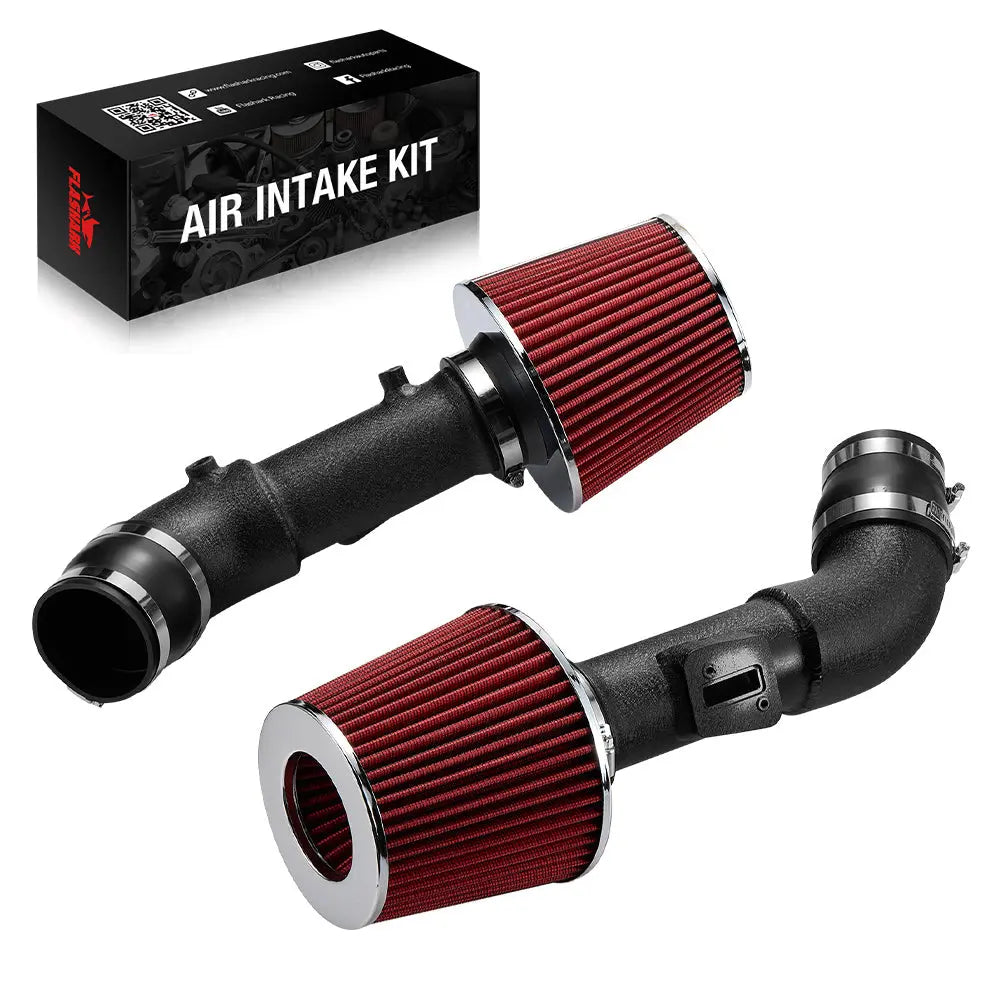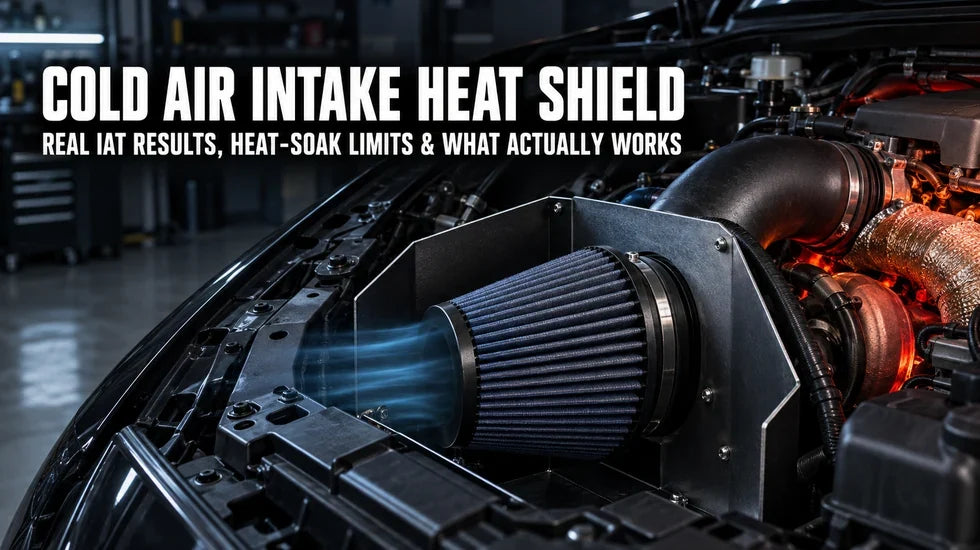
A cone filter can look fantastic when you pop the hood. It can sound even better when you lean into the throttle. But if that filter is sitting beside a hot exhaust manifold, turbocharger, radiator outlet, or aluminum cylinder head, we need to ask the uncomfortable question: is it really a cold-air setup, or did we build an expensive hot-air intake?
A cold air intake heat shield can help. Just do not expect a bent sheet of metal to perform magic. It does not refrigerate the air, erase underhood heat, or hold Intake Air Temperature at ambient while you idle through a drive-through in July.
What it can do is block direct radiant heat, reduce the amount of hot underhood air reaching the filter, and—when paired with a good hood seal and an outside-air inlet—help the intake recover faster once the car starts moving. The design matters. A lot.
How a Cold Air Intake Heat Shield Controls Heat
Listen, there are three different ways heat reaches an intake. People usually blame all of them on “heat soak,” but separating them makes the hardware much easier to understand.

Radiant Heat From the Exhaust, Turbo, and Engine
Stand near a hot exhaust manifold without touching it. You still feel heat on your hand. That is radiant heat. The exhaust manifold, turbocharger housing, cylinder head, radiator, and other hot surfaces radiate energy toward the filter, intake tube, MAF housing, and nearby brackets.
A shield works best here when it physically sits between the filter and the heat source. Think of it as shade for the filter. If the filter can “see” the glowing-hot side of a turbocharger through a large gap, the shield is not doing the whole job.
A reflective surface facing the hot component can reduce absorbed radiant energy. An air gap helps too. In many installations, a thin shield with a proper air gap performs more useful work than a heavy metal panel bolted directly to a hot bracket.
Convective Heat From Underhood Air
Convection is the bigger troublemaker at a stoplight. The cooling air that normally moves through the engine bay slows down, while the engine, exhaust, transmission cooler, air-conditioning condenser, and radiator keep dumping heat.
An exposed filter then inhales whatever air surrounds it. If that air is 30°F above ambient, the filter cannot negotiate with physics. It breathes the hot air.
A small panel can block some radiator wash or hot air rising from the exhaust, but warm air will still curl around its edges. A taller enclosure with fewer gaps does a better job of controlling where the filter gets its air.
Conductive Heat Through Metal Parts
Heat can also travel through the intake tube, MAF housing, shield, and mounting hardware. Aluminum transfers heat quickly. Steel is slower but heavier. Heat-resistant composite materials generally transfer less heat, although material choice is only one piece of the puzzle.
Do not confuse a cooler pipe surface with an identical drop in air temperature. Intake air moves through the tube quickly at higher engine loads. The tube may be too short—or the air may be moving too fast—for the air charge to absorb as much heat as the surface-temperature change suggests.
Technician’s note: Reflective foil, pipe wrap, and a filter shield solve different parts of the problem. Foil mainly reflects radiant energy. Insulation slows heat transfer through a surface. An enclosure controls which air the filter can inhale. Do not expect one piece of material to perform all three jobs.
Heat Shield vs. Sealed Airbox: What Changes?
This is where the hardware gets interesting. Two intakes can use the same filter and nearly identical tubing yet behave very differently in traffic because one controls the filter’s air supply and the other does not.

| Feature | Factory Airbox | Open Filter With Shield | Sealed Performance Airbox |
|---|---|---|---|
| Filter isolation | Usually fully enclosed | Partial; depends on coverage and gaps | High when the lid and connections seal correctly |
| Outside-air path | Usually ducted from the grille or fender | Varies from excellent to nearly nonexistent | Normally uses dedicated ducting |
| Idle heat-soak exposure | Usually moderate and predictable | Often highest when large gaps remain | Usually lower, but never eliminated |
| Induction sound | Quietest | Usually loudest | Stronger than stock but more contained |
| Airflow potential | Matched to the stock engine and noise target | Can be strong if the filter has enough surrounding space | Depends heavily on inlet and box area |
| Best use case | Stock daily driver and stable operation | Sound-focused build with good engine-bay airflow | Street performance and repeatable temperature control |
A Barrier Is Not Automatically an Airbox
A flat panel beside a cone filter is a barrier. A three-sided enclosure with rubber edging may become a semi-enclosed box when the hood closes. A true enclosed airbox surrounds the filter and feeds it through a defined inlet.
Those are not cosmetic differences. They change the filter’s air supply.
Here is a quick garage check: close the hood gently, reopen it, and inspect the weatherstrip. A light, continuous witness mark along the rubber suggests contact. No mark may mean a gap. A heavily crushed or torn strip can mean the enclosure is too tall.
Use removable chalk or painter’s tape if you need to inspect contact. Never place hard objects on top of the enclosure and slam the hood to “measure” clearance. That is how hoods get dented from underneath.
Why the Hood Seal Matters
When the upper edge seals against the hood, the hood becomes the top of the enclosure. That helps prevent rising engine-bay air from spilling over the shield and into the filter.
But there is a catch. The sealed pocket still needs a useful outside-air inlet. If the shield blocks the factory snorkel or leaves the filter trapped in a small pocket, the engine may pull air through every little gap it can find. At high airflow, that can mean restriction, hot-air leakage, or both.
The best enclosure does two jobs at once: it separates the filter from the engine bay and supplies enough outside air for the engine’s airflow demand.
When the Factory Airbox Is Hard to Beat
Modern factory systems are often better than enthusiasts give them credit for. Many already pull air from the grille, radiator support, or inner fender. Their plastic walls conduct less heat than bare aluminum, and the box is designed around water management, filtration, sensor stability, and low noise.
An aftermarket system can still improve airflow or sound, but removing a good factory box and replacing it with a naked cone beside the radiator is not automatically an upgrade.
If you want the broader mechanical picture before choosing a design, start with how a cold air intake works and what it changes.
Why IAT Climbs at Idle—and Falls While Driving
Ever watched IAT on a scan tool at a long red light? The number creeps up. Then you pull away, hit 25 or 30 mph, and it starts coming down. That behavior is normal.
What Happens at a Stoplight
- Vehicle speed falls, reducing fresh airflow through the front of the car.
- The exhaust, engine, turbocharger, radiator, and transmission continue releasing heat.
- Cooling-fan airflow can push warm radiator discharge toward the intake area.
- The filter, tube, sensor body, shield, and surrounding brackets begin absorbing heat.
- The engine inhales warmer air until vehicle movement restores stronger air exchange.
The shield can slow that temperature rise. It may reduce the peak. It cannot keep temperatures flat forever when a fully warmed engine is sitting still.
Hot Restart Can Look Worse Than Idle
Pull into a parking lot, shut the engine off for ten minutes, then restart it. IAT may jump higher than it was while driving. That is soak-back.
Coolant circulation and fan operation may stop or change after shutdown, yet the exhaust and engine remain extremely hot. Heat migrates into the intake tube, sensor housing, airbox, and trapped underhood air. The first IAT reading after restart can therefore look ugly.
Do not panic over one hot-restart number. Watch what happens once airflow returns. A healthy layout should begin shedding that stored heat as the car moves, although the recovery rate varies by platform and weather.
The IAT Sensor Is Part of the Story
The sensor does not float in space. It sits in a housing that can absorb heat. At low airflow, the sensor body and surrounding material can influence the reading. Once airflow increases, the moving air cools the sensor and housing, so the number can drop quickly.
Turbocharged cars add another wrinkle. One temperature reading may be near the MAF or compressor inlet, while another may be in the charge pipe or intake manifold. Air heated by turbo compression and then cooled by the intercooler is not directly comparable to pre-compressor air.
From the Garage: The Test I Use When an Owner Says “It Feels Slower After Traffic”
I do not start by blaming the filter, and I do not start by selling another part. First, I bring the engine to normal operating temperature. Then I log ambient temperature, IAT, coolant temperature, vehicle speed, RPM, and throttle position.
Next comes the part many people skip: a controlled five-minute idle. Hood closed. Air conditioning left in one consistent setting. No blipping the throttle for the sound.
After five minutes, I pull away normally and record IAT at 30, 60, and 120 seconds. If the temperature climbs rapidly at idle but drops quickly once the vehicle reaches road speed, I know airflow around the filter is the main issue. If it stays elevated, I inspect the outside-air duct, shield gaps, radiator discharge path, tube routing, and sensor location.
I have seen beginners wrap every inch of aluminum tube, then discover the real problem was a two-inch gap beside the radiator. Hot fan discharge was blowing straight into the filter pocket. The shiny wrap looked serious. The gap did the damage.
My rule is simple: fix the air path before adding more insulation.
If an intake installation is followed by unstable idle, hesitation, or unusual fuel trims—not just elevated temperature—work through this cold-air-intake rough-idle checklist. A loose coupler, disconnected breather hose, or incorrect MAF installation needs a different repair than heat soak.
How to Test an Air Intake Heat Shield Properly
One screenshot proves almost nothing. Maybe it was taken after a cold start. Maybe the car was already cruising at 70 mph. Maybe the ambient reading was delayed. You need repeatable conditions.

Record the Right Channels
Use a scan tool or logging device that can record as many of these channels as the vehicle supports:
- Ambient Air Temperature
- Intake Air Temperature
- Secondary or manifold intake temperature on applicable engines
- Engine Coolant Temperature
- Vehicle speed
- Engine speed
- Throttle position or calculated engine load
- Ignition timing and knock correction when available
Use the same temperature unit throughout the test. Also note where the vehicle places each sensor. A probe before the turbocharger answers a different question from a probe in the intake manifold.
Use Delta-T Instead of IAT Alone
Calculate:
Delta-T = Intake Air Temperature − Ambient Air Temperature
If ambient is 90°F and IAT is 108°F, Delta-T is 18°F. If the next test happens on a 70°F morning and IAT is 88°F, Delta-T is still 18°F. That makes the two runs easier to compare than the raw temperatures alone.
Delta-T does not eliminate every variable, but it is much more useful than bragging about the lowest number seen during a highway pull.
Run Three Separate Tests
- Steady cruise: Hold a safe, repeatable road speed long enough for temperatures to stabilize.
- Idle soak: Park safely and idle for a fixed five- or ten-minute interval.
- Road recovery: Pull away normally and measure how fast Delta-T falls during the next 30, 60, and 120 seconds.
Repeat each configuration at least three times when practical. Compare the factory box, the aftermarket intake without its shield if the hardware allows safe testing, and the completed shielded setup.
Safety warning: Let a passenger handle the logger, or configure it to record automatically. Do not operate a phone or scan tool while driving. Road safety matters more than an intake-temperature graph.
Control the Variables
For useful back-to-back results, keep these conditions as consistent as possible:
- Starting coolant temperature
- Idle duration
- Air-conditioning setting
- Road route and vehicle speed
- Traffic conditions
- Fuel and engine calibration
- Hood position
- Time parked before the test
- Weather and sun exposure
- Filter condition
A dirty filter changes restriction and airflow. Inspect it before testing. If it needs service, follow the correct method for its media; this cold air intake filter cleaning guide explains the basic process for dry and reusable filters.
Does Lower IAT Automatically Mean More Horsepower?
Cooler air is denser. That part is basic physics. But lower IAT does not create a guaranteed wheel-horsepower number by itself.
The result depends on how the engine management system responds, whether the factory intake was restrictive, the MAF housing geometry, throttle position, engine load, fuel quality, ignition timing, knock control, exhaust flow, and calibration.
Naturally Aspirated Engines
On a naturally aspirated engine, cooler inlet air can support a denser cylinder charge. The practical result is usually most relevant at high load, where the engine is demanding substantial airflow.
At light throttle, the throttle plate is deliberately restricting airflow. A 10°F change on a cruise log does not automatically translate into a noticeable acceleration difference.
Turbocharged and Supercharged Engines
Forced-induction engines compress the inlet air, and compression raises temperature. The intercooler then removes part of that heat. That means compressor-inlet temperature still matters, but it is only one part of the full charge-air path.
When testing a turbocharged vehicle, separate:
- Temperature entering the compressor
- Temperature leaving the compressor
- Temperature after the intercooler
- Temperature in the intake manifold
Calling all four values “IAT” creates bad comparisons fast.
Why Fixed Horsepower Claims Fall Apart
Suppose two cars both reduce cruising IAT by 15°F. One ECU maintains the same timing in both tests. The other had been pulling timing because of temperature and knock sensitivity. Their power response may be very different.
Dyno numbers also require context: same vehicle, same dyno, same correction method, similar coolant and oil temperatures, controlled tire pressure, comparable gear, and enough cooldown control to prevent the test order from deciding the result.
A heat shield should be viewed as thermal management hardware, not a guaranteed horsepower coupon.
How to Choose a Universal Heat Shield for Cold Air Intake Systems
A universal shield can work well when the engine bay gives you room to position and seal it. It can also become an aluminum decoration that rattles against the fender. Measure first.
Measure the Filter and Available Space
- Measure filter base diameter, widest diameter, and overall length.
- Measure intake-tube outside diameter where it passes through the shield.
- Check clearance to the hood, battery, radiator hose, wiring, and fuse box.
- Identify the exhaust, turbocharger, and radiator discharge sides of the filter.
- Locate the factory snorkel or any usable outside-air duct.
- Allow clearance for engine movement under load.
Do not pack a cone filter tightly against the shield. The filter needs open area around its pleats. Crowding half the filter against a panel can trade one restriction for another.
Look for Coverage, Sealing, and an Outside-Air Path
Judge a shield in this order:
- Does it block the filter’s direct view of the hottest components?
- Can the upper edge seal against the hood or a separate lid?
- Can the original outside-air duct remain functional?
- Can the tube opening be sealed without rubbing the tube?
- Are the mounting points rigid and clear of moving parts?
- Can the filter still be removed for service?
For vehicle-specific options, browse Flashark cold air intake kits by vehicle fitment. Match the intake to the vehicle year, engine, sensor layout, and selected configuration before ordering.
Choose Materials for the Actual Heat Problem
Powder-coated aluminum is lightweight and easy to shape. Stainless steel is strong but heavier. Composite panels transfer less heat but need suitable temperature resistance. Reflective foil can help when it faces a strong radiant heat source.
Material alone does not rescue a poor layout. A beautifully polished panel with a three-inch opening beside the radiator can perform worse than a plain enclosure with good sealing and a clear outside-air inlet.
Installation Mistakes That Create a Heat Trap
Leaving a Large Gap Around the Tube
The tube needs room for engine movement, but the opening should not become a tunnel for radiator discharge. Use suitable edge trim or a flexible seal that does not cut, melt, or rub through the intake tube.
Blocking the Factory Snorkel
This one drives me crazy because it is so easy to miss. A universal panel gets installed, looks tidy, and completely covers the original cold-air opening. The filter is now boxed away from both hot air and cold air.
Before tightening the brackets, trace the entire outside-air path from the grille or fender opening to the filter pocket.
Mounting the Shield to a Hot Component
A metal bracket attached directly to a major heat source can conduct heat into the panel. Use factory mounting points where possible, preserve safe gaps, and keep every bracket clear of the exhaust, belts, pulleys, cooling fan, and wiring.
Crushing the Hood Seal
More pressure is not always better. An over-tall enclosure can distort the hood, tear the weatherstrip, or transmit vibration. Close the hood slowly during the first fit check and inspect the seal contact afterward.
Trusting an Infrared Thermometer Alone
An infrared thermometer measures surface temperature, not the temperature of the moving air entering the filter. Shiny and matte surfaces can also produce different readings because their emissivity differs.
Use surface readings to locate hot components. Use an air probe or ECU temperature channel to evaluate the intake charge.
When a Heat Shield Is Worth It
A shield is more likely to earn its place when:
- The filter sits near an exhaust manifold or turbocharger.
- Radiator-fan discharge blows toward the filter.
- The vehicle spends substantial time in traffic, staging lanes, or low-speed operation.
- The enclosure can seal against the hood without crushing the weatherstrip.
- A factory or custom outside-air duct can feed the isolated area.
- Testing shows a large idle Delta-T or slow road-speed recovery.
A sealed airbox may be the smarter choice when the engine bay is tightly packaged, summer traffic is part of daily life, or stable temperature control matters more than maximum induction volume.
Keep the factory box when it already supplies cool outside air, supports the engine’s airflow demand, and no repeatable test shows it to be a restriction. Sometimes the factory engineers got the air path right. There is no shame in keeping the part that works.
Cold Air Intake Heat Shield FAQ
Q1: Does a cold air intake heat shield actually work?
A1: It can reduce direct radiant heating and limit hot-air exposure around the filter. Results depend on shield coverage, edge gaps, hood sealing, outside-air ducting, engine-bay layout, and vehicle speed.
Q2: Do I need a heat shield for an aftermarket intake?
A2: A shield becomes more valuable when an open filter sits inside the engine bay near the radiator, exhaust, cylinder head, or turbocharger. A filter located in a sealed box or isolated fender cavity may need a different form of thermal protection.
Q3: Is a sealed airbox better than an open filter with a shield?
A3: A sealed box normally controls the filter’s air supply more consistently, especially at idle and low speed. However, the box must have enough inlet area and a clear outside-air path to avoid unnecessary restriction.
Q4: Why does IAT rise while the car is idling?
A4: Fresh airflow through the engine bay falls while the engine, exhaust, radiator, and turbocharger continue releasing heat. The filter, tube, housing, and sensor absorb that heat until vehicle movement restores air exchange.
Q5: Why does intake temperature fall after I start driving?
A5: Vehicle movement pushes outside air into the intake area and removes hot air from the engine bay. Increased airflow through the tube also cools the sensor and nearby hardware.
Q6: How far above ambient should IAT be?
A6: There is no universal target. Sensor location, engine type, traffic, weather, vehicle speed, and intake layout all matter. Compare Delta-T under the same operating conditions instead of relying on one fixed number.
Q7: Does lower IAT guarantee more horsepower?
A7: No. Cooler air is denser, but the power response also depends on airflow restriction, engine load, MAF scaling, fuel quality, ignition timing, knock control, calibration, and the rest of the engine combination.
Q8: Can a poorly designed shield make IAT worse?
A8: Yes. A panel that blocks the outside-air inlet or traps warm air around the filter can slow temperature recovery. The shield must isolate heat without starving the filter of fresh air.
Q9: Does hood weatherstripping improve heat-shield performance?
A9: It can. Continuous contact with the hood helps stop hot air from spilling over the top of a semi-enclosed shield. The seal should touch evenly without crushing, tearing, or lifting the hood.
Q10: What is the best material for an intake shield?
A10: There is no single best material for every engine bay. Aluminum is light and easy to shape, stainless steel is durable, composites transfer less heat, and reflective surfaces help with radiant energy. Placement, air gaps, sealing, and ducting usually matter more than material alone.
Q11: Can I use a universal intake heat shield?
A11: Yes, if it fits the filter, clears the hood and moving parts, blocks the main heat sources, retains an outside-air path, and mounts securely. Measure the available space before buying or cutting.
Q12: Should I wrap the intake tube too?
A12: Tube insulation can slow heat transfer near strong heat sources, but it does not replace proper filter isolation. Fix hot-air ingestion and shield placement first, then evaluate whether tube insulation changes the logged temperature.
Q13: How should I test an intake shield?
A13: Record ambient temperature, IAT, coolant temperature, speed, RPM, and engine load. Run repeatable steady-cruise, fixed-duration idle, and road-recovery tests. Compare Delta-T and repeat the runs under similar conditions.
Q14: Is the factory airbox sometimes better?
A14: Yes. Many factory boxes already use a sealed enclosure and a grille or fender air inlet. An exposed aftermarket cone may sound louder without improving temperature control or usable airflow.
Q15: Does a turbocharged car benefit from cooler inlet air?
A15: Cooler compressor-inlet air can help, but the turbocharger heats the air during compression and the intercooler removes part of that heat. Review pre-compressor and post-intercooler temperatures separately.
Q16: Can a heat shield prevent all heat soak?
A16: No. It can reduce or delay heat transfer, but a fully warmed engine will still heat nearby air and hardware during extended idle or a hot restart. The useful question is how high the temperature rises and how quickly it recovers.

Steven Chen
Automotive Performance Specialist | Engine & Exhaust Systems
Steven focuses on practical engine performance, exhaust fitment, and real-world upgrade paths for classic and modern enthusiast vehicles. He reviews small-block Ford, LS, truck, and street/strip applications with one goal in mind: helping builders choose parts that actually work together. His philosophy: "Good power starts with the right combination, not the biggest part."