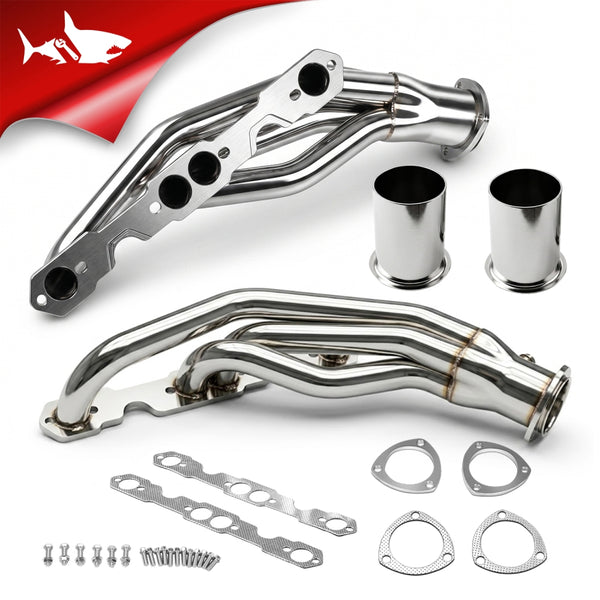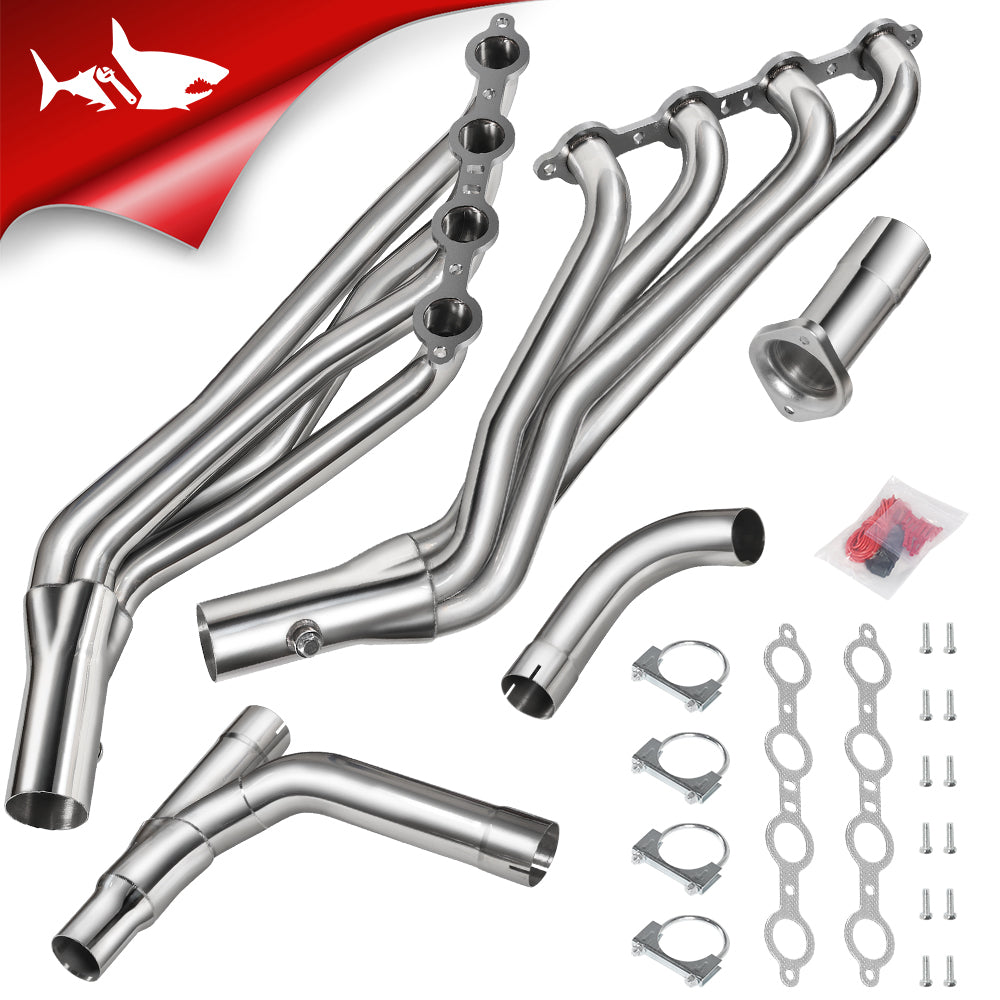
You have a decent set of 302 headers sitting in the garage. A 351 Windsor is going into the car. The bolt pattern looks familiar, the engines belong to the same Ford family, and somebody on a forum swears the headers will fit. So, can you reuse them?
Sometimes—but bolting a header to the cylinder head is only the first test. The taller 351W block changes where the cylinder heads sit inside the vehicle. That moves both headers upward and outward, which can put the tubes into the steering shaft, shock tower, frame, clutch linkage, starter, or floor. The collectors may also miss the exhaust system that previously lined up behind the 302.
That is why two builders can try what appears to be the same swap and report completely different results. One is working on a roomy truck with shorty headers and an automatic. The other is fighting long tubes, a Toploader, mechanical clutch linkage, and shock towers in an early Mustang. Same engine family. Very different Saturday afternoon.
Quick Answer
- At the cylinder head: Many conventional 302 headers can bolt to conventional 351W-style exhaust flanges when the ports, bolt holes, spark-plug angle, and flange dimensions match.
- Inside the vehicle: Fit depends on the chassis, engine mounts, steering system, transmission, bellhousing, clutch linkage, starter, and collector location.
- With shorty headers: Reuse is more plausible because the tubes stay compact, but the outlet may still miss the existing H-pipe or Y-pipe.
- With long-tube headers: The risk of floor, steering, crossmember, and collector interference is substantially higher.
- Best buying rule: Match the header to the complete vehicle combination—not merely to “small-block Ford.”

Why “Bolts On” Does Not Mean “Fits the Vehicle”
Here is the distinction that clears up most of the confusion: engine-side compatibility and chassis-side compatibility are separate questions.
Engine-side compatibility asks whether the header flange meets the cylinder head correctly. Do the bolt holes line up? Does the flange cover the exhaust port? Can the gasket seal? Can you remove the spark plugs without pulling the header back off?
Chassis-side compatibility starts after that. Now the tubes must pass through a crowded engine bay without touching anything that moves, melts, or carries electricity. Then the collectors must land somewhere useful underneath the car.
Garage rule: A header can fit the engine and still be completely wrong for the vehicle. If someone says, “It fits,” ask what car, what mounts, what transmission, what steering, and which exact header.
Why Another Builder’s Success Is Not Proof
A header that clears a 351W in an F-Series truck may be nowhere close in a 1965 Mustang. Even two Mustangs can differ. Manual versus automatic steering, factory versus aftermarket K-member, mechanical versus cable clutch, and stock versus swap mounts can move the problem from one side of the car to the other.
The header design matters just as much. Shorty, mid-length, Tri-Y, and long-tube systems take different paths through the engine bay. For a basic look at those layouts, this guide to how automotive headers work explains primary tubes, collectors, and packaging without treating every design as interchangeable.
Check the Exhaust Ports and Header Bolt Pattern First
Many traditional 302 and 351W cylinder heads use a similar exhaust-flange arrangement. That is the source of the familiar “yes, they bolt on” answer. It is not entirely wrong. It is simply incomplete.
Compare the Opening, Not Just the Bolt Holes
Remove the gasket and place it against both the cylinder-head face and the header flange. Look through the opening. A bolt pattern can line up while the header flange partly covers the port or leaves too little sealing surface around one edge.
Check these points before reaching for a wrench:
- Exhaust-port height and width
- Header flange opening and bolt spacing
- Gasket coverage around the entire port
- Weld intrusion inside the flange opening
- Fastener access with the tubes in position
- Spark-plug socket and plug-boot clearance
A small mismatch does not automatically mean the combination is unusable, but a flange hanging into the exhaust stream creates a hard step. A port that sits outside the gasket’s sealing area is worse—it invites a leak that will sound like a sharp tick every time that cylinder fires.

Aftermarket Heads Can Change the Answer
Do not shop by block displacement alone when the engine has aftermarket cylinder heads. Some performance heads use raised exhaust ports, enlarged openings, additional bolt holes, or altered spark-plug locations. GT40P-style plug angles are a famous example: the flange may attach, yet a primary tube can sit directly in the path of the plug boot.
The cylinder-head part number controls this check. “Fits a Windsor” is not detailed enough.
Do Not Confuse the 351W with the 351C or 351M
The W matters. A 351 Windsor is not a 351 Cleveland, and neither should be mixed up with the taller 351M/400 family. Similar displacement does not create shared header fitment. If you are identifying an unknown engine, settle that question before ordering exhaust parts.
How 351W Deck Height Changes Header Position
This is the part most quick answers skip.
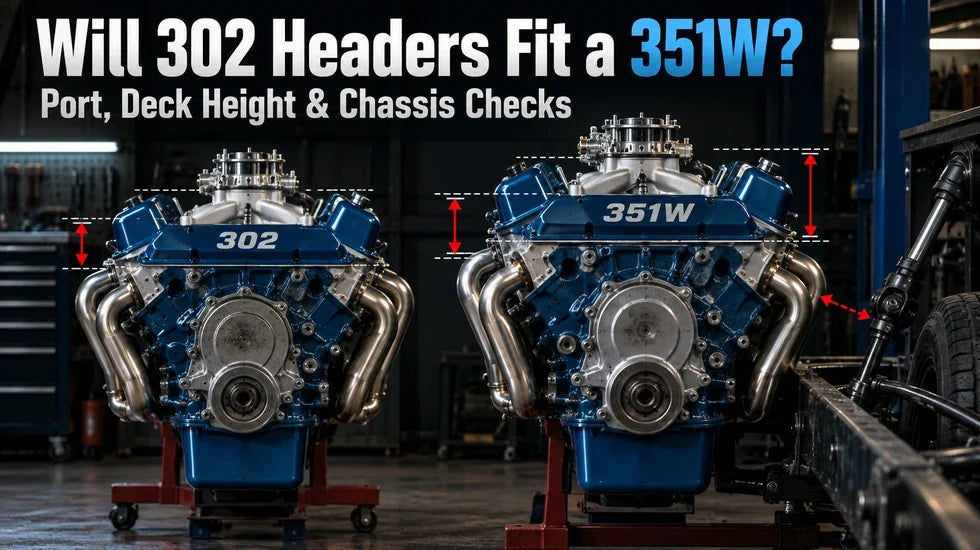
A production 302 Windsor has a deck height of roughly 8.206 inches. Early 1969–1970 351W blocks are commonly listed around 9.480 inches, while later production 351W blocks are approximately 9.503 inches. That puts the conventional 351W deck about 1.27 to 1.30 inches higher than the 302 deck.
| Engine configuration | Typical deck height | Header-position effect | Main fitment concern |
|---|---|---|---|
| Production 302 Windsor | About 8.206 in. | Lower and narrower head position | Original chassis packaging |
| 1969–1970 351W | About 9.480 in. | Heads move upward and outward | Steering, shock tower, and floor clearance |
| 1971–1996 351W | About 9.503 in. | Heads move upward and outward | Steering, transmission, and collector location |
| Modified or aftermarket block | Varies by block and machining | Must be measured as assembled | Assuming production dimensions |

Because a Ford small-block V8 has angled cylinder banks, that extra deck height does not move each head straight up. It moves each head up and away from the engine centerline. Using the nominal production dimensions as a geometric illustration, the change is roughly nine-tenths of an inch upward and nine-tenths outward per bank.
That is not a universal installation measurement. Deck machining, head dimensions, mounts, and chassis position can alter the assembled result. It does show why the header can suddenly get intimate with a steering shaft or floorpan even though the flange still bolts on.
What Happens at the Collector
A small movement at the cylinder head can become a much bigger headache at the end of a long primary tube. The collector may sit:
- Closer to the floor or transmission tunnel
- Farther outward toward a frame rail
- At a different angle from the old H-pipe or Y-pipe
- Too low for acceptable ground clearance
- Too close to the transmission crossmember
Do not force the downstream exhaust into alignment with a jack, ratchet strap, or heroic amount of profanity. A system assembled under tension often develops leaks, rattles, cracked welds, or failed hangers after repeated heat cycles.
Check Chassis and Steering Clearance
The driver-side header usually gets the most attention because the steering hardware lives there. Depending on the vehicle, that can mean a steering box, column linkage, rag joint, solid shaft, telescoping shaft, or rack-and-pinion U-joints.
Inspect the Steering Through Its Full Travel
Checking clearance with the front wheels pointed straight ahead is not enough. Turn the steering from lock to lock while watching every shaft joint and the closest primary tube. Leave room for engine movement. A tired rubber mount can let the engine roll much farther than it does while idling in the driveway.

Technician’s Note
Static clearance is not operating clearance. The engine moves on its mounts when torque loads the drivetrain, the exhaust grows as it heats, and the chassis flexes over real roads. A tube that barely clears in the shop can knock against the steering shaft on the first hard pull.
A First-Person Fitment Lesson
From the garage:
I remember working on a classic Mustang fitted with a 351W where the owner had reused headers from the previous small-block setup. With the car sitting still, the driver-side tube appeared to clear the steering shaft. It was close, but you could slide a finger between them. The owner assumed the job was done.
Under load, the engine rolled on its mounts and the tube tapped the shaft. You could feel it through the steering wheel. We initially looked for a loose column joint because the noise only appeared when the throttle opened. Once the engine was loaded while the car remained safely restrained, the witness mark on the primary tube told the story. That job taught the owner an expensive little lesson: daylight between two parts does not automatically equal usable clearance.
Shock Towers, Frame Rails, and Crossmembers
Early Mustang, Falcon, and Cougar engine bays can be unforgiving around the shock towers. Fox-body cars introduce K-member and steering-shaft variables. Trucks and Broncos may offer more room above, then create trouble around frame rails, crossmembers, front driveline hardware, or the Y-pipe.
Engine mounts are part of this geometry. Stock replacement mounts, convertible mounts, drop mounts, swap mounts, solid mounts, and aftermarket K-members do not necessarily hold the engine in the same place. Check mount condition and part selection before blaming the header.
Match the Transmission and Clutch Linkage
A product labeled for “manual transmission” still needs more detail. Which transmission? Which bellhousing? Mechanical linkage, cable, or hydraulic release?
Mechanical Clutch and Z-Bar Clearance
Classic Ford mechanical linkage can put the Z-bar, clutch rod, return spring, and clutch fork close to the driver-side tubes. A header designed around an automatic may attach perfectly to the head and leave no usable path for the linkage.

Cable and Hydraulic Clutch Systems
A cable needs a smooth route and protection from radiant heat. A hydraulic line needs distance from the tubes, secure supports, and suitable heat protection. Neither should rest against a primary tube. “It only touches a little” becomes a tow-truck sentence once the header is hot.
Bellhousing and Starter Access
Check the actual bellhousing, not merely the transmission name. Aftermarket safety bellhousings can have different external dimensions. Also confirm that the starter can be installed and removed after the header is in place. A header that traps the starter turns a future ten-minute electrical repair into half a day of exhaust work.
Will the Existing H-Pipe or Y-Pipe Still Fit?
Maybe. Do not budget the job around that assumption.
The 351W’s higher and wider cylinder-head position can shift the outlets of reused 302 headers. Shorty outlets may sit close enough to the old location for an application-specific connection, or they may require cutting and realignment. Long-tube collectors can end up at a different angle, height, or fore-aft position altogether.

Before final tightening, loosely assemble the headers and downstream exhaust as one system. Look for:
- Collector diameter and flange-style compatibility
- Left-to-right collector spacing
- Connection angle and pipe length
- Crossmember and transmission-pan clearance
- Ground clearance at the lowest point
- Oxygen-sensor location and wire reach on equipped vehicles
- Clearance around brake lines, fuel lines, and electrical cables
If collector planning is new territory, the explanation of why long-tube headers can require a different Y-pipe shows the same underlying problem on another platform: moving the collector changes everything behind it.
302 Shorty Headers vs. Long Tubes on a 351W Swap
Shorty headers are not automatically bolt-on, and long tubes are not automatically better. Packaging decides whether either design is practical.

| Comparison point | Factory manifold | Shorty header | Long-tube header |
|---|---|---|---|
| Packaging | Most compact factory layout | Compact tubular layout | Uses substantially more space |
| Outlet position | Factory location | Often near the factory area | Farther downstream |
| 351W swap risk | Depends on manifold application | Outlet and steering alignment | Steering, floor, gearbox, and collector interference |
| Downstream work | Factory configuration | Varies by outlet position | Matching or fabricated pipes are often part of the plan |
| Performance character | Designed around the factory combination | Packaging-focused with shorter primaries | Greater freedom to tune primary length and collector placement |
For a street car with tight shock towers, compact shorty headers for tight engine bays may offer a more manageable starting point. A performance-oriented build with sufficient room may justify browsing long-tube headers for performance builds. In both cases, the selected part must match the vehicle, engine, transmission, steering, and downstream exhaust.
If you are undecided between the two layouts, read the detailed shorty-versus-long-tube header comparison before choosing by appearance alone.
How to Test-Fit 302 Headers on a 351W
Listen to me on this one: mock up the entire system before coating the headers, tightening the flanges, or paying an exhaust shop to finish the pipes.

- Record the combination. Write down the vehicle, model year, block, cylinder-head part number, mounts, transmission, bellhousing, clutch system, steering layout, and header part number.
- Inspect the sealing faces. Check the head surface, flange flatness, port alignment, threads, and gasket coverage.
- Remove vulnerable parts as needed. Spark plugs, plug wires, starter cables, and nearby sensors are easy to damage during repeated trial fitting.
- Hang each header loosely. Start every accessible bolt by hand. Do not draw a misaligned flange into position with the bolts.
- Mock up the drivetrain-side hardware. Install or position the starter, bellhousing-related components, clutch linkage, and steering shaft.
- Connect the downstream exhaust loosely. Let the complete system settle before anything receives final torque.
- Check every clearance zone. Turn the steering lock to lock and inspect the frame, floor, mounts, wiring, brake lines, fuel lines, transmission, and collectors.
- Account for engine movement. Inspect worn mounts and consider how the drivetrain will rotate under load.
- Tighten in the specified sequence. Use the fastener and torque instructions supplied for the cylinder head and selected header.
- Heat-cycle and reinspect. After the system cools, check for leaks, witness marks, loose fasteners, melted insulation, and contact under the vehicle.
The broader performance-header installation guide covers preparation, initial assembly, leak checks, and post-install maintenance.
Do Not Reach for the Hammer Yet
A minor clearance correction and a badly crushed primary tube are not the same thing. If the tube is hard against the steering, frame, or transmission, stop. Check the mounts, engine position, header application, and installation path. Beating a large flat into the tube can hide an incorrect combination without fixing the geometry that caused it.
How to Choose the Right Header Before Ordering
When shopping for a 351W swap, use a complete fitment record. “1967 Mustang, V8” leaves out nearly everything that matters.
| Information | What to record | Why it matters |
|---|---|---|
| Vehicle | Year, model, submodel, chassis changes | Defines the available space |
| Engine and heads | Block type, deck height, head part number | Controls flange position and port fit |
| Drivetrain | Transmission, bellhousing, clutch system | Affects tube and linkage clearance |
| Steering | Box, shaft, rack conversion, power or manual | Determines driver-side routing space |
| Mounts and subframe | Mount and K-member part numbers | Controls engine location |
| Downstream exhaust | Collector, H-pipe, X-pipe, Y-pipe, sensors | Controls final connection and ground clearance |
Flashark organizes Ford Mustang exhaust headers by vehicle application, which is more useful than shopping by flange shape alone. Builders working across other platforms can compare vehicle-specific exhaust headers and narrow the choice by the complete configuration.
Do not treat either collection as a promise that a listed 302 part fits a custom 351W swap. Select the vehicle and configuration, read every fitment note, and contact Flashark support with the full combination if the car no longer matches its factory layout.
When Reusing 302 Headers Makes Sense
Reusing the old headers can be reasonable when all of these conditions are met:
- The header flange matches the installed cylinder heads.
- The manufacturer identifies the same part for the relevant engine and vehicle combination.
- The tubes clear the steering, chassis, starter, transmission, and clutch hardware.
- The spark plugs remain serviceable and the boots stay away from the tubes.
- The collectors align with a suitable downstream exhaust.
- The installation maintains safe ground clearance.
- The road-use and emissions configuration is suitable for the vehicle and location.
When a 351W Swap Header Is the Smarter Purchase
Start with a chassis-specific 351W solution when the old headers are listed only for a 289/302, the engine bay is tight, the car uses mechanical clutch linkage, or the project involves long tubes. It is also the sensible route when reuse would require crushed primaries, relocated steering hardware, or extensive collector fabrication.
Old headers look free because the purchase happened years ago. They stop being free once you pay for repeated removal, welding, damaged coating, custom pipes, new plug wires, and another set of headers after the experiment fails.
Final Verdict: Will 302 Headers Fit a 351W?
Many 302 headers can share engine-side compatibility with a conventional 351W cylinder head, but that does not establish vehicle fitment. The 351W’s taller deck moves the headers upward and outward. Chassis, steering, mounts, transmission, clutch linkage, starter access, and collector position make the final decision.
If the header maker identifies your complete combination, good. If not, test-fit carefully and measure everything. Do not buy a part just because the bolt holes look familiar. That is how a weekend engine swap becomes a month-long exhaust project.
Frequently Asked Questions
Q1: Will 302 headers fit a 351W?
A1: Many conventional 302 headers can bolt to compatible 351W cylinder-head flanges. Vehicle fit is not guaranteed because the taller 351W block changes tube and collector positions. Check the chassis, steering, mounts, transmission, clutch system, and downstream exhaust.
Q2: Are 302 and 351W exhaust bolt patterns the same?
A2: Many traditional Windsor heads use a similar exhaust-flange layout. Aftermarket heads can use raised ports, enlarged openings, different plug locations, or additional bolt holes, so the actual head and header part numbers still matter.
Q3: Why can a 302 header bolt on but hit the chassis?
A3: The 351W deck is roughly 1.27 to 1.30 inches taller than a production 302 deck. The angled cylinder banks move the heads and attached headers both upward and outward, reducing clearance around the steering, frame, floor, and transmission.
Q4: How much taller is a 351W than a 302?
A4: A production 302 deck is about 8.206 inches. Production 351W decks are commonly about 9.480 inches for 1969–1970 blocks and about 9.503 inches for later blocks. Machining and aftermarket blocks can change the assembled dimensions.
Q5: Will 302 long-tube headers fit a 351W swap?
A5: They may attach to compatible heads, but long primary tubes magnify changes in engine position. Steering, floor, transmission, crossmember, and collector interference are common areas to inspect. A chassis-specific 351W long-tube design is usually the lower-risk choice.
Q6: Will 302 shorty headers fit a 351W?
A6: A shorty layout may offer more room than long tubes, but it is not universally interchangeable. Confirm the flange, plug clearance, steering clearance, and outlet position relative to the existing exhaust.
Q7: Do I need different headers for a 351W-swapped Mustang?
A7: Use headers identified for the Mustang generation, 351W installation, steering arrangement, transmission, and clutch system whenever possible. Classic shock-tower cars and modified Fox-body combinations can have very different clearance limits.
Q8: Will 302 headers clear a steering shaft with a 351W?
A8: That depends on the vehicle, steering system, mounts, and tube routing. Check clearance from lock to lock and allow for engine movement under torque. No-contact clearance at idle is not enough by itself.
Q9: Can 302 headers work with a manual transmission behind a 351W?
A9: They can in some combinations, but the bellhousing, clutch fork, Z-bar, cable, hydraulic line, and shift linkage must clear the tubes. A header that fits an automatic-transmission car may not fit the manual version.
Q10: Will the old 302 H-pipe or Y-pipe connect after the 351W swap?
A10: Do not assume it will. The outlets can move with the higher cylinder-head position. Compare collector spacing, diameter, flange type, angle, length, and ground clearance before final assembly.
Q11: Do GT40P heads require special headers?
A11: GT40P-style spark-plug angles can place the plug boots close to certain primary tubes. Choose a header identified for the head design or test spark-plug and socket access before completing the installation.
Q12: Can I dent a header tube for clearance?
A12: A small, controlled correction is different from crushing a primary tube to hide a serious mismatch. If the tube is hard against the steering, frame, floor, or transmission, inspect engine position and header application before modifying it.
Q13: Do aftermarket aluminum heads change header fit?
A13: They can. Exhaust-port position, port size, flange thickness, bolt pattern, and spark-plug angle may differ from production heads. Match the header to the exact cylinder-head model.
Q14: Are 351W and 351C headers interchangeable?
A14: No. The 351 Windsor and 351 Cleveland use different cylinder-head and exhaust arrangements. A shared displacement does not make their headers interchangeable.
Q15: What information should I provide when asking about header fitment?
A15: Provide the vehicle year and model, block type, cylinder-head part number, header part number, engine mounts, steering system, transmission, bellhousing, clutch type, and downstream exhaust configuration.

Steven Chen
Automotive Performance Specialist | Engine & Exhaust Systems
Steven focuses on practical engine performance, exhaust fitment, and real-world upgrade paths for classic and modern enthusiast vehicles. He reviews small-block Ford, LS, truck, and street/strip applications with one goal in mind: helping builders choose parts that actually work together. His philosophy: "Good power starts with the right combination, not the biggest part."