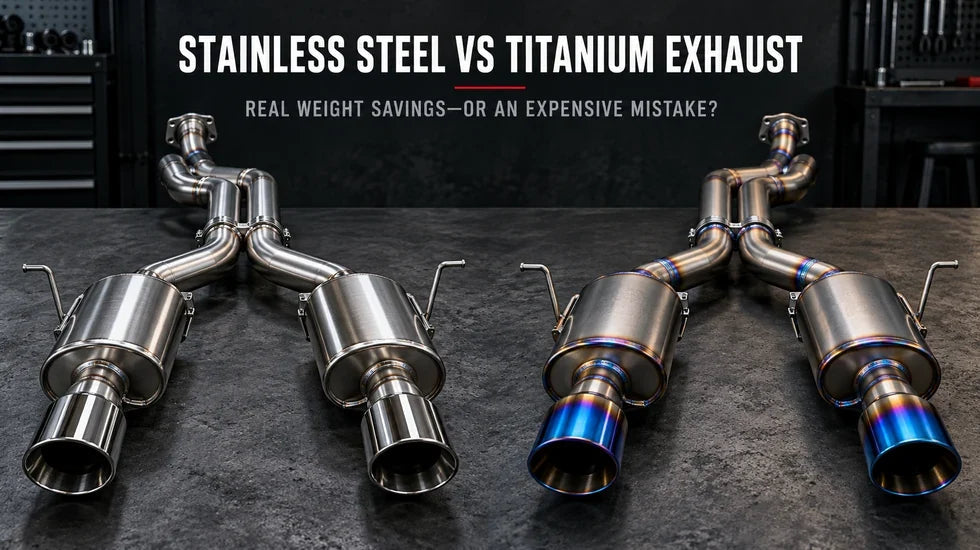
Titanium looks serious. Pick up a titanium muffler with one hand, see the blue-and-purple heat color around the welds, and it is easy to think the decision has already been made. Lighter must mean faster. More expensive must mean better. And that thin metallic bark must come entirely from the metal, right?
Not quite.
When drivers compare stainless steel vs titanium exhaust systems, they often focus on the material label and overlook the parts that actually decide whether a catback works well: alloy grade, tube thickness, muffler volume, resonator placement, hanger geometry, weld quality, ground clearance, and how the car is driven.
Listen to me on this one: titanium can be the right answer. It can also be a very expensive way to save weight you will never feel while accepting a repair problem you did not plan for. Stainless steel is heavier, but a properly built stainless catback can survive years of commuting, road salt, heat cycles, and driveway abuse without turning ownership into a science project.
Quick Answer: Which Exhaust Material Should You Choose?
- Choose 304 stainless steel for most daily drivers. It offers a useful balance of corrosion resistance, fatigue tolerance, repairability, and price.
- Choose titanium when measured weight reduction matters. It makes the most sense on a track car, time-attack build, lightweight weekend car, or premium project where removing 10–30 lb is part of a larger plan.
- Do not choose by sound clips alone. Titanium can emphasize a sharper, thinner-wall metallic character, but mufflers, resonators, pipe diameter, engine layout, and recording conditions usually have a larger effect.
- Expect titanium repair to require a specialist. Cleanliness, shielding gas, back purging, filler selection, and heat control are not optional when welding thin titanium tubing.
- Neither material automatically adds horsepower. Flow path, bends, pipe diameter, restrictions, and muffler construction affect performance; the metal name stamped on the box does not.
Stainless Steel vs Titanium Exhaust at a Glance
| Comparison | 304 Stainless Steel | Titanium | What the Driver Notices |
|---|---|---|---|
| Approximate density | About 7.9–8.0 g/cm³ | About 4.5 g/cm³ | Titanium starts with a major material-level weight advantage. |
| Common catback wall range | Roughly 1.2–1.5 mm | Roughly 0.8–1.2 mm | Thin titanium saves more weight but gives fabrication and support design less room for error. |
| Typical tone tendency | Fuller, rounder, deeper | Sharper, crisper, more metallic | Construction can outweigh the material tendency. |
| Corrosion resistance | Very good with quality 304 | Excellent in many road environments | Clamps, flanges, and fasteners may fail before the main tubing. |
| Local repair access | Widely available | Specialist service often required | Titanium can mean more downtime and a higher repair bill. |
| Best fit | Daily use, road trips, long ownership | Track use, serious weight reduction, premium builds | Use the car’s job—not the finish color—to make the decision. |
The wall ranges above are common construction examples, not universal specifications. A heavy titanium system with large mufflers can weigh more than a minimalist stainless single-exit setup. Compare complete system weights, not just metal density.
Stainless steel and titanium exhaust tube comparison](https://cdn.shopify.com/s/files/1/0293/4423/5619/files/stainless-vs-titanium-exhaust-tubes.webp?v=1789451041)
Alloy Grade Matters More Than the Material Label
304 vs 409 vs 321 Stainless Steel
“Stainless” is a family name, not a complete material specification. That distinction matters under a car.
409 stainless steel is common in factory exhaust systems. It handles heat and road duty well, but its lower chromium content means it can develop brown surface oxidation. Owners sometimes see that color and assume the pipe is about to rot through. Often, it is not. Surface appearance and structural failure are different things.
304 stainless steel is the familiar premium choice for an aftermarket catback. It resists corrosion well, stays presentable longer, and is friendly enough to fabricate and repair. If you commute through a northern winter or live near salt air, 304 is usually worth considering over a lower-cost stainless grade.
321 stainless steel earns its reputation in demanding high-temperature service. On a manifold, header, turbo outlet, or another hot area, its thermal stability can matter. A rear catback lives an easier thermal life. Paying extra for 321 behind the catalytic converter only makes sense when the complete design and use case justify it.
Commercially Pure Titanium vs Titanium Alloys
Titanium has the same labeling problem. Commercially pure Grade 2 titanium and a stronger alloy such as Grade 5 are not interchangeable just because both contain titanium. They form differently. They weld differently. Their strength, ductility, and high-temperature behavior differ too.
For a thin-wall exhaust, maximum room-temperature strength is not the only goal. The tubing has to be rolled and bent, the weld zones must survive vibration, and the assembly must move through thousands of heating and cooling cycles. A good manufacturer selects the alloy around the complete structure instead of choosing the most impressive number on a material chart.
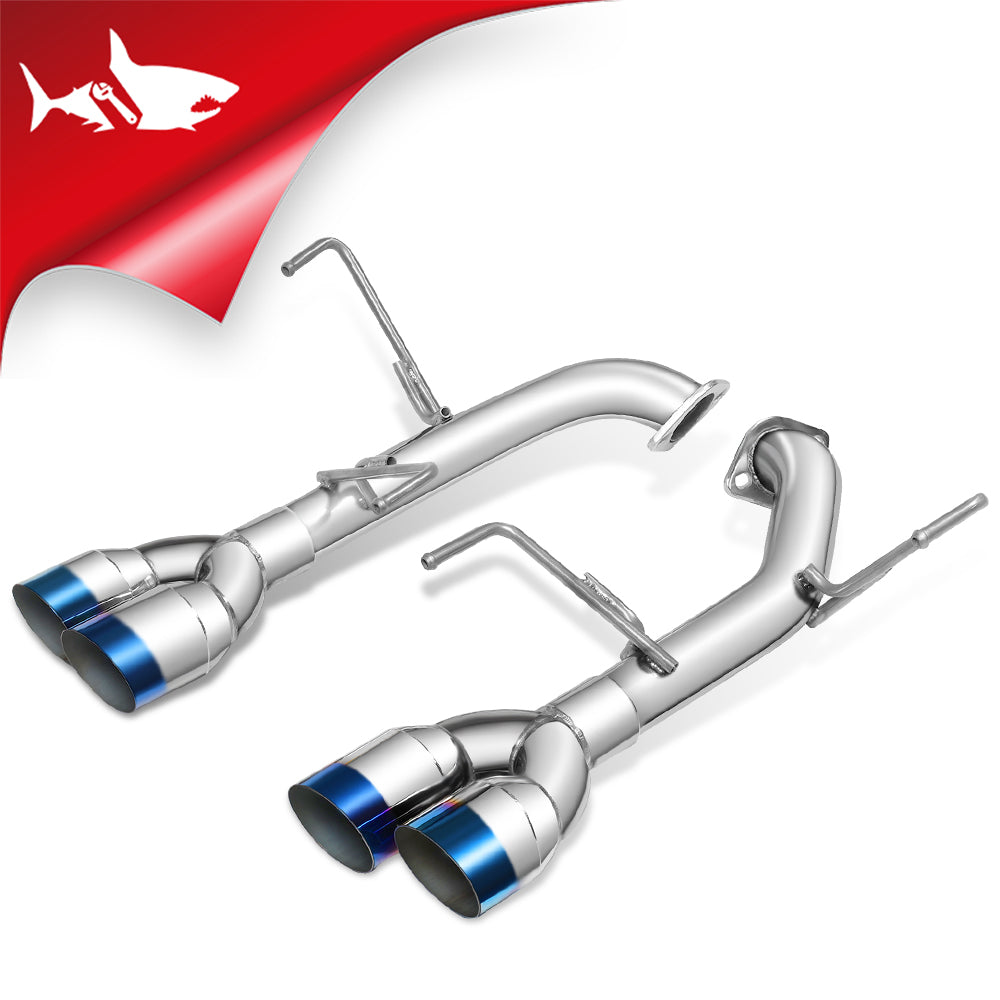
Technician’s Note: Ask three questions before buying: What alloy is the main tubing? How thick is it? Is the entire system made from that material, or only the muffler shell and tips? A blue tip does not make a stainless catback a titanium exhaust.
Why Wall Thickness Changes Weight, Sound, and Durability
Here is where the conversation gets interesting. Titanium is lighter by volume, but manufacturers often chase another reduction by using thinner tubing. Now two variables have changed at once: material and wall thickness.
A thin tube weighs less and responds more readily to vibration. It can sound lively and crisp. It also places more responsibility on the bends, hangers, gussets, weld toes, and slip joints. Make the tube too heavy and some of titanium’s advantage disappears. Make it too thin without controlling stress and the system can crack where a hanger meets the pipe.
That is why a well-designed 1.0 mm titanium system can be a brilliant part, while a poorly supported thin-wall system can become a rattling repair job. The metal did not design the hanger. Someone did.
How Much Weight Does a Titanium Catback Actually Save?
Material Density Is Not Installed Weight
At roughly 4.5 g/cm³, titanium is about 43% lighter by volume than 304 stainless at roughly 7.9–8.0 g/cm³. That sounds like a guaranteed 43% reduction. It is not.
A finished exhaust includes mufflers, perforated cores, packing, flanges, clamps, valve assemblies, tips, hangers, and sometimes mixed-material hardware. Pipe layout matters too. A single-exit titanium system and a dual-exit stainless system are not a clean material comparison.
For many passenger-car catbacks, a complete titanium system may save roughly 10–30 lb compared with a similar stainless layout. Compact single-exit systems can fall below that range. Large dual systems may exceed it. The only useful figure is the difference between two complete systems built for the same vehicle.
Factory vs Aftermarket Catback Weight and Construction
| Parameter | Typical Factory System | Typical Stainless Catback | Typical Titanium Catback |
|---|---|---|---|
| Design priority | Low noise, long service, mass production | Sound, flow, durability, value | Weight, sound character, premium construction |
| Muffler volume | Usually large | Moderate to large | Often smaller or lighter |
| Tube diameter | Sized for factory output and noise targets | Often larger than factory | Often larger than factory with thinner walls |
| Relative weight | Baseline | Can be lighter despite larger piping | Usually the lightest comparable layout |
| Road manners | Quietest and most isolated | Depends heavily on resonators and mufflers | Can transmit more high-frequency character |
Use a scale. Seriously. Record the stock assembly, every removed bracket, and the complete replacement system. Manufacturer figures are helpful, but your calculation should compare the exact configuration you plan to install.

Will You Feel a 20 lb Catback Weight Reduction?
On a 3,500 lb street car, removing 20 lb cuts total mass by about 0.57%. That is real, but it is not going to turn the car into a different machine. You might appreciate the easier installation. A stopwatch may eventually show value as part of a larger lightweight build. Your backside probably will not isolate that one change during a grocery run.
Also, a catback does not remove rotating mass like a lightweight wheel, driveshaft, or flywheel. It does not remove unsprung mass at the tire. Most of it sits low in the chassis, often near the center and rear. Useful? Sure. Magical? No.
Calculate Cost per Pound Saved
Use this simple test:
If the titanium version costs $1,200 more and saves 18 lb beyond the stainless version, that is about $66.67 per additional pound removed. Compare that with a lighter battery, wheels, seats, or unused equipment. Then decide which change best serves the car.
Does Titanium Exhaust Sound Different From Stainless Steel?
What the Metal Can Change
Titanium’s lower density and the thin tubing commonly used in performance systems can shift how the pipe wall vibrates. The result is often described as sharper, drier, more metallic, or more exotic. Stainless systems often sound rounder and heavier through the midrange.
Notice the wording: often. Not always.
A 3-inch titanium single exit with a small straight-through muffler will not sound like a 2.5-inch dual stainless system with two resonators. That comparison tells you almost nothing about material alone. Even a microphone can mislead you. Phone processing automatically changes gain and compresses loud peaks, so two clips recorded on different days can reverse your impression of which system is louder.
What Controls Tone More Than Material
- Engine layout and firing order: An inline-four, flat-four, V6, and cross-plane V8 start with different pulse patterns.
- Turbochargers and catalytic converters: Both remove acoustic energy before the gases reach the catback.
- Pipe diameter: Diameter changes gas velocity, volume, and the frequencies the system supports.
- Muffler construction: Body volume, perforated-core diameter, packing, and chamber layout reshape the note.
- Resonator placement: A properly selected resonator can trim rasp or a narrow unpleasant band without killing all volume.
- Single vs dual layout: Merge points, crossover placement, branch lengths, and outlet positions all matter.
- Wall thickness: Two systems made from the same alloy can sound different when one uses substantially thinner tubing.

Tone, Loudness, Rasp, and Drone Are Not the Same Problem
A titanium system can sound sharper without producing a higher peak decibel reading. A stainless system can sound deep outside and still hammer the cabin at 2,100 rpm. That low, steady cabin pressure is drone—not simply volume.
If highway comfort matters, read the guide to getting a deep exhaust sound without highway drone. It explains why a resonator, larger muffler, corrected pipe clearance, or tuned side branch may solve different problems.
Garage Warning: Do not delete the resonator because a 12-second rev clip sounded too quiet. Drive the car at 65–80 mph first. A setup that sounds clean behind the bumper can become exhausting inside the cabin when load and engine speed settle into one resonant band.
Heat Expansion and Thermal Cycling in a Catback
A Catback Does Not Live at Header Temperature
A catback starts behind the catalytic converter. By that point, the gas has traveled through hotter upstream components and shed part of its heat. It still gets hot enough to burn skin, discolor metal, soften nearby plastic, and expand the tubing, but it does not experience the same thermal environment as an exhaust port or turbo manifold.
This matters because material claims borrowed from racing headers do not automatically predict catback life. If you want to understand how coating changes heat behavior farther upstream, see the comparison of ceramic-coated vs stainless steel Tacoma headers. Headers face different heat loads, packaging limits, and underhood concerns than rear exhaust tubing.
How Much Does an Exhaust Grow When Hot?
As a simplified example, 304 stainless has a linear thermal-expansion coefficient around 17.3 × 10⁻⁶/°C, while commercially pure titanium is around 8.6 × 10⁻⁶/°C. Alloy and temperature change those figures, but the contrast is useful.
Take a straight 2-meter section and heat it by 400°C:
- 304 stainless could grow by roughly 13.8 mm, or about 0.54 inch.
- Commercially pure titanium could grow by roughly 6.9 mm, or about 0.27 inch.
A real exhaust is bent, mounted in rubber, divided by joints, and heated unevenly, so it does not simply push backward by that exact amount. Still, the calculation shows why cold bumper clearance and neutral hangers matter.

Why Heat Cycles Create Cracks
Every drive heats the system. Every parking period cools it. The tubes lengthen and contract while the engine moves on its mounts and the chassis twists over uneven pavement. A correctly installed system absorbs that motion through its joints and rubber isolators.
A preloaded system fights itself. One hanger pulls forward. Another drags sideways. A flange is forced into position with the bolts. The stress repeatedly concentrates at a weld toe or hanger junction until a small crack starts.
Material choice matters, but geometry decides where stress goes.
Common exhaust crack locations near welds and hangers](https://cdn.shopify.com/s/files/1/0293/4423/5619/files/common-exhaust-crack-locations.webp?v=1789451786)
Heat Color: Beautiful Finish or Warning Sign?
Titanium can develop gold, purple, and blue oxide colors with heat. Many enthusiasts love it. Stainless can turn straw-colored, gold, or brown. Normal color change is not a horsepower meter, and a blue tip does not prove the entire exhaust is titanium.
Fresh titanium welds deserve closer attention. Excessive gray, chalky white, or flaky contamination around a new weld can point to poor shielding during fabrication. On the other hand, normal in-service color extending away from a clean weld can simply reflect operating temperature.
Durability: Corrosion Is Only Half the Story
Road Salt, Rain, Condensation, and Short Trips
Both quality 304 stainless and titanium can perform well in wet or salty environments. The sneaky failures often appear elsewhere: low-grade clamps, flange hardware, mixed-metal joints, worn rubber isolators, or a scrape that flattened the lowest bend.
Short trips are rough on exhausts because water vapor can condense inside the system without enough running time to evaporate. Stainless resists this better than mild steel, and titanium has excellent corrosion resistance, but muffler packing, valves, clamps, and welds still need sensible construction.
Track Heat, Stiff Mounts, and Chassis Movement
Track use adds long high-load periods, aggressive curbing, rapid cool-downs, stiffer engine mounts, and more frequent inspection cycles. A titanium system can thrive there when it has proper support. It can also expose poor hanger placement quickly.
A street car has its own abuse: potholes, speed bumps, snow, salt, steep driveways, and thousands of low-intensity heat cycles. Durability is not a single “track tough” badge. It is whether the product’s structure matches the abuse it will actually see.
Welding, Repair, and the Case of the Cracked Hanger
Why Stainless Steel Is Easier to Repair
Most competent performance and exhaust shops can repair stainless tubing, replace a hanger, or fabricate a short replacement section. The work still needs clean metal, good fit-up, and appropriate filler, but the equipment and experience are widely available.
That matters six years after purchase, when the original manufacturer no longer sells one rear section and you just need the car back on the road.
Why Titanium Repair Needs the Right Shop
Titanium becomes unforgiving when it is hot enough to weld. Oxygen, nitrogen, hydrogen, dirt, oil, marker residue, and carbon inside a used exhaust can contaminate the joint. Proper repair may require internal back purging, a trailing shield, carefully prepared parent metal, compatible filler, and controlled gas coverage while the weld cools.
Many beginners watch a clean bench-welding video and assume a crack can be buzzed shut under the car. Please do not do that. A pretty bead on the outside can hide an oxidized, brittle root inside the tube.
Shop-Floor Case: The Crack Was Caused by Installation Preload
I remember a 2018 Subaru WRX that came into the shop with a sharp metallic buzz between roughly 2,700 and 3,100 rpm. The owner had already been told the thin-wall exhaust was “just noisy because it was titanium.” That explanation did not sit right with me.
We put it on the lift cold. The passenger-side rubber isolator leaned forward, the rear muffler sat about 3/8 inch off-center, and the mid-pipe had been tightened while rotated against the natural position of the rear section. Near the hanger weld, a hairline crack had started along the edge of the heat-affected zone.
The important part was not simply closing the crack. If we had welded it in the same position, it would have failed again. The section had to come off. The metal around the crack had to be cleaned and inspected, the repair area properly shielded, and the whole system reinstalled loose from front to rear. Only after the hangers sat neutral did we tighten the connections progressively.
The buzz was gone. More importantly, the repaired joint was no longer carrying the entire assembly’s installation stress.
The lesson: never use the flange bolts, clamps, or rubber hangers to drag an exhaust into place. If it only fits while something is being forced, stop and find the upstream alignment error.
Inspect These Areas Before and After Installation
- Lay every section on the floor and identify pipe direction, flange orientation, and hanger position.
- Inspect weld toes around hangers, muffler inlets, merge points, and tight-radius bends.
- Install every section loosely enough to rotate and slide.
- Seat the front connection naturally; do not use its bolts as a winch.
- Support the muffler without forcing it upward.
- Center the tips and remove twist from every rubber isolator.
- Check the driveshaft, axle, subframe, brace, heat shield, bumper, and fuel-system clearances.
- Tighten progressively from front to rear while watching the tips.
- Perform a cold-start leak check outdoors.
- Complete a controlled heat cycle, let the car cool fully, and inspect the alignment again.
If the tips move after tightening, use the seven-step catback exhaust alignment guide before bending hangers or cutting pipes. A small rotation near the front can move a rear tip much farther than most people expect.

Does Titanium Make More Power?
No—not because it is titanium.
An engine responds to pressure, mass flow, gas velocity, pulse behavior, temperature, and restriction. It does not inspect the invoice and reward the expensive alloy. If a titanium catback makes more power than the factory system, the change can come from its pipe diameter, bend quality, merge design, resonator, muffler core, or reduced restriction.
A stainless system with the same internal geometry should produce a very similar flow result. The titanium version’s measurable advantage is normally mass, not a special horsepower property.
On a naturally aspirated street car, changing only the rear exhaust may produce anything from no repeatable wheel-horsepower gain to a modest high-rpm improvement, depending on how restrictive the factory system was. Turbocharged vehicles can respond differently because turbine-outlet pressure and the upstream exhaust layout matter. A dyno claim without the vehicle, engine, baseline, correction method, fuel, calibration, tire setup, gear, and test configuration is just a number floating in space.
For a plain-language look at system scope and realistic benefits, read what a catback exhaust actually changes.
Price and Long-Term Ownership Cost
Why Titanium Costs More
The premium is not just exotic-metal tax. Titanium tubing costs more, forming it demands attention, and welding consumes time and shielding gas. Thin material also rewards precise fit-up and punishes contamination. Production volumes are generally lower, spreading tooling and development costs across fewer systems.
Then comes ownership. If you dent a stainless mid-pipe, many local shops can cut and replace the damaged section. If you crack a titanium merge, you may need to remove and ship it to a specialist. That difference belongs in the budget.
Watch for “Titanium Look” Descriptions
These are four different products:
- A complete titanium catback;
- A titanium muffler connected to stainless piping;
- A stainless system with real titanium tips;
- A stainless system with heat-colored or blue-finished tips.
They can all look attractive. They do not deliver the same weight reduction, repair requirements, or price. Review the material listed for the main pipes, resonator, muffler shell, internal core, flanges, and tips—not just the product name.
Street vs Track: Match the Material to the Car
Best Material for a Daily Driver
For a commuter that sees long highway trips, rain, parking ramps, and occasional winter salt, I usually lean toward a quality 304 stainless catback. It is durable, repairable, and less painful if the lowest bend eventually meets a driveway.
Put more attention into the resonator, muffler volume, cruising rpm, tip position, and fitment. Those details affect daily satisfaction more than saving the last 12 lb.
Best Material for a Weekend Street Car
This is where preference matters. Titanium can be worth it if you love the crisp tone, visible weld work, heat color, and reduced mass. You are allowed to buy a part because it makes the car feel special. Just do not confuse emotional value with a guaranteed performance gain.
If you want strong value and a deeper note, stainless remains hard to beat. Flashark’s vehicle-specific stainless steel catback exhaust systems offer a practical place to compare layouts, pipe construction, tip styles, and vehicle applications without paying solely for an exotic material label.
Best Material for a Track or Time-Attack Car
Titanium makes the strongest case when the car is already on a planned weight-reduction program. If the build uses lightweight seats, battery, wheels, body panels, and simplified interior parts, another 15–25 lb from the exhaust can be meaningful.
Still, do not buy the thinnest pipe you can find. Look for reinforced hanger areas, controlled joint movement, accessible replacement sections, adequate clearance, and a service plan. A system that saves 20 lb but cracks during an event is not fast.
Best Material for Long-Term Ownership
Think five or ten years ahead. Will replacement mufflers be available? Can a local shop weld it? Can the clamps be separated after winter use? Are the valve motors replaceable? Can one damaged tail section be purchased without buying the entire kit?
That is not glamorous garage talk, but it separates a good modification from a part you eventually regret.
Buyer’s Checklist Before Ordering a Catback
- Match the system to the vehicle year, engine, drivetrain, body style, and exhaust connection.
- Identify the alloy used for the main tubing—not only the tips.
- Compare complete installed weights for the exact configurations.
- Check tubing diameter and wall thickness.
- Determine whether the layout is resonated or non-resonated.
- Listen to cold start, warm idle, part throttle, full throttle, deceleration, and highway cruise.
- Check whether replacement sections are sold separately.
- Locate a shop capable of repairing the selected material.
- Review ground clearance around braces, axles, differentials, and bumpers.
- Inspect the crack, finish, and track-use terms of the selected product’s coverage.
- Review local sound and road-use rules.
- Calculate the added cost per pound saved.
Final Verdict: Buy the Better System, Not the Fancier Metal
For most street cars, 304 stainless steel is the sensible winner. It gives up some weight, but it returns excellent durability, easier repair, broad availability, and more money left for tires, brakes, suspension, or fuel.
Titanium wins when the weight saving has a job. A track-focused build, a premium lightweight project, or a driver who genuinely values the material’s tone and craftsmanship can justify the cost. Just judge the welds, supports, wall thickness, and complete design as hard as you judge the alloy.
The honest answer to stainless steel vs titanium exhaust is not “titanium for performance, stainless for budget.” It is more specific:
- Street and long-term use: start with 304 stainless.
- Serious weight reduction: consider a properly engineered titanium system.
- Deep sound: study the muffler, resonator, and layout before the metal.
- Maximum durability: prioritize stress-free fitment and fabrication quality.
- Actual power: compare flow design under controlled test conditions.
Good exhausts are combinations. The material is one part of that combination—not the whole story.
Frequently Asked Questions
Q1: Is titanium exhaust better than stainless steel?
A1: Titanium is better when low weight is the main target. Stainless steel is often better for a daily driver because it costs less, is easier to repair, and tolerates ordinary road use well. The better choice depends on the complete system and the vehicle’s job.
Q2: How much lighter is a titanium catback exhaust?
A2: A comparable titanium catback may save roughly 10–30 lb on many passenger cars, but system layout can move the result outside that range. Compare the complete titanium and stainless assemblies for the same vehicle instead of applying the raw material-density difference.
Q3: Does a titanium exhaust make more horsepower?
A3: Titanium itself does not create horsepower. A catback can change power when its diameter, bends, merge, resonator, or muffler reduces a meaningful restriction. A stainless system with equivalent internal geometry should deliver similar flow behavior.
Q4: Does titanium exhaust sound better than stainless steel?
A4: “Better” is personal. Titanium systems often have a sharper, crisper, more metallic character. Stainless systems often sound fuller and deeper. Engine layout, muffler design, resonators, pipe diameter, and wall thickness can influence the result more than material alone.
Q5: Is titanium exhaust louder than stainless steel?
A5: Not automatically. Titanium may emphasize higher-frequency sound, which can make it seem more aggressive without increasing the peak sound level. Muffler volume, resonator design, outlet location, and pipe layout are stronger predictors of loudness.
Q6: Does titanium exhaust drone more?
A6: Material alone does not decide drone. Drone appears when exhaust pulses and the vehicle cabin reinforce a narrow frequency range. Cruising rpm, pipe length, resonators, mufflers, tailpipe position, leaks, and body contact all matter.
Q7: Do titanium exhaust systems crack easily?
A7: A well-designed titanium system should not be dismissed as fragile, but thin walls leave less margin for poor welding, hanger preload, impact, and uncontrolled vibration. Cracks commonly begin near stressed welds, hangers, merge points, and damaged bends.
Q8: Can a cracked titanium exhaust be repaired?
A8: Yes, when the surrounding metal remains suitable and the work is performed by a titanium-welding specialist. The tube must be thoroughly cleaned, internally purged, properly shielded, and repaired with compatible material. Multiple fatigue cracks can make section replacement the safer choice.
Q9: How long does a titanium exhaust last?
A9: Service life depends on alloy, wall thickness, weld quality, hanger design, installation stress, heat cycles, impacts, and vehicle use. A properly supported system can last for years; a preloaded or contaminated thin-wall assembly can fail much sooner.
Q10: Is titanium worth the extra cost on a daily driver?
A10: Usually not for performance alone. It can still be worth buying if you value reduced mass, appearance, craftsmanship, and a specific sound character. For budget, repair access, and everyday durability, quality stainless is generally the more practical route.
Q11: Is stainless steel or titanium better for track use?
A11: Titanium can be advantageous in a track build where every pound is being removed deliberately. Stainless may be preferable in endurance, off-track, or grassroots use when quick local repairs and lower replacement costs matter more than minimum mass.
Q12: Is 304 or 409 stainless steel better for an exhaust?
A12: 304 usually offers better corrosion resistance and appearance retention. 409 is widely used in factory exhausts and can deliver long structural life, but it commonly develops brown surface oxidation. Climate, budget, finish expectations, and intended ownership period should guide the choice.
Q13: Is 321 stainless steel better than 304 for a catback?
A13: 321 has advantages in demanding high-temperature environments, but a catback operates downstream from the hottest exhaust components. For many street catbacks, well-designed 304 provides a better cost-to-benefit balance.
Q14: Do titanium exhaust tips change the sound?
A14: Swapping only the tips usually produces little audible change. Tip length, diameter, wall construction, and outlet position can alter the final edge of the note, but the muffler, resonator, and main piping dominate the sound.
Q15: Does titanium exhaust get hotter than stainless steel?
A15: There is no useful one-word answer. Surface temperature, heat capacity, thermal conductivity, wall thickness, airflow, coating, and gas temperature all affect what you measure. A thinner, lighter tube can heat and cool differently even when the exhaust gas entering it is the same temperature.
Q16: Why does a titanium exhaust turn blue?
A16: Heat changes the thickness of the oxide layer on titanium, producing gold, purple, and blue interference colors. The color indicates a thermal history at the surface; it does not prove a horsepower gain or identify the material used in every other part of the system.
Q17: Will installing a catback require an ECU tune?
A17: Tune requirements depend on the vehicle and the complete installed hardware. A rear-system change that retains the factory catalytic converters and sensor locations is different from modifying headers, downpipes, catalysts, or sensor placement. Follow the instructions for the exact vehicle and configuration.
Q18: Is a titanium catback legal for street use in the United States?
A18: The metal itself is not the main issue. Noise limits, equipment rules, and emissions-related requirements vary by state and locality. Match the system to the vehicle, retain required emissions equipment, and review the rules that apply where the car is registered and driven.

Steven Chen
Automotive Performance Specialist | Engine & Exhaust Systems
Steven focuses on practical engine performance, exhaust fitment, and real-world upgrade paths for classic and modern enthusiast vehicles. He reviews small-block Ford, LS, truck, and street/strip applications with one goal in mind: helping builders choose parts that actually work together. His philosophy: "Good power starts with the right combination, not the biggest part."