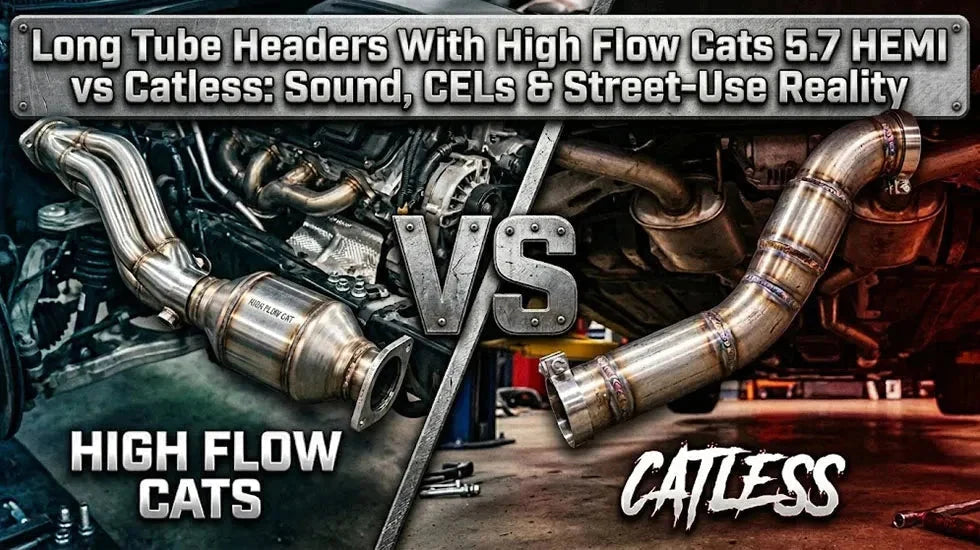
Colectores de Tubo Largo con Catalizadores de Alto Flujo 5.7 HEMI vs. Sin Catalizador: Sonido, Luces de Verificación del Motor y Realidad de Uso en la Calle
Seamos honestos. La mayoría de los propietarios de 5.7 HEMI no empiezan a buscar tubos largos porque la camioneta o el coche "necesiten un poco más de personalidad". El vehículo ya tiene personalidad. Empiezan a buscar porque los colectores de fábrica se sienten restrictivos, el sonido del escape es demasiado discreto, o ese tictac del colector en el arranque en frío empieza a molestarles.
Entonces se abre la caja de Pandora. Un tipo dice que use catalizadores de alto flujo. Otro dice que sin catalizador o nada. Otro dice que la luz de verificación del motor está garantizada. Otro dice que su coche pasó la inspección. Y debajo de todo ese ruido, la pregunta real es: ¿con qué configuración puedes vivir realmente después de que se pase la emoción del primer arranque en frío?
He visto muchas modificaciones de 5.7 HEMI donde el propietario compró con los oídos y pagó después con la cartera. Los colectores de tubo largo pueden despertar un HEMI, sin duda. En un 5.7L HEMI sano, mayormente de serie, con una puesta a punto adecuada y un escape decente detrás, los colectores de tubo largo a menudo logran mejoras de 18-35 caballos de fuerza en la rueda, dependiendo del vehículo, el diseño del colector, la configuración del escape, la calidad de la puesta a punto y la condición del motor. Pero ese número en el dinamómetro es solo una parte del trabajo.
La decisión más difícil es esta: colectores de tubo largo con catalizadores de alto flujo en una configuración 5.7 HEMI, o colectores de tubo largo sin catalizador en una configuración 5.7 HEMI? Una es más realista para vehículos enfocados en la calle. La otra es más ruidosa, más cruda y más orientada al uso en carreras. Ninguna de las dos es una solución mágica que hace desaparecer todos los problemas.
Respuesta rápida: Los catalizadores de alto flujo suelen ser la opción más inteligente para uso en calle. La opción sin catalizador es más ruidosa y para uso fuera de carretera/carreras.
- Vehículo de uso diario o HEMI enfocado en la calle: una configuración de tubo largo con catalizador es generalmente más fácil de usar porque mantiene el sonido profundo sin convertir cada semáforo en una sesión de humos de escape.
- Máximo sonido y actitud de uso en carreras: los tubos largos sin catalizador son más ruidosos, más nítidos y más agresivos, pero el riesgo de la luz de verificación del motor, el riesgo de inspección y el olor aumentan.
- Realidad de la luz de verificación del motor: los catalizadores de alto flujo pueden reducir el riesgo en comparación con los tubos sin catalizador, pero no garantizan la ausencia de códigos P0420 o P0430.
- Realidad de la puesta a punto: los colectores de tubo largo en un 5.7 HEMI suelen merecer una puesta a punto adecuada. Las configuraciones sin catalizador, en particular, no deben tratarse como simples "bolt-ons".
- Advertencia de uso en la calle: no asuma que "tener catalizadores" significa "legal en todas partes". Las normas estatales, la preparación OBD, la inspección visual y la aprobación del convertidor catalítico siguen siendo importantes.
Qué Cambian Realmente los Colectores de Tubo Largo en un 5.7 HEMI
Los colectores de fábrica del 5.7 HEMI están construidos para el empaquetado, el costo, el control de calor, la reducción de ruido y la supervivencia de la garantía. Son piezas fundidas compactas. Funcionan. Pero desde el punto de vista del rendimiento, no son precisamente generosos.
Los colectores de tubo largo cambian la trayectoria del escape de una manera real. Los tubos primarios son más largos. El colector se encuentra más abajo. Los pulsos de escape tienen más espacio para separarse y fusionarse. Eso mejora el barrido de gases, especialmente cuando el tacómetro sube y el motor quiere respirar con más fuerza.
Pero aquí está la parte que muchos propietarios nuevos pasan por alto: los tubos largos también cambian la ubicación del calor, el comportamiento del sensor de O2, los puntos de conexión posteriores y la forma en que la ECU ve el flujo de escape. Por eso, una instalación de colectores puede hacer que la camioneta suene genial el primer día y encienda la luz de verificación del motor unos pocos ciclos de manejo después.

| Configuración | Cambio Típico de Flujo | Cambio Típico de HP en Rueda | Cambio de Sonido | Riesgo de CEL / Inspección |
|---|---|---|---|---|
| Colectores de fábrica | Más restrictivo, diseño de fábrica silencioso | Línea base | Sordo, controlado, suave | El más bajo cuando las piezas de fábrica están en buen estado |
| Colectores cortos | Mejor que los de serie, más cerca de la posición de fábrica | Aproximadamente 5-12 whp en muchas configuraciones suaves | Más profundo, pero generalmente no salvaje | Generalmente más bajo que los tubos largos si los catalizadores permanecen cerca de la configuración de fábrica |
| Tubos largos con catalizadores de alto flujo | Gran mejora en el flujo con restricción catalítica reducida | Aproximadamente 18-30 whp con la puesta a punto y la combinación de escape adecuadas | Profundo, más nítido, más fuerte, generalmente menos áspero que sin catalizador | Moderado; la luz de verificación del motor aún es posible |
| Tubos largos sin catalizador | La trayectoria de escape más abierta | Aproximadamente 20-35 whp con puesta a punto; más posible en configuraciones con árbol de levas | Crudo, ruidoso, más nítido, más olor | El más alto; solo en contexto de uso fuera de carretera/carreras |
Nota del mecánico: No compre colectores solo por el sonido de un clip. Una camioneta con tubos largos, catalizadores de alto flujo, resonadores y un silenciador con cámaras sonará completamente diferente a la misma camioneta con tubos sin catalizador y un cat-back directo. Mismo motor. Experiencia de propiedad completamente diferente.
Colectores de Tubo Largo con Catalizadores de Alto Flujo: Lo que Ganas y lo que Pierdes
Los catalizadores de alto flujo se encuentran en un punto intermedio. No son convertidores de fábrica, y no son tubos vacíos. Reducen la restricción mientras siguen utilizando un elemento catalítico para ayudar a controlar el olor y el comportamiento de las emisiones.

Para muchos propietarios de HEMI en la vida real, esta es la ruta que tiene más sentido. No porque sea la más ruidosa. No lo es. No porque siempre genere el mayor número en el dinamómetro. Por lo general, no lo hace. Me gusta porque le da al motor espacio para respirar sin hacer que el vehículo sea insoportable para vivir con él.
Sonido de Colectores de Tubo Largo con Catalizadores de Alto Flujo 5.7 HEMI
Una buena configuración de tubo largo con catalizador le da al HEMI un sonido más profundo. El arranque en frío se vuelve más fuerte. El ralentí tiene más peso. Al acelerar, el tono se vuelve más nítido y el V8 finalmente suena como si tuviera espacio para exhalar.
En comparación con la configuración sin catalizador, los catalizadores de alto flujo suelen suavizar los bordes ásperos. Menos aspereza. Menos olor a combustible crudo. Menos crepitar metálico a revoluciones extrañas. Si el vehículo es una Ram 1500, Charger, Challenger, Magnum o 300C de uso diario, eso importa más de lo que la gente admite en línea.
Ganancia de Potencia sin Abundancia Total
En un 5.7 HEMI suave, no me preocuparía por los últimos caballos de fuerza entre una buena configuración de catalizador de alto flujo y una configuración sin catalizador. La puesta a punto, la fusión del colector, las fugas de escape, la sección trasera, el tamaño de los neumáticos, el clima y el tipo de dinamómetro pueden borrar esa diferencia en una tarde.
Donde una configuración con catalizador de alto flujo brilla es en el equilibrio. Obtiene un mejor barrido de gases y una contrapresión reducida mientras mantiene el escape más controlado. Para un 5.7 HEMI mayormente de serie, una dirección común para los tubos largos es un primario de aproximadamente 1.75 pulgadas y un colector de 3 pulgadas. Más grande no siempre es más inteligente. Demasiado tubo en un motor suave puede suavizar la velocidad y hacer que el vehículo se sienta perezoso a bajas revoluciones.
Riesgo de Luz de Verificación del Motor: Menor que sin Catalizador, No Nulo
Aquí es donde los nuevos propietarios se queman. Escuchan "catalizadores de alto flujo" y lo traducen como "sin luz de verificación del motor". Así no piensan los sensores de O2 posteriores.
Los catalizadores de alto flujo aún pueden activar códigos de eficiencia catalítica. Los sospechosos habituales son:
- Códigos de eficiencia catalítica P0420 o P0430
- Sensores de O2 traseros que leen de forma diferente porque los catalizadores fluyen más que los de serie
- Pequeñas fugas de escape en el colector, brida, junta deslizante o superficie de la junta
- Sensores de O2 viejos que ya eran lentos antes de la instalación de los colectores
- Cables de extensión de O2 demasiado cerca del calor
- Catalizadores de alto flujo baratos con una calidad inconsistente del sustrato interno
Así que sí, una configuración de colectores de tubo largo con catalizadores de alto flujo 5.7 HEMI suele ser más fácil de manejar que una configuración sin catalizador. Pero "más fácil" no significa "salpicadero limpio garantizado". Cualquiera que prometa eso está vendiendo humo.
Colectores de Tubo Largo sin Catalizador 5.7 HEMI: Por Qué Suenan Salvajes y Causan Más Problemas
Sin catalizador es como ese amigo ruidoso que llega a medianoche y cree que todo el vecindario quiere escuchar el ronroneo del motor. A veces suena increíble. A veces es demasiado. Depende del vehículo, los silenciadores, los resonadores y lo honesto que seas contigo mismo.
Una configuración de colectores de tubo largo sin catalizador 5.7 HEMI elimina la restricción catalítica de esa parte del escape. Eso generalmente significa un volumen más crudo, más olor a escape, un tono más nítido y una probabilidad mucho mayor de que la ECU se queje de la eficiencia catalítica.

Sonido: Más Fuerte, Más Crudo y No Siempre Mejor
Los tubos largos sin catalizador son más ruidosos en casi todas partes:
- Arranque en frío: más nítido, más violento y mucho más notorio en un garaje o entrada.
- Ralentí: más áspero y mecánico, especialmente con una configuración con árbol de levas. Velocidad de crucero: más propenso a exponer el zumbido si la combinación de silenciador y resonador es demasiado abierta.
- Aceleración a fondo: desagradable, crudo, agresivo y, sinceramente, la parte que convence a la gente.
Pero los clips de sonido mienten. Tu teléfono comprime las altas frecuencias. El video no muestra el olor. No muestra a tu cónyuge mirándote feo después del tercer arranque en frío a las 6:30 de la mañana. No muestra a la estación de inspección diciéndote que te des la vuelta.
Olor y Molestias en la Conducción Diaria
El escape sin catalizador huele. No es un "quizás". Lo hace. Arranque en frío, ralentí, garaje de estacionamiento, autoservicio, al meter el coche en el garaje después de un acelerón... lo notas. Algunos propietarios dicen que no les importa. De acuerdo. Pero si este es un coche de uso diario, ese olor se vuelve viejo más rápido de lo que internet admite.
Luces de Verificación del Motor y Monitores de Preparación
Los tubos largos sin catalizador ponen de mal humor a los sensores de O2 traseros. Los códigos P0420 y P0430 son comunes porque la computadora espera ver una señal de escape limpia después de los catalizadores. Con los tubos sin catalizador, ve lo contrario.
Sí, los foros hablan de espaciadores de O2, "non-foulers" y cambios de software. No voy a convertir esto en un tutorial de bypass de garaje. Esos atajos pueden crear problemas de inspección, problemas de diagnóstico y problemas de cumplimiento. La respuesta más limpia es simple: comprenda las reglas de su estado, comprenda su plan de puesta a punto y no trate el hardware para uso fuera de carretera/carreras como hardware normal para la calle.
Advertencia desde el taller: Sin catalizador no es "potencia gratis sin inconvenientes". Es más ruidoso, huele más, es más sensible a las inspecciones y es más probable que requiera una puesta a punto real. Si el vehículo tiene que pasar las emisiones donde vives, tómate tu tiempo antes de comprar.
Catalizadores de Alto Flujo vs. Sin Catalizador: Guía de Decisión Comparativa
Si quieres la versión corta, aquí la tienes. Los catalizadores de alto flujo son para el propietario que todavía quiere usar el vehículo como un vehículo. Sin catalizador es para el propietario que construye algo más ruidoso, más agresivo y más enfocado en el uso en carreras.
| Categoría | Tubos Largos con Catalizadores de Alto Flujo | Tubos Largos sin Catalizador |
|---|---|---|
| Mejor uso | Rendimiento enfocado en la calle, conducción diaria, sonido equilibrado | Configuraciones para uso fuera de carretera/carreras, máxima agresividad |
| Sonido | Profundo, fuerte, menos áspero | Más ruidoso, más crudo, más áspero |
| Olor a escape | Reducido en comparación con sin catalizador | Mucho más notorio |
| Riesgo de CEL | Moderado; no nulo | Alto sin una planificación y calibración adecuadas para uso en carreras |
| Riesgo de inspección | Depende del estado, aprobación del convertidor, preparación OBD e inspección visual | El más alto; no es una recomendación normal para uso en la calle |
| Necesidad de puesta a punto | Fuertemente recomendado | Darlo por hecho |
Mejor Opción para Vehículos de Uso Diario
Para una Ram 1500, Charger, Challenger, Magnum o 300C de uso diario, me inclino por los tubos largos con catalizadores de alto flujo cuando el resto del sistema de escape lo permite. Aún así obtienes una mejor respiración, un sonido HEMI más fuerte y una mejor respuesta del acelerador después de la puesta a punto. Pero no estás haciendo que el vehículo sea tan molesto para vivir con él.
Mejor Opción para Configuraciones Todoterreno o de Carreras
Para uso todoterreno o solo en carreras, los tubos largos sin catalizador tienen sentido cuando la configuración ya se está moviendo hacia el flujo máximo, el sonido agresivo y la puesta a punto personalizada. Los coches con árbol de levas, los juguetes de fin de semana y las configuraciones enfocadas en la pista son donde los tubos sin catalizador suelen pertenecer.
La Mejor Opción Si Quieres Sonido Pero Odias las Luces de Verificación del Motor
Utiliza componentes catalíticos de calidad donde sea necesario, revisa cada brida, usa juntas nuevas, enruta los arneses de O2 de forma segura y presupuesta una puesta a punto adecuada. Esa es la respuesta aburrida. También es la que ahorra la mayoría de los fines de semana.
¿Los Colectores de Tubo Largo con Catalizadores de Alto Flujo Aún Pueden Activar una Luz de Verificación del Motor?
Sí, pueden. Sé que no es la respuesta que todos quieren, pero es la honesta.
Cuando instalas tubos largos, el entorno del sensor de O2 cambia. El gas de escape se mueve a través de una tubería diferente, la curva de calor cambia y los sensores posteriores pueden no ver el mismo comportamiento de almacenamiento de oxígeno que veían con los catalizadores de fábrica. Incluso los buenos catalizadores de alto flujo pueden ser demasiado diferentes de lo que espera la calibración de fábrica.
La mayoría de las veces, los códigos de los que escuchas son P0420 y P0430. Esos son códigos de eficiencia del sistema catalítico para el Banco 1 y el Banco 2. No siempre significan que el convertidor catalítico está muerto. A veces el sensor es viejo. A veces hay una pequeña fuga de escape. A veces la puesta a punto no coincide. A veces el catalizador simplemente no se comporta como el convertidor de serie a ojos de la ECU.

Por Qué los Catalizadores de Alto Flujo Baratos Pueden Ser una Apuesta
He visto catalizadores de alto flujo de oferta funcionar bien durante un mes y luego empezar a arrojar códigos después de unos pocos ciclos de calor. El problema no siempre es obvio desde el exterior. Las soldaduras pueden parecer brillantes. El tubo puede encajar. Pero la calidad del sustrato interno, el número de celdas, la consistencia del revestimiento y la resistencia al calor son importantes.
Si el convertidor no puede encenderse correctamente o almacenar oxígeno de manera consistente, el sensor de O2 trasero lo delatará. Al escáner no le importa que la pieza se viera bien en la foto del producto.
Caso en primera persona: Recuerdo una Ram 1500 de 2018 que llegó después de instalar un cabezal de entrada. El propietario juró que los catalizadores de alto flujo eran basura porque el P0430 apareció después de tres días. Fumigamos el escape y encontramos una pequeña fuga en el colector del lado del pasajero. No era ruidosa. Apenas visible. Pero lo suficiente como para introducir oxígeno fresco en la corriente y alterar el sensor posterior. Junta nueva, alineación adecuada de la brida, se volvió a verificar el enrutamiento del arnés, el código permaneció inactivo después del ciclo de monitoreo. El catalizador no era el culpable. La fuga sí lo era.
¿Necesitas un ajuste después de instalar colectores de escape largos (long tube headers) en un 5.7 HEMI?
Escúchame en esto: los colectores largos merecen un ajuste. No estoy diciendo que el vehículo explotará en el momento en que lo arranques sin uno. Funcionará. Incluso puede sentirse bien en un viaje corto. Pero si pagaste por los colectores y dejaste la calibración de fábrica adivinando, dejaste una parte de la mejora en el suelo.
Un ajuste adecuado puede ayudar con:
- Corrección de la relación aire/combustible bajo carga
- Comportamiento del ajuste de combustible a largo plazo
- Respuesta del acelerador
- Sensación de cambio en vehículos automáticos
- Configuración del ventilador y comportamiento del calor en algunas configuraciones
- Manejo después de cambios en el sensor de O2 y el diseño del escape
Para más detalles sobre esta parte exacta de la construcción, lee la guía de colectores de escape largos 5.7 HEMI y ajuste. Ese artículo profundiza en los ajustes de combustible, el comportamiento de P0420/P0430 y por qué "simplemente borrar el código" no es una solución real.
Por qué el ajuste no se trata solo de la potencia máxima
Todo el mundo quiere el número del dinamómetro. Bien. Yo también. Pero un ajuste también se trata de cómo se comporta el vehículo a 1,800 rpm en el tráfico, cómo cambia de marcha con el acelerador parcial, si se acelera después de un arranque en frío y si los ajustes de combustible se desvían como un carrito de compras defectuoso.
En un 5.7 HEMI saludable con colectores largos, una calibración real puede ser la diferencia entre "suena ruidoso pero se conduce raro" y "así es como el camión debería haberse sentido de fábrica".
Caso en primera persona: Hace unos años, un Ram 1500 de 2014 llegó al taller con colectores largos, sin ajuste y el tablero encendido como un árbol de Navidad. El propietario había leído tres hilos de foros, había instalado espaciadores de O2 traseros y pensó que eso era "suficiente". Sacamos las bujías y estaban negras de combustible. Las puntas estaban hollín. Los ajustes de combustible eran horribles. Ahorró dinero durante unas dos semanas, luego pagó el doble. Un ajuste habría sido más barato que perseguir fantasmas.
Diferencias de sonido: arranque en frío, ralentí, crucero y aceleración a fondo
El sonido es donde el corazón empieza a discutir con el cerebro. Y en un HEMI, el corazón es ruidoso.
Arranque en frío
Catalizadores de alto flujo: más profundo, más fuerte, agresivo pero aún algo controlado.
Sin catalizador: más ruidoso, más nítido, más violento. En un garaje, puede sonar como si hubieras arrancado un camión de carreras small-block dentro de un cobertizo de metal. Genial una vez. Menos genial cada mañana.
Ralentí
Con catalizadores de alto flujo, el ralentí tiene más peso. Con tubos sin catalizador, el ralentí adquiere un toque más crudo y una textura de escape. Si el coche tiene árbol de levas, la diferencia se hace aún más obvia.
Crucero en carretera y zumbido
El zumbido no siempre es culpa del colector. He visto a gente culpar a los colectores largos cuando el problema real era la eliminación de un resonador, un silenciador directo barato, el contacto del tubo con el chasis o el modo MDS/eco que cambiaba el pulso de escape en la autopista.
Antes de culpar a los colectores, revisa todo el sistema:
- Diseño del silenciador
- Ubicación del resonador
- Diámetro del tubo
- Precarga de la percha de escape
- Espacio libre del chasis y el travesaño
- Posición de salida del tubo de escape
- Comportamiento del modo MDS o eco en camiones
Aceleración a fondo
Aquí es donde el "catless" gana el concurso de drama. Grita más fuerte. Penetra más. Suena más como una configuración de carrera. Los catalizadores de alto flujo suenan más limpios y controlados, por eso me gustan más para vehículos que aún circulan por carreteras normales, viajes largos y llevan pasajeros.
Uso en la calle, emisiones e inspección: lo que los compradores estadounidenses deben verificar
Esta sección no es emocionante, pero es la que te evita comprar la configuración incorrecta.
La legalidad de uso en la calle en EE. UU. no es tan simple como "con o sin catalizador". Debes considerar las normas federales de emisiones, las normas estatales, la inspección visual, la preparación de OBD, la certificación del convertidor catalítico y si tu vehículo está registrado en un área de emisiones estricta.
Por qué "catalizador de alto flujo" no significa automáticamente legal para la calle
Un catalizador de alto flujo sigue siendo un convertidor catalítico de recambio. Esto significa que los detalles importan. Dónde vives importa. El vehículo exacto importa. Si el convertidor está aprobado para esa aplicación importa. Si el inspector revisa visualmente o solo verifica los monitores OBD importa.
No asuma que una pieza es legal para uso en la calle solo porque tiene un elemento catalítico soldado. Así es como la gente se sorprende en el momento de la inspección.
Por qué el sistema sin catalizador debería considerarse para uso fuera de carretera o en carreras
Los tubos sin catalizador eliminan la función catalítica de esa sección del escape. Para un vehículo utilizado en vías públicas, ahí es donde comienza el riesgo. No estoy aquí para controlar tu configuración, pero seré directo contigo: si tu vehículo necesita pasar la prueba de emisiones o la inspección visual, una configuración sin catalizador es el punto de partida equivocado.
Comprobaciones de ajuste antes de comprar colectores para un 5.7 HEMI
El ajuste es donde las compras en línea se vuelven peligrosas. Un Ram 1500 5.7 HEMI no es el mismo problema de empaquetado que un Charger. Un 300C no es un camión 4x4. Una camioneta Magnum tiene su propia realidad en la parte inferior. La misma familia de motores no significa el mismo kit de colectores.
Antes de ordenar, verifique:
- Año del modelo
- Plataforma del vehículo
- Configuración 2WD, RWD o 4WD
- Espacio libre de la transmisión y el travesaño
- Espacio libre del eje de dirección
- Ubicación del orificio del sensor de O2
- Requisito de arnés de extensión de O2
- Tamaño del colector
- Compatibilidad del tubo en Y o del tubo intermedio
- Estilo de conexión cat-back
- Requisitos de emisiones estatales
Si aún estás comparando opciones de shorty y long tube, la guía de los mejores colectores para 5.7 HEMI es una buena lectura porque desglosa la conducción diaria, el tictac del HEMI, los objetivos de potencia y la dificultad de instalación.
Preocupaciones de ajuste para Ram 1500
Los camiones Ram son donde los pernos del colector rotos y los colectores de fábrica deformados aparecen todo el tiempo. Una configuración de tubo largo puede ser una mejora de rendimiento y una mejora del camino de reparación al mismo tiempo, pero solo si el kit coincide con el camión.
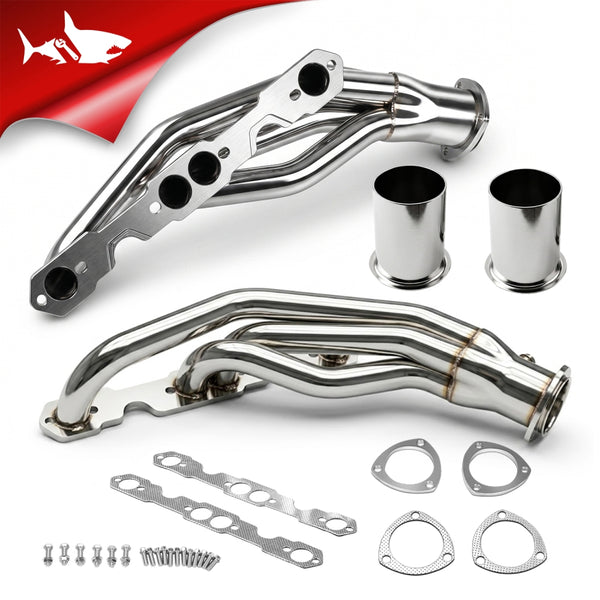
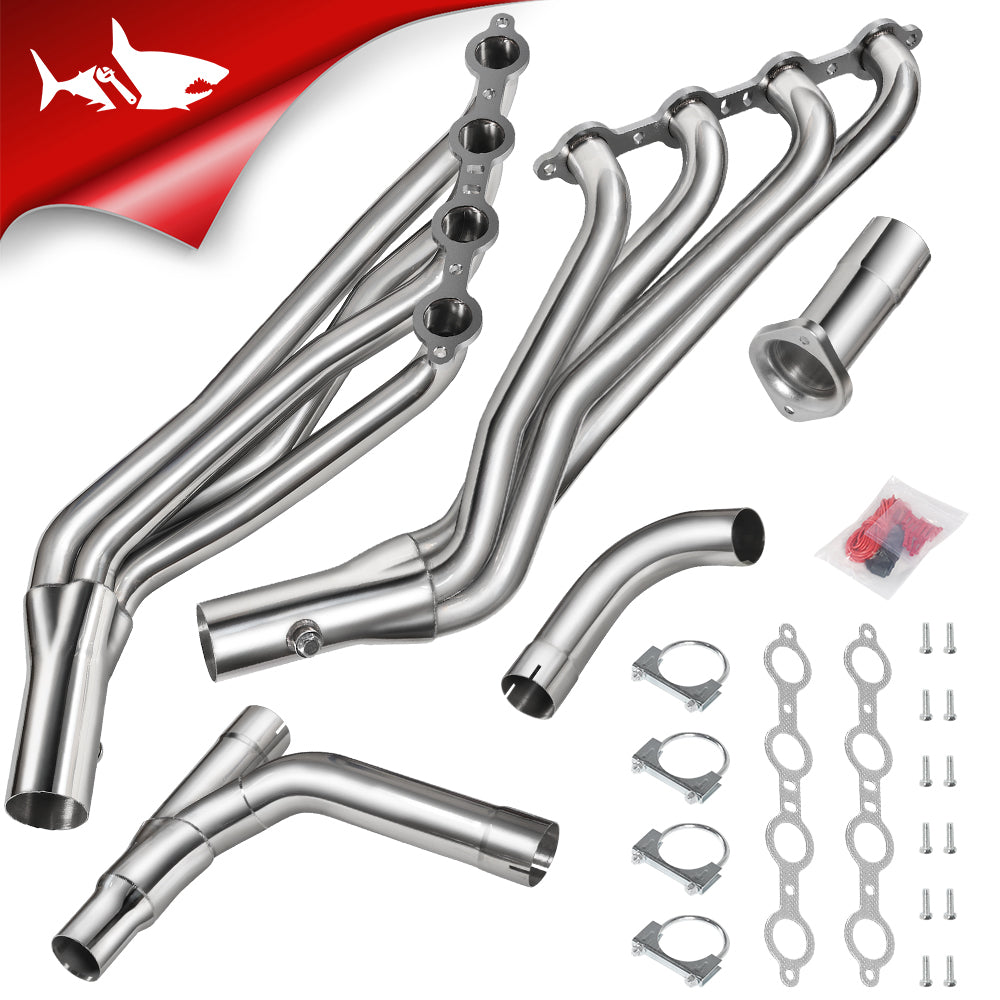
Para los propietarios de camiones que comparan opciones de colectores, la opción de colectores de tubo largo para Ram 1500 5.7 HEMI de 2009-2018 es la ruta de ajuste más relevante que intentar adaptar el hardware HEMI de plataforma de automóvil. Solo recuerde: esta es una mejora de colector, no un sistema completo de catalizador de alto flujo, por lo que su tubo en Y, tubo intermedio, configuración de convertidor catalítico, enrutamiento del sensor de O2 y plan de ajuste aún deben verificarse por separado.

Colectores Flashark Ram 1500 5.7 HEMI
Esta opción de colector está diseñada para propietarios de Ram que desean un flujo de escape más fuerte, un tono de camión más profundo y una ruta de mejora más limpia para los colectores de fábrica con fugas. No es un sistema completo de catalizador de alto flujo, así que confirme el tubo en Y, el tubo intermedio, la configuración del convertidor catalítico, el enrutamiento del sensor de O2 y el plan de ajuste antes de ordenar.
Precio de venta: $209.99 $399.99
Ver detalles del productoProblemas de ajuste para Challenger, Charger, Magnum y 300C
Los coches de plataforma LX tienen un problema diferente: empaquetado bajo la carrocería, enrutamiento del tubo intermedio, distancia al suelo y diseño de tracción trasera. La elección del producto debe coincidir con el coche, no solo con la insignia del motor.
Para los sedanes, cupés y camionetas HEMI de 2005-2011, la opción de colectores de escape para Dodge Charger Challenger Magnum Chrysler 300C 5.7 HEMI de 2005-2011 está dirigida a propietarios que desean una ruta de ajuste dedicada a la plataforma del coche en lugar de intentar forzar hardware de camión bajo un chasis más bajo.
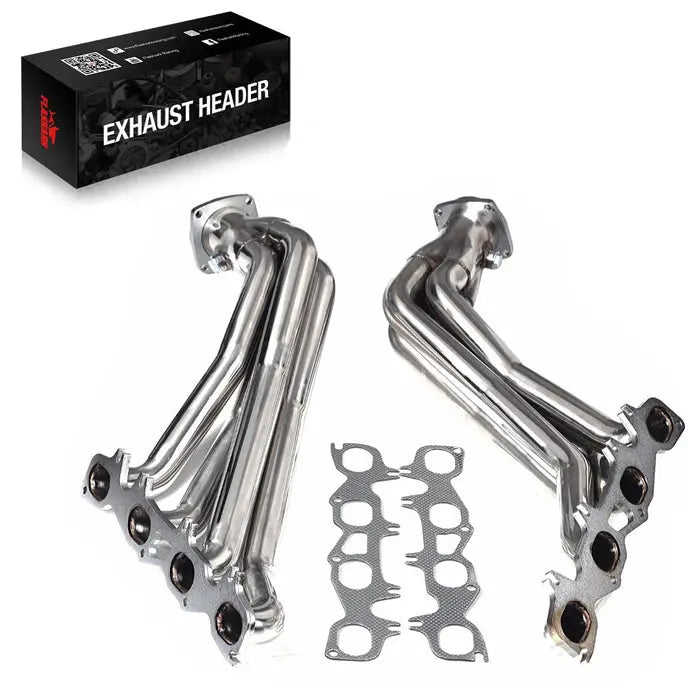
Colectores Flashark LX-Platform 5.7 HEMI 2005-2011
Esta opción está diseñada para aplicaciones HEMI de Dodge Challenger, Charger, Magnum y Chrysler 300C/300S de 2005-2011. Verifique el año, el motor, la configuración RWD, los planes de tubo intermedio y los requisitos de emisiones locales antes de comprar.
Precio de venta: $209.99 $300.00
Ver detalles del productoRealidad de la instalación: lo que suele salir mal
La instalación de colectores de tubo largo no es imposible. Pero tampoco son trabajos de "coge una llave de vaso y hazlo durante el descanso". Especialmente en camiones viejos con óxido, ciclos de calor y tornillos de fábrica que han estado viviendo cerca del calor del escape durante 100.000 millas.
Si planeas hacer el trabajo tú mismo, empieza con la guía de instalación de colectores de tubo largo para 5.7 HEMI, y luego sé honesto sobre tus herramientas, acceso al elevador y nivel de paciencia.

Tornillos del colector rotos y herrajes oxidados
En los camiones Ram 1500 5.7 HEMI, los tornillos del colector rotos no son raros. El colector de fábrica puede deformarse, la junta puede tener fugas y aparece el famoso tictac de arranque en frío. Una instalación de colectores puede reparar una fuga de escape cuando la fuga se encuentra realmente en el área del colector. No reparará un tictac de taqué, árbol de levas o tren de válvulas.
Fugas de escape después de la instalación
Una pequeña fuga puede arruinar todo el trabajo. Puede sonar como un tictac, alterar las lecturas de O2, crear un comportamiento de mezcla pobre falso y hacerte pensar que un colector o catalizador perfectamente bueno está defectuoso.
Después de la instalación, compruebe:
- Planitud de la brida del colector
- Patrón de aplastamiento de la junta
- Alineación de los pernos del colector o de la banda en V
- Juntas deslizantes
- Sellado del orificio del O2
- Conexión del tubo en Y o del tubo intermedio
- Contacto del tubo con travesaños, protectores térmicos o áreas del chasis
Gestión del calor
Los colectores largos mueven más tubos calientes a lugares para los que la fábrica no siempre planificó. Esto significa que los cables de las bujías, el área del motor de arranque, los arneses de los sensores de O2, los clips de plástico cercanos y las líneas de transmisión merecen atención.
La envoltura del colector no es mágica. El recubrimiento cerámico puede ayudar. Un buen enrutamiento ayuda más. Mantener los cables alejados de los tubos calientes es lo que más ayuda.
Caso en primera persona: Me llegó un Charger después de la instalación de un colector con un fuerte olor a quemado. El propietario pensó que el nuevo revestimiento se estaba curando. Lo subimos al elevador y descubrimos que el arnés de extensión del O2 estaba lo suficientemente cerca del tubo como para que el aislamiento hubiera empezado a cocinarse. Un error barato, pero podría haberse convertido en una pesadilla. Las bridas de plástico en el lugar equivocado no son gestión del calor.
¿Quién debe elegir catalizadores de alto flujo y quién debe ir sin catalizador?
Elija catalizadores de alto flujo si...
- Conduces el vehículo a diario.
- Quieres un sonido potente sin un olor constante a escape.
- Quieres un mejor comportamiento en la calle.
- Te preocupa el riesgo de inspección.
- Quieres una configuración más fácil de explicar a un taller, a un afinador o a un inspector.
- Quieres la mayor parte del rendimiento sin todos los inconvenientes de ir sin catalizador.
Elija sin catalizador si...
- El vehículo es solo para uso fuera de carretera/carreras.
- Quieres el sonido de escape más crudo posible.
- Ya tienes previsto un ajuste personalizado.
- Aceptas la luz de verificación del motor, la inspección, el olor y las limitaciones de uso en la calle.
- Estás construyendo pensando primero en el rendimiento y segundo en la comodidad.
Evita ambos hasta que compruebes esto primero
Si no conoces tu año exacto, transmisión, plataforma, diseño de escape, reglas de inspección y plan de ajuste, deja de comprar durante cinco minutos. Obtén esas respuestas primero.
Y si estás trabajando en otra plataforma por completo, no copies los consejos HEMI en una familia de motores diferente. Para opciones de colectores más amplias, empieza con la colección de colectores de escape de rendimiento de Flashark. Si tu otro proyecto es un camión LS, Vortec o small-block Chevy, usa la colección de colectores de escape Chevy en lugar de adivinar el ajuste de Mopar.
Rutas de configuración recomendadas para diferentes propietarios de 5.7 HEMI
Configuración de calle suave
Mejor ruta: colectores largos, catalizadores de alto flujo donde sea legal y apropiado, cat-back resonado, verificación cuidadosa de fugas y un ajuste conservador.
Esta es la configuración que recomendaría para un vehículo de uso diario donde el propietario aún quiere disfrutar del camión o automóvil sin luchar contra el zumbido, los humos y el drama repetido de la luz de verificación del motor.
Configuración de fin de semana ruidosa
Mejor camino: tubos largos, catalizadores de alto flujo o un tubo intermedio más agresivo, silenciadores de alto rendimiento y un ajuste que coincida con el hardware.
Esta es la ruta de "lo quiero ruidoso, pero no quiero odiar mi vida en la autopista".
Construcción de competición todoterreno
Mejor ruta: colectores largos sin catalizador, escape de competición, calibración profesional y una clara comprensión de que esta no es la recomendación normal para uso en la calle.
Esta ruta no es para todos. Suena salvaje. También conlleva la mayor responsabilidad.
Veredicto final: Catalizadores de alto flujo para la cordura en la calle, sin catalizador para la agresividad en carreras
Si tu 5.7 HEMI todavía circula por vías públicas, realiza largos viajes por carretera, pasa inspecciones, lleva pasajeros y lleva una vida normal, yo comenzaría con un plan de catalizadores de alto flujo donde las piezas, el vehículo y las normas locales encajen. Una configuración de colectores largos con catalizadores de alto flujo 5.7 HEMI te brinda un sonido más profundo, un mejor flujo y una sensación de rendimiento más fuerte sin saltar directamente a la opción más ruidosa y complicada.
Si estás construyendo un HEMI enfocado en la pista o para uso todoterreno/carreras y quieres el sonido más crudo posible, el hardware de colectores largos sin catalizador 5.7 HEMI puede tener sentido. Simplemente no pretendas que es la misma experiencia de propiedad. Es más ruidoso. Huele más. Requiere un ajuste. Conlleva un mayor riesgo de inspección.
Antigua regla del taller: la mejor configuración de escape no es la que suena más loca durante diez segundos en video. Es la que se adapta a tu vehículo, a tu ajuste, a tu estado y a tu tolerancia al ruido, al olor y a las luces del tablero.
Preguntas frecuentes: Colectores largos 5.7 HEMI con catalizadores de alto flujo vs. sin catalizador
P1: ¿Valen la pena los colectores largos con catalizadores de alto flujo en un 5.7 HEMI?
R1: Sí, para muchas configuraciones enfocadas en la calle valen la pena. Mejoran el flujo de escape, profundizan el sonido y pueden soportar ganancias de aproximadamente 18-30 whp con el ajuste adecuado y las piezas de apoyo. El gran beneficio es el equilibrio: mejor rendimiento sin el olor completo y el dolor de cabeza de la inspección de los tubos sin catalizador.
P2: ¿Los colectores largos sin catalizador hacen que un 5.7 HEMI sea más ruidoso?
R2: Sí. Los tubos largos sin catalizador suelen ser más ruidosos al arrancar en frío, al ralentí, en crucero y a aceleración máxima. También producen más resonancia y olor a escape crudo, especialmente con silenciadores de flujo directo o eliminadores de resonador.
P3: ¿Los catalizadores de alto flujo detendrán una luz de verificación del motor?
R3: No siempre. Los catalizadores de alto flujo pueden reducir el riesgo de que se encienda la luz de verificación del motor en comparación con los tubos sin catalizador, pero no garantizan un tablero limpio. Los códigos P0420 y P0430 aún pueden aparecer si la ECU detecta que la eficiencia del catalizador está fuera de su rango esperado.
P4: ¿Por qué los colectores de tubo largo de 5.7 HEMI activan el P0420 o el P0430?
R4: Los colectores de tubo largo cambian el flujo de escape, el calor y la ubicación del sensor de O2. Los sensores de O2 traseros pueden ver un patrón de oxígeno diferente al de serie, lo que puede hacer que la ECU piense que los convertidores catalíticos están funcionando por debajo de su rendimiento.
P5: ¿Necesito un ajuste para los colectores largos con catalizadores de alto flujo en un 5.7 HEMI?
R5: Se recomienda encarecidamente un ajuste. El vehículo puede arrancar y conducir sin uno, pero una calibración adecuada ayuda a corregir el suministro de combustible, la respuesta del acelerador, el comportamiento de los cambios y los problemas relacionados con la luz de verificación del motor.
P6: ¿Los colectores de tubo largo sin catalizador requieren un ajuste?
R6: Cuente con ello. Los tubos largos sin catalizador crean un cambio mucho mayor en el flujo de escape y en las lecturas del sensor de oxígeno trasero. Sin un ajuste adecuado, puede obtener CEL, mala manejabilidad, comportamiento rico o pobre, y una respuesta débil del acelerador parcial.
P7: ¿Los colectores de tubo largo sin catalizador son legales para uso en la calle?
R7: Las configuraciones sin catalizador deben tratarse como piezas para uso fuera de carretera o de carrera, no como hardware normal para uso en la calle. La legalidad en la calle depende de las normas federales, las normas estatales, el tipo de inspección y los requisitos de los equipos de emisiones.
P8: ¿Puede un 5.7 HEMI pasar las emisiones con catalizadores de alto flujo?
R8: Depende. El vehículo aún puede necesitar convertidores catalíticos conformes, una correcta preparación del OBD, sin CEL activo y puede que necesite pasar una inspección visual. Siempre verifique los requisitos estatales y locales antes de comprar.
P9: ¿Los catalizadores de alto flujo pierden mucha potencia en comparación con los sin catalizador?
R9: En un 5.7 HEMI de aspiración natural suave, la diferencia suele ser menor de lo que la gente espera. La calidad del ajuste, el diseño del colector, las fugas de escape, la disposición del tubo en Y, el diseño del cat-back y el estado del motor pueden importar más que la pequeña diferencia de flujo máximo.
P10: ¿Los colectores de tubo largo causarán zumbido en el escape?
R10: Los tubos largos pueden cambiar el tono, pero el zumbido suele ser causado por la combinación completa del escape. El tipo de silenciador, los resonadores, el diámetro del tubo, el estilo de la cabina, el comportamiento del MDS y el contacto del tubo pueden crear zumbido.
P11: ¿Qué suena mejor en un 5.7 HEMI, catalizadores de alto flujo o sin catalizador?
R11: Si desea un sonido profundo, fuerte y más limpio, los catalizadores de alto flujo suelen sonar mejor para el uso diario. Si desea el tono más fuerte, crudo y agresivo y el vehículo es para uso todoterreno/de carrera, los sin catalizador son más ruidosos.
P12: ¿Qué debo verificar antes de comprar colectores de tubo largo para un 5.7 HEMI?
R12: Verifique el año del modelo, la plataforma del vehículo, la disposición 2WD/RWD/4WD, las ubicaciones de los sensores de O2, la longitud del arnés de O2, el tamaño del colector, la compatibilidad del tubo en Y o del tubo intermedio, la conexión del cat-back, la distancia al suelo y los requisitos de emisiones.
P13: ¿Los catalizadores de alto flujo baratos pueden causar problemas con el CEL?
R13: Sí. Los catalizadores de alto flujo de baja calidad pueden tener una calidad inconsistente del sustrato interno, poca durabilidad al calor, soldaduras débiles o un comportamiento deficiente de almacenamiento de oxígeno. Cualquiera de ellos puede activar códigos de eficiencia del catalizador.
P14: ¿Son los espaciadores de O2 o los no ensuciadores una solución adecuada para los CEL?
R14: No son una solución de diagnóstico adecuada. Los foros hablan de ellos, pero pueden crear problemas de inspección, cumplimiento y resolución de problemas. Primero, verifique las fugas de escape, el estado del sensor, el hardware correcto y el ajuste adecuado.
P15: ¿Los colectores de tubo largo son mejores que los colectores cortos para un 5.7 HEMI?
R15: Para un rendimiento máximo y un sonido más agresivo, los tubos largos suelen ganar. Para una instalación más fácil, una menor interrupción de las emisiones y un conductor diario más estilo de fábrica, los colectores cortos suelen ser la opción más segura.

Steven Chen
Especialista en rendimiento automotriz | Sistemas de motor y escape
Steven se enfoca en el rendimiento práctico del motor, el ajuste del escape y las rutas de actualización del mundo real para vehículos clásicos y modernos para entusiastas. Revisa aplicaciones de Ford de bloque pequeño, LS, camiones y calle/pista con un objetivo en mente: ayudar a los constructores a elegir piezas que realmente funcionen juntas. Su filosofía: "La buena potencia comienza con la combinación correcta, no con la pieza más grande".