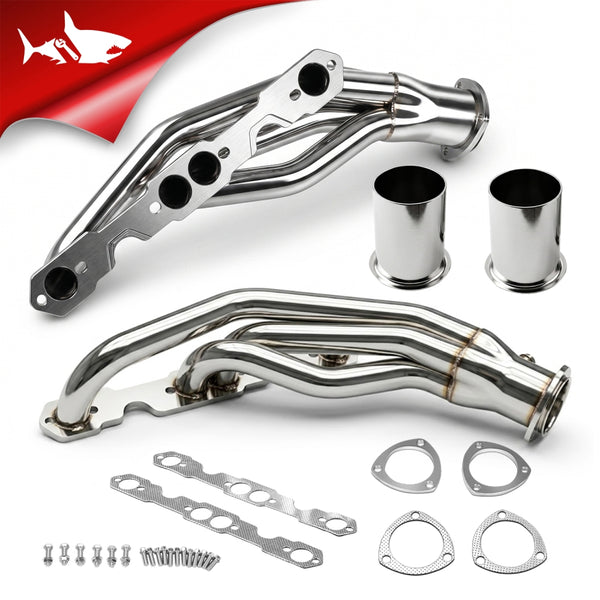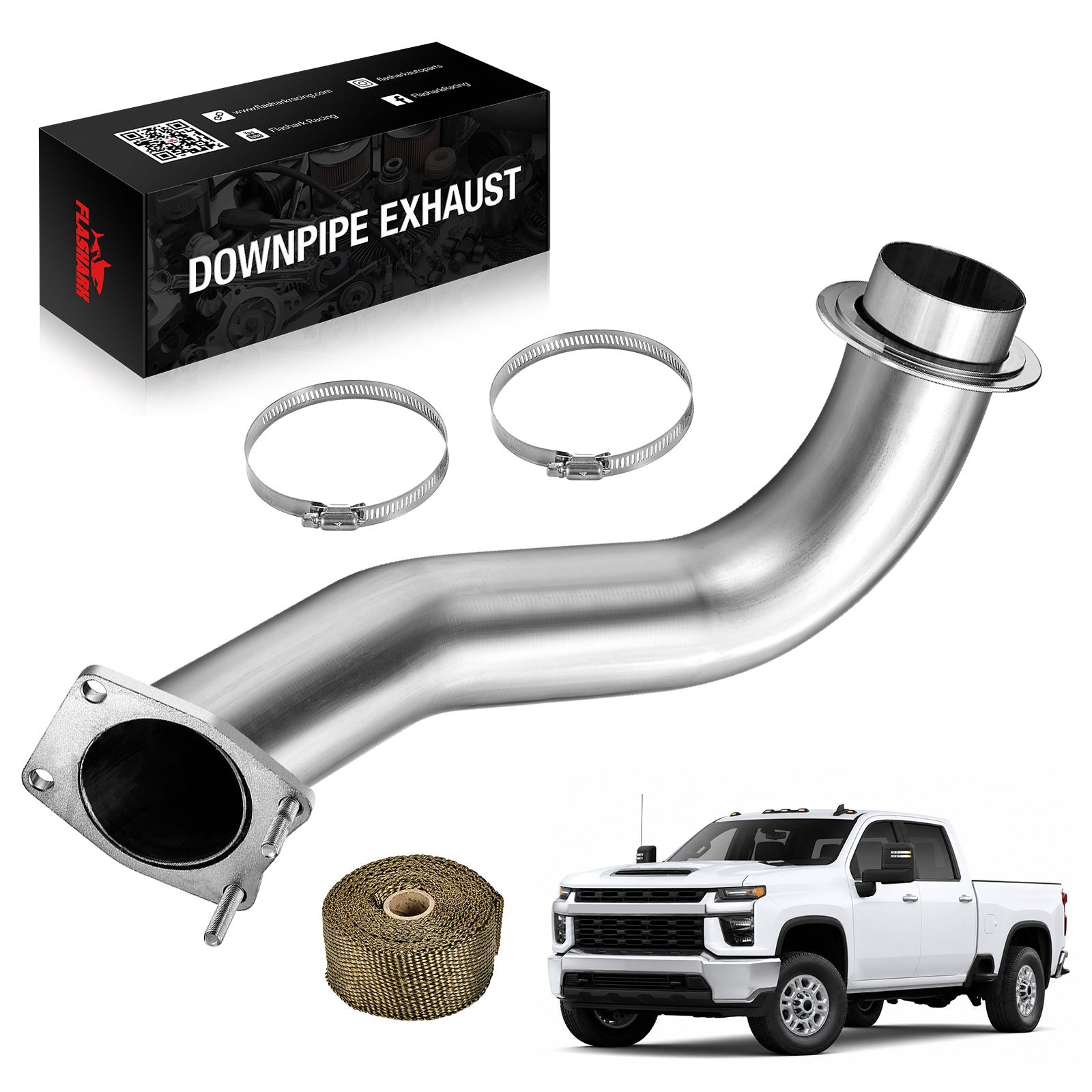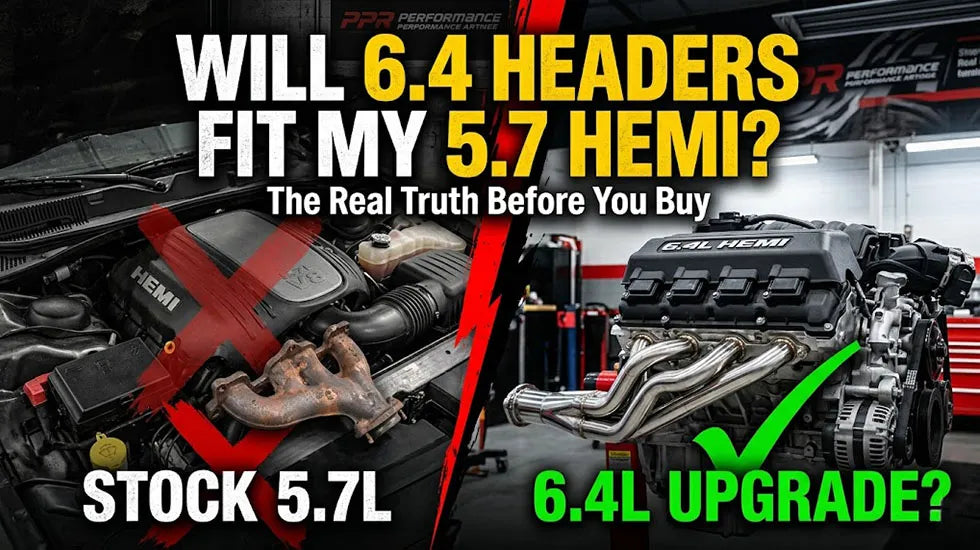
Así que encontraste un juego de colectores 6.4 HEMI. Quizás venían de un Scat Pack. Quizás un amigo tiene un par limpio guardado en el garaje. Quizás viste a alguien en línea decir: "Sí, se atornillan directamente a un 5.7".
Escucha, esa respuesta es solo a medias útil.
La verdadera pregunta no es solo si los colectores 6.4 HEMI caben en un 5.7 HEMI. La mejor pregunta es: ¿esos colectores encajarán en tu coche o camión exacto sin convertir la instalación en un dolor de cabeza de cortar, esmerilar y soldar? He visto a gente tener éxito con este cambio. También he visto a gente comprar colectores SRT usados baratos, pasar un sábado entero debajo del camión, y luego darse cuenta de que el colector apunta al lugar equivocado y que la tubería central de fábrica ni siquiera se acerca.
Esta guía está escrita de la manera en que lo explicaría en el taller: primero el ajuste del motor, segundo el ajuste del vehículo, tercero la conexión del escape, y los aspectos legales antes de que te metas en problemas.
Respuesta Rápida: ¿Los Colectores 6.4 Caben en un 5.7 HEMI?
- A veces, sí: ciertos colectores de fábrica tipo "shorty" de 6.4 HEMI o colectores de posventa pueden atornillarse físicamente a algunas culatas de 5.7 HEMI.
- Pero no siempre como un "bolt-on": los problemas reales de ajuste suelen provenir del chasis, el ángulo del colector, la conexión del catalizador, el tubo intermedio, el tubo en Y, la ubicación del sensor de O2, la columna de dirección y la holgura 2WD/4WD/AWD.
- Los coches Ram y LX no son lo mismo: un colector que encaja en un Challenger o Charger 5.7 puede no encajar en una Ram 1500 5.7 sin modificaciones.
- Los colectores "shorty" son más fáciles: suelen ser más parecidos a un reemplazo de múltiple. Los colectores largos (long tube) son mejores para la potencia, pero conllevan más problemas de instalación, ajuste y emisiones.
- La regla segura: compra colectores por año, marca, modelo, motor, transmisión y configuración de emisiones, no solo por "5.7 vs 6.4".

El Ajuste del Motor No Es lo Mismo Que el Ajuste del Vehículo
Aquí es donde comienza mucho de los malos consejos. Alguien dice: "La brida del colector 6.4 se alinea con la culata 5.7". Bien. Eso puede ser cierto en algunos casos. La familia HEMI Gen III comparte suficiente arquitectura como para que la idea no sea descabellada.
Pero un colector no es solo una brida plana atornillada a una culata. Es un conjunto de tubos que tiene que serpentear por el chasis, el motor de arranque, la columna de dirección, los soportes del motor, la transmisión, los protectores térmicos, los catalizadores y el cableado del sensor de O2. Ahí es donde el cambio funciona limpiamente o se vuelve feo.
Regla del mecánico: un colector puede encajar en el motor y aun así ser el colector equivocado para el vehículo.
Por Qué el 5.7 y el 6.4 HEMI Parecen Compatibles en el Papel
El 5.7 HEMI y el 6.4 HEMI son ambos V8 modernos de Mopar, y mucha gente se centra primero en el lado de la culata. Miran la forma del puerto de escape, la disposición de la brida y el patrón de los pernos. Esa es la parte fácil de entender, por lo que, naturalmente, se repite en los foros.
Pero el ajuste en el papel no te dice si la salida aterriza en el lugar correcto. No te dice si los catalizadores de fábrica pueden quedarse. No te dice si el cable del sensor de O2 aguas abajo llegará. Definitivamente no te dice si el tubo del lado del pasajero va a rozar el larguero del chasis bajo carga.
Dónde Comienza Realmente el Problema de Ajuste
La mayoría de las instalaciones fallidas que he visto no fueron porque la brida estuviera totalmente equivocada. Fallaron debido a las piezas después de la brida:
- Ángulo del colector y posición de salida
- Estilo de brida del convertidor catalítico
- Ubicación del tubo intermedio o tubo en Y de fábrica
- Colocación del orificio del sensor de O2
- Longitud del arnés del sensor de O2
- Espacio libre de la columna de dirección
- Espacio libre del larguero del chasis
- Espacio libre del travesaño de la transmisión
- Paquete 2WD, 4WD, RWD o AWD
- Diferencias de chasis entre Ram 1500 y Ram 2500/3500
Por eso la respuesta a si los colectores 6.4 en un 5.7 HEMI tiene que ser condicional. La misma familia de motores ayuda. La misma plataforma de vehículo importa más.

Colectores OEM 6.4 vs Colectores Largos Aftermarket
Antes de comprar nada, define lo que quieres decir con "colectores 6.4". Esta frase se usa con demasiada ligereza.
Lo que la Gente Suele Entender por Colectores 6.4
La mayoría de los propietarios se refieren a uno de estos:
- Colectores de fábrica estilo "shorty" de 6.4 SRT o 392
- Colectores Scat Pack usados retirados durante una mejora
- Colectores "shorty" de posventa listados para aplicaciones 6.4 HEMI
- Colectores largos de posventa para coches 6.4
- Colectores de un Charger o Challenger que alguien quiere instalar en una Ram 5.7
Esas no son la misma cosa. Un colector de fábrica 6.4 usado es un proyecto muy diferente a un juego de colectores largos con salidas de 3 pulgadas. Uno podría ser un reemplazo práctico estilo múltiple. El otro puede necesitar tubos intermedios a juego, extensiones de O2, afinación y verificaciones de holgura serias.
Por Qué los Colectores "Shorty" OEM 6.4 Son Populares para Propietarios de 5.7
Son tentadores. Lo entiendo. Un juego usado podría ser más barato que un kit de colectores nuevo. Se ven mejor que los feos múltiples de hierro fundido de serie. Y si tu 5.7 tiene ese "tic" al arrancar en frío por una fuga en el múltiple, cualquier cosa que parezca más fuerte empieza a sentirse como la respuesta.
Pero las piezas baratas pueden resultar caras rápidamente. Si los catalizadores no se alinean, el ángulo de salida es incorrecto o falta la tornillería, el "barato" cambio a 6.4 puede costar más que un kit de colectores específico para 5.7.
Por Qué los Colectores Largos Son un Trabajo Diferente
Los colectores largos no son solo un reemplazo de múltiple. Cambian toda la sección delantera del recorrido del escape. El colector está más abajo. Los convertidores catalíticos pueden moverse. Los sensores de O2 pueden ver diferentes temperaturas de escape y comportamiento del flujo. La afinación puede necesitar atención.
Esa es también la razón por la que los colectores largos pueden generar más potencia. En un HEMI 5.7 en buen estado, un conjunto de colectores largos bien combinados con el escape y la afinación adecuados pueden mostrar a menudo entre 20 y 35 caballos de fuerza a la rueda en un dinamómetro. Los colectores "shorty" suelen ser más modestos, a menudo cerca de 8-12 caballos de fuerza a la rueda, dependiendo del vehículo, la afinación y la configuración del escape. Los números reales varían. Un motor viejo, catalizadores obstruidos, una afinación débil, una mala instalación, todo eso cambia el resultado.
Múltiples de Serie vs Colectores "Shorty" 6.4 vs Colectores Largos
| Configuración | Mejor Para | Cambio Típico de WHP | Dificultad de Instalación | Problema Común |
|---|---|---|---|---|
| Múltiples de Fundición Stock 5.7 | Reemplazo de fábrica, conducción diaria silenciosa | Línea base | Medio si los pernos están limpios | Múltiples deformados y pernos rotos |
| Colectores 6.4 OEM / SRT Estilo Shorty | Cambio económico, mejora del múltiple, mejora leve del sonido | A menudo modesto; aproximadamente 5-12 whp cuando la configuración funciona bien | Medio a alto, dependiendo de la plataforma | La conexión aguas abajo puede no alinearse |
| Colectores Shorty Específicos para 5.7 | Conductores diarios, "tick" HEMI por fugas en el múltiple, reemplazo más fácil | Aproximadamente 8-12 whp en muchas configuraciones 5.7 suaves | Medio | Aún requiere trabajo cuidadoso de juntas y pernos |
| Colectores Largos Específicos para 5.7 | Construcciones de rendimiento, sonido más fuerte, configuraciones ajustadas | Aproximadamente 20-35 whp con modificaciones de soporte y ajuste adecuados | Alto | Trabajo de ajuste, O2, catalizadores y tubo intermedio |
Ajuste por Plataforma de Vehículo: Ram, Challenger, Charger y 300
Aquí es donde debes ir con calma. No compres colectores solo porque otro propietario de un 5.7 dijo que funcionaban. Pregúntale qué vehículo tenía. Pregúntale si era RWD o AWD. Pregúntale si era una camioneta. Pregúntale si mantuvo los catalizadores de fábrica. Pregúntale si tuvo que soldar algo.
Dodge Challenger, Dodge Charger, Chrysler 300 y Magnum
La multitud de LX/LC/LD tiene la mejor oportunidad de que la discusión sobre colectores de aplicación cruzada tenga sentido, especialmente cuando el kit de colectores está realmente diseñado para cubrir aplicaciones HEMI de 5.7L y mayores dentro de esa misma plataforma de automóvil. Pero incluso aquí, aún necesitas verificar el año del modelo, la transmisión, la configuración de la dirección, RWD/AWD y la conexión del escape.
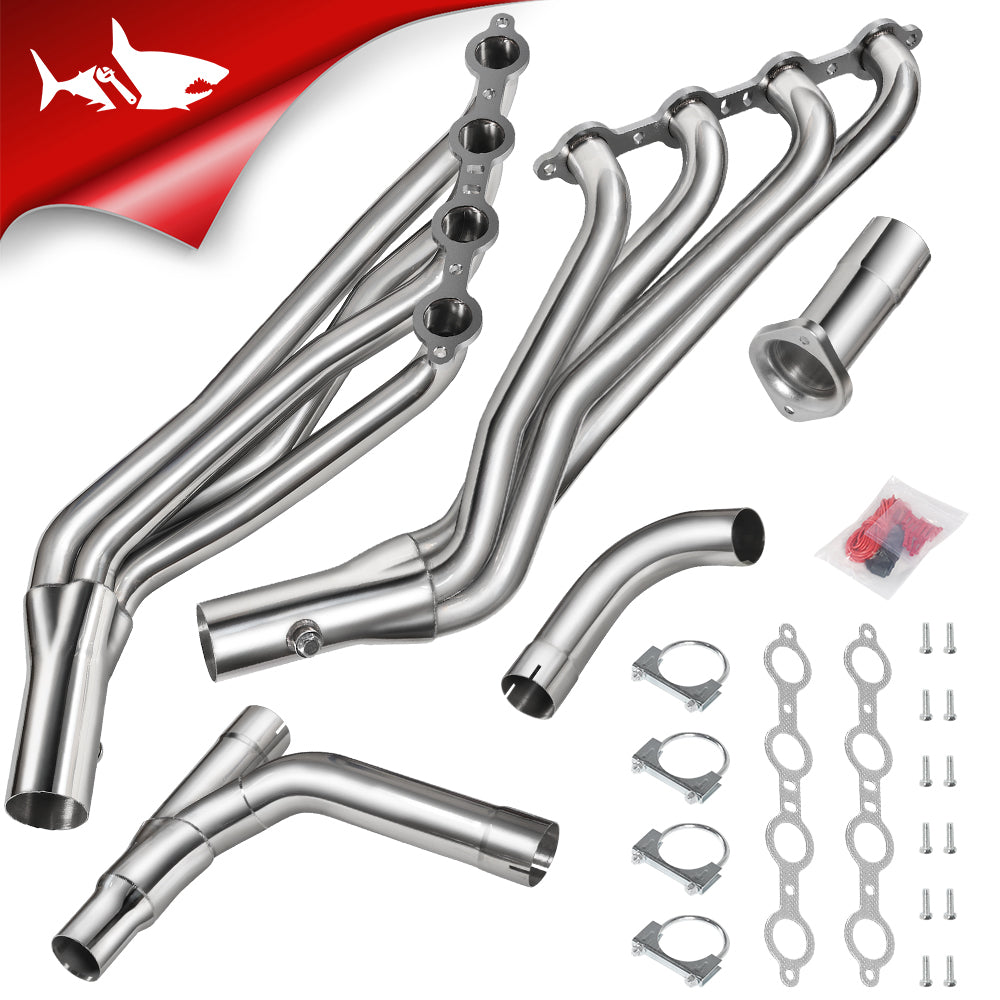
Si estás trabajando en un Chrysler 300C, Charger, Challenger o Magnum de 2005-2011 con un HEMI 5.7L y quieres una ruta de rendimiento de ajuste conocido, un kit de colectores largos específico para el coche suele ser más limpio que arriesgarse con piezas de desecho 6.4 usadas. Para esa plataforma, Flashark ofrece colectores largos para Chrysler 300C 5.7 HEMI 2005-2011 construidos alrededor de esas aplicaciones de coches HEMI 5.7L/6.1L anteriores.
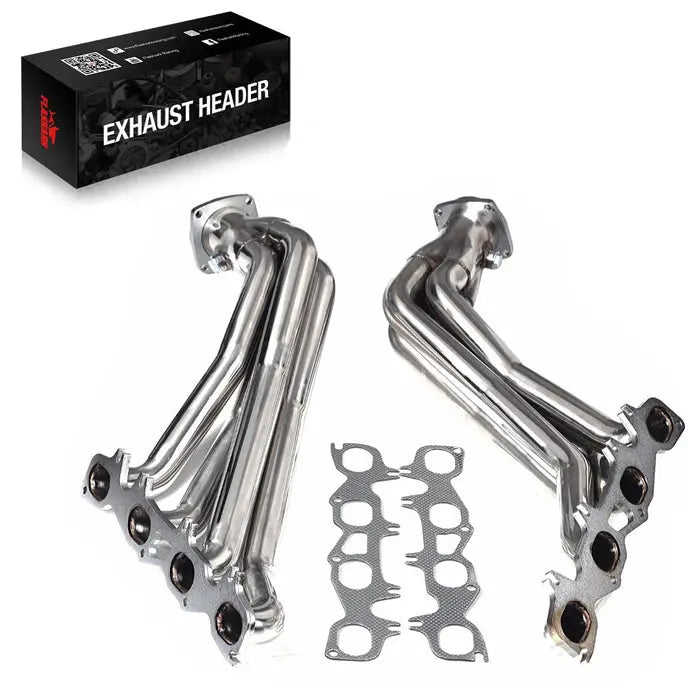
Colectores Largos Flashark para Chrysler/Dodge 5.7L HEMI 2005-2011
El mejor ajuste para coches HEMI 5.7L estilo LX anteriores, donde una configuración de tubo largo específica para el coche tiene más sentido que adivinar con colectores 6.4 usados.
Precio de venta: $209.99 $300.00
Verificar compatibilidadRam 1500 5.7 HEMI
La Ram es donde mucha gente se quema. El compartimento del motor de una camioneta no es el mismo animal que el compartimento del motor de un Challenger. El chasis, la columna de dirección, la suspensión, el eje delantero en los modelos 4x4 y el tubo en Y de fábrica pueden cambiar todo el trabajo.
Para un propietario de una Ram 1500 5.7 de 2009-2018, suelo decir a la gente que deje de comprar por motor donante y empiece a comprar por ajuste de la camioneta. Si quieres la ruta más segura, busca un kit de colectores diseñado para la camioneta, como los colectores cortos y largos para Dodge Ram 1500 5.7 HEMI 2009-2018. Eso te da un mejor punto de partida que pedirle a una pieza de Challenger 6.4 que se comporte en un chasis de camioneta.

Colectores Cortos y Largos Flashark para Ram 1500 5.7L HEMI 2009-2018
Usa la opción de colectores cortos para un reemplazo de múltiple más limpio para el uso diario. Usa la opción de colectores largos cuando tu objetivo sea un flujo más fuerte, un sonido más potente y una construcción de rendimiento con afinación.
Precio de venta: $209.99 $399.99
Verificar compatibilidadCamiones Ram 2500 y Ram 3500 HEMI
No mezcles el ajuste de la Ram HD con el ajuste de la Ram 1500 a menos que el fabricante lo indique. Lo digo en serio. Los camiones 2500 y 3500 tienen un empaquetado del chasis, una disposición de la suspensión y un enrutamiento del escape diferentes. Una pieza que encaja en un 1500 puede ser completamente incorrecta para un camión de servicio pesado.
Aquí también es donde muchas preguntas sobre colectores de camión 6.4 usados se vuelven complicadas. Un HEMI 6.4 de un camión HD no es el mismo problema de ajuste que un Scat Pack 6.4. El mismo número de cilindrada. Un mundo diferente debajo del vehículo.
Aplicaciones Jeep, Durango y Otros SUV
Los propietarios de SUV deben ser aún más cuidadosos. El empaquetado AWD/4WD, la holgura del diferencial delantero y un enrutamiento de escape más ajustado pueden arruinar una instalación rápidamente. No apliques los consejos de los foros de Charger, Challenger o Ram directamente a un Grand Cherokee, Durango o Jeep a menos que se haya confirmado la misma plataforma.
Las Piezas que Debes Revisar Antes de Decir "Encaja"
Antes de comprar colectores usados, pide fotos al vendedor. No una foto borrosa desde tres metros de distancia. Quieres fotos de las bridas, de los colectores, de los orificios de los sensores de O2 y fotos de la conexión aguas abajo. Si el vendedor no puede mostrarte eso, considera el riesgo en el precio.
Patrón de Pernos de la Culata y Forma del Puerto de Escape
Este es el primer paso. Compara la forma de la junta, el espaciado de los puertos, la disposición de los orificios de los pernos y el grosor de la brida. Si la brida no asienta plana o los puertos no se alinean limpiamente, detente ahí mismo.
Pero de nuevo, no detengas tu inspección en la brida. Así es como la gente termina con un arte mural brillante en lugar de colectores funcionales.
Ángulo del Colector y Posición de Salida
Esta es la parte que arruina los fines de semana. El colector puede apuntar demasiado hacia abajo, demasiado hacia adentro, demasiado hacia afuera o quedar a varios centímetros de tu tubo intermedio. En una configuración de tubo largo, incluso una pulgada puede importar. En una camioneta, una pulgada puede ser la diferencia entre "cabe" y "roza el chasis cuando el motor se tuerce".
Conexión del Convertidor Catalítico y Tubo Intermedio
Aquí está la parte cara. Si la salida del colector no coincide con tus catalizadores o tubo intermedio, te espera trabajo de fabricación. Eso puede significar cortar, soldar, comprar un tubo intermedio a juego o cambiar la ubicación del convertidor catalítico.
Para un vehículo que circula por la calle, esto no es solo un problema de rendimiento. Es un problema legal. Si el cambio elimina, reubica o modifica los convertidores catalíticos, necesitas comprender las leyes de emisiones de tu estado antes de pedir piezas. Los compradores de California, especialmente, deben verificar el estado de la Orden Ejecutiva (EO) de CARB y la legalidad para el uso en carretera antes de tocar piezas relacionadas con las emisiones.
Ubicación de la Rosca del Sensor de O2 y Longitud del Arnés
No jales los cables del O2 para que "alcancen". He visto ese error más de una vez. El cable se estira, el aislamiento se quema cerca del tubo del colector, y el propietario regresa con un código de calentador de O2 o un código de respuesta lenta dos días después.
Si la posición del sensor de O2 se mueve, usa las extensiones adecuadas donde sea necesario, mantén el arnés alejado del calor y asegúrate de que el ángulo del sensor no acumule condensación. Es un trabajo aburrido, pero importante.
Juntas, Pernos, Espárragos y Pernos del Múltiple Rotos
Recuerdo una Ram 1500 de 2018 que llegó al taller con el clásico "tic" al arrancar en frío. El dueño pensó que el motor estaba dañado. Ya había visto tres videos y pedido un juego usado de colectores desmontados porque alguien le dijo que era "básicamente atornillar". Quitamos el lado del pasajero y encontramos dos pernos del múltiple rotos, una orejeta del múltiple deformada y un rastro de hollín negro justo en el borde de la junta.

Los colectores no fueron la parte difícil. Lo difícil fue extraer los pernos rotos sin dañar la culata, limpiar la superficie de sellado, revisar la brida y asegurarse de que la nueva tornillería sujetara de manera uniforme. Ese trabajo pasó de "cambio rápido de colectores" a una tarde entera muy rápido.
Muchos novatos se apresuran en este paso. Raspan mal la superficie de la junta, reutilizan pernos gastados, omiten el compuesto antigripante donde tiene sentido y aprietan desde un extremo como si estuvieran atornillando una silla de jardín. Luego se preguntan por qué el "tic" vuelve.
Consejo de taller: si el objetivo es arreglar una fuga en el escape, la calidad del sellado importa más que el brillo del tubo. Brida plana, junta nueva, superficie limpia, secuencia de apriete adecuada. No te saltes esos pasos.
Si quieres un desglose más profundo sobre la decisión entre múltiples y colectores, lee esta guía relacionada de Flashark sobre colectores 5.7 HEMI vs múltiples de escape de serie. Es un buen seguimiento interno para decidir si realmente necesitas colectores cortos, largos o simplemente una reparación adecuada del múltiple.
Ganancias de potencia: lo que los colectores 6.4 pueden y no pueden hacer en un 5.7 HEMI
Primero, acabemos con la fantasía. Un cambio de colectores no es un botón mágico de 70 caballos en un 5.7 de serie. Si un anuncio o una publicación en un foro lo hacen sonar así, retrocede.
Los colectores cortos no son magia en potencia
Los colectores cortos pueden ser útiles. Pueden mejorar el flujo de escape en comparación con los múltiples de serie restrictivos o deformados. Pueden agudizar el sonido. Pueden ayudar a solucionar una situación de fuga en el múltiple. Pero en un 5.7 HEMI mayormente de serie, los colectores cortos suelen ofrecer una ganancia modesta, no un camión o coche completamente diferente.
En realidad, en muchas configuraciones suaves, piensa en aproximadamente 8-12 whp cuando todo está en buen estado y el lado del escape no te está dando problemas. A veces menos. A veces la mayor "ganancia" es que la fuga del escape ha desaparecido y el motor finalmente suena bien de nuevo.
Los colectores largos tienen más sentido para la potencia
Los colectores largos es donde los números empiezan a tener más sentido. Los primarios más largos ayudan al barrido. El motor respira mejor a revoluciones medias-altas. Combínalos con una admisión adecuada, un cat-back, una reprogramación y un tubo intermedio limpio, y el 5.7 se despierta.
En una construcción de 5.7 HEMI bien ajustada, los colectores largos a menudo pueden mostrar aproximadamente 20-35 whp dependiendo de la reprogramación, el escape, el estado de la leva, la admisión y la condición del motor. Un coche o camión con levas puede beneficiarse aún más porque el motor realmente tiene una mayor demanda de flujo de aire.
Para una discusión más amplia sobre la potencia en diferentes configuraciones de V8, también puedes consultar la guía de Flashark sobre cuánta potencia añaden los colectores largos. Esa pieza es útil cuando intentas separar las ganancias realistas en el dinamómetro del ruido de internet.
Por qué una reprogramación cambia el resultado
Una reprogramación no hace mágicamente que unos colectores malos sean buenos. Pero con los colectores largos, ayuda al motor a utilizar el nuevo flujo de aire. Puede mejorar el suministro de combustible, la respuesta del acelerador, la estrategia de encendido y la facilidad de conducción. También puede ayudar a diagnosticar si el coche está realmente contento después del cambio.
No utilices la reprogramación como una forma perezosa de ocultar una mala instalación. Si los colectores tienen fugas, el cableado de la sonda lambda está quemado o los catalizadores no funcionan correctamente, arregla primero el problema mecánico.
Diferencia de sonido: ¿Los colectores 6.4 harán que un 5.7 HEMI sea más ruidoso?
Sí, generalmente. Pero cuán más ruidoso depende del tipo de colector y del resto del escape.
Qué cambia con los colectores cortos
Los colectores cortos suelen añadir una nota de escape más limpia y nítida. El arranque en frío puede tener un sonido un poco más fuerte. Los acelerones suenan un poco más metálicos. En una camioneta, es posible que escuches más el carácter HEMI bajo carga sin que el habitáculo sea insoportable.
Si mantienes los catalizadores y silenciadores de fábrica, no esperes que el sonido se convierta en una configuración de carrera completa. Eso no es lo que mejor hacen los colectores cortos.
Qué cambia con los colectores largos
Los colectores largos son otra historia. Profundizan el tono, aumentan el volumen y hacen que el escape se sienta más vivo por encima de las 3.000 rpm. Con un cat-back agresivo o la eliminación del silenciador, pueden volverse ruidosos. Muy ruidosos. Los arranques en frío pueden volverse tan ruidosos que molesten a los vecinos.
¿Y el zumbido? Sí, puede ocurrir. Especialmente en camiones y coches equipados con MDS con la combinación incorrecta de silenciador/resonador.
Advertencia para el conductor diario
Si este es tu coche de uso diario, no tomes la decisión basándote solo en un video de arranque en frío. Pregunta cómo suena a 65-75 mph. Pregunta por el zumbido con poco acelerador. Pregunta si el dueño mantuvo los resonadores. A internet le encantan los arranques en frío. Tus oídos viven en la autopista.
Reprogramación, luz de "check engine" y problemas con el sensor de O2 después de los cambios de colectores
Aquí es donde muchas historias de "cambio fácil" se callan. Los colectores se instalan, el coche suena brutal, el propietario está contento durante 30 millas, y luego se enciende la luz de "check engine".

Por qué los colectores largos a menudo activan las luces de "Check Engine"
Los colectores largos pueden cambiar la ubicación de los catalizadores y la rapidez con la que se calientan. Pueden cambiar la temperatura de los gases de escape que ven los sensores de O2. Si los sensores de O2 traseros ven algo que a la ECU no le gusta, es posible que obtengas códigos de eficiencia catalítica.
Los problemas comunes incluyen:
- Códigos de eficiencia catalítica P0420 o P0430
- Códigos de respuesta lenta del sensor de O2
- Códigos del circuito del calentador de O2
- Monitores de preparación que no se completan
- Ralentí irregular causado por fugas de escape antes del sensor de O2
- Lecturas falsas de mezcla pobre debido a un sellado deficiente
¿Se puede conducir sin una reprogramación?
Con colectores cortos, algunos propietarios se las arreglan sin reprogramación si los catalizadores y la disposición de los sensores de O2 se mantienen cerca de los de serie. Con colectores largos, yo presupuestaría una reprogramación. No porque el motor explote instantáneamente sin ella, sino porque la facilidad de conducción, el suministro de combustible, el comportamiento de la luz de "check engine" y el rendimiento general suelen ser mejores cuando la calibración coincide con el hardware.
Si estás planeando una instalación de colectores largos por tu cuenta, esta guía interna paso a paso sobre cómo instalar colectores largos en un 5.7 HEMI vale la pena leerla antes de subir el camión a los gatos.
Emisiones y problemas de legalidad en la calle en Estados Unidos
Lo sé. Hablar de legalidad no es divertido. Pero es más barato que no pasar la inspección o quedarse con piezas que no puedes usar en un coche de calle.
Por qué los cambios de colectores pueden convertirse en un problema de emisiones
Los colectores pueden afectar las emisiones cuando cambian la ubicación del catalizador, eliminan los catalizadores de fábrica, alteran el comportamiento de los sensores de O2 o afectan la preparación OBD. En algunos estados, el coche puede ser revisado visualmente. En otros, los monitores OBD son lo más importante. En California, el estado de CARB EO puede decidir si la pieza es legal para uso en la calle en un vehículo específico.
CARB EO, 50 estados legal y solo para uso fuera de carretera
- CARB EO: la pieza tiene una Orden Ejecutiva para aplicaciones específicas. Siempre verifica el año, la marca, el modelo y el motor exactos.
- Legal en 50 estados: afirmación de uso en la calle más fuerte, pero aún así confirma la aplicación y documentación exactas del producto.
- Solo para uso fuera de carretera: generalmente no destinado a vehículos con control de emisiones que circulan por la calle.
- Solo para uso en carreras: debe tratarse como uso en competición en pista cerrada, no para uso en vías públicas.
Si tu estado tiene una inspección estricta, no compres colectores primero y preguntes sobre cuestiones legales después. Eso es al revés.
Colectores 6.4 usados: ¿ganga barata o error costoso?
Los colectores usados de SRT o 392 pueden ser una buena oferta para la persona adecuada. También pueden ser una trampa. Depende de lo que obtengas con ellos y del vehículo del que procedan.
Qué inspeccionar antes de comprar
- Año, modelo, transmisión y motor del vehículo donante
- Planitud de la brida
- Grietas alrededor de las soldaduras o las zonas del colector
- Estado de los orificios del sensor de O2
- Tubos de salida cortados o modificados
- Espárragos, tornillos o herrajes faltantes
- Daños en la superficie de la junta
- Estilo de conexión del catalizador o del tubo intermedio
- Evidencia de raspaduras, golpes o daños por calor
Cuando un kit de colectores nuevo específico para 5.7 es más seguro
Si no quieres fabricar, soldar o buscar piezas faltantes, un kit de colectores específico para el vehículo suele ser la compra más inteligente. Ahí es donde una marca como Flashark encaja naturalmente en la decisión. No solo estás comprando tubos brillantes. Estás comprando un kit construido alrededor de una aplicación de vehículo conocida, con ajuste del producto, hardware y una ruta de instalación más clara.
Para opciones más amplias fuera de los ejemplos específicos de HEMI en este artículo, la colección de colectores de escape de alto rendimiento de Flashark es la página más adecuada para buscar por plataforma de vehículo en lugar de adivinar basándose solo en la familia de motores.
Dificultad de instalación: Lo que un mecánico comprobaría primero
Antes de siquiera coger una llave, quiero la historia completa del vehículo. Año. Modelo. Motor. Transmisión. Configuración del escape. Situación de la inspección estatal. Nivel de óxido. Si el propietario quiere un manejo diario silencioso o un sonido total.
Lista de verificación previa a la instalación
- Confirmar año, marca, modelo y submodelo
- Confirmar la generación y aplicación del motor 5.7 HEMI
- Confirmar la fuente de los colectores donantes si se utilizan colectores 6.4
- Comprobar el diseño RWD, AWD, 2WD o 4WD
- Inspeccionar los catalizadores de fábrica y la posición del tubo intermedio
- Contar los sensores de O2 e inspeccionar el recorrido del cableado
- Comprobar el árbol de dirección y la holgura del chasis
- Verificar el hardware del colector, las juntas y la calidad de la brida
- Planificar la extracción de tornillos de colector rotos
- Comprobar la legalidad de las emisiones antes de la instalación
Sorpresas comunes en la instalación
Aquí está la fea lista. No para asustarte. Para salvar tu fin de semana.
- Tornillos rotos atascados en la culata
- Sensores de O2 viejos atascados en su lugar
- Escudos térmicos que dificultan cada ángulo de la llave
- Colector que no coincide con el tubo intermedio de fábrica
- Tubo del colector demasiado cerca del árbol de dirección
- Problemas de holgura con el motor de arranque o la transmisión
- Cableado demasiado cerca del tubo después de la instalación
- Fuga de escape por un par de torsión desigual de la brida
- Luz de "check engine" después del primer ciclo de conducción
¿Instalación por cuenta propia o en taller?
Si tienes un elevador, un soplete, herramientas para tornillos rotos, llaves de vaso para sensores de O2, mucha paciencia y tiempo real para trabajar, puedes hacer mucho en casa. Si estás instalando colectores largos con el coche en caballetes por primera vez, sé honesto contigo mismo. Esto no es lo mismo que cambiar un tubo de admisión.
Para camiones oxidados, problemas de espacio en 4x4 o cualquier trabajo que implique soldadura y trabajo con catalizadores, un taller profesional suele valer la pena la factura de mano de obra.
La mejor elección para diferentes propietarios de 5.7 HEMI
Lo mejor para arreglar fugas de escape o el "HEMI Tick"
Si el "tick" se debe a una fuga en el múltiple de escape, una brida deformada o tornillos del múltiple rotos, concéntrate primero en el sellado y la durabilidad. Los colectores cortos o una ruta de reemplazo de múltiple adecuada y específica para el 5.7 pueden tener más sentido que las piezas usadas aleatorias de un 6.4.
Pero ten cuidado: si el "tick" es un ruido interno de los taqués o del tren de válvulas, los colectores no lo arreglarán. No gastes dinero en piezas de escape para un problema del motor.
Lo mejor para la conducción diaria
Para un conductor diario, me gustan los colectores cortos o una configuración conservadora de colectores largos con catalizadores y un escape suave. Que sea habitable. Que sea fácil de mantener. Que el cableado del sensor de O2 esté limpio. No construyas un camión que suene increíble durante tres minutos y te moleste durante tres años.
Lo mejor para ganancias de potencia
Para la potencia, los colectores largos ganan. Combínalos con un tubo intermedio adecuado, catalizadores sanos o una configuración legal para carreras cuando sea aplicable, un buen cat-back y una reprogramación. Ahí es donde el 5.7 se siente menos ahogado. Ahí es también donde el coste sube rápidamente.
Lo mejor para compradores con presupuesto limitado
Los colectores 6.4 usados pueden tener sentido si sabes exactamente de dónde provienen y te sientes cómodo resolviendo problemas de ajuste. Si los compras solo porque son baratos, frena. Barato más desconocido suele ser igual a caro.
Quién no debería comprar colectores 6.4 para un 5.7
- Cualquiera que espere un ajuste garantizado del 100% atornillable
- Propietarios que no modificarán o reemplazarán el tubo intermedio si es necesario
- Conductores de estados con emisiones estrictas sin documentación legal
- Propietarios de AWD o 4WD que no han confirmado la holgura
- Propietarios de Ram 1500 que compran piezas de Charger/Challenger sin medir
- Compradores de colectores largos que se niegan a presupuestar la reprogramación
- Cualquiera que intente arreglar el "tick" interno del taqué HEMI con piezas de escape
Veredicto final: ¿Deberías poner colectores 6.4 en un 5.7 HEMI?
Aquí está el veredicto honesto: la pregunta de si los colectores 6.4 encajarán en un 5.7 HEMI no es un sí o no. Algunos pueden atornillarse físicamente. Algunos pueden funcionar bien. Otros son una mala idea para tu vehículo exacto.
Si tienes la misma plataforma, la ubicación de salida correcta, catalizadores o tubo intermedio compatibles, una ubicación limpia del sensor de O2 y ningún problema de holgura, los colectores estilo 6.4 pueden ser una mejora práctica. Si estás mezclando una pieza de Challenger 6.4 en una camioneta Ram, adivinando la holgura en 4x4 o ignorando las emisiones, estás apostando.
La regla de compra más clara es simple:
Compra los colectores primero para el vehículo, después para el motor. Un colector 6.4 que encaja en una culata 5.7 aún puede ser el colector equivocado para tu coche o camioneta.
Si quieres menos complicaciones, elige un kit de colectores diseñado para tu aplicación real de 5.7 HEMI. Eso no es tan emocionante como una ganga en un foro. Suele ser más barato cuando el trabajo está terminado.
Preguntas frecuentes sobre los colectores 6.4 en un 5.7 HEMI
P1: ¿Los colectores 6.4 se ajustarán a un 5.7 HEMI?
R1: Algunos colectores de 6.4 HEMI pueden atornillarse físicamente a ciertas culatas de 5.7 HEMI, pero eso no garantiza el ajuste completo del vehículo. Aún debes confirmar la holgura del chasis, la posición del colector, los catalizadores, los sensores de O2 y la conexión del tubo intermedio.
P2: ¿Son los colectores 6.4 HEMI iguales que los 5.7 HEMI?
R2: No siempre. La disposición del lado del motor puede ser similar en algunos casos, pero el ángulo de salida, el tamaño del tubo primario, la posición del colector y la conexión del escape posterior pueden ser diferentes.
P3: ¿Los colectores 6.4 SRT se atornillan a las culatas 5.7 HEMI?
R3: En algunas aplicaciones, sí, pueden atornillarse a las culatas. El verdadero problema es si se conectan a tu sistema de escape y despejan el chasis de tu vehículo, la dirección, la suspensión y el equipo de emisiones.
P4: ¿Los colectores 6.4 Challenger se ajustarán a una Ram 5.7?
R4: No asumas que sí. Los diseños del chasis del Challenger y la Ram son muy diferentes. Un colector que funciona en un coche puede no despejar el chasis de la camioneta, el árbol de dirección, el tubo en Y o los componentes de la tracción 4x4.
P5: ¿Necesito modificar los catalizadores?
R5: Posiblemente. Si la ubicación del colector o el ángulo de la brida cambian, los catalizadores de fábrica pueden no alinearse. Los colectores largos a menudo requieren un tubo intermedio a juego, diferentes catalizadores o trabajos de fabricación.
P6: ¿Necesito una reprogramación después de instalar colectores 6.4 en un 5.7 HEMI?
R6: Para colectores tipo shorty, es posible que no siempre se requiera una reprogramación si los sensores de O2 y los catalizadores se mantienen cerca de los de serie. Para colectores largos, se recomienda encarecidamente una reprogramación para la facilidad de conducción, la potencia y la gestión de la luz de "check engine".
P7: ¿Los colectores 6.4 añadirán caballos de fuerza a un 5.7 HEMI?
R7: Pueden hacerlo, pero las ganancias dependen de la configuración. Los colectores tipo shorty pueden añadir una mejora modesta, a menudo alrededor de 5-12 whp en condiciones favorables. Los colectores largos con modificaciones de soporte y una reprogramación pueden mostrar aproximadamente 20-35 whp.
P8: ¿Son los colectores OEM 6.4 mejores que los múltiples de serie 5.7?
R8: A veces, especialmente si tus múltiples 5.7 están deformados, agrietados o tienen fugas. Pero "mejor" solo importa si encajan en tu vehículo y se conectan correctamente al resto del escape.
P9: ¿Los colectores arreglarán el "HEMI tick"?
R9: Los colectores pueden ayudar si el "tick" es causado por una fuga en el múltiple de escape, tornillos rotos del múltiple o una junta defectuosa. No arreglarán el ruido interno de los taqués, del árbol de levas o del tren de válvulas.
P10: ¿Se encenderá la luz de "check engine" después de cambiar los colectores?
R10: Es posible, especialmente con colectores largos, catalizadores de alto flujo, sensores de O2 movidos o fugas de escape antes de los sensores. Los problemas comunes incluyen P0420, P0430 y códigos de respuesta del sensor de O2.
P11: ¿Son legales en la calle los colectores 6.4 en un 5.7 HEMI?
R11: Depende de la pieza, el vehículo, el estado, el equipo de emisiones y si el producto tiene documentación legal como la aprobación CARB EO para esa aplicación exacta. Nunca asumas que un cambio de colectores es legal en la calle.
P12: ¿Son mejores los colectores largos que los colectores cortos 6.4?
R12: Para una máxima potencia, los colectores largos suelen tener más potencial. Para una instalación más sencilla, la conducción diaria y el reemplazo del múltiple, los colectores cortos suelen ser más prácticos.
P13: ¿Puedo instalar colectores 6.4 en un 5.7 HEMI de serie?
R13: Es posible que puedas instalar ciertos colectores tipo shorty en un 5.7 de serie, pero aún necesitas confirmar la plataforma del vehículo y la conexión del escape. Los colectores largos deben planificarse como un cambio de sistema completo, no como una instalación casual.
P14: ¿Qué debo preguntar antes de comprar colectores 6.4 usados?
R14: Pregunta por el vehículo donante, el año, la transmisión, el motor, fotos de la brida y el colector, si se incluyen los catalizadores o el tubo intermedio, si se cortaron las salidas y si los orificios de los sensores de O2 están intactos.
P15: ¿Cuál es la mejora de colectores más segura para un 5.7 HEMI?
R15: La mejora más segura es un kit de colectores diseñado para tu año, marca, modelo, motor y transmisión exactos. El ajuste específico del vehículo siempre supera las conjeturas basadas solo en la familia de motores.

Steven Chen
Especialista en Rendimiento Automotriz | Sistemas de Motor y Escape
Steven se enfoca en el rendimiento práctico del motor, la instalación del escape y las rutas de mejora en el mundo real para vehículos clásicos y modernos para entusiastas. Revisa aplicaciones de Ford de bloque pequeño, LS, camiones y calle/pista con un objetivo en mente: ayudar a los constructores a elegir piezas que realmente funcionen juntas. Su filosofía: "Una buena potencia comienza con la combinación correcta, no con la pieza más grande."