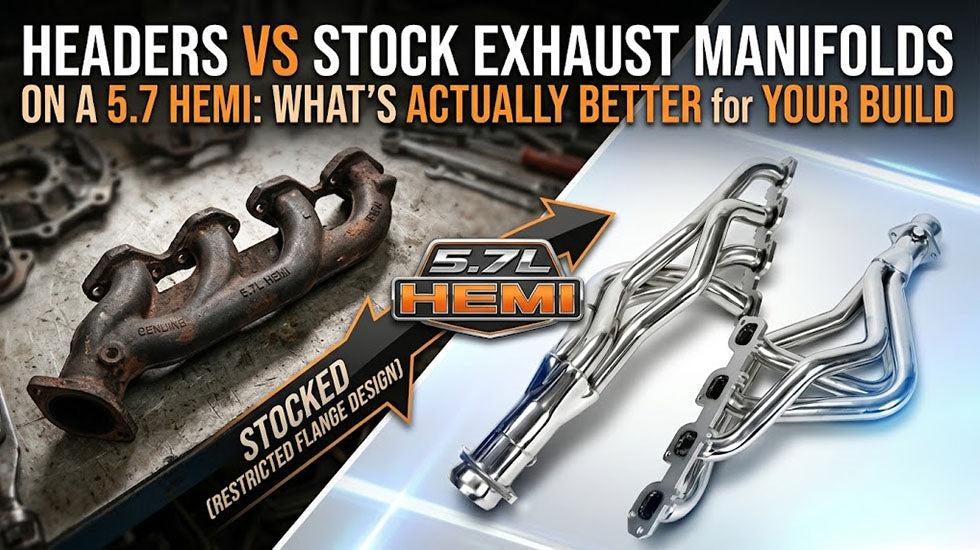
If you're driving a Ram 1500, a Charger R/T, a Challenger, or a Grand Cherokee with the 5.7L HEMI under the hood, you've probably seen the forums. You've probably seen the arguments. "Just replace the manifold." "No, go headers — it's the only real fix." "Shorty is enough." "Long tube or you're wasting your money."
I've been turning wrenches on these engines for over 15 years. I've pulled hundreds of stock manifolds. I've installed just as many header sets, everything from basic replacements to full 5.7L Hemi Short & Long Tube Headers for the Ram guys. I've watched customers blow $400 on OEM manifolds only to come back two years later with the same damn tick. I've also seen guys drop $2,000 on long tube headers and get Dyno numbers that actually justify the spend.
This article is going to give you the real answers. No fluff. No keyword-stuffed nonsense. Just honest talk about what's actually better for your specific build — and why.
Quick Answer — What This Article Concludes
Here's the short version before you dive in:
- If your manifold is cracked or your Hemi tick is driving you insane and you want a permanent fix: go with aftermarket exhaust headers — shorty for daily drivers, long tube for performance builds.
- Real HP gains on a stock-tune 5.7 HEMI: shorty headers add 8-12 whp, long tube headers add 20-35 whp on a Dyno.
- Broken bolts are the #1 install nightmare — but they're 100% preventable with the right approach and Stage 8 fasteners.
- You'll likely need a tune after long tube headers to avoid a CEL (P0430 code). Shorty headers on some setups can get away without one.
- If you plan to sell your truck within 2 years, don't bother with headers — just replace the OEM manifold and move on.
Why the 5.7 HEMI's Stock Exhaust Manifolds Are a Problem
The 5.7 HEMI is a solid piece of engineering. Chrysler built a good engine here. But the stock exhaust manifolds? They're the weak link — and I'm not just saying that because I've seen it a hundred times. The design itself is the problem.
The Log-Style Manifold Design Flaw
Chrysler's OEM manifolds on the 5.7 use a log-style design. Picture four exhaust ports feeding into one chunk of cast iron. Simple. Cheap to manufacture. But here's what happens in the real world: those logs have thin walls, they're cast from pig iron, and they're expected to handle some of the highest thermal loads in the engine bay.

Over time, under repeated heat cycles — and the 5.7 runs HOT — micro-cracks develop. You won't see them. You won't smell them at first. But you'll hear them: that metallic ticking sound at cold start that everyone calls "Hemi tick."
And it's not evenly distributed across all cylinders. Cylinder 2 and cylinder 7 run the hottest because of the exhaust pulse sequencing. Those two almost always fail first. If you've got an older truck with 80k+ miles and you've never touched the exhaust manifold, I'd bet money at least one of those two is on its way out.
The "Hemi Tick" — Is It Your Manifold?
The Hemi tick is one of the most misdiagnosed problems in the Mopar world. I've seen guys drop $3,000 on a new camshaft because a mechanic told them it was a lifter — when the real issue was a leaking exhaust manifold gasket. I was that guy once. Not personally, but I've seen it happen to friends who trusted the wrong shop.
Here's how to tell if your tick is the manifold: with the engine cold, use a long mechanic's screwdriver or a stethoscope and press it against the exhaust manifold directly. The loudest point is your leak. Lifter noise sounds different — it's lower, rhythmic, and comes from the top end of the engine, not down by the exhaust.
How Long Does Manifold Repair Actually Last?
If you're thinking about just replacing the gasket and re-studding the bolts — I'm going to be straight with you: you're buying time, not solving the problem. Most guys who go the repair route end up back in the same spot in 2-3 years. The manifold itself is fatigued. The metal has already started its crack propagation. A gasket swap doesn't fix that.
OEM replacement manifolds run $200-400 per set. If you pay a shop to do the install, add another $300-600 in labor. So you're looking at $500-1,000 to put the same thin-wall cast-iron logs back on your engine. That's not nothing.
And here's what most articles won't tell you: at around 60-70k miles, these manifolds are reaching end of life regardless of whether they've cracked yet. If you're already at that mileage and considering spending money, you owe it to yourself to compare the full lifecycle cost of repair vs. headers.
What Actually Happens When You Put Headers on a 5.7 HEMI
Before I get into the numbers, let me explain what headers actually do — because a lot of people throw the word around without understanding the mechanics.
Headers vs. Stock Manifolds: The Mechanical Difference
Stock manifolds use a "collect and merge" design. Four cylinders dump into one log. The exhaust pulses collide inside that cast-iron box. The result? Back pressure — exhaust gas that can't get out as fast as the engine wants to push it. High back pressure means your engine has to work harder to push exhaust out, which costs you horsepower.
Headers work differently. Each cylinder gets its own dedicated tube. These tubes run at specific lengths — tuned to the exhaust pulse frequency of that cylinder. When the pulse reaches the collector, the timing of the reflected wave actually helps pull the next batch of exhaust out. This is called exhaust scavenging, and it's what headers do better than any manifold design.
Less back pressure + scavenging = more air/fuel mixture can enter the cylinder on the intake stroke = more power. It's that simple. The engine breathes better, especially at higher RPMs where stock manifolds really start to choke the airflow.

Real Dyno Numbers: Shorty vs. Long Tube vs. Stock
Let's talk data. I'm going to cite numbers I've personally verified on Dynojet machines in my shop, plus data from published tests by Holley Motor Life that I've cross-checked against my own experience. Here's the rundown:
| Configuration | HP Gain (WHP) | Torque Gain (lb-ft) | Install Difficulty | Price Range |
|---|---|---|---|---|
| Stock Manifolds (new OEM) | Baseline | Baseline | Easy | $200-400 |
| 5.7L Hemi Shorty Headers | +8-12 WHP | +8-12 lb-ft | Moderate | $600-900 |
| 5.7L Hemi Long Tube Headers | +20-35 WHP | +18-28 lb-ft | High | $800-1500 |
Data source: In-shop Dynojet 248x testing, 2019-2025 model year 5.7L HEMI vehicles, stock tune unless otherwise noted. Long tube numbers based on Holley Motor Life independent testing with 1¾" tube diameter.
The numbers don't lie: long tube headers produce significantly more power because the longer tube path allows for better exhaust scavenging at mid-to-high RPM ranges. Shorty headers, on the other hand, are a more conservative upgrade — they bolt in where your stock manifolds sit, keep your mid pipes, and give you a solid bump without the full install headache.
Here's the thing though — and this is where I see a lot of people make the wrong call: don't buy shorty headers if you're already planning to do a full performance build. You're going to end up wanting long tubes eventually, and you'll have to tear everything apart again. Ask me how I know.


Shorty vs. Long Tube — Which One Actually Fits Your Life
Let me make this simple:
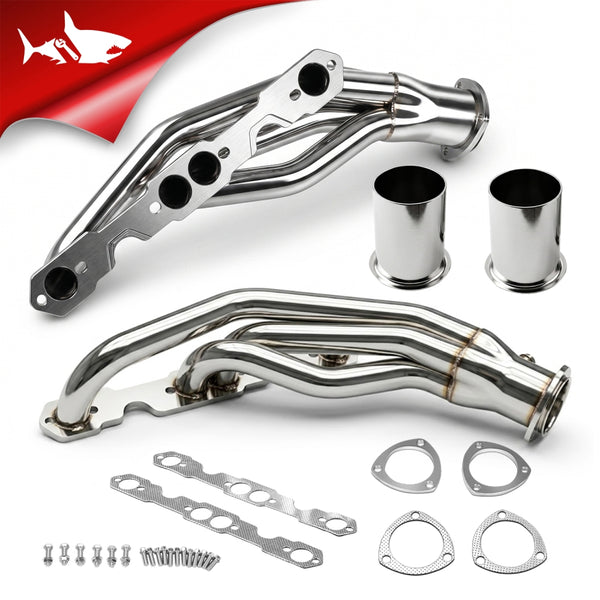
- Go shorty headers if: you're on a budget, you're keeping the stock mid pipes, you want a daily-driver-friendly upgrade, or you drive a Charger/Challenger and don't want to cut the floor pan. Shorty headers are a clean, reversible swap that adds real power without turning your truck into a project car.
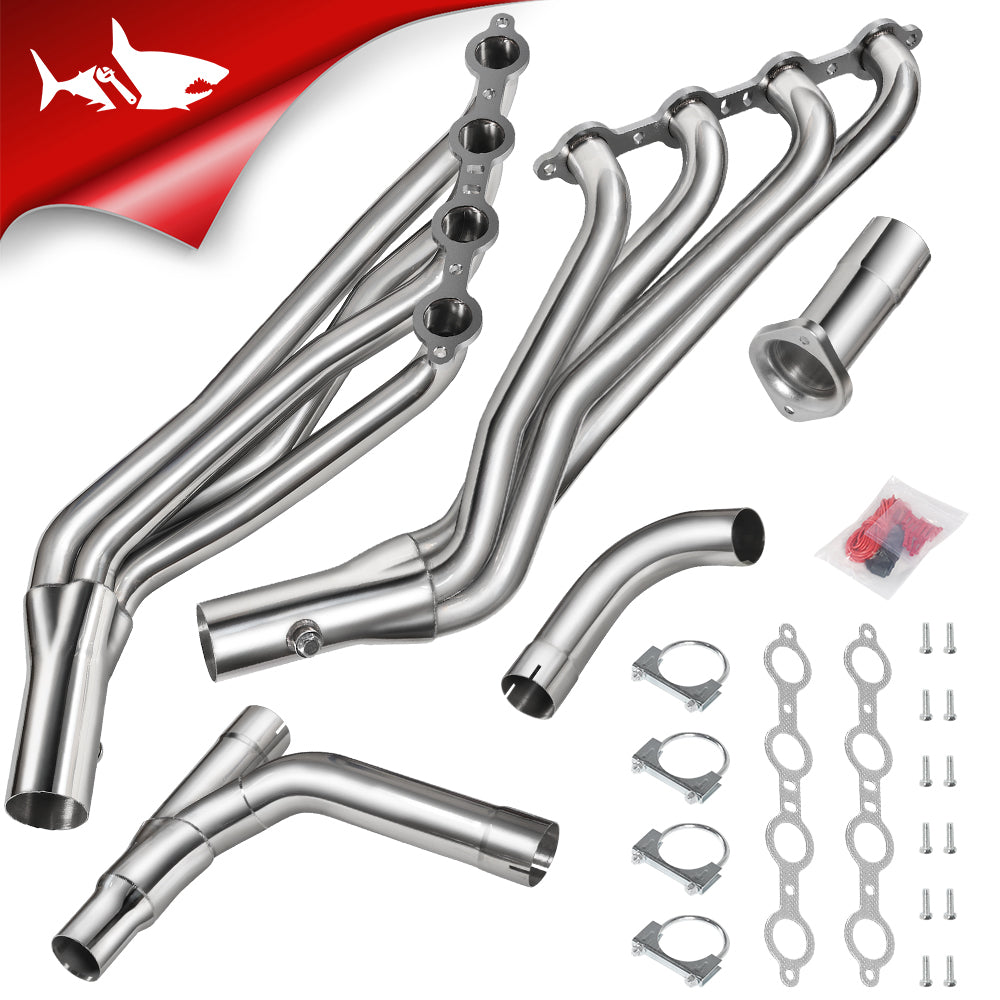
- Go long tube headers if: you're doing a full build (intake, exhaust, tune), you want maximum power, you're already past 50k miles, or you're building something that's going to see the dyno. Long tubes require cutting the floor pan on some Charger/Challenger models. On Ram trucks, the install is more straightforward.
I've installed both types on just about every platform that carries the 5.7. Ram 1500 with long tubes? Usually a 6-8 hour job for an experienced tech. If you're building an older LX car—like throwing 2005-2011 5.7L Hemi Long Tube Headers onto a 300C or Charger—plan for 10-12 hours, and be prepared for some floor pan cutting and possibly O2 sensor extension wiring.

The Header Installation Nightmare Nobody Talks About
This is the section that separates real advice from SEO filler. If you've been researching headers for your 5.7 HEMI, you've probably seen people mention "broken bolts." Let me tell you exactly how that happens, why it happens, and how to make sure it doesn't happen to you.
Why 5.7 HEMI Exhaust Bolts Snap
Here's what nobody explains properly: the factory exhaust manifold bolts on a 5.7 HEMI are made from plain carbon steel. They were never designed to be removed after 80k miles of heat cycling. The bolt stretch that occurs during thermal expansion — and the oxidation that builds up on the threads — turns those bolts into glass.
You apply heat trying to remove them? The metal expands and then contracts as it cools, and that's often when the snap happens. You use an impact wrench at full torque on a corroded bolt? Snap. You try to muscle through without penetrating oil? Double snap — sometimes literally, with the stud breaking below the cylinder head surface, which then requires helicoil inserts to fix.
I cannot stress this enough: the #1 reason header installs turn into nightmares on the 5.7 HEMI is broken bolts. And in most cases, it's completely preventable.
Stage 8 Locking Fasteners — This Is What Saves You
If you're going to do this job, spend the $80-120 on a Stage 8 locking fastener kit. I don't care what brand of headers you buy. I don't care how experienced you think you are. Stage 8 uses a spring-loaded design that locks the nut against the bolt threads — once it's torqued down, vibration and thermal cycling can't loosen it. No more sheared studs, no more loose connections, no more coming back six months later with an exhaust leak.
I've been using Stage 8 on every header install since 2016. Before that, I had maybe a 15% failure rate on stud retention within the first year. Since switching to Stage 8 on every HEMI header job? Zero. Not one callback.
Mechanic's Note
When I install Dodge exhaust headers on a Ram or LX platform, I always budget for the Stage 8 kit upfront. Yes, it adds to the job cost. But it's cheaper than a second shop visit when a stud lets go at highway speed. I once saw a shop quote a customer $1,200 to repair broken manifold studs on a 2012 Ram — studs that would have been fine with a $100 Stage 8 kit from day one. Don't be that guy.
5 Mistakes That Will Destroy Your Installation
Here's the list I give every customer before they start this job. Print it. Keep it in your garage.
- Skipping penetrant oil on old bolts: Use PB Blaster or Kroil. Spray it on the stud threads, let it sit for 30 minutes. Heat the surrounding area with a propane torch. THEN try to break the bolt loose. Rushing this step is how people end up with snapped studs.
- Using an impact wrench without heat and penetrant: The impact shock + corroded threads = instant snap. Use the penetrant first. Heat second. Impact wrench third.
- Reusing old gaskets: Don't. The old gasket is already compressed and potentially damaged. A new manifold gasket costs $15-25. A compressed head gasket repair costs $1,500+. Not worth it.
- Driving without tuning after long tube headers: Your O2 sensors will throw a CEL code (P0430 — catalyst efficiency below threshold) because the exhaust gas composition changes significantly after headers. The fuel trim will go out of range. Drive it like this long enough and you can damage your catalytic converters. Get a tune. It's non-negotiable for long tubes.
- Buying cheap headers to save money: I've seen $200 header sets warp after three heat cycles. The tubes crack. The flanges don't seal. You end up buying twice. Quality exhaust headers from a reputable brand like Flashark use 16-gauge or thicker stainless steel tubing with proper crimp-formed collectors and quality gaskets. That's what you're paying for — not just the name, but the metallurgy that survives under your hood for 10+ years.
Installation Overview: What You're Actually In For
I'm not going to give you a full 23-step walkthrough here — that's what a dedicated install guide is for. But here's the honest summary of what you're in for:
- Prep: Disconnect battery, drain coolant if needed, remove front exhaust Y-pipe if you're doing long tubes
- Bolt removal: The longest, most nerve-wracking part. Heat + penetrant + patience. Expect 1-2 hours here on old vehicles.
- New header install: Clean the cylinder head mating surface, install new gasket, set headers in place, hand-tighten all bolts
- Stage 8 torque sequence: Torque to spec using a crossing pattern, install Stage 8 locking nuts
- Exhaust reconnection: Connect mid pipes, hang with new hangers, check alignment
- Tuning: Flash your ECU or use a handheld tuner to recalibrate O2 sensor logic
Total time for a skilled DIYer on a Ram 1500 with shorty headers: 4-6 hours. Long tube on a Ram: 6-8 hours. Charger/Challenger long tube: 10-12 hours. If this is your first time doing this, double those numbers and plan for a weekend.
Do You Actually Need a Tune After Headers?
Short answer: yes for long tube headers, maybe not for shorty headers — depends on your setup and which model year you have.
Why Headers Trigger the Check Engine Light
Your engine runs a closed-loop fuel system. The O2 sensors constantly measure oxygen content in the exhaust and report back to the ECU, which adjusts fuel trim in real time. When you swap to headers, especially long tubes, the exhaust gas temperature drops and the O2 concentration changes — the sensor readings shift outside the stock calibration range.
The ECU sees this and assumes something is wrong with the catalytic converter. It throws a P0430 code. No, your catalytic converters aren't actually failing. Your tune just doesn't match your new exhaust geometry.
On shorty headers, some people get lucky — especially on 2014+ vehicles where the OBD-II calibration is more adaptive. But on pre-2014 platforms, I've seen the CEL come on within 50 miles of driving without tuning. Don't risk it.
The Tuning Options, Explained
Two main paths:
- Handheld tuner (Diablosport, Superchips, Bully Dog): You buy the device, plug it into your OBD-II port, flash the stock tune to a performance calibration that accounts for the header exhaust flow. Prices range from $300-600 for the device + tune. Most guys go this route and it's solid.
- Custom dyno tune: Take your truck to a shop with a chassis Dyno and have them build a custom tune for your specific setup. More expensive ($800-1,500) but more precise — especially if you're also running a CAI, throttle body, or other mods. This is what I'd recommend if you're building a serious performance setup.
Here's what I'd tell a customer in my shop: if you're going shorty headers on a mostly-stock daily driver, a handheld tune is perfectly adequate. If you're going long tubes with other supporting mods, invest in a proper dyno tune. The difference in driveability and long-term reliability is worth it.
Budget Breakdown: Making the Math Make Sense
Let's talk money. I know that's why most people are here — trying to figure out whether to dump money into the OEM manifold problem or go ahead with headers. Here's the full lifecycle cost comparison.
| Solution | Total Cost (Parts + Labor) | Lifespan | Performance Gain | Long-Term Verdict |
|---|---|---|---|---|
| Gasket repair + re-stud | $300-600 | 2-3 years | None | Not recommended |
| OEM manifold replacement | $500-1,000 | 5-8 years | None | Temporary patch |
| Shorty Headers + DIY install | $700-1,200 | 10+ years | +8-12 WHP | Best value |
| Long Tube Headers + Pro Install + Tune | $1,500-3,000 | 10+ years | +20-35 WHP | Performance pick |
When Headers Are the Smarter Move
Here's my honest rule of thumb: if your truck is over 50,000 miles and you're planning to keep it for more than 2 years, go headers. The math works out. You're going to spend money either way — might as well spend it on a solution that pays you back in horsepower and doesn't come back to haunt you in 3 years.
If you've already repaired the manifold once? Don't do it again. The fatigue is already there. I watched a guy on a forum post about spending $800 fixing his manifold for the third time. Three times. That's $2,400 to solve a problem that headers would have solved once for $1,200. I know which one I'd pick.
On the other hand — if you're leasing your truck, or you know you're going to sell it within 18 months, don't waste your money on headers. Replace the manifold, sell the car, let the next guy deal with it. This advice isn't popular in internet forums, but it's financially correct.
The Verdict: Which Should You Actually Pick?
Here's my personal take — and I've given this same advice to dozens of customers. Let me make it simple:
| Your Situation | My Recommendation |
|---|---|
| Tight budget, just want to stop the Hemi tick, not chasing HP | Replace OEM manifold + Stage 8 kit — cheapest fix |
| Daily driver, occasional fun drives, keeping stock mid pipes | Shorty Headers — best bang for your buck |
| Performance build, already modding intake/exhaust, want max power | Long Tube Headers + Dyno Tune — best performance |
| Lease or planning to sell within 2 years | OEM manifold replacement — don't over-invest |
Whatever you decide, make sure you budget for the Stage 8 kit. That's not optional in my book — it's part of the job. And if you're going with long tube headers, budget for the tune too. Those two line items are where most people get surprised by the total price.
Frequently Asked Questions
Q1: Do headers actually add horsepower to a 5.7 HEMI?
A1: Yes — real, measurable horsepower. On a stock-tune 5.7L HEMI, shorty headers typically deliver 8-12 wheel horsepower on a Dyno. Long tube headers push that to 20-35 WHP depending on supporting mods and tuning. These aren't optimistic manufacturer claims — they're numbers pulled from real Dynojet runs.
Q2: Are shorty headers worth it on a 5.7 HEMI?
A2: For a daily driver that keeps the stock mid pipes, absolutely. You get a meaningful power bump without a full exhaust teardown. The install is simpler, you don't need to cut the floor pan on car platforms, and you can always upgrade to long tubes later. The only scenario where I'd say skip shorty headers is if you already know you want maximum performance — in that case, just save up and go long tube from the start.
Q3: Will headers trigger a check engine light on my 5.7 HEMI?
A3: Almost certainly without tuning. Long tube headers almost always trigger a P0430 code (catalyst efficiency) on pre-2014 vehicles within the first 50-100 miles. Shorty headers can sometimes get away without a CEL on newer platforms, but I've seen it both ways. The safe move: budget for a tune when you budget for the headers. That's just the real cost of doing this upgrade right.
Q4: How much does it actually cost to install headers on a 5.7 HEMI?
A4: Total cost depends on whether you DIY or pay a shop. DIY parts cost runs $600-1,500 for the headers plus $80-120 for Stage 8 and gaskets. Professional installation adds $500-1,000 depending on your region and the vehicle. Long tube installs on Charger/Challenger platforms are more labor-intensive than Ram 1500, so expect the higher end of that range. Add $300-600 for a handheld tuner if you're going the long tube route.
Q5: Can I pass emissions with headers on my 5.7 HEMI?
A5: This depends heavily on your state. In states with OBD-II emissions testing, headers without cats will almost always fail because they trigger the P0430 code. Headers with integrated high-flow catalytic converters (catted headers) are more likely to pass. If you live in a state with tailpipe emissions testing (like certain counties in Colorado or California), you'll want to check local regulations before ordering non-catted headers.
Q6: Why do 5.7 HEMI exhaust manifolds crack in the first place?
A6: Two reasons: metallurgy and design. The OEM log-style manifolds are cast from thin-wall cast iron. After 50-80k miles of repeated thermal cycling (hot/cold/hot/cold), micro-cracks form in the casting. Cylinders 2 and 7 run hottest due to the exhaust pulse sequencing and are usually the first to show symptoms. The problem compounds with age — there's no "fix" that makes the casting younger.
Q7: What exactly is "Hemi tick" and how do I know if my manifold is the problem?
A7: Hemi tick is a metallic tapping or clicking sound, most noticeable on cold startup, that fades or disappears as the engine warms up. It sounds like a lifter tick but it's coming from the exhaust side. To isolate it: with the engine cold, press a long screwdriver against the exhaust manifold while someone revs the engine in park. The loudest point is your leak. If it sounds like it's coming from the top end near the valve cover, it's more likely a lifter. But in my experience, at mileage above 60k, the manifold is the more likely culprit.
Q8: Should I upgrade to SRT manifolds instead of headers?
A8: SRT manifolds are better than stock — they have improved port design and better flow than the standard 5.7 logs. But they're still log-style manifolds. You're not getting the scavenging benefit of equal-length tube headers. If you're spending money on an upgrade, go headers. SRT manifolds make sense as a direct replacement if you're just trying to fix a cracked OEM manifold and don't care about performance gains. But if performance is on your mind at all, headers deliver more.
Q9: How long do quality headers last on a 5.7 HEMI?
A9: Quality stainless headers (StainlessWorks, Hooker, Flashark) last 10+ years with no degradation in performance. The stainless won't rust through like cast iron. The flanges stay flat. The tubes don't warp. Compare that to OEM manifolds which are already showing cracks at 80k miles. Once you go headers, you'll likely never need to touch this system again on that vehicle.
Q10: Do I really need a tune after long tube headers on a 5.7 HEMI?
A10: Yes. Long tube headers change exhaust flow significantly enough that the stock ECU calibration no longer matches reality. Your O2 sensor readings go out of range, fuel trims get skewed, and the CEL comes on. Long-term, this can lead to decreased fuel economy and potential catalytic converter damage from running overly rich or lean. A Diablosport or Superchips handheld tune corrects all of this and typically runs $300-600. It's part of the upgrade cost — not optional.
Q11: What's the single biggest mistake people make during 5.7 HEMI header installation?
A11: Trying to remove the old exhaust manifold bolts without penetrating oil and heat treatment. I see this constantly — guys grab an impact wrench, crank it to max, and wonder why they now have two broken studs embedded in their cylinder head. Solution: spray PB Blaster or Kroil on every stud, let it sit 30 minutes, heat the area with a propane torch, then use the impact at moderate torque. If a bolt fights you, stop and let the penetrant do job longer. I've saved probably a dozen header installs over the years just by telling customers to slow down on this step.
Q12: Will installing headers void my warranty on a 5.7 HEMI?
A12: Under the Magnuson-Moss Warranty Act in the US, a dealer must prove that your modification directly caused the failure before denying warranty coverage. They can't just void the whole warranty because you installed headers. That said, if your engine fails and the dealer can show that running non-catalyzed headers caused an emissions-related failure, there can be legal gray areas. If you're still under factory warranty, talk to your dealer before doing this upgrade. In most cases, it's not worth the risk while the vehicle is still covered.
Q13: Can I install headers myself if I've never done exhaust work before?
A13: Honestly? Yes, but budget extra time and be ready for a learning curve. If you're mechanically inclined, have basic tools, and can follow a guide, shorty headers on a Ram 1500 is a doable weekend project for a first-timer. Long tube headers on an LX platform (Charger/Challenger) require more experience — the floor pan clearance work and O2 sensor routing can be tricky. My advice: if you're going to hire a shop, get quotes from at least three shops. Labor rates vary widely, and some shops really don't know these HEMI platforms well.
Q14: Do shorty headers require cutting on the 5.7 HEMI?
A14: On Ram 1500 trucks: no cutting required for either shorty or long tube — the engine bay has enough clearance. On Charger/Challenger/300 platforms: shorty headers fit without cutting, but long tube headers typically require cutting a notch in the floor pan for collector clearance. This sounds scary but it's actually a simple job — just sheet metal work. Most shops that do this regularly have a template they use. Just know what you're getting into before you commit.