Look, I’ve spent more time under the hood of a square body Chevy than I have in my own living room. Most guys hear "emissions legal" and immediately think "restrictive junk." I get it. For decades, those heavy, cast-iron factory manifolds were basically exhaust-flow-killing bricks bolted to the side of your Small Block Chevy. But if you're trying to keep your build street-legal in states like California without sacrificing that classic V8 grunt, you need to play the game right. We’re talking about real-world flow, clearing the steering shaft without a sledgehammer, and actually passing the Smog Check.
The Bottom Line Up Front
Don't want to read the whole breakdown? Here are the hard facts you need for your Chevy 350 upgrade:
- Best for Strict Smog Compliance: Shorty headers are your safest bet. They replace the factory manifold in the exact same location, retaining all AIR injection and O2 sensor hookups without throwing red flags.
- Expected Performance Impact: On a dyno, a properly sealed set of headers on a mild 350 SBC will net you a real-world 8-12 whp (wheel horsepower) and around 15-20 lb-ft of mid-range torque.
- Legal Reality: Look for a welded CARB EO (Executive Order) plate. If your state does visual inspections, a clean sniffer test means absolutely nothing without that D-number.
- The Sizing Rule: Keep primary tubes to 1-5/8" for street trucks and cruisers. Stepping up to 1-3/4" on a stock cam will kill your low-end exhaust velocity.
Why Upgrade to Aftermarket Headers on a Chevy 350?
Truth be told, the factory exhaust setup on a 5.7L Chevy is a massive bottleneck. They were engineered by bean counters to be cheap to cast and whisper quiet. If you actually want your engine to breathe, you need to install proper automotive headers. Unlike the factory "log" style manifolds that force exhaust pulses to violently collide and create engine-choking backpressure, a good set of headers gives each cylinder its own dedicated path. This creates a scavenging effect—it literally vacuums the burnt exhaust gases out of the combustion chamber, making room for a denser fresh air/fuel charge on the next stroke.

| Performance Metric | Stock Cast-Iron Manifold | Flashark Performance Headers |
|---|---|---|
| Flow Efficiency | Extremely Poor (Turbulent log-style collisions) | High (Individual tube scavenging) |
| Dyno Gains (est.) | Baseline | +10 to +15 HP / Torque instantly |
| Heat Management | Heavy heat soak, bakes engine bay | Faster cooling, T304 Stainless dissipation |
| Weight | Extremely heavy (Cast Iron) | Lightweight (Tubular Steel) |
Demystifying Emissions Compliance: What Makes a Header "Smog Legal"?
The Dreaded CARB Check and EO Numbers
Let's talk about the elephant in the room: the California Air Resources Board (CARB). If you live in a state that has adopted CA emissions standards, your inspector is going to run a mirror under your truck. They are looking for a welded metal tag with an EO (Executive Order) number. If it’s not there, you fail. Period. It proves the manufacturer paid for laboratory testing to confirm the part doesn't alter the factory emissions output.
Shorty vs. Long Tube Headers: The Legal Divide
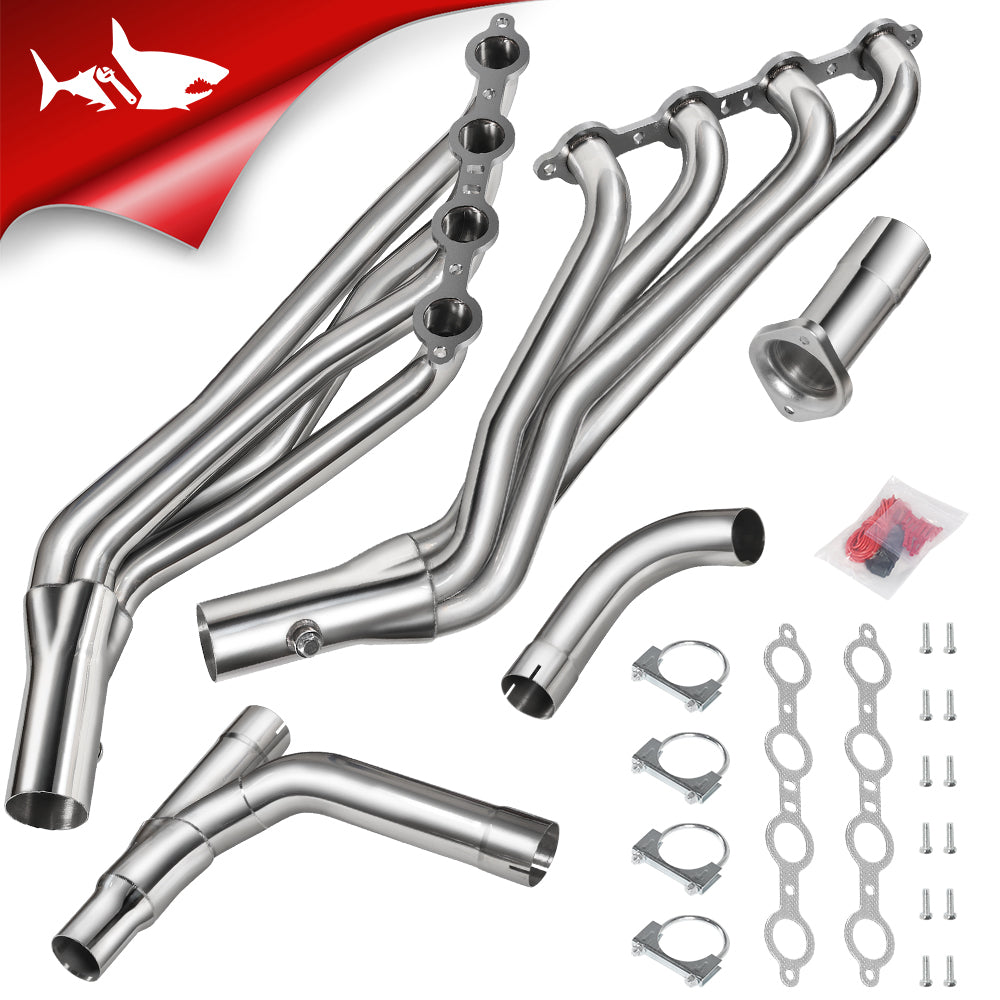
Here is the cold, hard reality: long tube headers are almost never smog legal in strict states. Why? Because they physically force you to relocate the catalytic converters further downstream from the engine, which alters how fast the cats heat up. If you live in an emissions-exempt county or are building an off-road rig, a set of 1988-1997 Chevy 350 long tube headers will give you the absolute highest top-end horsepower.
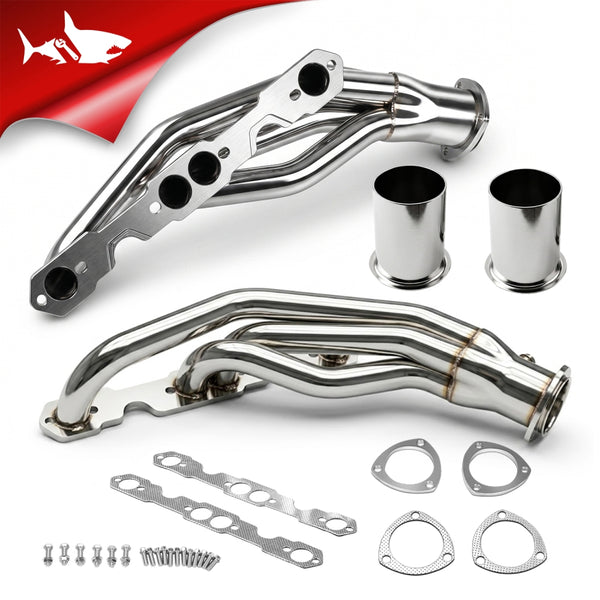
But for a daily driver that has to pass the state referee, 1988-1997 Chevy 350 Short headers are your best friend. They bolt directly up to your factory Y-pipe and keep your O2 sensors right where the ECU expects them to be.

Long Tube Headers For 1988-1997 Chevy/GMC 5.7L/5.0L 305/350 SBC (Vortec/TBI)
$299.99 $145.99
Engineered for the 1988-1997 Chevy/GMC C/K Series chassis, these high-performance long tube exhaust manifolds offer a perfect fit for both 5.7L (350) and 5.0L (305) SBC engines. Gain an instant 10-15 HP and that deep V8 growl.
- TIG Welded CNC Machine Flange
- High-Quality T304 Stainless Steel
- Inlet Size: 1.5" / Outlet Size: 3.0"

Exhaust Headers for 1988-1997 Chevy GMC C1500 K1500 5.0L 305 / 5.7L 350 V8
$199.99 $129.99
The perfect direct bolt-on upgrade for C/K 1500/2500, Silverado, Blazer, and Tahoe drivers seeking enhanced throttle response and reliability. Significantly improves airflow without the hassle of custom fabrication.
- Direct bolt-on fit for 88-97 SBC Trucks
- Reduces backpressure and improves engine efficiency
- Includes reducers, bolts, and metal gaskets
Crucial Dimensions & Fitment Guide: Don't Buy the Wrong Size
I remember back in 2018, a guy towed a pristine '85 Monte Carlo into the shop. He’d bought a set of dirt-cheap, generic tube headers online and spent three days fighting them in his driveway. The driver’s side primary tube was literally resting hard against the steering column. He had two choices: smash his brand new tubes with a ball-peen hammer to create clearance (completely ruining the airflow dynamics he just paid for), or rip them out and buy a properly engineered set. We yanked the junk out, installed a set of 1970-1988 Chevy 350 long tube headers from Flashark, and they dropped in perfectly on the first try. That’s what happens when you buy parts designed for your exact chassis, not a "universal fit" nightmare.
Listen to me: flange thickness matters. A lot of the cheap stuff uses thin 1/4" flanges. After three or four hard heat cycles, they warp. Once they warp, you get that ticking exhaust leak sound that drives everyone insane. You want a minimum of a 3/8" thick flange to maintain a true seal against the cylinder head.

Exhaust Header for 1970-1988 Chevrolet Monte Carlo SBC 283 327 350 400
$204.00 $135.99
Hugs the block for a closer fit and extra clearance in tight classic car engine bays. Fits a massive range of SBC V8s including Monte Carlo, El Camino, Chevelle, Nova, and Camaro.
- 1 5/8" Primary Tube Size for optimal velocity
- Beefy 3/8" Outlet Flange Thickness prevents warping
- Mirror Polish Stainless Steel
Installation Realities: What the Manual Doesn't Tell You
A lot of rookies watch a five-minute YouTube tutorial, slap the pipes on, and call it a day. Two days later, their spark plug wires are melted to the primaries, or worse, they've started an engine bay fire. I'm telling you right now, don't be that guy. When installing 1982-2002 Chevy 350 Short headers, especially into a cramped chassis like an S10 V8 swap, clearance is tight. You absolutely need to run 90-degree spark plug boots and invest in quality fiberglass heat sleeves for your wires.
And regarding those rusted factory exhaust bolts? Do not put a breaker bar on them while they are dry. You will snap the stud flush with the cylinder head, and then you are looking at pulling the whole head off to drill it out. Spray them down with penetrating oil every day for three days before you start the job. Let the chemicals do the hard work.

Exhaust Headers For 1982-2002 Chevy S10 / S15 / Blazer SBC V8 2WD
$256.00 $159.99
The ultimate solution for Small Block V8 swaps into the S10 platform. Built from durable T-304 stainless steel with TIG-welded CNC flanges, delivering massive power gains and clearance for floor-shifted automatics.
- Exclusively fits TH350 automatic transmissions (floor shift)
- 1.500 in. Tube Diameter / 2.500 in. Collector
- Perfect for engine swap kits
Frequently Asked Questions About Smog Legal Chevy 350 Headers
Q1: Do I need a tune after installing smog legal shorty headers on a Chevy 350?
A1: For a standard stock or mildly modified 350, no. Shorty headers keep the O2 sensors in the factory location. The factory ECU can easily adjust fuel trims to compensate for the improved exhaust flow. If you swap to long tubes, a custom tune is highly recommended.
Q2: How much horsepower do smog legal headers actually add to a 350?
A2: On a chassis dyno, you can expect a realistic gain of 8 to 15 wheel horsepower (whp) and around 15-20 lb-ft of torque. It smooths out the mid-range power band significantly compared to restrictive stock manifolds.
Q3: Are long tube headers ever smog legal in California?
A3: Very rarely. Because long tubes require relocating the catalytic converter from its original factory position, they almost never pass CARB visual inspections or receive an EO number. Shorties are the standard for CA legality.
Q4: Where do I find the CARB EO number on my headers?
A4: Manufacturers weld a small metal placard directly onto one of the primary tubes or onto the main flange. The inspector must be able to visually see this D-XXXX number from inside the engine bay or underneath the truck.
Q5: Will aftermarket headers make my Chevy 350 fail the visual smog inspection?
A5: They will fail the visual inspection ONLY if they lack a valid CARB EO number, or if they delete factory emissions equipment (like the AIR injection tubes or EGR valve hookups). Legal headers will have ports for all factory sensors.
Q6: Do I have to keep the AIR injection tubes with new headers?
A6: If your truck originally came equipped with an AIR (Air Injection Reactor) system, yes, you must retain it to pass smog. Make sure you purchase headers specifically listed as "with AIR fittings."
Q7: What is the best primary tube size for a stock Chevy 350?
A7: 1-5/8 inches. This diameter maintains high exhaust gas velocity at lower RPMs, which preserves your low-end torque for daily driving and towing. Going larger on a stock engine hurts performance.
Q8: Can I pass emissions if my header has a CARB sticker but my catalytic converter is modified?
A8: No. The emissions system is evaluated as a whole. A legal header will not save you if the inspector sees that you have hollowed out or removed the factory catalytic converters.
Q9: Will ceramic coated headers pass a smog check?
A9: Yes, the exterior coating does not impact emissions output. Ceramic coating is highly recommended as it drastically reduces under-hood temperatures, protecting nearby wiring and hoses.
Q10: Do smog legal headers fit with angle plug cylinder heads?
A10: Usually, no. Most standard headers are designed around straight plug heads. Angle plugs alter the boot angle, causing interference with the primary tubes. You must look for headers specifically engineered to clear angle plugs.
Q11: Why do some 50-state legal headers cost so much more than standard headers?
A11: Getting an EO number from CARB requires thousands of dollars in laboratory testing for the manufacturer. Brands factor this certification cost into the price of the legal parts.