Look, we’ve all been there. You walk out to your driveway on a cold morning, fire up the truck, and immediately hear it. Tick-tick-tick-tick. It’s loud, it’s embarrassing, and it drives you absolutely crazy. A lot of guys try to convince themselves it’s just noisy fuel injectors or typical Ford valvetrain clatter. But deep down? If you wrench on these trucks, you know exactly what’s happening.
I’ve spent years in the shop with my hands covered in grease, pulling apart more 3.5L EcoBoosts and 5.0L Coyotes than I can count. Ignoring F150 exhaust leak symptoms isn't just something you can put off until next season. It’s a guaranteed path to burned exhaust valves, melted wiring harnesses, and absolutely gutted fuel economy. Let’s cut the crap, figure out exactly why your rig is bleeding pressure, and get it fixed properly.
Diagnostic Summary: Key Takeaways
- Temperature Dependent Tick: A cold-start ticking that fades as the engine warms up is the single most common sign of a warped exhaust manifold or blown gasket on the 3.5L EcoBoost and 5.0L V8.
- Hidden Performance Killer: Exhaust leaks upstream of the O2 sensors introduce "false air." Your ECU responds by dumping excess fuel, causing a sudden 2-4 MPG drop and lethargic throttle response.
- The Soapy Water Trick: A spray bottle of soapy water and a shop-vac is still the cheapest, most effective diagnostic tool to find the exact leak point.
- The Upgrade Path: If you're paying labor to extract broken manifold studs, replacing it with an identical OEM cast-iron manifold is a trap. Upgrading to tubular headers and a full catback exhaust is the only permanent fix.
Why F150 Exhaust Leaks Are Inevitable (By Generation)
Ford builds a tough block, but the factory exhaust systems take a massive beating. Your truck sits through extreme temperature swings, road salt, mud, and the constant vibration of a high-output engine. The tight packaging of the engine bay, especially with twin-turbo setups, traps heat and accelerates metal fatigue.

| Generation / Engine | Most Common Leak Location | Root Cause |
|---|---|---|
| 2004–2008 (11th Gen) | Flange gasket at catalytic converter inlet; muffler weld cracks | Aggressive corrosion from road salt; poor factory weld quality on mild steel. |
| 2009–2014 (12th Gen) | Manifold gaskets (5.4L 3V); exhaust flex pipe cracking | Thermal cycling fatigue; gasket material breakdown. |
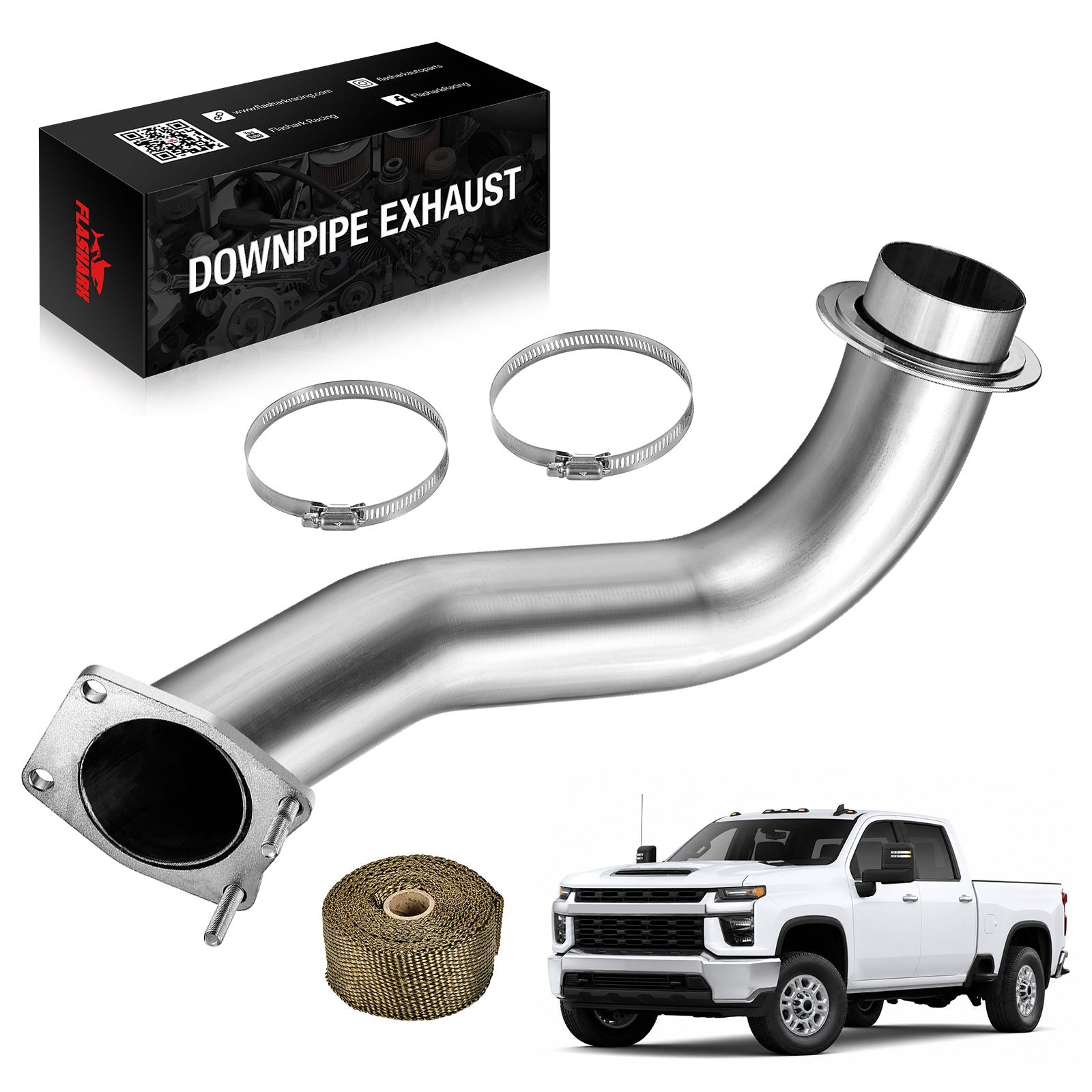
| 2015–2020 (13th Gen) | Passenger-side manifold gasket (5.0L); turbo downpipe flange (3.5L EB) | Cast-iron warping under extreme EGTs, snapping the rear mounting studs. |
| 2021+ (14th Gen) | Downpipe-to-cat flange; muffler inlet weld | Thermal expansion stress; early corrosion in northern climates. |
The 2004–2008 trucks deserve special mention here. The factory mild steel piping on these trucks rusts aggressively. I've pulled mufflers off 11th Gen F150s that were completely hollowed out inside from corrosion. At that point, replacing individual rotted sections makes less sense than bolting on a 2004-2008 Ford F150 catback exhaust that covers everything from the cat flange back in one shot.

Top Symptoms You Can't Ignore
1. The Cold Start "Tick" (Not a Cam Phaser Issue)
There is a massive acoustic difference between a cam phaser rattle and an exhaust leak. A failing phaser sounds like marbles in a tin can for about three seconds on startup until oil pressure hits the top of the engine. An exhaust leak tick is a sharp, metallic snapping sound that matches your engine RPM perfectly.
When you cold-start, the gap between your warped manifold and the block is at its absolute widest. As the exhaust gases hit 1,000°F+, the iron swells, the gap closes, and the noise fades. If your ticking stops when the truck gets up to operating temp, you’re bleeding exhaust.
👨🔧 Technician's Case Log:
I remember a guy bringing a 2018 3.5L EcoBoost into the shop. He was convinced his passenger-side turbo was blowing its seals because of a high-pitched squeal under heavy load. When we finally tore the top end down and pulled the factory manifold off, I put a precision straight edge across the flange. It was warped nearly 3/16 of an inch at the rear port. You could literally slide a drill bit under it. Upgrading him to thicker aftermarket headers didn’t just fix the noise; we datalogged it afterward and saw his EGTs drop by a solid 85 degrees under peak boost.
2. Sudden and Unexplained MPG Drop & Power Loss
When a leak happens upstream of your primary O2 sensors, atmospheric oxygen gets sucked into the exhaust stream. The O2 sensor reads this fresh air and screams at the ECU, "We are running dangerously lean!" The ECU panics and commands the injectors to dump raw fuel. You end up burning way more gas (dropping 2-4 MPG) and losing low-end torque.
Your engine relies on exhaust velocity and backpressure scavenging to violently pull spent gases out of the cylinders. A manifold leak ruins this vacuum effect, making the truck feel incredibly sluggish, especially when trying to pass on the highway with a heavy trailer. Restoring that sealed exhaust flow and pairing it with a high-flowing 2015-2020 Ford F150 catback exhaust is the most effective way to claw back that lost low-end torque on the 5.0L Coyote and 3.5L EcoBoost platforms.

3. Smelling Raw Exhaust in the Cab
This is a massive red flag. Factory exhaust gas is engineered to exit safely behind the rear axle. If you are sitting in stop-and-go traffic and suddenly smell bitter, raw exhaust fumes inside your cab, your HVAC system is actively sucking up gas escaping directly from the engine block. That’s carbon monoxide. Crack your windows immediately and get it fixed.
How to Diagnose the Issue Like a Pro
Don’t just start firing the parts cannon at your truck hoping something sticks. Verify exactly where the leak is coming from.
The Reverse Shop-Vac Method (Step-by-Step)
This is my favorite old-school garage trick. Do this ONLY on a completely cold engine.
- Take your shop-vac and hook the hose to the blower port (exhaust).
- Wedge the other end of the hose securely into your tailpipe. Use duct tape to seal off any gaps so it pressurizes the entire exhaust system backward.
- Turn the shop-vac on. You should hear air rushing through the pipes under the truck.
- Take a spray bottle filled with a mix of dish soap and water (1:4 ratio).
- Crawl under the hood and heavily spray the soapy water onto the exhaust manifold flanges where they meet the engine block, and along the exhaust piping joints.
- Watch closely. If you see bubbles forming around the cylinder head, mounting studs, or muffler welds, you have confirmed your exact leak point without burning your hands.

OBD2 Scanner: Check Your Fuel Trims
Plug in an OBD2 scanner and look at your short-term and long-term fuel trims (STFT and LTFT) at idle. If you see +12% to +20% fuel trim on one bank, the system is adding massive amounts of fuel to compensate for a leak. The 5.0L V8 has two banks with separate front O2 sensors, making this diagnostic perfect for pinpointing which manifold gasket failed.
Fixing the Leak: Why OEM is a Trap
Once you confirm the leak, you have a major choice to make. You can take it to the dealership, or you can fix it permanently.
The Dealership Tax
Ford will happily charge you 6 to 8 hours of labor (often running $1,200 - $1,800 per side) to extract the broken studs and bolt on a brand new OEM cast-iron manifold. But here is the brutal, honest truth: it’s the exact same flawed part. In 40,000 to 50,000 miles, the heat cycles are going to warp it all over again. You are literally just renting time.
The Permanent Fix: Upgrading Your Headers & Exhaust
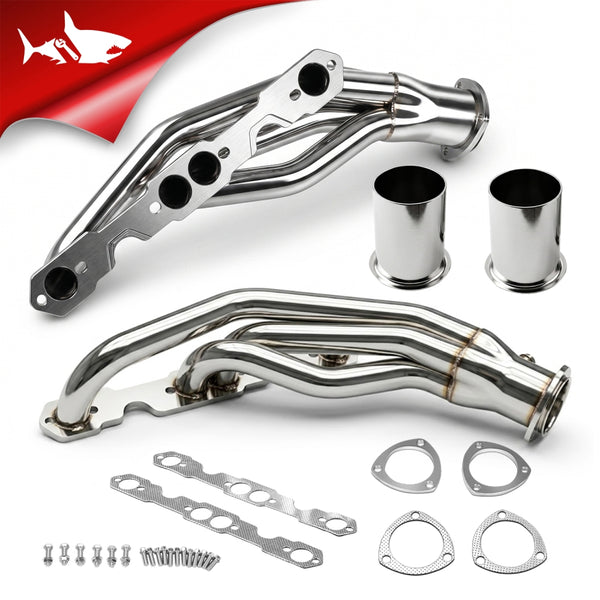
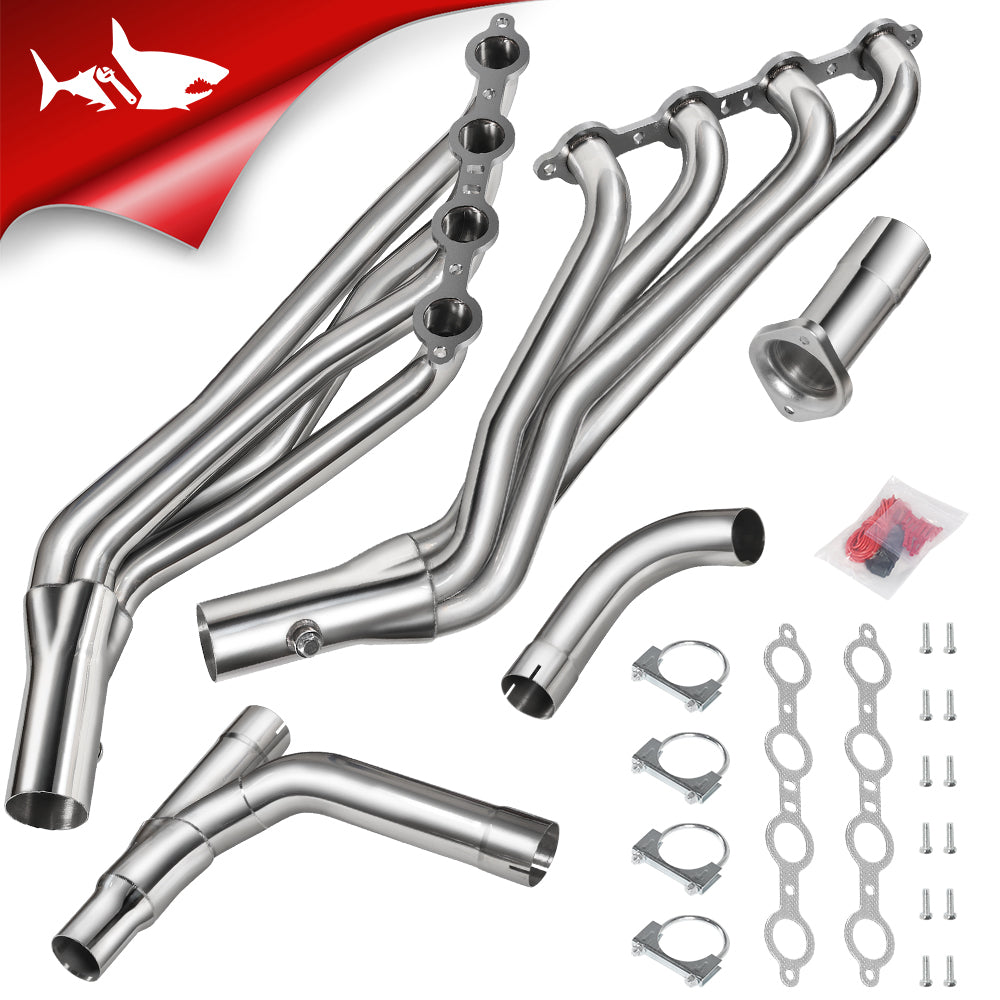
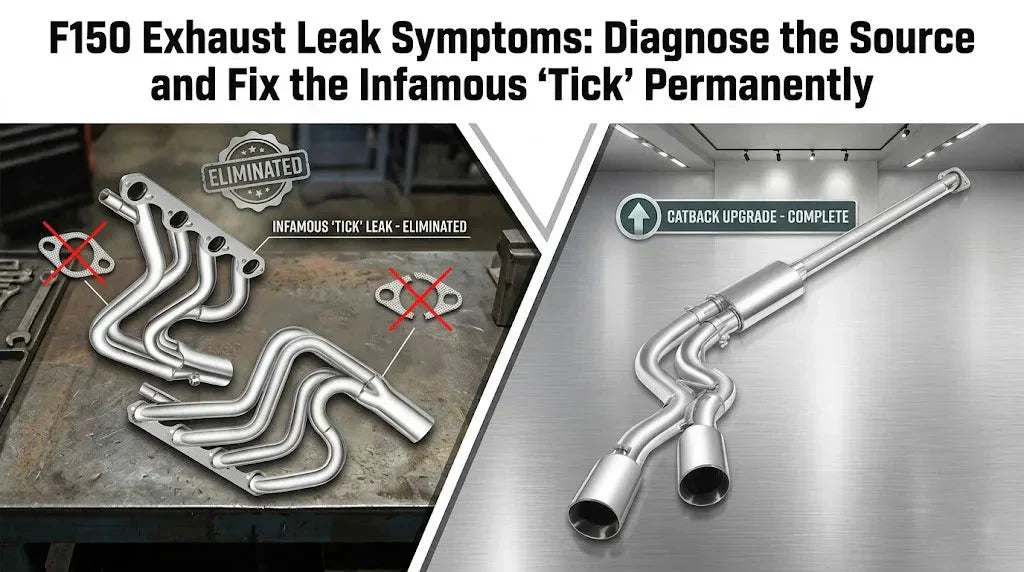
If you are going through the absolute agony of pulling the top end apart, draining the coolant, and drilling out broken steel studs from an aluminum block, you better upgrade the parts. Swapping to high-performance stainless steel F150 headers, like the ones we engineer at Flashark, is the only permanent solution for manifold warping.
| Spec / Feature | Factory OEM Manifold | Flashark Upgraded Headers |
|---|---|---|
| Material Construction | Brittle Cast Iron | T304 Stainless Steel Tubing |
| Flange Design | Thin, uneven casting | Massive 3/8" thick CNC-machined flat flange |
| Failure Rate (Warping) | Extremely High (Inevitable) | Virtually Eliminated |
| Performance Yield | Restrictive, traps heat | Better scavenging, lower EGTs |
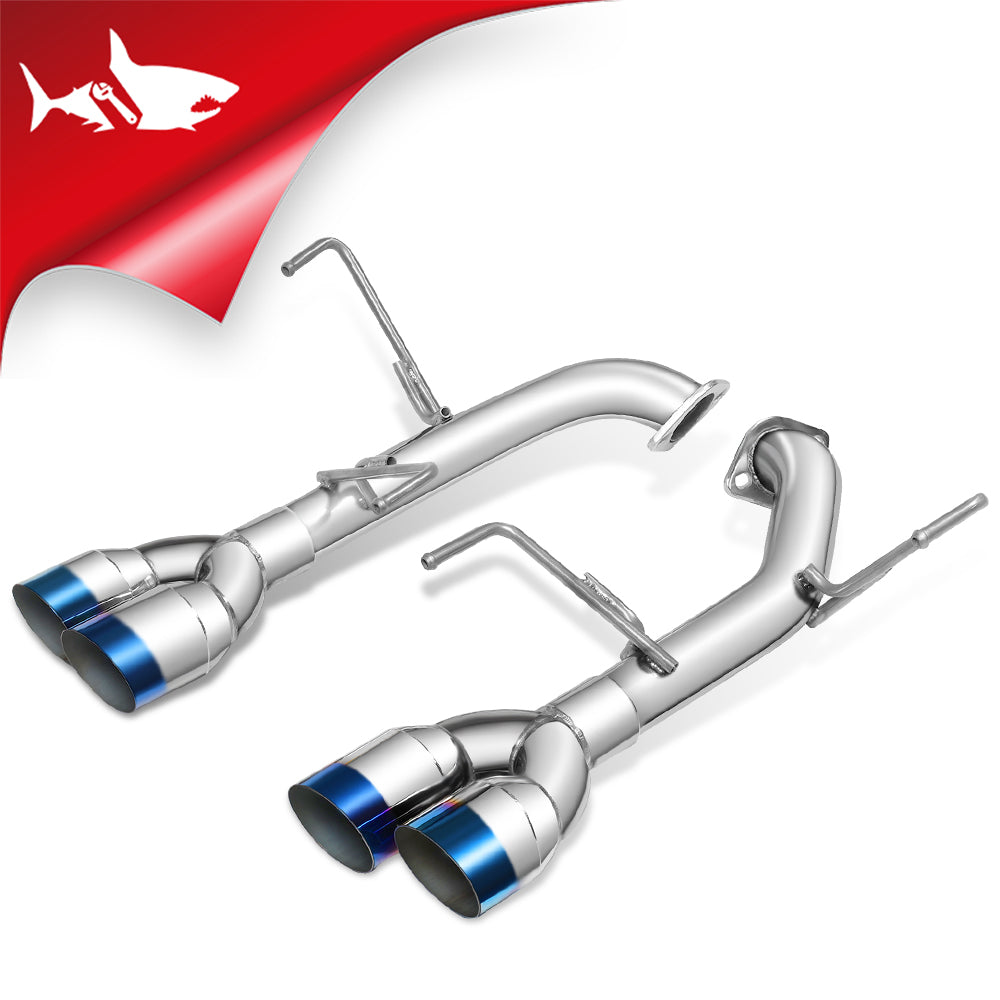
If your leak is further back—caused by corroded flanges or cracked welds on the factory piping—replacing individual rotted sections is a band-aid. Upgrading to a full Ford catback exhaust system crafted from T304 or T409 stainless steel guarantees you won't be crawling under the truck to chase another rusted-out flange next winter. The surrounding metal on a factory pipe is usually just as compromised, so doing it right the first time saves you labor costs down the road.
F150 Exhaust Leak FAQ
Q1: How do I know if my F150 has an exhaust leak or a lifter tick?
A1: The easiest way to tell is the warm-up test. An exhaust leak tick usually fades or disappears within 30–60 seconds of startup as the metal expands and partially seals the gap. A lifter tick stays consistent and may actually get louder as oil pressure builds. Also, try the soapy water spray test around the manifold flanges while the engine is cold—if you see bubbles, it's an exhaust leak, not a valvetrain issue.
Q2: Can an exhaust leak cause a check engine light on my F150?
A2: Yes, but it depends on the leak location. Leaks upstream of the front O2 sensors (manifold, downpipe, or pre-cat flange) will affect air-fuel ratio readings and can trigger P0171/P0174 (system too lean) or P0420/P0430 (catalyst efficiency below threshold). Leaks downstream of the rear O2 sensor typically won't trigger a code, which is why you shouldn't rely solely on the check engine light to catch an exhaust leak.
Q3: How much does it cost to fix an exhaust leak on an F150?
A3: It ranges from $50 to $800+ depending on what's leaking. A manifold gasket replacement runs $80–200 in parts. A muffler replacement is $150–400. If the intermediate pipe or catalytic converter flange is rusted and needs replacement, you're looking at $300–800+ depending on the shop rate and whether the catalytic converter itself needs replacement. A catback exhaust system costs $400–900 but replaces everything behind the cat with stainless steel that won't rust again.
Q4: Is it safe to drive my F150 with an exhaust leak?
A4: For short distances, a minor exhaust leak won't leave you stranded. But it's not something to ignore long-term. The two main risks are carbon monoxide entering the cabin (especially dangerous if the leak is near the firewall or cowl) and catalytic converter damage from incorrect air-fuel ratios. If you smell exhaust inside the truck or feel drowsy while driving, fix it immediately before driving again.
Q5: Will a catback exhaust system fix my F150 exhaust leak?
A5: Only if the leak is located behind the catalytic converter—in the muffler, intermediate pipe, tailpipe, or their connection points. A catback system replaces everything from the catalytic converter rear flange to the tailpipe tips. If your leak is at the exhaust manifold, downpipe, or catalytic converter flange, a catback alone won't address it. You'd need to fix the upstream leak separately.
Q6: What causes exhaust manifold leaks on the 2015–2020 F150 5.0L?
A6: The primary cause is gasket material fatigue from repeated thermal cycling. The 5.0L Coyote manifold runs extremely hot, and over tens of thousands of heat-up and cool-down cycles, the multi-layer steel gasket loses its ability to seal. Secondary causes include manifold bolt stretch (the factory bolts are torque-to-yield and don't handle repeated removal well) and in some cases, slight warping of the manifold flange itself. Ford updated the gasket design for later production runs, and the replacement gaskets are more durable than the originals.
Q7: Can an exhaust leak make my F150 lose power?
A7: Yes, and it's most noticeable in the low-to-mid RPM range. An exhaust leak before the front O2 sensor causes the ECU to read a false lean condition, which pulls ignition timing and adds fuel unnecessarily. On a stock 5.0L F150, dyno testing shows 8–12 WHP loss from a moderate manifold leak. On the 3.5L EcoBoost, turbo spool time increases by 200–400 RPM, making the truck feel sluggish off the line. You'll notice it most when towing or merging.
Q8: How long does it take to replace an exhaust manifold gasket on an F150?
A8: For a competent DIYer with basic hand tools, jack stands, and a torque wrench, plan on 2–3 hours for the 5.0L and 3–4 hours for the 3.5L EcoBoost (the turbo heat shield adds complexity). The passenger side is typically easier than the driver's side due to better access. If you're paying a shop, expect 2.5–4 hours of labor depending on the generation and engine. Shop rates vary by region, but budget $250–500 in labor on top of parts.
Q9: Does an exhaust leak affect fuel economy on the F150?
A9: It can, and often by a meaningful amount. Real-world data from F150 owners reporting exhaust leak repairs shows fuel economy improvements of 1.5–3.5 MPG after fixing leaks. The reason is straightforward: the ECU adds extra fuel to compensate for the false lean readings caused by unmetered air entering through the leak. That extra fuel doesn't produce extra power—it just gets wasted. Over a year of driving, this can add up to $200–400 in additional fuel costs.
Q10: What's the difference between a manifold leak and a muffler leak on the F150?
A10: The symptoms are quite different. A manifold leak produces a ticking sound (especially at cold start), affects O2 sensor readings, triggers check engine codes, and reduces power. A muffler leak produces a more general raspiness or hissing in the exhaust note, doesn't affect engine performance or emissions readings (it's downstream of all sensors), and won't trigger a code. Both need fixing, but a manifold leak is the more urgent repair because it impacts engine operation.
Q11: Can I use exhaust tape or sealant to temporarily fix an F150 exhaust leak?
A11: For very small cracks or pinholes in the muffler body or tailpipe, exhaust repair tape (like J-B Weld ExhaustWeld) can buy you a few weeks or months. But it does not work on flange gasket leaks or manifold connections—there's too much pressure and thermal cycling for any sealant to hold. Think of it as a temporary patch for a cracked pipe, not a real fix. And don't use it on any connection that needs to maintain a seal under pressure, because it won't.
Q12: How often should I inspect my F150 exhaust system?
A12: At minimum, once a year during an oil change or tire rotation. If you live in a rust-belt state that uses road salt (Minnesota, Michigan, Ohio, New York, etc.), inspect twice a year—once before winter and once after. Look specifically for surface rust scaling, soot streaks at flange connections, and wet spots around gaskets. If you off-road or ford water regularly, inspect more often because mud and water accelerate corrosion in the underbody areas.
Q13: Will a catback exhaust void my F150 warranty?
A3: No. Under the Magnuson-Moss Warranty Act, a catback exhaust system cannot void your vehicle warranty unless the manufacturer can prove the aftermarket part directly caused the failure you're claiming warranty coverage for. A catback system doesn't modify the engine, emissions system (it's behind the catalytic converter), or any powertrain component. That said, if your engine fails and you're claiming warranty coverage, Ford could theoretically argue the modified exhaust contributed—though this is extremely rare and generally not upheld unless the catback removed or modified the catalytic converter.
Q14: What type of stainless steel is best for an F150 catback exhaust?
A14: T409 stainless is the best balance of cost, durability, and corrosion resistance for daily-driven F150s. It handles the temperature cycling well and resists surface rust far better than factory mild steel. T304 stainless is a step up in corrosion resistance (it's the same grade used in exhaust tips for a mirror finish) but costs more. For trucks in the rust belt or coastal areas, T304 is worth the upgrade. For trucks in dry climates, T409 is plenty and saves money. Avoid aluminized steel catback systems on the F150—they look good for two years and then rust just like the factory system.