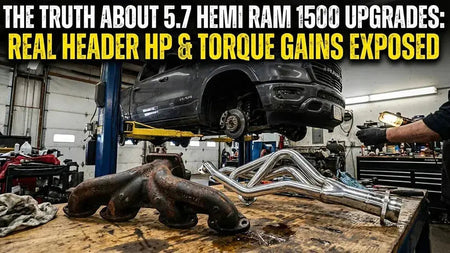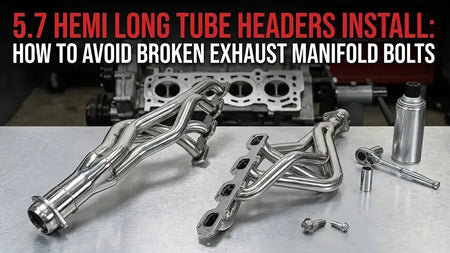
Listen. I’ve pulled cracked factory manifolds off Gen III Hemis more times than I care to admit. Your knuckles get busted, the rear bolts are almost always snapped completely flush with the cylinder head, and the customer is usually frustrated because their rig sounds like a clapped-out tractor on cold starts. But once we get past the repair cost, the very next question is always the same: "If I throw tubular headers on this thing, am I going to be at the gas station every other day?"
- Headers don't kill fuel economy on a 5.7 HEMI — if anything, a well-tuned setup gains 1–2 MPG under highway cruise.
- Scenario A (Fixing the Tick): If you are fixing the "Hemi tick" (a leaking manifold) with shorty headers, expect a recovery of 1-2 MPG back to factory baselines.
- Scenario B (Long Tubes): Requires an ECU retune to prevent running rich. When tuned properly, highway cruising MPG often improves.
- Scenario C (Heavy Foot Syndrome): If you drive aggressively just to hear the V8 rumble, your MPG will drop. That is driver error, not a hardware fault.
- RAM 1500 owners running performance headers built for the 2009–2018 5.7L HEMI consistently report no MPG regression when paired with an AFR tune.
Why Headers and Fuel Economy Are More Connected Than You Think
Most people assume the relationship between exhaust modifications and fuel economy is a straight trade-off: more power = worse mileage. That's true for cam swaps and boosted builds. For headers on a naturally aspirated HEMI, the dynamic is different.
To understand the reality, you need to understand volumetric efficiency (VE). An engine is essentially an air pump. The harder it has to work to push exhaust gases out of the combustion chamber, the more energy (and fuel) it wastes. This is called "pumping loss." Under highway cruise — say 1,600–2,200 RPM — the restrictive factory exhaust pulses don't fully evacuate before the intake valve opens again. The engine compensates by injecting slightly more fuel to maintain stoichiometry.

Tubular headers fix this. Equal-length runners use exhaust pulse scavenging to actively pull exhaust gas out of the cylinder. At cruise RPM, the combustion chamber is cleaner, the engine uses less fuel to hit the same AFR target, and efficiency goes up — not down.
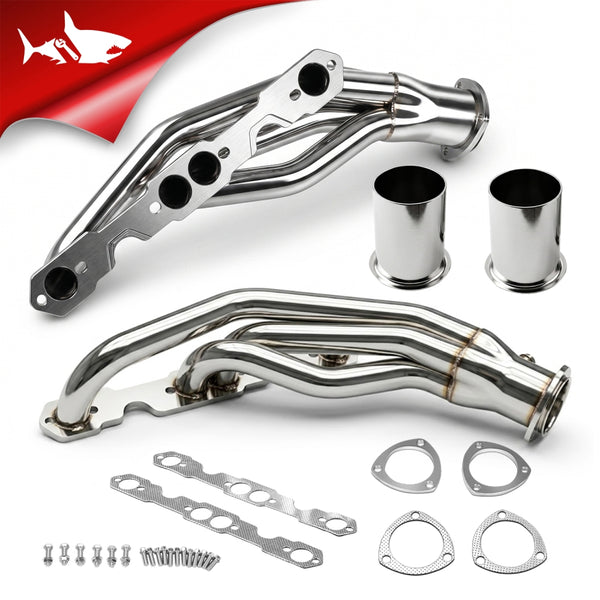
I remember a customer who dragged his 2018 Ram 1500 into the shop. The cold-start tick was deafening, and he was furious because his dash gauge was showing a miserable 11.5 MPG in the city. We ripped off those warped factory logs and bolted on a set of tubular headers for the 4th Gen Ram 5.7 from Flashark. We cleared the ECU's Keep Alive Memory (KAM) so the fuel trims would reset. He drove it normally for a week. He called me the next Friday—his average city mileage had climbed back to 15.2 MPG. The headers didn't perform a miracle; they just stopped the ECU from falsely dumping fuel because the upstream exhaust leak was tricking the O2 sensors into a "false lean" condition.

What the Factory Cast-Iron Manifold Gets Wrong
The stock 5.7 HEMI exhaust manifold isn't terrible for mass production. It's thick cast iron, and it keeps exhaust heat away from the valley of the engine. But from a flow perspective? The runners are a massive compromise.
| Feature | OEM Cast Manifolds | Aftermarket Tubular Headers |
|---|---|---|
| Weight | Heavy (approx. 35 lbs pair) | Lightweight Stainless (approx. 18 lbs pair) |
| Flow Characteristics | Restrictive, turbulent flow | Smooth, directed scavenging |
| O2 Sensor Reading | Prone to false lean (when warped/ticking) | Accurate, stable closed-loop fueling |
Real-World MPG Data — What 5.7 HEMI Owners Actually Report
I've aggregated data from RAM 1500 forums, Challenger/Charger groups, and a handful of 300C builds. Here is what is consistent across nearly all reported installs:

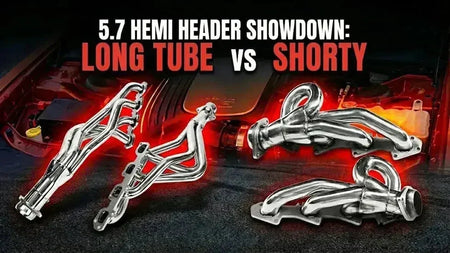
Short-Tube vs Long-Tube Headers: The MPG Equation
If fuel economy is your primary concern alongside performance, your choice of tube length dictates exactly how your fuel trims will react.
The Case for Shorty Headers — Street / Daily Driver
Shorties are direct replacements. They bolt right up to your factory mid-pipes. Because the O2 sensors stay exactly where Dodge engineered them to be, the heater circuits work perfectly, and the ECU enters closed-loop fueling quickly. They retain MDS (the 4-cylinder economy mode) on RAM trucks, meaning you keep those highway MPG gains. You also preserve low-end torque, which gets heavy cars moving without dipping deep into the throttle.
The Case for Long Tube Headers — Performance Build
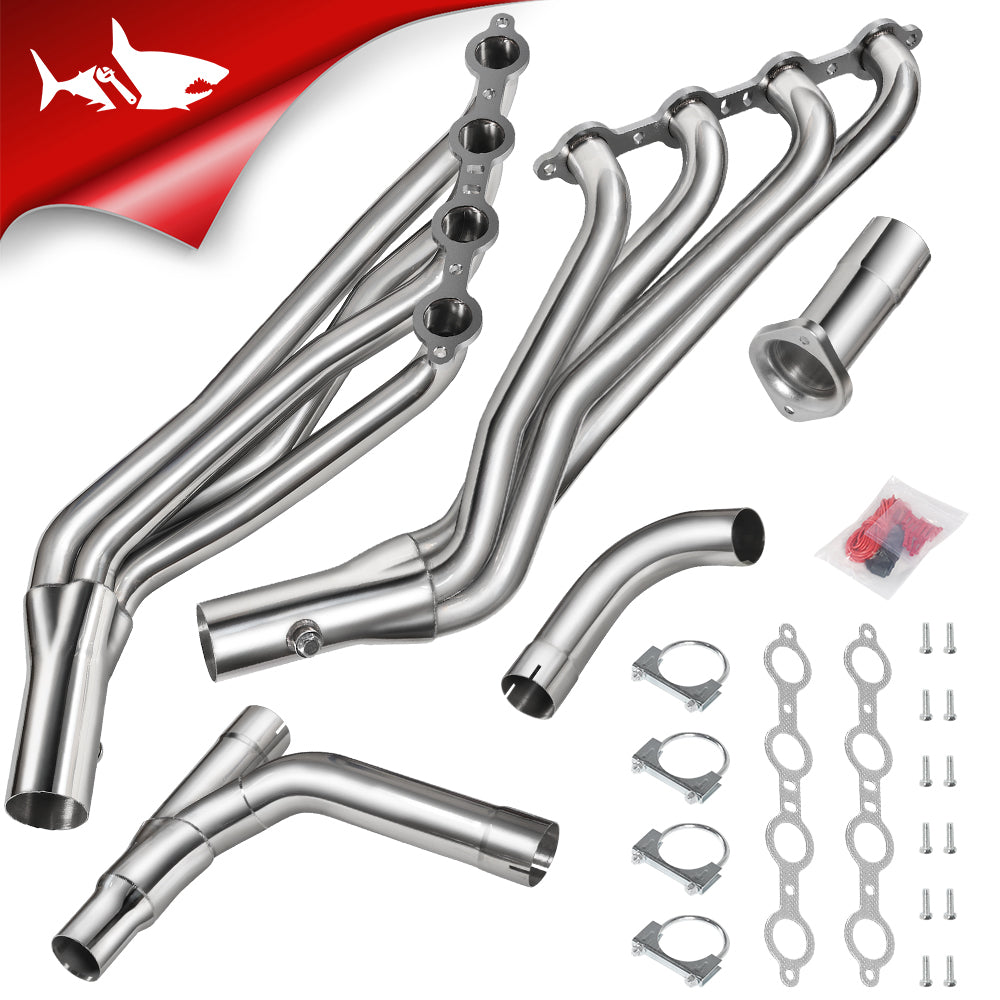
Long tubes are strictly for maximizing top-end horsepower (often 15–22 WHP gains). But here is the catch for fuel economy: you are pushing the O2 sensors further downstream. They take longer to heat up, keeping the engine in a rich "open loop" status longer during cold starts. Without a tune, expect a 0.5–1 MPG regression. With a full tune, however, they can equal or beat short-tube MPG numbers at highway cruise.
The 300C and Other Chrysler 5.7 Platforms
The 300C, Charger, and Challenger sit lower, and the exhaust routing is tighter. Because these cars are lighter than a RAM 1500, any efficiency gain represents a bigger percentage of total fuel consumption. While shorties are great for simple bolt-on applications, many performance-minded owners running a custom-tuned long tube header setup on the 5.7L Hemi report some of the strongest highway MPG improvements in the entire HEMI community. As long as the ECU is properly recalibrated for the relocated O2 sensors, you get the best of both worlds: massive top-end power gains and highly efficient highway cruising.
The Tune Factor: Why ECU Calibration Determines Everything
Hardware is only half the battle. If you bolt on high-flowing pipes, you have fundamentally altered the airflow dynamics of the engine. A proper tune does three things:
- Recalibrates AFR targets for the new exhaust flow characteristics.
- Adjusts ignition timing advance — headers often allow 1–3° more timing at cruise RPM, directly improving efficiency.
- Updates fuel trim tables so the ECU doesn't fight itself trying to add fuel to compensate for a leaner O2 signal.
Without the tune, short-tubes break even, and long tubes run rich. With the tune, you're reliably gaining 1–2 MPG highway regardless of tube length.
Common Mistakes That Tank Your MPG After a Header Install
A lot of novices read online tutorials, buy a shiny new aftermarket header system, install it, and then immediately complain that their gas mileage went to trash. I see it constantly. You didn't ruin your truck's efficiency; you ruined your driving habits. The V8 suddenly sounds so aggressive that you are doing wide-open throttle pulls from every single stoplight just to hear the roar. Trust me, once the novelty wears off and you go back to normal commuting, that MPG gauge will stabilize.
- Skipping the Oxygen Sensor Inspection: Old O2 sensors will be completely inadequate when moved. Replace them if you have 80k+ miles.
- Exhaust Leaks at the Flange: Leaks let oxygen into the exhaust stream upstream of the O2 sensor. The sensor reads lean, the ECU dumps fuel, and your MPG craters. Use quality copper gaskets and re-torque!
- City Drive Cycle Expectations: Headers help at steady-state cruise RPM. Don't expect your stop-and-go city MPG to suddenly jump up.
For a complete list of platform-specific options that fit these exact specs, you can browse the Dodge V8 header lineup to ensure you're getting the right tube length and MDS compatibility for your exact build.
Frequently Asked Questions (FAQs) About 5.7 HEMI Headers & MPG
Q1: Do long tube headers decrease MPG on a 5.7 HEMI?
A1: Not inherently. While they shift the power band higher and relocate O2 sensors (which can momentarily affect warm-up fueling), a proper custom tune will usually maintain or slightly improve highway MPG. City MPG might see a negligible drop.
Q2: Will shorty headers improve fuel economy on my Ram 1500?
A2: Yes, typically by 1-2 MPG, especially if you are replacing warped factory manifolds that were causing an exhaust leak and forcing the engine to run rich.
Q3: How much MPG do you gain with headers and a tune?
A3: Realistically, if you keep your foot out of the throttle, you can expect a 1-3 MPG increase during steady-state highway cruising due to improved exhaust scavenging and optimized timing.
Q4: Does fixing the Hemi tick with headers improve gas mileage?
A4: Absolutely. The "tick" is an exhaust leak that tricks the O2 sensors into reading a lean condition. The ECU compensates by dumping excess fuel. Sealing the exhaust with headers corrects this fuel waste.
Q5: Will headers trigger a Check Engine Light (CEL) on a 5.7 HEMI?
A5: Shorty headers rarely trigger a CEL because they utilize factory catalytic converters. Long tube headers almost always trigger a CEL due to catalyst inefficiency codes or slow O2 response, which requires a tune to turn off.
Q6: Do I need a custom tune for 5.7 HEMI shorty headers?
A6: It is not strictly required to run safely, as the ECU's short-term and long-term fuel trims can adapt to minor flow changes. However, a tune is highly recommended to extract the maximum horsepower and fuel economy gains.
Q7: How do headers affect low-end torque for daily driving?
A7: Shorty headers excel at boosting low-to-mid range torque, which is perfect for moving a heavy truck efficiently in city traffic. Long tubes sacrifice a tiny bit of low-end torque for massive top-end horsepower gains.
Q8: Does changing to headers ruin O2 sensor readings?
A8: Only if there are exhaust leaks at the collector flanges or if long tube O2 extensions are poor quality. A tight seal on quality headers ensures accurate, rapid O2 sensor readings.
Q9: Are long tube or shorty headers better for towing fuel economy?
A9: Shorty headers are generally better for towing. They produce more torque in the lower RPM ranges (2,000 - 3,500 RPM) where you spend most of your time while pulling a heavy trailer, meaning less throttle is needed.
Q10: Why did my MPG drop immediately after installing headers?
A10: This happens for three reasons: the ECU is still re-learning the new airflow dynamics (give it 100 miles), you have a tiny exhaust leak before the O2 sensor, or (most likely) you are driving aggressively to hear the new exhaust tone.