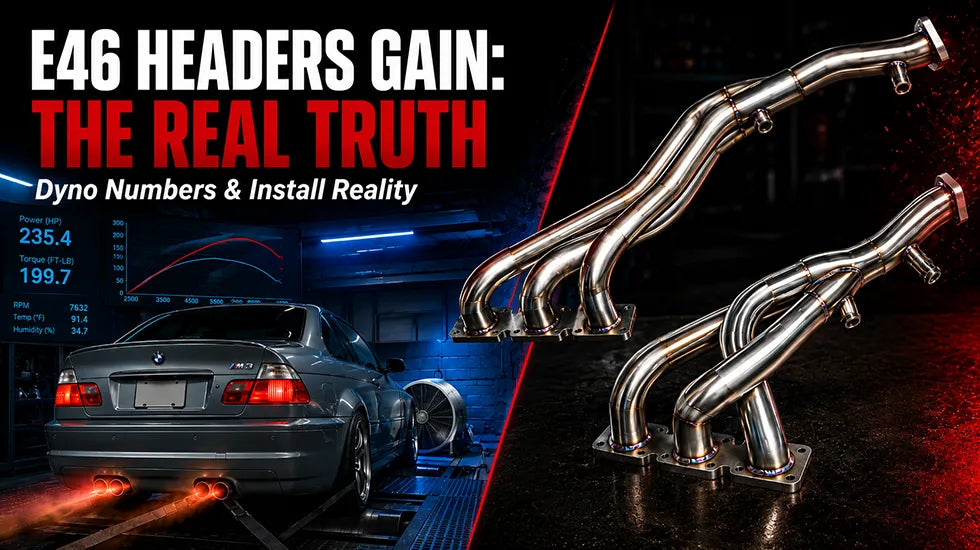
Let’s be honest for a second. The BMW E46 chassis is a handling masterpiece right out of the factory. But the stock exhaust manifolds? Absolute garbage. To meet strict emissions standards, BMW shoved highly restrictive catalytic converters right up against the cylinder head. You are basically driving around with a potato stuffed in your tailpipe. Naturally, swapping them out is step one for most owners. But there is a ton of misinformation out there. I’ve tuned, wrenched on, and driven dozens of these cars, and today we are stripping away the marketing fluff to look at the raw, dyno-proven e46 headers gain.
TL;DR: The true E46 headers gain ranges from 10-15 WHP on non-M (M54/M52) engines to 20+ WHP on the M3 (S54). But here is the catch: you will only see these numbers—and keep the Check Engine Light off—if you pair long tube headers with a proper ECU tune to eliminate the CEL and optimize fueling.

The Bottom Line: What to Expect
If you want the quick answer before getting your hands dirty, here is what the data actually shows:
- M54 Engine (325i/330i): Expect a true 10-15 WHP (Wheel Horsepower) increase in the mid-to-high RPM range, provided you flash the ECU.
- S54 Engine (E46 M3): Dropping the restrictive US-spec cats yields massive returns, typically 15-20+ WHP.
- The Catch: These numbers are strictly conditional. To see the full e46 headers gain and eliminate the inevitable Check Engine Light (CEL), an ECU tune is 100% mandatory.
The Reality of E46 Headers Gain: What the Dyno Actually Shows
Listen, you can’t argue with physics. The factory manifolds create massive back-pressure. When you swap to a tubular design—like a high-flowing set of E46 323i/328i headers—you fix the exhaust scavenging effect, pulling spent gases out of the combustion chamber more efficiently. This lets the engine breathe. But the gains aren't just a flat number across the board; they depend heavily on what is under your hood.
M54 & M52 Engine Expected Gains
For the non-M guys, deleting the primary cats and moving to a free-flowing setup completely wakes the car up. On the dyno, we usually see an 8-12 whp bump before tuning, and up to 15 whp after the air-fuel ratio (AFR) is dialed in. More importantly, it flattens out that annoying torque dip you feel around 3,500 RPM. If you want a reliable setup without breaking the bank, picking up a set of M52 E46 headers from Flashark is a solid starting point to achieve these exact numbers without fighting fitment issues.

| Engine Type | Stock Manifold Flow | Dyno Proven WHP Gain | Torque Change |
|---|---|---|---|
| M52/M54 (Non-M) | Highly Restrictive | 10 - 15 whp | +12 ft-lbs (Mid-range) |
| S54 (M3 US-Spec) | Moderate Restriction | 15 - 20+ whp | +15 ft-lbs (Top-end) |

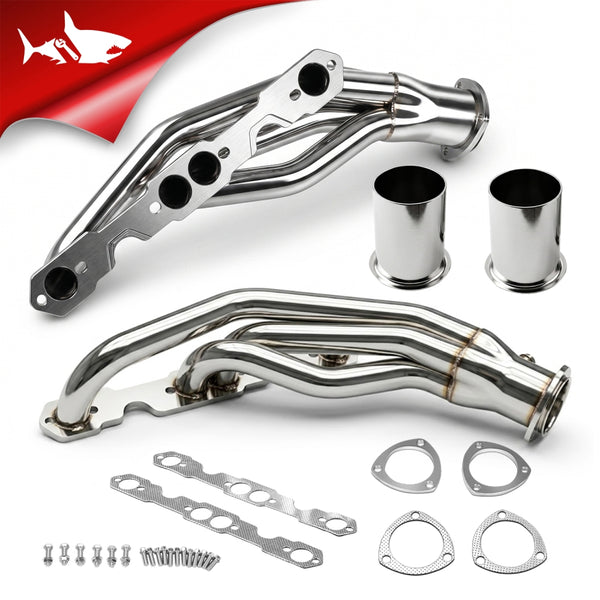
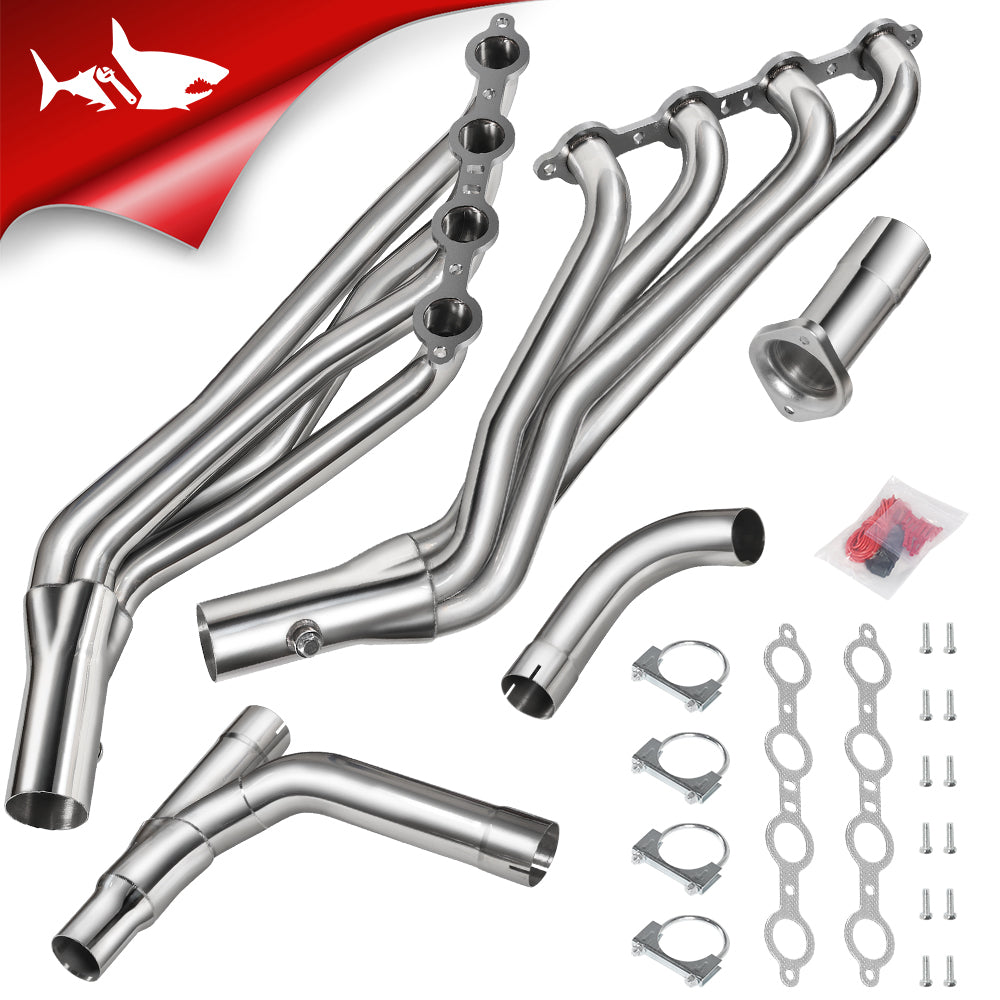
BMW M52 Long & Short Tube Headers (1994-2002) | E36 E46 320i 323i | E39 520i 523i 528i | Z3 2.0-2.8L | E38 728i
These high-performance stainless steel exhaust headers are specifically designed for BMW models with the M52 6-cylinder engine...
Fitment Includes: 320i, 323i, 520i, 523i, 528i, Z3 and more across E36, E46, E39, E38 chassis. Crafted from durable T304 stainless steel.
Exhaust Header VS Manifold: Exhaust headers are made of lighter, thinner steel compared to thick iron manifolds, eliminating back pressure and improving performance.*Note: Includes full fitment tables for 1994-2000 Short Tube and 1996-2002 Long Tube headers. Check full specs on product page.
Long Tube vs. Shorty Headers: How It Affects Your Gains
If you are looking at the BMW automotive headers on the market, you will immediately notice two distinct styles: Long Tube and Shorty. Your choice here drastically changes where you feel the e46 headers gain in the RPM band.
- Shorty Headers: These are easier to install because they mimic the factory manifold length and usually bolt directly to the stock section 1 exhaust. The trade-off? The horsepower gain is lower (around 5-8 whp). However, they excel at preserving low-end torque, making them a snappy, responsive choice for daily street driving.
- Long Tube Headers: This is where the real 15+ whp magic happens. By extending the primary tubes, you maximize exhaust scavenging at high RPMs. If you take your E46 to the track or love ringing it out to the 6,500 RPM redline, long tubes are the only way to go. Yes, the install is tougher, and you will need to modify or replace your section 1 mid-pipe to make them fit, but the top-end pull is undeniable.
The Infamous "E46 Rasp": Sound Changes Explained
We can't talk about exhaust modifications without mentioning the sound. Bolting on exhaust headers is going to make your inline-6 significantly louder. But there's a catch: the infamous E46 rasp. Right around 2,500 to 4,000 RPM, catless setups tend to produce a harsh, metallic tin-can sound. Some guys love it. Most hate it. If you want the horsepower without sounding like a broken tractor, you'll need to weld in some anti-rasp resonators into your section 1 mid-pipe.
The Installation Nightmare: Is the HP Gain Worth the Blood and Sweat?
I’m going to shoot straight with you here. Installing these things is a massive pain in the ass. The space between the strut tower and the engine block is practically non-existent. You will be operating by feel, stringing together long extensions and universal joints just to reach the copper nuts on the underside.

Mechanic's Case Study: I remember back in '18, a guy brought his 330i into the shop. He had watched a 10-minute YouTube tutorial and thought he could do it on a Sunday afternoon. Many beginners watch online tutorials and just rip into the tear-down without prepping the hardware, which leads to disaster. He snapped two heavily rusted exhaust studs completely flush with the aluminum cylinder head on cylinder #5. What should have been a simple swap turned into a multi-day extraction nightmare. My advice? Soak every single stud in penetrating oil for at least 48 hours before you pick up a wrench. Heat is your best friend. Do not rush it.
3 Mechanic Secrets to Survive the E46 Header Install
If you're stubborn enough to tackle this on jack stands, you need to know a few secrets that the basic forum guides usually skip. Here is a sneak peek from our complete DIY E46 Headers Install Manual:
- The "Engine Mount" Cheat Code: Do not try to fight the chassis rail. Locate the passenger side engine mount, remove the top nut, and slowly jack the oil pan (use a block of wood near the reinforced edge to protect it) up by about 1.5 to 2 inches. This slight tilt opens up a massive amount of clearance to drop the old cats out and slide the new headers in.
- Don't Cross the Streams (O2 Sensors): The connectors for Bank 1 (cylinders 1-3) and Bank 2 (cylinders 4-6) are identical. If you mix these up during reinstallation, your car will misfire and idle violently. Label them with masking tape before you unplug anything.
- Respect the M7 Studs (Torque Specs): The single biggest mistake beginners make is over-tightening. The M7 exhaust nuts only require 15 to 20 Nm (11 to 15 ft-lbs). Torquing them to 24 Nm or just "cranking them down" will stretch and snap the copper studs, turning a weekend project into a machine-shop nightmare.

Exhaust Headers for BMW 1998-2006 E46 323i 328i & 1997-2000 E39 5 Series – 2.5L/2.8L/3.0L
Upgrade your BMW’s exhaust system with Flashark Exhaust Headers, designed specifically for BMW's M52 engine family (including M52B25 and M52B28).
- Improved TIG welding with each weld back purged.
- Includes 4 O2 (lambda) sensor ports.
- Improvement is approx. 12 hp (Over 30 HP with ECU tune).
✅ Verified Fitment: 323i / 328i (1998-2006) 3 Series E46 Chassis, and 5 Series (1997-2000) E39 Chassis, 2.5L/2.8L/3.0L inline-6 Engine.
ECU Tuning: The Missing Link for Maximum E46 Header Gains
You can't just bolt up headers and call it a day. The factory DME (Digital Motor Electronics) is programmed to run with those restrictive cats. Once you rip them out, the O2 sensors freak out. They read a massive spike in flow and incorrect emissions data, which instantly throws a Check Engine Light and forces the engine to run artificially rich to protect itself.
To actually get that 15+ e46 headers gain, you need software. A proper flash tune recalibrates the air-fuel ratio, advances the timing slightly to take advantage of the better flow, and tweaks the VANOS (variable valve timing) engagement points. Plus, the tuner will code out the post-cat O2 sensors so your dash doesn't light up. I’ve seen guys skip the tune to save a few bucks, and they end up losing low-end torque. Don't be that guy. If you are going to buy quality aftermarket headers, spend the money to tune the ECU.
Frequently Asked Questions (FAQs)
Q1: How much HP do headers actually add to an E46 330i?
A1: On average, a non-M E46 like the 330i will see a realistic gain of 10 to 15 wheel horsepower (WHP). This requires pairing the catless headers with a proper ECU flash tune to optimize the air/fuel mixture and correct the factory restrictions.
Q2: Do I absolutely need a tune after installing headers on my E46?
A2: Yes. Without a tune, your engine will run rich, you won't realize the full horsepower gains, and you will permanently trigger a Check Engine Light (CEL) due to the missing primary catalytic converters.
Q3: Will catless headers make my E46 throw a Check Engine Light?
A3: Absolutely. The downstream O2 sensors monitor catalyst efficiency. Once the cats are gone, the readings go out of range. A tuner must write out the secondary O2 sensor parameters to clear the CEL permanently.
Q4: Are E46 M3 (S54) headers interchangeable with non-M (M54/M52) engines?
A4: No. The S54 engine and the M52/M54 engines have completely different cylinder head designs, exhaust port spacing, and flange bolt patterns. You must buy headers specifically designed for your engine block.
Q5: How do I get rid of the rasp after installing E46 headers?
A5: The best way to eliminate the metallic rasp is to install a custom mid-pipe (section 1) that includes high-quality anti-rasp resonators or an X-pipe crossover to smooth out the exhaust pulses.
Q6: Are long-tube or shorty headers better for the E46?
A6: Long-tube headers are generally superior for mid-range and top-end horsepower gains because they promote better exhaust scavenging. Shorty headers are easier to install but leave performance on the table.
Q7: Will my E46 pass emissions in the US with aftermarket headers?
A7: In strict emissions states like California (CARB regulated), catless headers will absolutely fail the visual and sniffer tests. They are strictly designated for off-road or track use.
Q8: How long does a DIY header install take on a BMW E46?
A8: For a first-timer on jack stands, expect it to take anywhere from 8 to 12 hours. The working space is incredibly tight, and dealing with rusted, seized exhaust studs often doubles the expected labor time.
Q9: Can I install E46 headers on jack stands at home?
A9: Yes, it is physically possible, but it requires patience, a vast array of socket extensions, swivel joints, and plenty of penetrating fluid. A professional lift makes the job significantly easier.
Q10: Do I need to replace the O2 sensors when installing new headers?
A10: It is highly recommended. O2 sensors that have been heat-cycled for 100,000 miles often weld themselves into the old manifolds. The threads usually strip upon removal, so installing fresh sensors prevents massive headaches.
Q11: Does upgrading headers negatively impact E46 fuel economy?
A11: Surprisingly, no. Because the engine doesn't have to work as hard to push exhaust gases through restrictive catalytic converters, highway cruising MPG can actually slightly improve—provided you keep your foot off the floorboard.