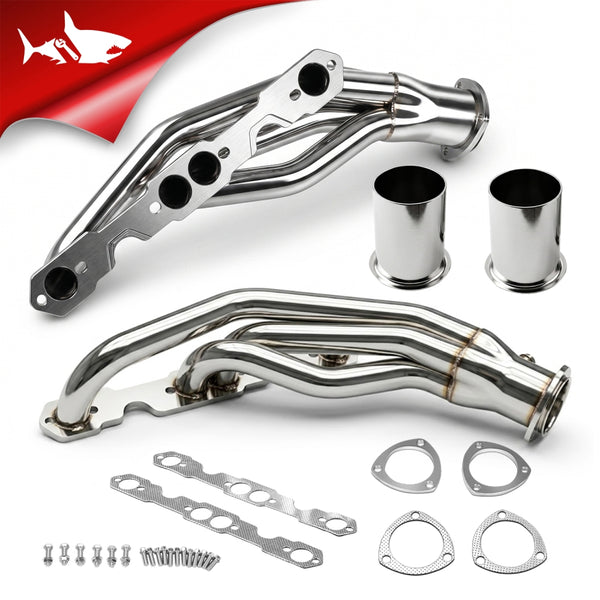
Welcome to Flashark, your go-to source for automotive performance upgrades and enhancements. If you are searching for the best 5.3 Silverado long tube headers, the right choice depends on your truck's year range, drivetrain, engine family, exhaust setup, and whether you plan to tune it afterward.
For most 1999-2014 Chevy Silverado and GMC Sierra owners with a 5.3L Vortec or LS-based truck engine, long tube headers are one of the most effective exhaust upgrades for better flow, a deeper sound, and stronger horsepower potential. This guide explains what long tube headers do, which 5.3 Silverado applications they fit best, what to expect during installation, and how to choose the right Flashark header kit without guessing.

Executive Summary: What Are the Best Long Tube Headers for 5.3 Silverado?
The best long tube headers for a 5.3 Silverado are the headers that match your exact truck generation, engine, and drivetrain. For 1999-2006 GMT800 trucks, choose a long tube header and Y-pipe kit designed for the 4.8L, 5.3L, and 6.0L Vortec platform. For 2007-2014 GMT900 trucks, choose headers made specifically for the later Silverado, Sierra, Tahoe, Suburban, Yukon, and related GM truck chassis.
- Best for 1999-2006 5.3 Silverado: Flashark long tube headers with Y-pipe for GMT800 1500 2WD trucks.
- Best for 2007-2014 5.3 Silverado: Flashark long tube headers for GMT900 2WD trucks and SUVs.
- Expected power gain: Around 15-25 wheel horsepower on many tuned 5.3 setups with a free-flowing exhaust.
- Tune required? Strongly recommended for best horsepower, drivability, and check-engine-light control.
- Install difficulty: Moderate to difficult. Expect tight clearance, O2 sensor extensions, and possible Y-pipe adjustment.
What Are Long Tube Headers?
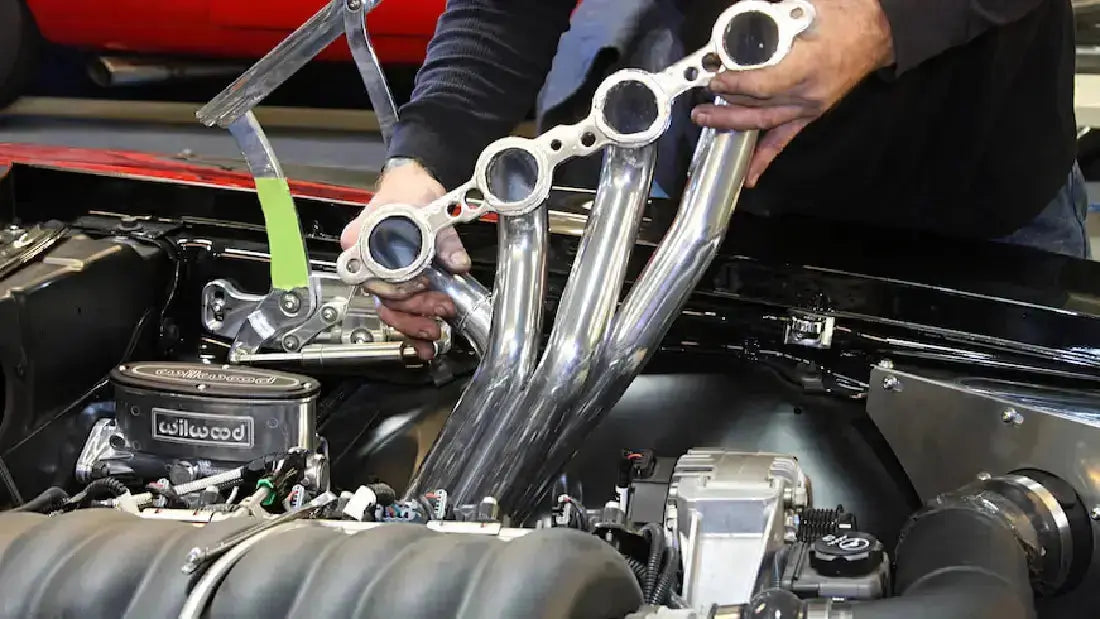
Long tube headers are aftermarket exhaust components designed to replace the factory cast exhaust manifolds on your vehicle's engine. Instead of forcing exhaust gases through a compact and restrictive manifold, long tube headers use individual primary tubes that route each cylinder's exhaust pulse into a collector farther downstream.
On a 5.3 Silverado, this design helps the engine breathe more efficiently, especially in the mid-range and upper RPM range. That is why long tube headers are popular on LS and Vortec truck builds with a tune, intake, camshaft upgrade, cat-back exhaust, or more aggressive street performance setup.
Anatomy of Long Tube Headers
Long tube headers consist of individual primary tubes, a merge collector, flanges, oxygen sensor bungs, and a connection point for the rest of the exhaust system. Compared with factory manifolds, the longer primary tubes are designed to improve exhaust pulse timing and reduce backpressure.
For a 5.3 Silverado, the most important header details are primary tube diameter, collector location, flange thickness, weld quality, material, O2 sensor placement, and whether the kit is designed for your specific truck generation.
How Long Tube Headers Work
Long tube headers improve the scavenging effect in your engine's exhaust system. When one cylinder pushes exhaust gas out, that pulse travels through the primary tube toward the collector. A well-designed header helps maintain exhaust velocity, which can help pull the next exhaust pulse out of the combustion chamber more efficiently.
This reduces restriction and can improve horsepower, torque, throttle response, and exhaust sound. On a 5.3 Silverado, the difference is usually most noticeable when the engine is under load, especially above 3,000 RPM.

Mechanic Note: Long Tubes Are Not Just About Peak Horsepower
On a mild 5.3 Silverado, long tube headers are usually felt in three places: stronger pull after 3,000 RPM, sharper throttle response, and a deeper exhaust tone. The truck may not feel completely transformed at idle or light throttle, but once the engine is loaded, the reduced exhaust restriction becomes much more noticeable.
5.3 Silverado Header Fitment Guide by Year
Before buying headers for a 5.3 Silverado, confirm the truck's year, platform, engine, and drivetrain. A header that fits a 2003 Silverado 5.3 does not automatically fit a 2016 Silverado 5.3, even though both trucks are often described as “5.3 Silverado” models.
| Year Range | Platform | Common Engines | Best Header Direction | Fitment Notes |
|---|---|---|---|---|
| 1999-2006 | GMT800 | 4.8L, 5.3L, 6.0L Vortec | Long tube headers with Y-pipe | Best match for classic 5.3 Silverado LS/Vortec builds. Verify 2WD or 4WD before purchase. |
| 2007-2014 | GMT900 | 4.8L, 5.3L, 6.0L, 6.2L | GMT900-specific long tube headers | Check AFM, O2 sensor wiring, Y-pipe connection, and steering shaft clearance. |
| 2014-2018 | K2XX | 5.3L L83 EcoTec3 | Use headers made specifically for L83 trucks | Do not assume older GMT800 or GMT900 Vortec headers will fit the L83 chassis. |
| 2019-newer | T1XX | 5.3L L84 EcoTec3 | Use dedicated 2019-newer Silverado headers | Fitment, emissions hardware, and sensor locations differ from older trucks. |
Fitment Warning: 2WD vs 4WD Matters
Many 5.3 Silverado long tube headers are designed around a specific drivetrain layout. A 2WD header may have different collector routing than a 4WD truck because of the front differential, transfer case, crossmember, and driveshaft clearance. Always verify drivetrain fitment before ordering headers.
Benefits and Disadvantages of Long Tube Headers
Before making any modifications to your truck, it is important to understand both sides of the upgrade. Silverado long tube headers can deliver real performance and sound benefits, but they also require more planning than a simple muffler swap.
Benefits of Long Tube Headers
Increased Horsepower and Torque
Long tube headers improve exhaust flow, allowing the 5.3 engine to expel spent gases more efficiently. This reduction in backpressure can lead to stronger horsepower and torque, especially when paired with a proper tune and a free-flowing exhaust system.
Improved Exhaust Flow
Factory cast manifolds are durable, but they are not designed for maximum performance. Long tube headers provide a smoother path from each exhaust port to the collector, helping the engine breathe more easily and improving throttle response under load.
Enhanced Engine Efficiency
With improved scavenging and reduced restriction, long tube headers can help the engine operate more efficiently. Results vary by truck and tune, but better exhaust flow is one of the most important foundations for a stronger 5.3 Silverado build.
Aggressive Sound and Deeper Exhaust Note
Long tube headers can give your 5.3 Silverado a louder, deeper, and more aggressive exhaust tone. The final sound depends on your muffler, catalytic converter setup, resonator, pipe diameter, and whether the truck uses a single or dual exhaust layout.
A Smart Upgrade When Factory Manifold Bolts Break
Many older 5.3 Silverado trucks develop broken exhaust manifold bolts, especially near the rear cylinders. This often causes a ticking noise on cold start. If you are already paying labor to remove broken bolts or fix an exhaust leak, upgrading to long tube headers can be a practical performance-minded repair.
15-Year Mechanic Insight: The Broken Bolt Silver Lining
Over the past 15 years in the performance shop, one of the most common 5.3L Vortec problems I have seen is snapped factory exhaust manifold bolts, especially on the rear cylinders. The owner hears a ticking sound on cold start, then finds out the manifold hardware has failed.
Instead of paying heavy labor just to drill out broken studs and reinstall a restrictive cast iron manifold, many builders use that repair as the right time to upgrade. Long tube headers can fix the leak, improve flow, and give the truck the deeper LS/Vortec sound it should have had from the beginning.
Disadvantages of Long Tube Headers
Long tube headers offer strong performance benefits, but they are not the easiest or quietest exhaust upgrade. Here are the main downsides to consider before installing them on a 5.3 Silverado:
- Higher cost: Long tube headers usually cost more than stock manifold replacement or shorty headers.
- More complex installation: Installation can require tight under-truck access, O2 extensions, gasket alignment, and exhaust adjustment.
- Warranty concerns: Exhaust modifications may affect factory or extended warranty coverage.
- Increased noise: Long tube headers can make the truck noticeably louder, especially with aggressive mufflers or no catalytic converters.
- Emissions concerns: Some long tube setups may not be legal for street use in certain areas.
- Tune recommended: A tune is strongly recommended to get the best performance and reduce check-engine-light issues.
Shop Warning: Installation Reality Check
Do not expect a quick 30-minute driveway job. On many 5.3L Silverado long tube header installs, the driver-side header is the tightest part of the job. Because long tubes push the collector farther down the chassis, the factory oxygen sensor wiring often will not reach without O2 sensor extensions. You may also need to loosen the steering shaft to gain enough clearance to slide the driver-side header in from below.
If you are installing these at home, plan for a full weekend. If the truck has rust, broken manifold bolts, or old exhaust hardware, budget extra time.

Long Tube Headers vs Shorty Headers vs Stock Manifolds
When people search for headers for a 5.3 Silverado, they are often comparing three options: keeping the stock manifolds, installing shorty headers, or upgrading to long tube headers. Each choice has a different purpose.
| Header Type | Power Gain | Sound Change | Install Difficulty | Best For |
|---|---|---|---|---|
| Stock manifolds | Baseline | Quiet | No upgrade needed | Factory reliability and emissions simplicity |
| Shorty headers | Usually modest | Mild to moderate | Easier than long tubes | Manifold replacement, mild street builds, simpler installs |
| Long tube headers | Best potential gain | Deep, aggressive, louder | Harder; may need O2 extensions and exhaust work | Tuned 5.3 Silverado builds, performance exhaust setups, stronger sound |
How Much Horsepower Do Long Tube Headers Add to a 5.3 Silverado?
On many mild 5.3 Silverado setups, long tube headers can add around 15-25 wheel horsepower when paired with a proper tune and free-flowing exhaust. A completely stock truck without a tune may still sound better and flow better, but the full performance gain usually comes after tuning.
The actual horsepower gain depends on:
- Engine condition and mileage
- Truck year and engine code
- Primary tube diameter and collector design
- Cat-back exhaust or Y-pipe setup
- Whether catalytic converters are retained, relocated, or removed
- ECU tuning quality
- Supporting mods such as intake, camshaft, throttle body, or gears
Realistic Power Expectation
If your 5.3 Silverado is stock and untuned, do not expect long tube headers alone to feel like a supercharger. The biggest difference usually comes from the combination: long tube headers, good exhaust flow, no leaks, correct O2 sensor placement, and a tune that adjusts fueling and spark for the new airflow.
What Are the Best Long Tube Headers for 5.3 Silverado?
Looking to upgrade your 1999-2006 5.3 Silverado or 2007-2014 5.3 Silverado? Flashark long tube headers are a strong choice for owners who want better exhaust flow, a deeper LS/Vortec sound, and more horsepower potential from a tuned truck.
The best choice depends mainly on your truck generation. GMT800 trucks and GMT900 trucks use different chassis layouts, so you should not choose headers by engine size alone. Always confirm year, platform, engine, and drivetrain before ordering.
Fitment Note
Most Flashark 5.3 Silverado long tube header applications are designed around specific 2WD truck platforms. Do not assume a 2WD header kit will automatically fit a 4WD truck. Front differential, transfer case, crossmember, and driveshaft clearance can change the collector route.
Material Matters: Why 304 Stainless Steel Is Non-Negotiable
When you are pushing exhaust gases out of a 5.3L Vortec under load, heat cycling is brutal on header tubes, flanges, and welds. This is why material choice matters. Mild steel may look attractive because of the price, but it can rust quickly and may not survive repeated heating and cooling as well as stainless steel. For a street-driven truck, stainless construction is the safer long-term choice.
| Header Material | Heat & Stress Handling | Corrosion Resistance | Mechanic's Verdict |
|---|---|---|---|
| Mild steel | More vulnerable to repeated heat cycling | Poor | Avoid for long-term truck use if rust and labor cost matter. |
| 409 stainless steel | Good for many daily drivers | Moderate; surface rust can appear | Functional, but not the cleanest option for long-term appearance. |
| 304 stainless steel | Excellent | High | Best option for durability, corrosion resistance, and serious builds. |
Flashark core features at a glance:
- Material durability: Built from stainless steel for long-term corrosion resistance and heat-cycle durability.
- Flow-oriented design: Primary tube and collector layout are designed to reduce exhaust restriction compared with factory manifolds.
- Generation-specific fitment: Choose the correct kit for GMT800 or GMT900 truck applications.
- 5.3 Silverado use case: Best suited for owners who want stronger sound, better exhaust flow, and a foundation for future tuning or LS/Vortec upgrades.
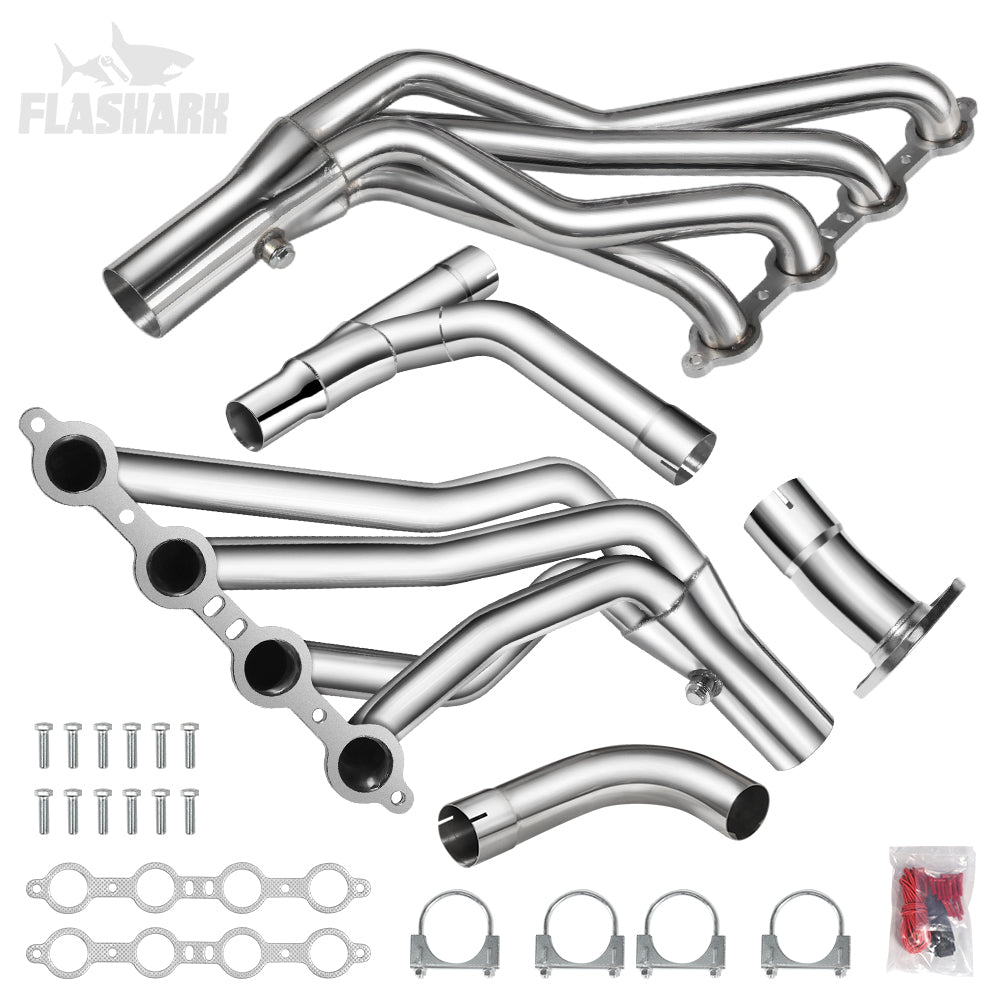
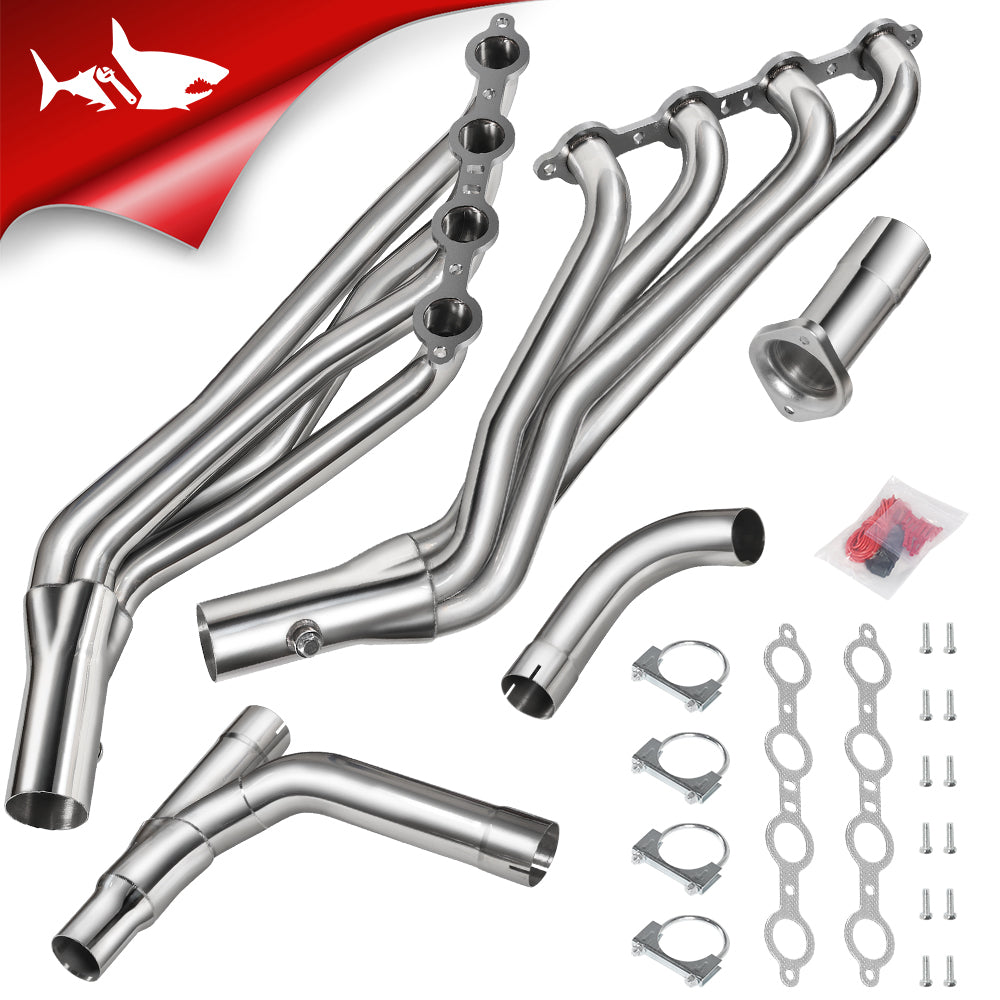
Long Tube Headers 4.8L 5.3L 6.0L for 1999-2006 Chevy/GMC GMT800 Silverado/Sierra/Avalanche 1500 Y-Pipe 2WD
Boost horsepower and sound on your 1999-2006 5.3L Silverado with FLASHARK long tube headers. Built from stainless steel, TIG-welded, and designed for max exhaust flow in 2WD models.
Price: $269.99
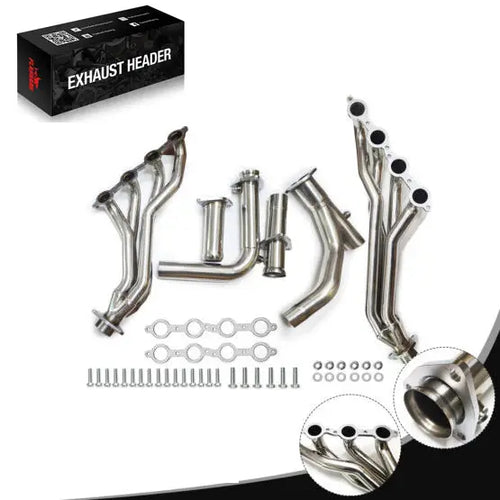
Exhaust Header for 2007-2014 Silverado Suburban Sierra 4.8L 5.3L 6.0L 6.2L 2WD
FLASHARK exhaust headers enhance power, torque, and sound for 2007-2014 Chevy Silverado, GMC Sierra, and SUVs with 4.8L-6.2L engines.
Price: $319
Do You Need a Tune for 5.3 Silverado Long Tube Headers?
Yes, a tune is strongly recommended after installing long tube headers on a 5.3 Silverado. The truck may run without a tune, but the ECU is still working around factory airflow assumptions. A proper tune helps maximize horsepower, improve throttle response, correct fueling, and reduce check-engine-light issues related to rear oxygen sensors or catalytic converter efficiency codes.
A tune becomes even more important if your truck has:
- Catless long tube headers
- High-flow catalytic converters
- Aftermarket Y-pipe
- Cold air intake
- Camshaft upgrade
- Large exhaust diameter changes
- AFM/DOD-related modifications
What Size Long Tube Headers Are Best for a 5.3 Silverado?
For most street-driven 5.3 Silverado builds, a 1-5/8 inch or 1-3/4 inch primary tube size is usually the sweet spot. A smaller primary can help maintain exhaust velocity on mild trucks, while a larger primary can support more airflow on cammed or higher-horsepower setups.
- 1-5/8 inch primary: Good for mild daily-driven 5.3 trucks focused on torque and response.
- 1-3/4 inch primary: Good all-around choice for many 5.3 builds with tune, intake, exhaust, or cam upgrades.
- 1-7/8 inch primary: Usually better suited for larger displacement, high-RPM, or more heavily modified setups.
Builder Tip
Bigger is not always better. An oversized primary tube on a mild 5.3 truck can reduce exhaust velocity and make the truck feel softer down low. Match the header size to the engine combination, not just the biggest number on the spec sheet.
Installation Checklist for 5.3 Silverado Long Tube Headers
Use this checklist before installing long tube headers on your Silverado:
- Confirm year, engine, platform, and 2WD/4WD fitment.
- Order O2 sensor extensions if the kit or truck requires them.
- Inspect exhaust manifold bolts before disassembly.
- Plan for broken manifold bolts on older 5.3 trucks.
- Use quality gaskets and check flange surfaces.
- Check steering shaft clearance on the driver side.
- Test-fit collector and Y-pipe alignment before final tightening.
- Check spark plug wire clearance around hot header tubes.
- Retighten header bolts after several heat cycles.
- Schedule a tune after installation for best results.
Are Long Tube Headers Legal on a 5.3 Silverado?
Long tube header legality depends on where you live and how the headers affect emissions equipment. If a header setup removes, relocates, or changes catalytic converters or oxygen sensor function, it may not be legal for street use in some regions. Always check local emissions regulations before installing long tube headers on a street-driven Silverado.
Emissions Warning
For street-driven trucks, do not assume that every long tube header kit is emissions-compliant. Rules vary by state, county, and inspection program. If your Silverado must pass emissions testing, confirm catalytic converter placement, O2 sensor readiness, and local legal requirements before installation.
Ready to Wake Up Your 5.3L LS Engine?
Upgrading to long tube exhaust headers is one of the most effective ways to unlock more sound and performance from your 5.3 Silverado. With improved exhaust flow, stronger horsepower potential, better throttle response, and a deeper exhaust note, long tube headers can make an older LS/Vortec truck feel more alive.
If you own a 1999-2006 5.3 Silverado or Sierra 2WD, the Flashark GMT800 long tube header and Y-pipe kit is the better match. If you own a 2007-2014 5.3 Silverado, Sierra, Tahoe, Suburban, Yukon, or related 2WD truck/SUV, choose the Flashark GMT900 header kit instead. For 2014-2018 L83 or 2019-newer L84 Silverado owners, do not use older Vortec header fitment as a shortcut. Those trucks need headers designed specifically for their platform, sensor layout, and chassis clearance.
Frequently Asked Questions: Upgrading Your 5.3L Silverado Exhaust
Q1: What are the benefits of long tube headers for a 5.3 Silverado?
A1: Long tube headers improve exhaust flow on a 5.3 Silverado, which helps increase horsepower and torque, reduce backpressure, improve throttle response, and deliver a more aggressive exhaust sound compared to stock exhaust manifolds.
Q2: What are the best long tube headers for 5.3 Silverado?
A2: The best long tube headers for a 5.3 Silverado are headers that match your truck's exact year range, platform, engine, and drivetrain. For 1999-2006 GMT800 2WD trucks, use a GMT800-specific long tube header and Y-pipe kit. For 2007-2014 GMT900 2WD trucks, use a GMT900-specific long tube header kit.
Q3: Are long tube headers compatible with all 5.3 Silverado models?
A3: No. Not all models are compatible. Most long tube headers are designed for specific year ranges and drivetrain setups, such as 1999-2006 and 2007-2014 2WD 5.3 Silverado models. Always verify year, engine, platform, and drivetrain fitment before purchase.
Q4: Will long tube headers improve towing performance?
A4: They can help by improving exhaust flow and torque delivery, especially on tuned setups. However, towing performance also depends on gearing, transmission condition, engine tune, tire size, and total load. For towing-focused trucks, avoid oversizing the header primary tubes.
Q5: Do I need a tune after installing long tube headers on a 5.3 Silverado?
A5: A tune is strongly recommended. While the truck may run without one, proper tuning maximizes performance gains, improves drivability, and helps prevent issues such as check engine lights or incorrect air-fuel ratios.
Q6: Are Flashark long tube headers made from stainless steel?
A6: Yes. Flashark long tube headers are constructed from stainless steel, offering good corrosion resistance, durability, and long-term performance under high exhaust temperatures.
Q7: Will long tube headers make my 5.3 Silverado louder?
A7: Yes. Long tube headers significantly increase exhaust volume and create a deeper, more aggressive sound. The final noise level also depends on your muffler choice, catalytic converter setup, resonator, pipe diameter, and tailpipe layout.
Q8: Is installation of long tube headers difficult?
A8: Installation can be complex and is more involved than replacing stock manifolds. It often requires tight engine bay clearance, under-truck access, proper gasket alignment, O2 sensor extensions, and careful collector positioning. Professional installation is recommended if you are not comfortable with exhaust work.
Q9: Do long tube headers affect emissions compliance?
A9: They can. In some regions, long tube headers may not be emissions-legal, especially if catalytic converters are removed or relocated. Always check local emissions laws before installing long tube headers on your Silverado.
Q10: Can long tube headers improve fuel economy?
A10: In some cases, slight fuel economy improvements are possible due to better exhaust flow and engine efficiency. However, gains vary depending on driving habits, tune quality, tire size, gear ratio, and supporting modifications.
Q11: What engines are compatible with Flashark long tube headers for Silverado?
A11: Flashark long tube headers are compatible with Chevy and GMC trucks equipped with 4.8L, 5.3L, 6.0L, and select 6.2L engines, depending on the model year and specific header design. Always check the product fitment before ordering.
Q12: Will I need O2 sensor extensions to install long tube headers on my 5.3 Silverado?
A12: Almost always, yes. Because long tube headers move the collector flange farther downstream, the factory oxygen sensor wiring harnesses may be too short to reach the new sensor bungs. Plug-and-play O2 sensor extensions are usually the safest and easiest solution during installation.
Q13: Are 5.3 LS headers and 5.3 Vortec headers the same thing?
A13: In many Silverado discussions, “5.3 LS headers” and “5.3 Vortec headers” are used to describe headers for GM's LS-based 5.3 truck engines. However, fitment still depends on truck year, chassis, drivetrain, and engine generation. Always check the product application before buying.
Q14: Are long tube headers better than shorty headers for a 5.3 Silverado?
A14: Long tube headers usually offer better horsepower potential and a more aggressive sound. Shorty headers are easier to install and may be better for mild manifold replacement, but they typically do not provide the same performance gain as long tubes.
Q15: Can I install long tube headers on a 4x4 5.3 Silverado?
A15: You can install long tube headers on some 4x4 5.3 Silverado trucks, but you must buy headers specifically designed for 4x4 fitment. A 2WD header kit may not clear the front differential, driveshaft, or transfer case components.
Q16: Will long tube headers fix a broken exhaust manifold bolt leak?
A16: They can be part of the solution if the broken bolts are properly removed and the cylinder head sealing surface is cleaned. Long tube headers replace the factory manifolds, but the repair still depends on correct bolt extraction, gasket sealing, and installation.

Steven Chen
Automotive Performance Specialist | Engine & Exhaust Systems
Steven focuses on practical engine performance, exhaust fitment, and real-world upgrade paths for classic and modern enthusiast vehicles. He reviews small-block Ford, LS, truck, and street/strip applications with one goal in mind: helping builders choose parts that actually work together. His philosophy: "Good power starts with the right combination, not the biggest part."