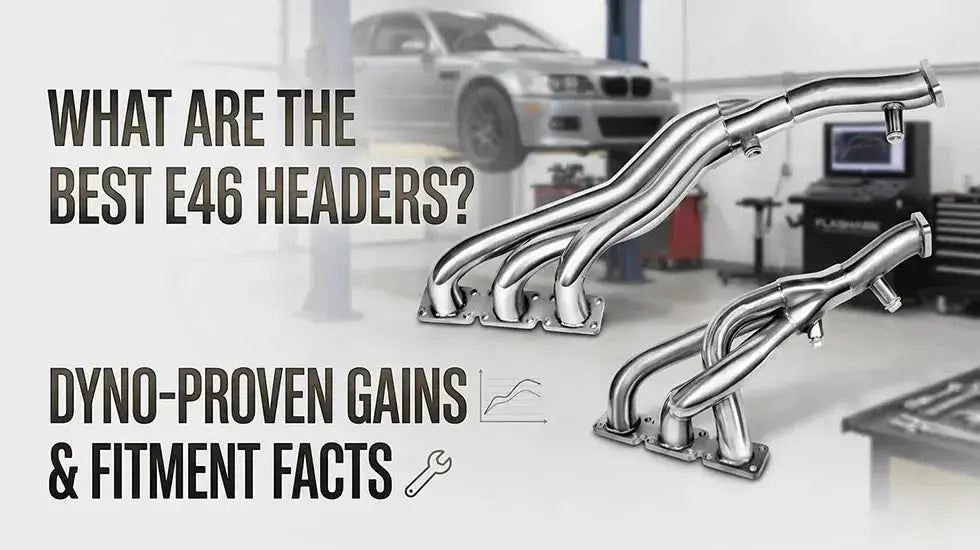
Pulling the factory exhaust manifold off an M52TU or M54 engine explains everything you need to know about why your E46 feels suffocated past 4,000 RPM. BMW essentially crammed dense, heavy catalytic converters right against the engine block to meet strict early-2000s emissions standards.
The result? Those cats act like glowing heaters. They cook your valve cover gaskets, bake your plastic cooling lines, and create a massive wall of backpressure. If you want to wake up that inline-six and let it breathe, swapping to a set of catless tubular headers isn't just a "nice-to-have" mod—it’s the mandatory first step.
Here is the no-nonsense truth about finding the best E46 headers, what fits, and the installation traps that leave amateur mechanics stranded in their driveways.
- The Goal: Eliminate the turbulent restriction of factory cats for smooth, high-velocity exhaust scavenging.
- Fitment Warning: M52TU (323i/328i) and M54 (325i/330i) flanges differ. Always verify engine codes before ordering.
- The Sweet Spot: Avoid cheap, thin-flanged eBay specials that warp. Look for thick, 3/8" CNC-machined flanges like the Flashark T304 series.
- Expected Gains: A proven 10-15 WHP and drastically lower engine bay temperatures (requires a proper ECU tune).
The Bottleneck: Why Your Factory E46 Exhaust Manifold Sucks

Let's talk fluid dynamics for a second without getting too nerdy. An engine is essentially a giant air pump. The faster air gets in and out, the more power you make. The factory E46 exhaust manifolds were designed for strict emissions compliance, not scavenging efficiency.
The OEM design forces exhaust gases from three cylinders to violently crash into each other inside a restrictive catalytic converter mere inches from the exhaust valves. This creates turbulence and backpressure. A proper set of long-tube or mid-length aftermarket headers separates those exhaust pulses, creating a vacuum effect (scavenging) that literally pulls the exhaust out of the next firing cylinder.
| Feature | Factory E46 Manifold (with Cats) | Quality Aftermarket Catless Headers |
|---|---|---|
| Exhaust Flow | Highly restricted, turbulent | Smooth, high-velocity scavenging |
| Weight | Extremely heavy (cast iron + cat core) | Lightweight (T304 Stainless Steel) |
| Engine Bay Temps | High heat retention, bakes plastics | Significantly reduced ambient heat |
| Dyno Results (WHP) | Baseline | +10 to +15 WHP (with proper tune) |
Engine-Specific Fitment: M52TU vs. M54
Do not assume all E46 exhaust parts are universally identical. The chassis is the same, but buying the wrong flange layout means you're going to have a very bad weekend.
Early Models: E46 323i & 328i (M52TU 2.5L/2.8L)
These early engines are incredibly robust but severely choked. Because of the slightly different port shapes and O2 sensor wire routing compared to later models, you need a system engineered specifically for this block. If you're driving an early model, you want to look at a dedicated exhaust header for BMW e46 323i 328i to ensure smooth exhaust flow right out of the cylinder head and perfect port matching.

Later Models: E46 325i & 330i (M54 2.5L/3.0L)
When BMW shifted to the M54, they changed the flange connection at Section 1 (the mid-pipe). The M54 also has much stricter tolerances for the pre-cat and post-cat O2 sensors. When upgrading a 330i exhaust, make sure the headers explicitly state M54 compatibility.
You will almost certainly need O2 sensor harness extensions for the M54. Relocating the bungs further downstream on aftermarket headers means the factory wiring will not reach without putting dangerous tension on the wires.
Finding the Sweet Spot: Quality vs. Price
I've seen guys drop $1,500 on mathematically perfect European headers, and I've seen guys buy $100 unbranded specials. Both usually end in regret. Spending $1,500 on metal piping for a 20-year-old chassis offers terrible return on investment, while the cheap stuff will warp and leak within a month.
The sweet spot for daily drivers and weekend track warriors is finding a set with thickened CNC-machined flanges and mandrel-bent T304 stainless steel. Thin flanges warp under the extreme heat cycles of an inline-six, causing an infuriating ticking exhaust leak.
This is why we engineered the Flashark exhaust header collection to solve the actual problems mechanics hate. By over-engineering the flange thickness (a solid 3/8"), we ensure a permanent seal against the aluminum engine block without the "BMW tax" of premium brands. Plus, if you run into a snag under the car, you actually have an ASE-certified support team to reach out to.

Installation Traps to Avoid (From the Shop Floor)
Don't let YouTube DIYs fool you; this is a knuckle-busting 4 to 6-hour job. The working space near the passenger side shock tower is completely unforgiving.
Do not immediately grab an impact gun to hammer on rusted exhaust studs. If you snap a steel stud flush inside that aluminum cylinder head, you are going to spend your entire weekend drilling and tapping. The Fix: Spray every single exhaust stud with penetrating oil (like PB Blaster) 24 hours before you start the job. Use a hand wrench. If a nut binds, tighten it slightly, spray again, and slowly rock it back out.
The Gasket Rule: Throw away the cheap composite gaskets that come with budget kits. Buy brand-new, multi-layer steel (MLS) OEM gaskets (Elring or genuine BMW) and new copper-plated exhaust nuts.
Secondary Air Pump (SAP): If you are going fully catless, you will likely need to delete the factory SAP system. Make sure you order SAP block-off plates ahead of time to seal the ports on the cylinder head.
Frequently Asked Questions (FAQ) About E46 Headers
Q1: Will installing aftermarket E46 headers cause a Check Engine Light (CEL)?
A1: Yes. Removing the factory catalytic converters will cause the post-cat O2 sensors to read an emissions failure, triggering a CEL. You will need to install O2 sensor spacers (defoulers) to pull the sensor out of the direct exhaust stream, or ideally, get an ECU tune to code out the rear O2 sensors entirely.
Q2: How much true horsepower (WHP) can I gain on my E46?
A2: On a healthy M52TU or M54 engine, bolting on catless headers will typically yield 10 to 15 wheel horsepower (WHP) and a noticeable bump in mid-range torque. To maximize these gains, a custom ECU tune is highly recommended to adjust fuel maps for the increased airflow.
Q3: Are the headers for an E46 323i the exact same as a 330i?
A3: No. While they look incredibly similar, the M52TU (323i/328i) and M54 (325i/330i) have slight differences in the exhaust port profiles and the mating flanges where they connect to Section 1 of the exhaust. Always buy headers specifically listed for your engine code.
Q4: Do I need a custom tune after installing headers on my E46?
A4: The factory ECU has adaptive learning and will adjust to the new airflow to run safely, so a tune isn't strictly mandatory to drive the car. However, to eliminate the CEL, smooth out the idle, and extract the full 15 whp potential, a tune is absolutely necessary.
Q5: How difficult is the DIY header installation on an E46?
A5: Honestly, it is a 7/10 in difficulty. The physical process is straightforward, but the working space near the shock tower and engine block is incredibly tight. Expect 4 to 6 hours of labor. You will need a good assortment of extensions, universal joints (swivels), and an 11mm deep socket for the exhaust nuts.
Q6: What is the best exhaust gasket to use for E46 headers?
A6: Never use cheap composite or paper gaskets on an inline-six exhaust. Always use brand-new, multi-layer steel (MLS) OEM gaskets. Brands like Elring or genuine BMW parts are mandatory to prevent ticking exhaust leaks.
Q7: Will these headers make my E46 drone on the highway?
A7: Headers themselves do not create drone; they increase the volume and raspiness of the exhaust note. Highway drone is almost entirely caused by the design of your rear muffler and resonators. If you keep the factory mid-pipe and muffler, the car will sound mostly stock at cruise, but aggressive under wide-open throttle.
Q8: Are catless E46 headers legal for street use (Emissions/Smog)?
A8: No. Removing factory emissions equipment makes catless headers strictly for off-road or track use only in the United States and many other countries. You will not pass a visual smog inspection or a tailpipe sniffer test without catalytic converters.
Q9: Do I need to weld anything, or are they true bolt-on for the E46?
A9: High-quality headers like Flashark are designed to be a true bolt-on replacement. They bolt directly to the cylinder head and use the standard two-bolt flanges to mate to your factory Section 1 mid-pipe. No welding or cutting is required.
Q10: Will upgrading headers lower my engine bay temperatures?
A10: Massively. The factory catalytic converters act like glowing heaters right next to your engine block, baking your valve cover gasket and plastic coolant pipes. Removing them and installing stainless tubular headers allows the exhaust gas (and heat) to exit the engine bay much faster, drastically reducing under-hood ambient temperatures.