I’ve spent the last 15 years busting my knuckles on Japanese steel, breathing in exhaust fumes, and chasing down exhaust leaks. If there’s one car that spends more time on my lift than almost any other, it’s the Z33. The VQ35DE (and the later HR) is a bulletproof, legendary motor. But let’s be brutally honest—Nissan completely choked it from the factory.
You know exactly what I'm talking about. You step on the gas, expecting a deep, aggressive growl, and instead, you get that infamous, raspy "VQ trumpet" sound echoing off the canyon walls. It sounds like a teenager blowing into a brass instrument they don't know how to play. You want to fix it. You’ve got cash burning a hole in your pocket, but the forums are an absolute mess of conflicting opinions. Some guys swear by chopping off the mufflers, others say you need straight pipes, and the veterans tell you to buy a full system.
Look, I’m going to cut through the noise. No fluff. Just hard facts from a guy who has welded, bolted, and dyno-tested hundreds of these setups.
Bottom Line Up Front: The Best 350Z Exhaust Setup
Don't have time to read the whole breakdown? Here is the exact setup you need based on your situation:
- If you are on a strict budget (<$300) and only care about looks: An Axle-Back might suffice, but expect zero horsepower gains and a tone that still sounds a bit hollow. You will likely outgrow it in a month.
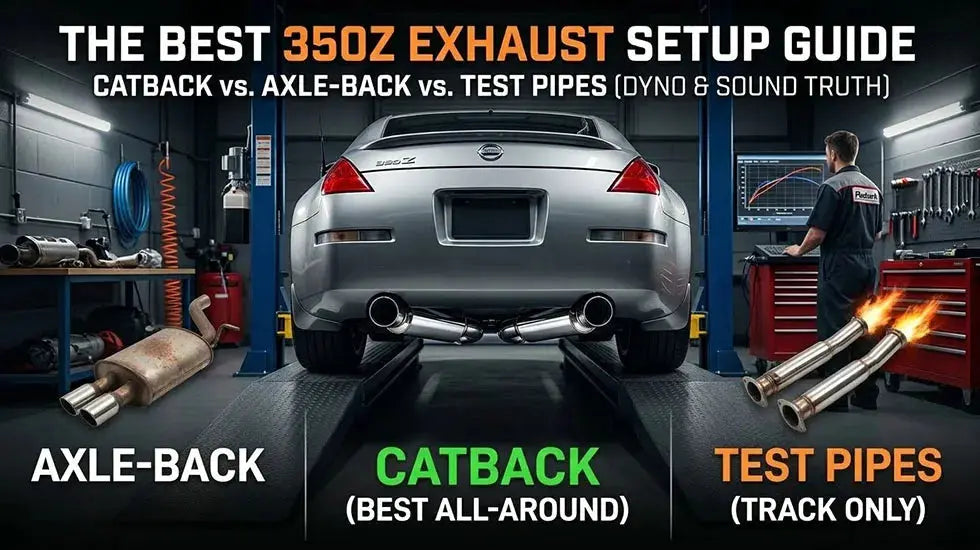
- If you are building a dedicated track car: Test Pipes combined with a full exhaust. It will be obnoxiously loud and smell like raw fuel, but it maximizes top-end exhaust flow. Not recommended for street use due to extreme drone and check engine lights (CEL).
- If you want the ultimate balance of deep tone, zero rasp, and real horsepower (8-12 whp): The Catback exhaust is the undisputed king. It replaces everything from the catalytic converters back, optimizing flow and eliminating the VQ trumpet sound entirely.
What is an Axle-Back Exhaust? (The Budget Illusion)
An axle-back system is exactly what it sounds like. It replaces the exhaust components located behind the rear axle. On a 350Z, this essentially means you are just swapping out the rear muffler and the exhaust tips.
Guys usually gravitate toward this because it’s cheap. It’s a quick Saturday morning driveway job. But here is the reality of the situation: the restriction on a VQ35 isn't just in the rear muffler. It’s in the tiny, crushed factory mid-pipe and the restrictive Y-pipe. By only changing the axle-back, you are trying to push a massive volume of air through a straw, only to let it expand at the very end.
The Truth About Test Pipes (Loud, But Is It Worth It?)
Now we get to the controversial stuff. Test pipes completely replace your factory catalytic converters with straight tubing. The theory is simple: less restriction equals more power.
Does it flow better? Yes. But at a massive cost to your sanity and your daily driving experience.

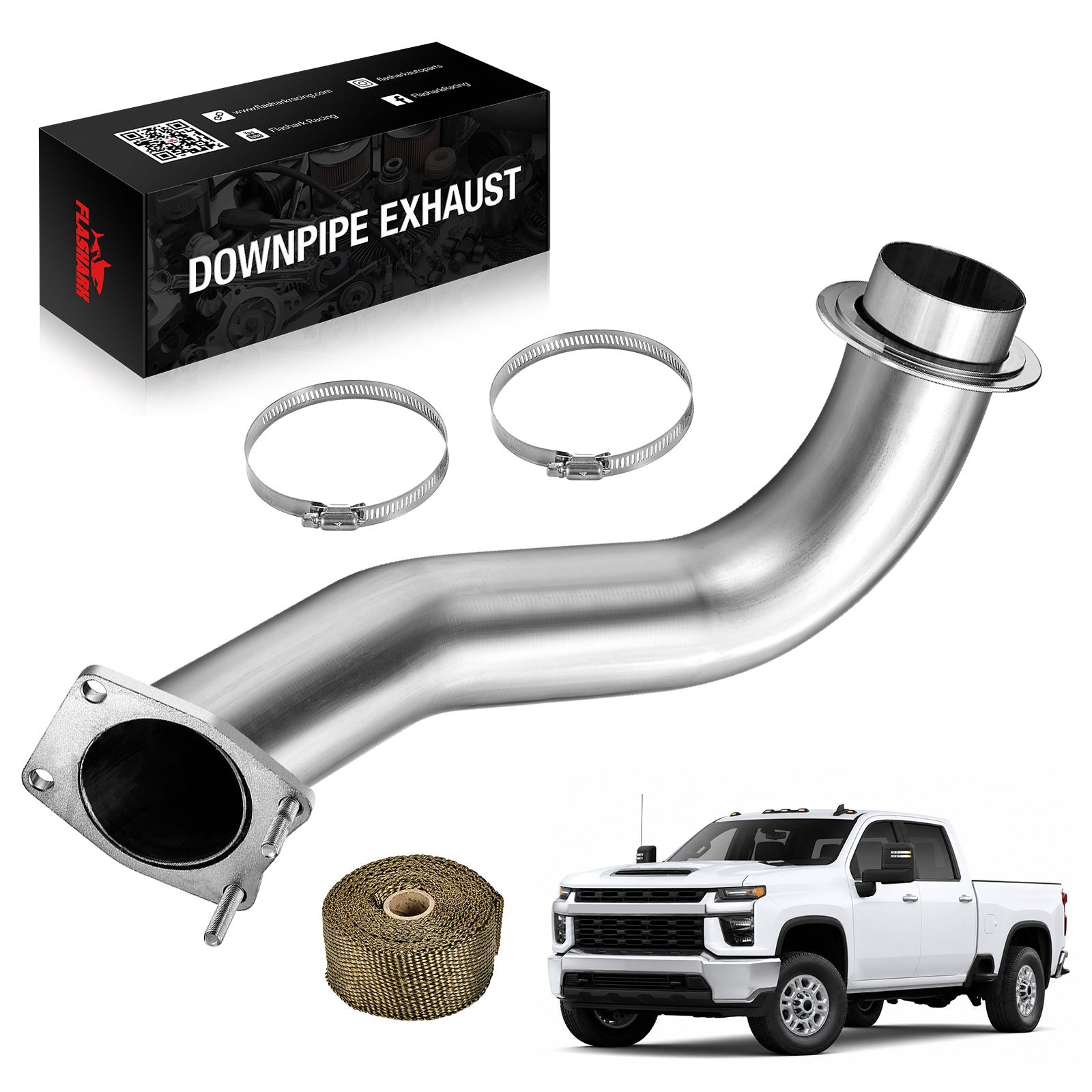
If you just bolt on test pipes to a stock exhaust, you will amplify the VQ trumpet sound by 300%. It sounds terrible. However, if you are building a forced-induction Z or a dedicated track weapon, getting a high-quality, resonated 350z test pipe is a crucial piece of the puzzle. Just know that to actually harness that flow, you need the rest of the piping to match.
Why a Catback is the Best 350Z Exhaust Setup
If you want to do it right, you start from the catalytic converters and replace everything backward. This is the Catback. It includes a new Y-pipe (or X-pipe, depending on the design), a mid-pipe with proper resonators, and a rear muffler setup.

This is where the magic happens. A properly engineered catback utilizes the "scavenging effect." By increasing the pipe diameter—usually to 2.5 inches or 3 inches—and smoothing out the mandrel bends, the exhaust pulses actually help pull the next pulse out of the engine cylinder. This isn't just noise; this is volumetric efficiency.
The Dyno and Sound Truth
Let's talk numbers. On our dyno, a bone-stock VQ35DE usually puts down around 230-240 wheel horsepower (whp). When we bolt on a high-flow catback, we consistently see an increase of 8 to 12 whp, especially in the mid-to-high RPM range where the engine needs to breathe the most. Throttle response becomes noticeably sharper.
But the real reason you buy it is the sound.
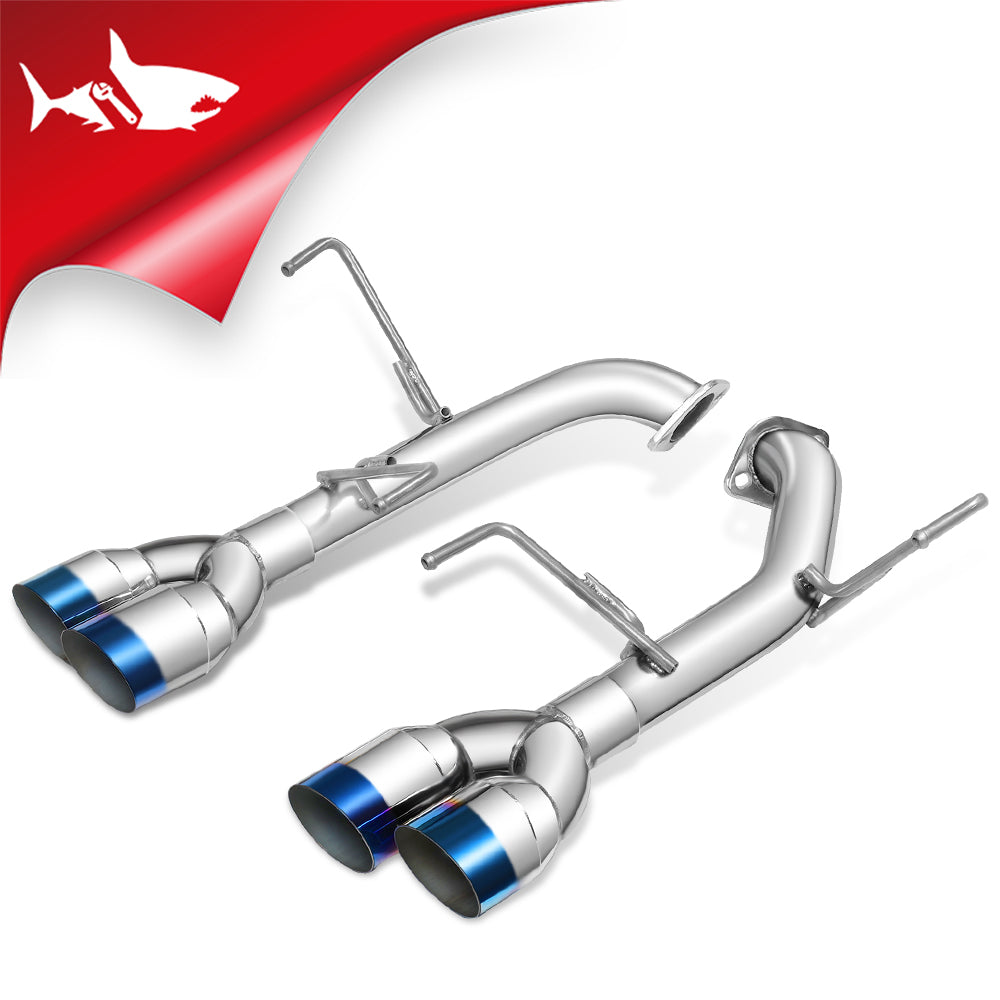
Instead of hacking up your car, you need a system designed specifically for the Z33 chassis. The 350z cat back exhaust by Flashark is what I keep recommending to my customers lately. Why? Because it attacks the VQ rasp from two angles.
- Resonator Design: It uses perfectly tuned resonators in the mid-pipe that act like an acoustic filter, cancelling out those high-pitched frequencies while letting the low, guttural bass pass through.
- The Visual Impact: It features massive 4.5-inch dual tips. The factory bumper cutouts on a 350Z are huge, and the stock tips look puny in there. Dropping in 4.5-inch polished tips completely transforms the rear stance of the car. It looks mean.

| Setup Type | HP Gains | Drone Level (1-10) | The Verdict |
|---|---|---|---|
| Stock Setup | Baseline | 1 (Quiet) | Too restricted for performance. |
| Axle-Back | +1-2 whp | 3 (Mild) | All show, no go. |
| Non-Resonated Test Pipes | +5-7 whp | 10 (Ear-splitting) | Rasp monster. Avoid for street. |
| Flashark Full Catback | +8-12 whp | 4 (Aggressive but Clean) | The sweet spot for Z33 owners. |
Do it once, do it right. Get the car up on jack stands, spray some penetrating oil on those rusty factory flange bolts, and bolt on a system that actually makes you want to roll the windows down and listen to that V6 sing.
Frequently Asked Questions (350Z Exhaust Setup)
Q1: Does a catback exhaust add horsepower to a 350Z?
A1: Yes. On a dyno, a well-designed catback replacing the restrictive factory Y-pipe and mid-pipe will typically free up 8 to 12 wheel horsepower (whp) and improve mid-range torque on a VQ35.
Q2: Will test pipes throw a check engine light (CEL) on my Z33?
A2: Almost certainly. Because you are removing the catalytic converters, the secondary O2 sensors will read an inefficient exhaust stream and trigger a CEL. You often need O2 sensor defoulers or a custom ECU tune to clear it.
Q3: What is the best exhaust diameter for a naturally aspirated 350Z?
A3: For a naturally aspirated VQ35, a true dual 2.5-inch diameter or a single 3-inch pipe is the sweet spot. Going larger than 3 inches on a non-turbo motor will kill your exhaust gas velocity and actually cause you to lose low-end torque.
Q4: Can I pass emissions with test pipes installed?
A4: No. Test pipes remove the emissions control devices (catalytic converters). You will fail both visual inspections and sniffer tests in almost all states.
Q5: How do I fix the VQ trumpet rasp sound?
A5: The best way to eliminate the VQ rasp is to install a catback system that utilizes high-quality, dense resonators in the mid-pipe section. These act as acoustic dampeners to kill the high-frequency trumpet noise.
Q6: Is an axle-back exhaust loud enough for a 350Z?
A6: It depends on your definition of loud. It is only marginally louder than the factory setup because the factory mid-pipe resonators and restrictive Y-pipe are still bottling up the sound.
Q7: How long does it take to install a catback exhaust on a 350Z?
A7: For an experienced mechanic with a lift, it takes about 45 minutes. For a DIYer in a driveway using jack stands, expect it to take 1.5 to 2 hours, depending on how rusted your factory bolts are.
Q8: Do I need a tune after installing a catback exhaust?
A8: It is not strictly mandatory. Your factory ECU can adjust fuel trims enough to handle a catback. However, getting an UpRev or EcuTek tune afterward will maximize the horsepower gains and optimize throttle response.
Q9: What’s the difference between a Y-pipe and an X-pipe on a 350Z?
A9: A Y-pipe merges the two exhaust banks into a single mid-pipe, which is common for maintaining exhaust velocity on a street car. An X-pipe is used in true dual setups where the gases cross over to balance pressure, generally creating a smoother, higher-pitched racing tone.
Q10: Will an aftermarket exhaust cause drone in the cabin at highway speeds?
A10: Poorly designed exhausts and straight pipes will cause massive drone around 2,500-3,000 RPM. A high-quality catback, like the ones from Flashark, uses tuned mufflers to eliminate resonance, keeping the cabin comfortable at cruising speeds.