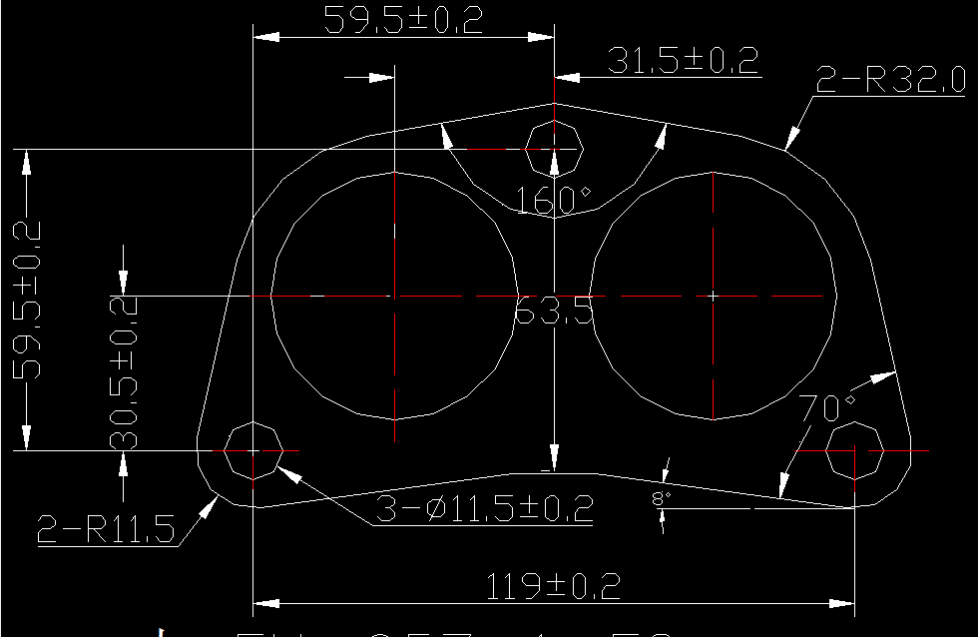
Q1: Will these 7AFE headers fit my 1993-1997 Toyota Corolla?
A1: Yes, as long as your Corolla has the 1.8L 7A-FE engine. These 7AFE headers are designed for the 1993-1997 Corolla on the E100/AE102 platform. If you have the 1.6L 4A-FE engine instead, these won't bolt up—the port spacing and flange pattern are different. Check your engine code on the VIN tag or the emissions sticker under the hood before ordering.
Q2: What does 4-2-1 design mean on these 7AFE headers?
A2: 4-2-1 means four primary tubes merge into two secondary tubes, which then merge into one collector. It's a tri-Y layout. Compared to a 4-1 design (all four tubes go straight into one collector), the 4-2-1 configuration produces more mid-range torque and a broader power band. For a daily-driven Corolla with a 7A-FE, that's exactly what you want—you're not revving to 8,000 RPM, so mid-range grunt matters more than peak horsepower.
Q3: How much horsepower do 7AFE headers add to a Corolla?
A3: Realistically, 10-15 hp at the wheels on an otherwise stock 7A-FE. The factory exhaust manifold is a cast iron log design that chokes flow across all four cylinders. These headers give each cylinder its own tube, eliminating that back pressure. The gain isn't going to transform your Corolla into a race car, but you'll notice better throttle response and a freer-revving engine past 3,000 RPM. If you pair the headers with a high-flow catalytic converter and a cat-back exhaust, the combined gains can push closer to 15-20 hp.
Q4: Are these 7AFE headers a direct bolt-on installation?
A4: Yes, no modifications needed for the header itself. It bolts directly to the 7A-FE cylinder head and connects to the rest of the exhaust using the factory mounting points. The inlet is 1.5" (38.1mm) and the outlet is 2.0" (50.8mm), which lines up with the stock exhaust on most 1993-1997 Corollas. That said, the O2 sensor bung location may vary slightly from stock, so you might need to extend the O2 sensor wire on some models. Not a big deal, but worth knowing going in.
Q5: Will these Toyota Corolla headers trigger a check engine light?
A5: If your 7A-FE has a single O2 sensor upstream of the catalytic converter, you should be fine—no CEL. The headers don't move or delete the primary O2 sensor. If your particular model year has a downstream O2 sensor (post-cat), and you're also replacing the catalytic converter with a high-flow unit, that downstream sensor might throw a code. The fix is either keeping the stock cat or running a non-fouler on the rear O2. The header itself doesn't cause the CEL.
Q6: Do these 7AFE headers work on the 4A-FE 1.6L engine?
A6: No. The 4A-FE and 7A-FE share a family, but the exhaust port spacing and flange bolt pattern are different. The 4AFE has smaller ports and a different port geometry. GSC search data shows people looking for "4afe headers" as a related query, so the confusion is real—just know that these are for the 1.8L 7A-FE only. If you have a 4A-FE, you need headers made specifically for that engine.
Q7: Do I need to retune my ECU after installing 7AFE headers?
A7: On an OBD-I Corolla (1993-1995), the ECU is pretty forgiving and will adapt to the increased airflow on its own. You probably won't need a tune. On OBD-II models (1996-1997), the ECU is a bit more sensitive—some owners report running slightly lean at part throttle after a header install. A mild tune helps, but most people just drive it and let the stock ECU compensate. If you've also done intake and exhaust mods, a tune becomes more worthwhile.
Q8: Will these headers fit a 1993-1997 Toyota Celica with the 7A-FE?
A8: The 6th-gen Celica (ST204) used the same 7A-FE engine, and the exhaust port layout is identical. The header itself should bolt to the head without issue. The catch is the undercarriage routing—the Corolla and Celica have different floor pans and exhaust hanger positions, so the downpipe section might not line up with your stock mid-pipe. Some guys make it work by having a short section of pipe fabricated at a muffler shop. Not plug-and-play, but doable.
Q9: Are these Corolla headers street legal?
A9: These headers do not carry a CARB Executive Order number, so they're not legal for street use in California or states that follow CARB emissions standards. California Vehicle Code Section 27156 prohibits exhaust modifications that alter emissions controls. These are sold for off-road and competition use. In states without emissions testing, you're unlikely to have issues. But if you live in a CARB state and get sent to a referee, headers without an EO number will fail you.
Q10: What's the difference between these 7AFE headers and the stock exhaust manifold?
A10: The stock manifold is a heavy cast iron log. All four cylinders dump exhaust into one shared chamber, which creates back pressure and kills flow. These 7AFE headers use individual tubes for each cylinder in a 4-2-1 layout, so exhaust gases exit without fighting each other. Less back pressure means more power, better throttle response, and a noticeably different sound. The header is also stainless steel and a lot lighter than the cast iron manifold—probably 10-15 lbs lighter.
Q11: How do these 7AFE headers change the exhaust sound?
A11: The Corolla with a stock manifold is quiet to the point of being boring. With these headers, you get a deeper, slightly raspy tone that's more noticeable above 2,500 RPM. It's not loud—this is a 1.8L four-cylinder, not a V8—but it has a sharper, more aggressive edge compared to the muffled stock note. If you pair it with an aftermarket cat-back, it gets noticeably louder. With the stock cat-back, it's a subtle improvement that most people find pleasant.
Q12: Can I reuse my stock exhaust gasket with these headers?
A12: You can try, but I wouldn't recommend it. The stock gasket is designed for the stock manifold's flange thickness and port shape, which don't perfectly match an aftermarket header. The mismatch can cause exhaust leaks at the head, which you'll hear as a ticking sound on cold start. Use the gasket that comes with the headers, or better yet, buy a quality aftermarket gasket from Toyota or a reputable brand. It's a $10 part that saves you from pulling the header off again later.


 Product Specifications